Page count: 400 pages
Rating: 4.5 stars
Quicksilver is the sequel to Ultraviolet, and while you might be able to read it as a stand-alone, I wouldn't recommend it, as I doubt it would be as satisfying a read.
Tori Beaugrand had everything a teenage girl could want. Beauty, popularity, money. Then she disappeared, without a trace, for several months, only to be returned, bruised and with a broken nose, with no apparent memory of where she'd been or who'd taken her there. With her is Alison, the girl who was suspected of murdering her, and who spent much of the time of Tori's disappearance in a mental institution. During the investigation of her disappearance, certain strange medical results turned up as a result of DNA testing. Tori and her parents are getting calls from a genetics lab, and one police investigator in particular, refuses to believe that Tori has no recollection of what happened to her.
Tori and her parents relocate, and change their names, all to protect her secret. Being the centre of attention is no longer an option. She needs to stay as anonymous as possible, which seems to be going well, until Sebastian Faraday, a man she thought she'd never see again, suddenly appears in her bedroom, warning her of danger to come. Her new friend Milo, who already suspects that everything is not entirely is what it seems with Nikki (which is what Tori calls herself in her new life) and is dragged along on an adventure beyond his wildest dreams.
In Ultraviolet, told from Alison's perspective, Tori seems like your typical popular, rich Mean Girl, and it's only towards the end of the book that Alison discovers why Tori why so hostile towards her, and never seemed to like her. The two form a genuine friendship in the dramatic last third of that book, but in order to protect her new friend, as well as the truth of her identity, Tori has to move away from the little town that's always been her home. No longer the Queen Bee in school, she becomes as anonymous as possible, with a new hairstyle, contact lenses, a very non-glamorous part time job and home schooling. Reinventing herself isn't just a curse for Tori, though. Becoming Nikola (after Nikola Tesla - yay!) opens up opportunities she's never had before. Always striving to hide her secret, and please her parents, Tori/Nikki has never really had a chance to explore who she really is and wants to become.
While I came to really like Alison, I pretty much loved Tori/Nikki from the start. She's an amazing young adult heroine - smart, strong, capable, caring. She's also openly asexual, something you don't normally see in novels, and the strong friendship between her and Milo (who is the best sidekick/supporter anyone could wish for), rather than yet another star-crossed romance, is all the more refreshing.
This book is tense, and action packed, and funny and I loved the characters. The danger to Tori/Nikki is genuine, and she has to use all of her considerable genius to try to find a solution, which she does, without needing anyone else to save her. She does have to realise that occasionally requiring help from friends, doesn't make her any weaker. If the last third of the previous book was unexpected and tense, this one was pretty much insane. I think I audibly gasped at one point, because even though it was clear what had to happen, I still didn't think the author would go there. The only reason that I'm deducting half a star from my rating of the book, is that I don't like the way Anderson leaves one of the supporting characters at the end of this book. If that is the resolution to the danger to Alison and Tori, then I'm not sure I'm happy. With everything that's been established over the course of the two books, it's not a good situation for this character to be in, and I wish the story could have been resolved some other way. It's a minor niggle, though, this book is great. Go - read both of them!
This is my book blog, where I review books I read as part of Cannonball Read 18, where members compete to be the first to reach 52 reviews. We also try to get people excited about books and reading, and make money for cancer charities. As always, I will be reading and reviewing in memory of friends and family who died of cancer in the past few years. Wish me luck!
Showing posts with label R.J. Anderson. Show all posts
Sunday, 16 June 2013
#CBR5 Book 55. "Ultraviolet" by R.J. Anderson
Page count: 416 pages
Rating: 4 stars
Alison is sixteen, and currently residing in a mental institution. Ever since she was little, she's know she's not quite like everyone else. To her, words have distinct tastes and colours. Certain sounds can make her see things. She feels physically sick if she herself tries to lie, and can taste it in the back of her mouth if people are lying or not. Loud noises give her fits. She's suspected of the murder of the most popular and perfect girl in her school, Tori Beaugrand, and only Alison knows why the authorities haven't been able to find a body. Tori Beaugrand disintegrated in front of Alison's eyes, after they had a terrible fight. How insane is that?
Alison doesn't want to stay sectioned, and tries to appeal to be released. Yet her mother is afraid to keep her at home with her younger brother, and the doctors at the institution want her to take her anti-psychotic drugs so she can get better. The police want to know where Tori Beaugrand is, and why Alison came home, distraught, with bloody hands. As the weeks pass, Alison no longer knows what the truth is. Only the enigmatic young scientist Sebastian Faraday seems to believe that Alison is innocent. He performs a number of cognitive tests on her, and explains that what she and her mother always believed was madness, and have kept hidden from everyone, is actually just synesthesia, and that she has a particularly complex form of it. His further testing seems to suggest that she also has the ability to see lights on the ultraviolet spectrum. With each new meeting, Sebastian puts Alison's mind more at ease, and when she confesses what happened to Tori, he actually seems to believe her.
Then the doctors reveal to Alison that Sebastian is not who he claims to be. He's not a grad student, but a journalist, and his motives for coming to see Alison in the hospital were unlikely to be charitable. Yet Alison discovers that the reason he lied to her is stranger than she could have imagined, and the reason he believes in her innocence, is because he knows what actually happened to Tori.
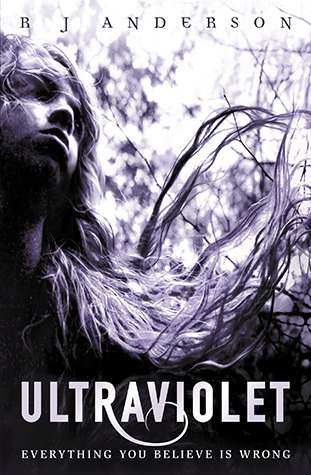
I found Ultraviolet through a very glowing review on The Book Smugglers, and put it on my TBR list, and then promptly forgot about it, because I discover intriguing sounding books all the time. Besides, the cover looked so very generic, and there were so many other shiny things to distract me. I decided to give this a try, because the sequel (where Tori Beaugrand is the even more awesome than Alison protagonist) starts with a Q, and that's not the easiest thing to find for my A to Z challenge. I was pretty instantly engrossed, and because I'd consciously tried not to find out too much about the book, I was very surprised by the twists and turns it took.
While I grew fond of Alison over the course of the book, she's prickly and sullen and not the easiest of characters to like at first. It's pretty obvious early on (if you've ever heard of or read about synesthesia) that what she considers part of her insanity is something that could have been diagnosed if her mother had been less rigid and paranoid about doctors (it is revealed over the course of the book where that fear comes from, though). The fact that she believes she saw a person dissolve into thin air in front of her eyes, that's more of a mystery. While she may not be insane, you start to realise, as the book progresses, why she's never exactly been a popular kid in school, and while it's obvious that she's not insane or a murderer, she could probably be a bit more gracious about accepting help from people. Luckily, while she's slow to adapt, she does change, and becomes a lot more easy to root for by the end of the book.
I really liked the world building in this book, and that something that I thought was just another YA novel with mystery elements turned out to be something completely different. The supporting characters are incredibly well developed, and none of them seem to be your stock "troubled teen asylum inmate" tropes that a lesser writer might have resorted to. There is a tiny romantic subplot with the always mysterious (but so much more strange than I first expected) Sebastian, and the last third of the book especially, was surprising and very well done. I'm trying as hard as I can not to give anything away, because these books are better if you don't know too much going in. Give this book a try, it's miles above a lot of YA fare out there.
Rating: 4 stars
Alison is sixteen, and currently residing in a mental institution. Ever since she was little, she's know she's not quite like everyone else. To her, words have distinct tastes and colours. Certain sounds can make her see things. She feels physically sick if she herself tries to lie, and can taste it in the back of her mouth if people are lying or not. Loud noises give her fits. She's suspected of the murder of the most popular and perfect girl in her school, Tori Beaugrand, and only Alison knows why the authorities haven't been able to find a body. Tori Beaugrand disintegrated in front of Alison's eyes, after they had a terrible fight. How insane is that?
Alison doesn't want to stay sectioned, and tries to appeal to be released. Yet her mother is afraid to keep her at home with her younger brother, and the doctors at the institution want her to take her anti-psychotic drugs so she can get better. The police want to know where Tori Beaugrand is, and why Alison came home, distraught, with bloody hands. As the weeks pass, Alison no longer knows what the truth is. Only the enigmatic young scientist Sebastian Faraday seems to believe that Alison is innocent. He performs a number of cognitive tests on her, and explains that what she and her mother always believed was madness, and have kept hidden from everyone, is actually just synesthesia, and that she has a particularly complex form of it. His further testing seems to suggest that she also has the ability to see lights on the ultraviolet spectrum. With each new meeting, Sebastian puts Alison's mind more at ease, and when she confesses what happened to Tori, he actually seems to believe her.
Then the doctors reveal to Alison that Sebastian is not who he claims to be. He's not a grad student, but a journalist, and his motives for coming to see Alison in the hospital were unlikely to be charitable. Yet Alison discovers that the reason he lied to her is stranger than she could have imagined, and the reason he believes in her innocence, is because he knows what actually happened to Tori.
I found Ultraviolet through a very glowing review on The Book Smugglers, and put it on my TBR list, and then promptly forgot about it, because I discover intriguing sounding books all the time. Besides, the cover looked so very generic, and there were so many other shiny things to distract me. I decided to give this a try, because the sequel (where Tori Beaugrand is the even more awesome than Alison protagonist) starts with a Q, and that's not the easiest thing to find for my A to Z challenge. I was pretty instantly engrossed, and because I'd consciously tried not to find out too much about the book, I was very surprised by the twists and turns it took.
While I grew fond of Alison over the course of the book, she's prickly and sullen and not the easiest of characters to like at first. It's pretty obvious early on (if you've ever heard of or read about synesthesia) that what she considers part of her insanity is something that could have been diagnosed if her mother had been less rigid and paranoid about doctors (it is revealed over the course of the book where that fear comes from, though). The fact that she believes she saw a person dissolve into thin air in front of her eyes, that's more of a mystery. While she may not be insane, you start to realise, as the book progresses, why she's never exactly been a popular kid in school, and while it's obvious that she's not insane or a murderer, she could probably be a bit more gracious about accepting help from people. Luckily, while she's slow to adapt, she does change, and becomes a lot more easy to root for by the end of the book.
I really liked the world building in this book, and that something that I thought was just another YA novel with mystery elements turned out to be something completely different. The supporting characters are incredibly well developed, and none of them seem to be your stock "troubled teen asylum inmate" tropes that a lesser writer might have resorted to. There is a tiny romantic subplot with the always mysterious (but so much more strange than I first expected) Sebastian, and the last third of the book especially, was surprising and very well done. I'm trying as hard as I can not to give anything away, because these books are better if you don't know too much going in. Give this book a try, it's miles above a lot of YA fare out there.
Subscribe to:
Posts (Atom)