Friday, 27 June 2014

#CBR6 Book 59: "The Fiery Cross" by Diana Gabaldon

Page count: 1456 pages
Rating: 3.5 stars

This is book 5 in the Outlander series, and really NOT the place to start reading these books. By this point, some of the principal characters have grown to middle age and have children and grandchildren. If you're interested, say because the TV series is coming to Starz in August, start at the beginning with Outlander. Standard spoiler-warning spiel applies. If you've not read the first four books in the series, I cannot be held responsible for any spoilers you may or may not find in this review.

So - the plot. There really is rather a lot of it, but possibly not as much as you'd think for a book this huge, spanning years worth of story. It's 1771 and Jamie Fraser along with his family are at the Gathering, a huge, well gathering of Scottish clansmen in North Carolina. Jamie Fraser's family at this point consists of his wife Claire, his daughter Brianna, Brianna's fiancee Roger (all three of the afore-mentioned time-travellers born originally in the 20th Century), Brianna's son Jem (paternity as of yet uncertain), his adopted son Fergus, a former French street urchin, Fergus' wife Marsali (also Jamie's step-daughter) and their children. Bree and Roger are to be wed at the Gathering, as is Jamie's aunt Jocasta. However, the priest is arrested and carted off, leading to Jocasta's wedding being postponed, and Bree and Roger's being performed by a Protestant minister, much to the chagrin of the very Catholic Fraser-patriarch.

Once there have been weddings and christenings and servants have been acquired, the Frasers all travel back to their homestead and Jamie and Claire set their affairs in order before going to gather up volunteers. There are Regulators protesting against the rule of the British, and Jamie has been tasked with the Governor to fight them as the Colonel of the local Militia. Initially, they avoid any direct fighting, but later on, there is a battle, with very dire effects for some of the extended Fraser family. Over the course of the massive book, Jocasta Cameron finally gets married on her lavish plantation at River Run, but the festivities is marred by a murder, and Jamie and Claire play amateur detectives when they're not busy getting it on in the shrubberies. Seriously, they might be middle aged, but there is certainly nothing wrong with their libidos.

There is also a subplot involving the search for the Fraser's current nemesis, the dastardly Stephen Bonnet. There are also villainous types wanting to find long-lost French gold, Claire's attempts to cultivate penicillin, Roger's attempts to learn to shoot straight and re-learn his singing, the mystery of Jem's true paternity and a number of other story lines throughout the book. It is without a doubt, the longest book I own and/or have ever read. The only book I have that even comes close to rivalling it, is the next in the series, A Breath of Snow and Ashes. Diana Gabaldon does a LOT of research, and really really likes to show it all off. Most of the time, I love the characters dearly and love spending time with them. If the entire book was them getting into what Mrs. Julien is so fond of calling "the perils of Pauline", it would be a dreadfully tedious book, as it would if everything was the day to day minutiae of their lives in Frontier North Carolina.

I like the blend of everyday and action, what gets to me is that there seems to have been NO attempts at editing any of it out. If I recall correctly, a lot of the characters introduced in this book and a lot of the minor and seemingly insignificant events come back in a big way later, but as I was forcing myself through yet another seemingly pointless chapter consisting mainly of Bree's dream journal, I was hard pressed to see why some of it hadn't been edited out. The important character moments get drowned in the boredom of slogging through chapters with no clear purpose except to bulk out the page count some more. This is not the 19th Century, where authors were paid by the word and books were encouraged to be as big as possible because they were the only sources of entertainment during the long dark winters. I would have greatly preferred it if Gabaldon and her editors had removed a few hundred pages from this book, so I could have enjoyed the time I spent with characters I care deeply about without wanting to throw the book (or in this case, my trusty Reader, because really, I'm not getting the arm strain of actually carrying the physical book) at the wall. This is, upon re-reading, so far my absolute least favourite of the series, but it still gets a rating of 3.5 because the bits that are good, are extremely good. You just have to get through a lot of chapters to get to them.

Crossposted on Cannonball Read.

Thursday, 26 June 2014

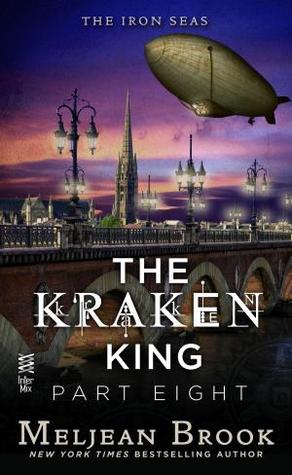
#CBR6 Book 58: "The Kraken King, parts 5-8" by Meljean Brook

Total page count: 350 pages
Part Five: The Kraken King and the Iron Heart - 4.5 stars
Part Six: The Kraken King and the Crumbling Walls - 4 stars
Part Seven: The Kraken King and the Empress's Eyes - 4.5 stars
Part Eight: The Kraken King and the Greatest Adventure - 4 stars

Parts 1-4 reviewed here.

Zenobia and Ariq are over the initial awkward state getting to know one another and actually falling in love part of their relationship. That doesn't mean that their communication runs smoothly and that there are no more cultural and emotional misunderstandings in their future together. There is also very real danger to Ariq's friends and family if he and Zenobia can't convince the Empress of Nippon that the rebel attacks are a clever plot against her, from people she believes are loyal supporters. If they can't convince the Empress, then they'll have to take the dangers on themselves, but the dangers are great and there are numerous obstacles in their way.

In part five, Zenobia and Ariq are separated and we discover the lengths Ariq is willing to go to get back to the woman he's fallen for. Zenobia has clearly learned a lot during her adventures, and is no shrinking violet either. She's not going to sit around being used as a bargaining piece and doesn't hesitate to try to rescue herself. In part six, Zenobia finally reveals the truth about her double identity and literary career to her friend Helene, and she and Ariq wait for the Empress to grant them an audience. In part seven, it turns out that the Empress isn't above using torture to get to the bottom of the plots against her, and Zenobia discovers that she's not strong enough to watch the the man she's come to love being forced to suffer. They need to escape the Empress' forces, and get help from an unexpected quarter. In part eight, Ariq and Zenobia race back to Krakentown, hoping to beat the Empress' forces there. They need to use the fearsome weapon Ariq has been hiding to eliminate the threat to their loved ones, once and for all.

I managed to wait until the final part was released to read the last four, which meant that I didn't need to worry about pesky cliff hangers. In these four instalments, the story changes its focus from Zenobia and Ariq's blossoming romance to the solving of the central underlying conflict set up in the first half, with the mysterious attacks on flying ships by unknown assailants. Unable to persuade the Empress' captain of the guard of where the true danger lies, as she and others are chiefly interested in the powerful war machine only Ariq knows the location of, he and Zenobia have to rely on themselves, their friends and allies in defending Krakentown.

In my review of the first four parts, I emphasised how much I enjoyed the ethnic diversity of the characters in The Kraken King and the nuance in which they are portrayed. I should also point out that most of the significant characters in this story are women, to a degree unusual even in paranormal/urban fantasy, which tends to be chiefly written by women and most often features female protagonists. It's sad that I feel the need to point this out, but Meljean Brook shows how easy it could be for any number of writers to do the same thing. While her books are set in an alternate historical world, the degree of equality between the sexes seems unusual in the genre, and I applaud that, even as I hope that more fantasy (and normal contemporary writers) follow suit.

Crossposted on Cannonball Read.

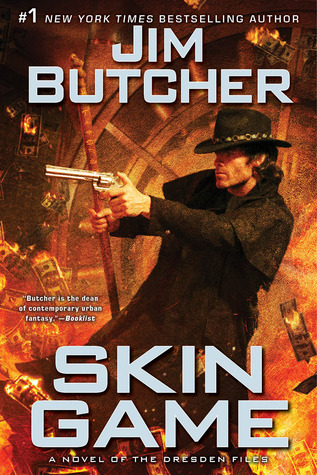
#CBR6 Book 57: "Skin Game" by Jim Butcher

Page count: 454 pages
Audio book length: 15hrs and 50 mins
Rating: 5 stars

Standard spoiler warning! This is book 15 in the series. You don't want to start here. If you're not caught up with the series, you may want to skip this review, because while I'm going to try to not spoil this actual book, I can't actually avoid spoilers for some of the previous ones. It took me a long time to get hooked on these books, but they are totally worth the effort. Just skip the first three and start directly with book 4, Summer Knight. You'll thank me, because the first three are a slog to get through.

Are you still here? Spoilers be on your own head then.
Harry has been stuck on Demonreach, his island/supernatural prison for the past year. He's kept busy doing parkour in the tunnels underground, needing the sentient spirit who lives there to help him keeping his headaches from crippling him. Mab shows up and claims he will be dead in three days if he doesn't do her bidding. The parasite inside his head will burst through his skull, take shape and go after everyone he holds dear. That Mab, she's such a motivator.

Seems the Queen of Air and Darkness has loaned out her Winter Knight to pay back a debt. Harry has to help none other than Nicodemus Archleone, head of the Order of the Blackened Denarius, pull off a near-impossible heist. If he agrees, he's pretty sure that Nicodemus will try to kill him during the mission. If he doesn't agree, Mab will let him die, and appoint a new Knight in his place. He doesn't have much of a choice. Now he has to work with some of the slipperiest characters of the supernatural underworld (most of whom would happily kill him as soon as they got the chance) to break into the treasure vault of Hades himself. What could possibly go wrong?

I've been putting off this review, because I'm not sure I can put into words how much I enjoyed this book. Long time readers of my blog and/or reviews will know that it took me quite a long time to jump on the Butcher band wagon, but over the last year or so, I have slowly but surely caught up, and had only a few weeks to wait for the release of this one. Of course, now I'm stuck waiting with the rest.

In my review for Cold Days, the previous book in the series, I said that I couldn't really see how Butcher was going to keep amping up the tension and making the danger levels greater and higher with each book. There's only so much more he can do to Harry, or so you'd think. I certainly didn't see the developments in this book coming (seriously, that's some crazy ass headache explanation), and of course, Harry is not the only character in the book who can experience dangers or high stakes. Sooner or later, Butcher is going to kill off a major character that I have grown to love and then we are going to have a serious problem on our hands. I'm not sure I'll be able to deal rationally. I know these are fictional characters, but they are important to me.

As always, I bought this book as an Audible audio book, because the Dresden Files and James Marsters' narration are now inextricably linked in my head. I listened to maybe the first 25% before I broke down and tracked down an e-book copy, because I just didn't have the patience to listen to the entire audio book to find out what was going to happen next. I'm glad to have the audios, for when I will inevitably revisit the books, but I suspect, from now on, I will want to read the books myself, it's oh so much faster. While I am worried at what being the Winter Knight is turning Harry into, the end of this book made me very very happy. I may have reread that bit in the hospital quite a few times.

Crossposted on Cannonball Read.

#CBR6 Book 56: "The Firebird" by Susanna Kearsley

Page count: 484 pages
Rating: 4 stars

Nicola Marter has psychometric powers. This means that when she touches an object, she can see glimpses of whoever's owned it or touched it before. Her grandfather, who escaped from Russia, has the same powers and always admonished her to keep the gift hidden, which she does, even from her boss Sebastian, an eccentric and successful antiquities dealer. Yet when a woman, Margaret Ross, comes to them with a wooden carving which she wants authenticated, claiming that it was once owned by Empress Catherine of Russia, Nicola touches the little Firebird and can tell that the woman's story is true. There just isn't any actual proof, and poor Margaret has to go away disappointed. Having cared for sick relatives most of her life, the authentication and sale of the carving could have secured this woman's finances. Nicola can't forget her, and decides that she wants to try and help her, without actually openly revealing her powers.

She'll need help proving the carving's history, though, and turns to a man she hasn't seen in two years, Rob McMorran, whose psychic gifts are much stronger than her own. He agrees to help her, and together they travel first to Dundee in Scotland, and later to Belgium, France and Russia, all to track Anna, Margaret's ancestor, and try to prove that the Firebird carving was a gift from a Russian empress. As they travel, their feelings for one another start to resurface. But can they ever have a future when they feel so differently about their psychic gifts?

Nicola is an intensely private person, keeping her psychic gifts hidden from everyone around her, always remembering the dire warnings from her grandfather. Apart from her family, only a very few people in the world know what she can do, Rob McMorran is one of them. Nicola met him while studying in Edinburgh, and his psychic powers are much more extensive than hers, he has premonitions and visions, and much more control of his gifts than she ever managed. The two shared an attraction that could have turned into something more significant, if Nicola hadn't gotten spooked and run away. Now, two years later, she realises that she can't help Margaret without Rob's aid.

Nicola is about to go to Russia to acquire a mural for her boss. What better time to investigate further into the Firebird carving Margaret Ross wanted authenticated? Nicola doesn't think her own powers are strong enough to trace through the centuries to Margaret's ancestor, so she goes to Berwick Upon Tweed to find Rob. If he were to come with her to Dundee, to see Margaret a second time, and touch the carving, he may give her enough clues as to what to search for in St. Petersburg. She wants to prove that the carving originated with the Russian Empress, so Margaret can sell it and get enough money to travel the world.

Rob is a police officer in Berwick and also works as a volunteer lifeguard. It's obvious that the entire town knows about his abilities and that they are a great aid to him in his work. One of the reasons Nicola fled from Edinburgh is because she felt that her powers made her a freak, and she has trouble accepting that Rob can so proudly and openly display his clairvoyance. When she turns up in Berwick, it becomes obvious that he was already expecting her and he's cleared his schedule so he can come with her on her journey.

Their quest to authenticate the carving takes them on a longer and more complicated trip than Nicola had anticipated. When tracking Anna, Margaret's ancestor, who Nicola saw being given the carving by the Empress in her first vision, they first go further north in Scotland to Slains castle, only to discover that she was taken from Scotland to Belgium as a young girl.

When Anna Logan is about eight, she discovers that the family that has raised her isn't actually her own, and that her parents gave her up as a baby to keep her safe. Her great uncle arrives to take her to a convent in Belgium, as in 1715, it was not safe for Jacobites in Scotland and as both Anna's real parents were prominent Jacobites, there are fears for her safety. Traveling with her great uncle is the injured Lieutenant Jamieson, who Anna takes to seeing as a sort of surrogate father. They spend a lot of time together until Jamieson's leg heals, and he promises to return before too long to take Anna from the convent to her family.

Even in the Belgian convent, Anna is not entirely safe. There are those who would use her as leverage to get to her family and relatives, all Jacobites, and through a series of dramatic events, Anna has to flee the convent and eventually ends up in St. Petersburg with a kindly naval captain, who in time becomes vice admiral to the Russian Tsar. Anna is raised in his family alongside his own daughters, but always feels a longing for her real family. To aid her foster father's further rise in society, Anna goes to live with General Lacy, as a companion to his pregnant wife. There she meets the roguish Edmund O'Connor, the general's Irish kinsman. Initially, they are constantly at each other's throats, but time and proximity causes their feelings to develop into something deeper.

Suddenly reunited with Rob, spending so much time with him chasing through Europe and Russia for Anna's history, Nicola's feelings towards him start to reawaken. They have to be in physical contact to share the visions of the past, and Rob always behaves as a perfect gentleman, almost like a brother much of the time. At other times, he confuses her by being decidedly flirtatious. During their journey, Rob keeps pushing her to use her psychic abilities more and more, challenging her perceptions that being able to do such things are bad or undesirable things. He can't understand why she hides and represses her talents; she is unnerved at how willing he is to show his skills to the world.

There are two parallel stories in The Firebird, a narrative device that may seem familiar to anyone whose read any of Kearsley's other books. This book is actually a sequel to one of Kearsley's previous novels, The Winter Sea, known as Sophia's Secret in the UK. It is also, as far as I could tell, loosely connected with her book The Shadowy Horses, where Rob McMorran first appeared. Anna Logan is actually Anna Moray, the daughter of Sophia and John from The Winter Sea. Her life is an eventful one, and throughout she seeks love, belonging and to be reunited with her true family. That's not to say that she doesn't experience a lot of love and care in both of her foster families. The Logans and later the Gordons care for her deeply, and while she doesn't have the life that her parents wished for her, it's by no means a bad one.

I read The Winter Sea a long time ago now, and must admit that I no longer remember all the details of the plot. I do remember finding Kearsley's writing completely spell-binding though, and being drawn into the story, captivated by the story lines in both the past and the present. It's exactly the same with this book. When I read Lauren Willig's The Pink Carnation series, I tend to get annoyed every time I have to leave the story of the brave spies of the past, always feeling that the jumps back to the framing story in the present is a bit like getting an ad break just as the movie you're watching is getting really good. Here, I was almost more compelled to read about Nicola and Rob in the present day, although Anna's story was also fascinating. It's a big book, which takes its time to reveal its secrets. I especially loved the sections in St. Petersburg, which I was lucky enough to visit about five years back. This book really made me want to return there.

The carving that Nicola is trying to authenticate is a Firebird, which appears in several Russian folktales. There are several different versions, but they all seem to amount to the same thing: whoever goes to chase after a Firebird, may return from their journey with something entirely different than what they originally set out to find. This is absolutely the case for both Nicola and Anna, and I very much enjoyed taking part in their romantic journeys.

This is the third Kearsley novel I have read, and I can see why she's so popular among her fans. I would also like to emphasise that while this book is a sequel, and seems connected to some of Kearsley's other books, it works fine on its own, and as it features a lot of the narrative devices I've seen in other of her novels, can be a great introduction to her writing.

Crossposted on Cannonball Read.

Sunday, 22 June 2014

#CBR6 Book 55: "The Kraken King, parts 1-4" by Meljean Brook

Total page count: 335 pages

Part One: The Kraken King and the Scribbling Spinster - 4 stars
Part Two: The Kraken King and the Abominable Worm - 4 stars
Part Three: The Kraken King and the Fox's Den - 4.5 stars
Part Four: The Kraken King and the Inevitable Abduction - 4 stars

Because The Kraken King is being published in eight weekly instalments, I'm going to blog the first four as one book, and the final four as another, mainly because I don't want to wait until I've read all the parts to share my feels so far. So to anyone reading - be aware that there is more to come.

Zenobia Fox is used to a quiet life in Fladstand (on the north-East coast of what we'd know as the US). The only bursts of any kind of excitement are when she occasionally gets abducted and held for ransom, because her brother is a tremendously wealthy adventurer and explorer, married to a ruthless and fierce airship captain (see Heart of Steel). Zenobia is the woman who chronicles their adventures, in stories everyone believes to be fiction. Her childhood friend Helene, however, knows nothing of her secret life as an author, and believes her to be a widow very conscientious about her correspondence. She asks Geraldine (Zenobia's real name) to accompany her on a journey to Nippon (Japanese-controlled areas of what we'd know as Northern Australia.) and Zenobia eagerly accepts. It will give her a chance to see some of the parts of the world she's only ever read about in her brother's letters, and ideas for her new stories.

At first, everything seems to be going well, with Zenobia's mercenary bodyguards posing as her maid and late husband's valet. When the airship they are on is shot down by bandits, Zenobia gets to experience more adventure than she had hoped for. They are rescued by none other than the Kraken King, a legendary warrior who fought the Mongolian Horde, but now wishes to live peacefully as governor of his little settlement. He needs to figure out who is behind the bandit attacks in the area and stop them, because the Nipponese Empress and her forces will obliterate all threats first and ask questions later. He is intrigued by Zenobia and her fortitude. She needs to hide her true identity, and is, as always, worried that people will use her to get to her brother. Ariq, the Kraken King, believes she may be a spy or foreign agent, and is determined to figure out what she is hiding, while also trying to tempt her into his bed.

While both keep their cards close to their chest, unaware of how much their mutual secrecy is complicating matters between them, Ariq and Zenobia's attraction towards one another grows. Zenobia and Helene need to get to Nippon, for Helene to be reunited with her husband as quickly as possible (as the lady is expecting, and can't really pass it off as her husband's if she hasn't seen him in months). Zenobia just wants to write her stories and protect her brother, while Ariq needs to prove to himself that the fascinating woman he just met and is falling for isn't a dangerous spy who could bring down destruction on him and his town.

I love Meljean Brook's Iron Seas books. The world-building of her Steampunk alternate history world is fascinating. She has a very useful guide to her fictional world here, complete with world map. The previous books, The Iron Duke, Heart of Steel and Riveted have focused mostly on the European parts of this world, with the Mongolian Horde as the villains of the piece. Now she moves the action East, and shows us other exciting aspects of the world. Here Zenobia and Helene, as a white females are in a definite minority, and we see that not all the Horde are ruthless villains, and some of them were just as opposed to the world domination plans of their rulers as those who were occupied in Europe and Africa.

There is absolutely a romance at the centre of the story here, but because of the instalments, it builds slowly and there are all sorts of obstacles and misunderstandings that get in the way for the happy couple. Each instalment is about three to four chapters long, and frequently ends on a cliff-hanger. In the first part, Zenobia and Ariq meet and Zenobia's airship crashes. In the second, their party is attacked by a terrifying gigantic boiler worm on the way to a smuggler's settlement. In part three, Ariq tries to hunt down the bandit's in the various smuggler's settlements and discovers Zenobia's true identity when he rescues her from a kidnapping attempt, and in part four, he and Zenobia are in fact (as the title suggests) abducted, but not because someone wants to hold Zenobia for ransom. No, it's Ariq the abductors want. Zenobia is just taken for leverage.

I'm glad I waited until the four parts were out, so I could read it all in one go. Even so, it was very exciting to get an e-mail notification every Tuesday announcing that the next part was available for download. I can see why some fans were annoyed at Brook's decision to publish this way, but I very much enjoyed the serial format. My review of the second half of the story will follow soon.

Crossposted on Cannonball Read.

Sunday, 15 June 2014

#CBR6 Book 54 + bonus novella: "Eternity in Death" and "Creation in Death" by J.D. Robb

Total page count: 467 pages
Eternity in Death - 3 stars
Creation in Death - 4.5 stars

Creation in Death is book 25 in the In Death series (and the novella precedes it, counting as 24.5) and this is possibly not the place you want to start, as a whole load of character development comes before. However, as the books are a bit like episodes in a crime procedural show, picking up with this one would be like watching a random episode of a show a few seasons in. I don't think there's any major spoilers for previous books in this review, but if you jump in at 25, you have only yourself to blame.

Eternity in Death is a novella, first included in the anthology Dead of Night. A wealthy society girl is found dead in her apartment, with two puncture wounds in her neck. Lt. Dallas and her partner Delia Peabody investigate, and all clues point to an underground horror club, where the owner is indeed purporting to be an actual vampire, with an alibi for the night in question. Pragmatic Dallas ignores all superstitious rumours and is determined to prove the guilt of the skeevy club owner.

In Creation in Death, Dallas and her crew hunt a serial killer, after a young brunette is found tortured and murdered in a public park. Carved into her torso is the time it took her to die, complete in hours, minutes and seconds. The dead woman was artfully draped on an expensive sheet, and had a silver ring placed on her left ring finger. The body signals the return of "The Groom", who nine years earlier killed four women in fifteen days, and then disappeared. Eve and Feeney, her then partner, now her friend and mentor, worked the case, and both see it as a personal failure that the killer got away.

To make the case even more personal, it becomes obvious that the victim was employed by Eve's billionaire husband Roarke, and all the products used to clean the body, as well as the sheet she was lying on was bought in stores owned by him. As the case progresses, it becomes obvious that the killer is going to target only women employed by Roarke, and he intents his fourth and final victim to be Eve herself.

Some of the In Death novels are quick, entertaining, light reads, with a fairly generic mystery of the week, usually with some subplot involving Eve and Roarke's marriage or their relationship to their friends. This book is tense and exciting, with the stakes being very high for everyone involved. As the reader also gets to see the POVs of the victims "the Groom" has captured, as well as the killer himself, you really get a feel for the case, and understand the tension in the police department to stop him. Because of the personal stakes for the investigators, tempers are also frayed, and there is quite a lot of tension between Eve and Feeney, whose roles are now reversed. She, who used to be the rookie, is now heading the investigation, and Feeney has to follow her lead.

The investigation also shows how far Eve is willing to go to bring murderers and criminals to justice. While normally unfailingly moral and law-abiding, she's not above using all the resources her husband's unimaginable wealth can provide, and in this case, she needs him more than ever. After the fairly annoying complications forced on their marriage in the last book, Innocent in Death, it was nice to see them working together more as a team. I also thought, considering the very real danger facing his wife, that Roarke kept his sometimes very annoying domineering alpha male tendencies in check, and trusted both the competency of his wife and her colleagues in keeping her safe. This is definitely one of the better books of the series, and reminded me why I enjoy them so much and keep reading.

Crossposted on Cannonball Read.

Saturday, 14 June 2014

#CBR6 Book 53: "Teori og praksis" (Theory and Practice) by Nikolaj Frobenius

Page count: 295 pages
Rating: 2 stars

Nikolaj moves to a newly constructed house in a suburb in one of the counties surrounding Oslo in the early 1970s. His father is one of the architects who planned the area, and is full of dreams about the social opportunities the new affordable housing will mean for families in the area. As it turns out, most of the families who move in stick to a rigid routine of conformity and normality - their children wear the same thing, cut their hair the same way, they mow their lawns on the same day and wash their cars once a week. As the only boy in the neighbourhood with shoulder-length hair, a father who's a hippie and a mother who's Danish, Nikolaj finds it difficult to fit in. All his attempts at youthful rebellion are thwarted because his parents are fully supportive of youthful protest, defiance and voicing one's own opinion. They cheer him on rather than disapprove.

When Nikolaj's mother is killed by a hit and run driver, his life irrevocably changes. Magnus, his formerly jovial and cheerful father withdraws completely into grief and depression, forcing Nikolaj to take on the role as caretaker. His aunt and uncle take his younger brother away, leaving Nikolaj alone with the grieving widower. He barely ever goes to school and desperately seeks a way out. He finds some outlet of his own grief and frustration in punk, forming a punk band with some of his friends and starts experimenting with drugs. Initially, Magnus seems baffled by his son's love of the Sex Pistols and other punk idols, but eventually ends up almost co-opting this attempt at teenage rebellion too, even stepping in to help out on drums at one of the band's concerts. Things are bound to come to a head, and they do.

The blurb for this novel describes it as a "lying autobiography". The protagonist shares the author's name, and grew up in the same place as him in the 70s, but his father was not an architect and most of the events, while somewhat loosely based on the author's adolescence are heavily fictionalised. The book was also turned into a successful movie here in Norway in 2011 (with a cameo appearance by Johnny Rotten), the screenplay adapted by the author himself. I wrote about the adaptation from novel to movie in exam term paper, comparing and contrasting the two.

Out of the two, I absolutely preferred the movie, possibly because the film compresses most of the action to a year of Nikolaj's life, and skips most of his early childhood, where not that much actually happens, except small things that add up to set the scene for his later rift with his father. The book is also a lot more focused on how the "theory" of the social-democratic ideals of the 1970s failed spectacularly in the area where Frobenius grew up, the "practice" being that the almost forced expectation of conformity and sameness, without any proper outlets for leisure activities, except the local mall, resulting in a huge amount of disenfranchised youths turning to drugs and alcohol when trying to rebel against their middle class parents. The movie is more a portrayal of the father-son relationship with its ups and downs before and after the mother's death.

As of yet, I haven't received the resulting grade for my exam paper, so I don't know yet whether I did a good or a disappointing job on my analysis. I doubt I would have chosen to read the book if it wasn't part of my coursework, even though it's set about 20 minutes away from where I grew up in the mid-80s to 90s. Where I grew up, Rykkin (the area Frobenius grew up) had a bad reputation, and it was well known that you didn't want to go to that mall after dark, as that was where all the druggies were. Can't say that the book dispelled my youthful preconceptions.

Crossposted on Cannonball Read.