Page count: 544 pages
Audio book length: 18hrs 18 mins
Rating: 5 stars
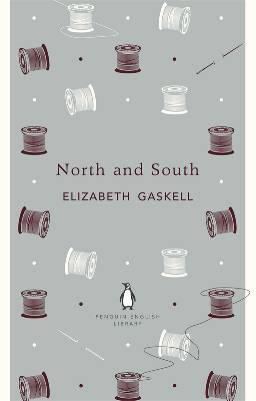
Young Margaret Hale's life is turned on its head when her father, a parson from the South of England, renounces his position because he experiences a crisis of faith. He moves his anxious wife and dutiful daughter to the factory town of Milton Northern, where he's going to work as a tutor. The town, a bustling result of the Industrial Revolution, is full of cotton mills, soot and smoke, a stark contrast to the pastoral idyll of the Southern English countryside. With the loss of Mr. Hale's living, the family is in severely reduced financial circumstances, (not helped by the fact that they keep sending money to Margaret's brother who is wanted for mutiny in England, and as a result living in exile in Spain) and can't really afford more than a modest lifestyle. Margaret bravely adapts fairly quickly, but her mother never feels happy or comfortable in Milton and her health gradually deteriorates.
In Milton, the main social interaction the Hales have is with Mr. John Thornton, a mill owner who leases from Mr. Hale's best friend, Mr. Bell (Margaret's godfather). Thornton's father drove his family into debt and further caused scandal when he committed suicide. Thornton had to quit school, and take a position as a shop clerk to support his sister and widowed mother. Putting aside most of what he earned, he slowly and quietly worked to repay all his father's debts and became a respected and formidable man in Milton. His mother is a proud and arrogant woman who loves her son fiercely, constantly worried some fortune-hunting young miss will get her claws into him.
Mr. Hale tutors Mr. Thornton, and they develop a close friendship. Margaret initially has difficulties relating to him, however. Thornton thinks Margaret is very beautiful, but aloof, distant and too caught up in her sheltered and genteel way of thinking, while she thinks Thornton is cold, arrogant, coarse and too hard on his workers. Before Margaret moved with her parents to Milton, she lived with her wealthy aunt in London for ten years, until her cousin Edith married an army captain and moved to Corfu. In the north, she has very few friends. Mrs. Thornton is dismissive of the Hales, and Miss Hale is spoiled, self-centred, vain and not in any way interested in the prim and serious Miss Hale. The only friends Margaret makes are of a lower class than her, Mr. Higgins and his consumptive daughter Bessie, and they become more of a charity project for her than confidantes and support to her.
I was surprised at how useless both of Margaret's parents are. Her father upends his family's entire life because of a point of principle, but once they arrive in Milton and it turns out that their new life is going to be difficult and not at all what he'd planned, he withdraws into his studies and teaching, leaving poor Margaret to deal with the complicated practicalities of managing the household with their meagre finances, the inability to secure extra help in the house, her mother's depression and deteriorating health and the worry about Frederick. She sees the deep love between her parents, and because of that, she won't accept a marriage proposal from a man she doesn't love. Shortly after leaving her aunt's house in London, she rejects the proposal of Mr. Lennox, her cousin Edith's brother-in-law, as she cannot see him as anything but a friend. So when Mr. Thornton is persuaded by his mother and sister that Margaret must be infatuated with him, he proposes, and is vehemently rejected. By the time Margaret is ready to reconsider his advances, a number of coincidences and complications has made Thornton believe that she loves another and is lost to him.
I discovered the BBC adaptation of North and South, with the darkly handsome Richard Armitage (currently most famous as the broodingest exiled dwarf king evah in The Hobbit) and the lovely Daniela Denby-Ashe a few years ago, but it's taken me until now to actually read the novel. I got the audio book narrated by the excellent Juliet Stevenson, who varies between crisp arch tones for the southern characters and wonderful northern accents. I was surprised at how nuanced the book is, for a Victorian novel, both Margaret and Thornton's feelings are very clearly depicted. I really hadn't expected so much insight into the emotions of both main characters. Gaskell's novel is typical of the time, showing a lot of social responsibility, with the social developments after the Industrial Revolution, the clashes between the factory owners and the workers, the hardship of a strike and so forth, but it doesn't feel like it's sermonising and lecturing the reader. I will absolutely be reading more Gaskell in future.
This is my book blog, where I review books I read as part of Cannonball Read 18, where members compete to be the first to reach 52 reviews. We also try to get people excited about books and reading, and make money for cancer charities. As always, I will be reading and reviewing in memory of friends and family who died of cancer in the past few years. Wish me luck!
Saturday, 16 November 2013
#CBR5 Book 134. "You Don't Have to Say You Love Me" by Sarra Manning
Page count: 560 pages
Rating: 4 stars
Neve is in her mid-twenties and awkward around new people, especially men. She works as an archivist and seeks refuge in classical literature. Over the course of the last three years, she's kept up an old-fashioned pen and paper correspondence with William, one of her professors from Oxford, whose currently lecturing in California. During the same three years, she's also lost more than half her body weight (from a UK size 32/US size 30/European size 62 to a smallish UK size 16/US size 14/EU size 44) through a strenuous and rigid exercise and diet regime. William is due back in little over three months, at which point Neve is determined to be a size 12. She's sure that once William sees her again, he will love her as much as she has always loved him, and everything in her life will finally be perfect.
Her little sister Celia is not convinced that Neve is doing the right thing, pining for William and rejecting all other men. She encourages Neve to get some dating experience, saying that she doesn't want to be completely innocent when William finally returns. The only man she warns Neve away from entirely, is Mx, one of the assistant editors at the fashion and lifestyle magazine where Celia works, claiming that he's a bit of a man whore and will only break Neve's heart. As Max has a young blonde draped over each arm and throws an ice cube at her accidentally the first time they meet, Neve is pretty sure she'll be able to resist his "charm", yet ends up taking him home at the end of the night, desperate to get some of that precious experience with someone who seems to have lots of it. Their first night together is absolutely dreadful, and it's clearly better if she and Max never speak again.
Neve is put off the idea of casual sex after that first attempt with Max, but wants a "pancake relationship" to get some practical experience before William returns. Her theory is that the first pancake always turns out messed up and gets discarded, it's the practise run for the real pancakes. She goes on a series of absolutely awful first dates, and suddenly Max doesn't seem so bad after all. He finds the idea of a non-sexual relationship with a woman, where Neve can get experience with kissing, dating, and even sleeping with a man strangely intriguing. He knows he has the reputation of a cad, a shallow social butterfly and an inconsequential ladies' man, and to him, a temporarily permanent non-sexual relationship represents something new, an exciting challenge, so he agrees to be her "pancake" boyfriend.
Neve and Max have three months to practise before Neve hopefully reaches her goal weight and is ready for her HEA with the scholarly and intellectual William. Despite Celia and Neve's personal trainer's misgivings, the relationship, after a few initial hiccoughs goes pretty well. Max brings Neve out of her reclusive existence and shows her that social events can be fun if you're with the right people, and Neve gives Max a much needed grounding and stability. Yet the day when William returns is rapidly approaching. Is he actually the man she's destined to be happy with, or is Neve overlooking someone a lot closer to home?
A good contemporary romance novel is basically a romantic comedy in book form. There is a certain predictability and inevitable outcome in a story like this, but it's the journey, not the destination that is what makes it so enjoyable. I'm not going to say that the ending doesn't matter, because we all know that would be a lie. But the build up in a romance, the gradually developing relationship, that is what is really important for the HEA to feel truly earned and satisfying. From the setup of this book, with the bookish, innocent young woman pining for another man, and the introduction of the charming and worldly playboy, with their agreement to help each other test-drive a relationship so to speak - it's not really going to end with Neve going off into the sunset with William. The fun of the story is how two such opposite personalities as Neve and Max can realise how perfectly they compliment each other, and support and nurture the other, finally realising that they can't live without the other.
Neve has huge self esteem issues. She was always a big girl, and her weight ballooned as she was bullied all through school. She achieves something truly remarkable by losing so much weight, reshaping herself entirely and taking control of her life (some might say that her control tendencies go a bit far with regards to her diet), but she still has tremendous trouble accepting the praise and acknowledgement she gets for this from other. Even though she's come so far, only her end result matters. Until she is a size 12, she cannot relax, cannot settle down and she certainly won't be able to find true happiness. Everything up until that point is practise, meant to be left behind and discarded. She's quite blind to her own achievements, and rather judgemental. She believes all of Celia's gossip about Max and his irresponsibility and fickleness. There's a fair amount of slut shaming towards Max, even though he's never anything but completely honest about who he is and the way he lives.
It quickly becomes clear, that for all of Neve's body image issues, Max is the more emotionally vulnerable of the two. His lack of experience with long term girlfriends may be because he doesn't think anyone would actually want to commit to a permanent relationship with him. Both his parents are dead, his mother left him with a number of emotional issues, and the closest thing he has to a family are those of the footballer's fiancee whose chick lit novels he ghost-writes. For all her complaints about her parents and siblings, Neve has a close network of supportive family members and close family friends who have always been there for her. Max is drawn to that, as much as to Neve herself. While she initially is quite dismissive of him and his lifestyle, he doesn't judge her. Instead he tries to bring her out of her shyness and awkwardness, daring her to try new things. He admires her intelligence, drive and cleverness, and despairs at her blind belief that she's still fat and unattractive. While he hopes she'll change her mind about the no sex-rule, he never tries to pressure her and gives her the time and space to come to terms with her own desires.
I found Neve very easy to relate to, yet also wanted to shake her vigorously several times. Max is clearly a great guy, your modern day rake. He's got a good career, he's gorgeous, he's adopted a neurotic shelter dog and most of all, he's fun! William is half a world away, his letters to her show that he's unlikely to feel as strongly about her as she does for him (it's not like she ever confessed to her crush on him), and while I knew that she and Max would end up together in the end, I was not looking forward to the obligatory third act conflict before they sort everything out and settle down for good. While it's quite a long book, I didn't mind. I enjoyed spending time with the characters and liked the supporting cast of Neve's family and co-workers, and the gradual friendship developing between her and Max, which evolves into something romantic as their "pancake relationship" progresses. I discovered this book when looking for books for my A to Z reading challenge, and had such a good time reading it. Neve's weight loss battle has also helped me force myself to the gym a bit more often in the weeks since I finished it, as well, so added bonus there.
Rating: 4 stars
Neve is in her mid-twenties and awkward around new people, especially men. She works as an archivist and seeks refuge in classical literature. Over the course of the last three years, she's kept up an old-fashioned pen and paper correspondence with William, one of her professors from Oxford, whose currently lecturing in California. During the same three years, she's also lost more than half her body weight (from a UK size 32/US size 30/European size 62 to a smallish UK size 16/US size 14/EU size 44) through a strenuous and rigid exercise and diet regime. William is due back in little over three months, at which point Neve is determined to be a size 12. She's sure that once William sees her again, he will love her as much as she has always loved him, and everything in her life will finally be perfect.
Her little sister Celia is not convinced that Neve is doing the right thing, pining for William and rejecting all other men. She encourages Neve to get some dating experience, saying that she doesn't want to be completely innocent when William finally returns. The only man she warns Neve away from entirely, is Mx, one of the assistant editors at the fashion and lifestyle magazine where Celia works, claiming that he's a bit of a man whore and will only break Neve's heart. As Max has a young blonde draped over each arm and throws an ice cube at her accidentally the first time they meet, Neve is pretty sure she'll be able to resist his "charm", yet ends up taking him home at the end of the night, desperate to get some of that precious experience with someone who seems to have lots of it. Their first night together is absolutely dreadful, and it's clearly better if she and Max never speak again.
Neve is put off the idea of casual sex after that first attempt with Max, but wants a "pancake relationship" to get some practical experience before William returns. Her theory is that the first pancake always turns out messed up and gets discarded, it's the practise run for the real pancakes. She goes on a series of absolutely awful first dates, and suddenly Max doesn't seem so bad after all. He finds the idea of a non-sexual relationship with a woman, where Neve can get experience with kissing, dating, and even sleeping with a man strangely intriguing. He knows he has the reputation of a cad, a shallow social butterfly and an inconsequential ladies' man, and to him, a temporarily permanent non-sexual relationship represents something new, an exciting challenge, so he agrees to be her "pancake" boyfriend.
Neve and Max have three months to practise before Neve hopefully reaches her goal weight and is ready for her HEA with the scholarly and intellectual William. Despite Celia and Neve's personal trainer's misgivings, the relationship, after a few initial hiccoughs goes pretty well. Max brings Neve out of her reclusive existence and shows her that social events can be fun if you're with the right people, and Neve gives Max a much needed grounding and stability. Yet the day when William returns is rapidly approaching. Is he actually the man she's destined to be happy with, or is Neve overlooking someone a lot closer to home?
A good contemporary romance novel is basically a romantic comedy in book form. There is a certain predictability and inevitable outcome in a story like this, but it's the journey, not the destination that is what makes it so enjoyable. I'm not going to say that the ending doesn't matter, because we all know that would be a lie. But the build up in a romance, the gradually developing relationship, that is what is really important for the HEA to feel truly earned and satisfying. From the setup of this book, with the bookish, innocent young woman pining for another man, and the introduction of the charming and worldly playboy, with their agreement to help each other test-drive a relationship so to speak - it's not really going to end with Neve going off into the sunset with William. The fun of the story is how two such opposite personalities as Neve and Max can realise how perfectly they compliment each other, and support and nurture the other, finally realising that they can't live without the other.
Neve has huge self esteem issues. She was always a big girl, and her weight ballooned as she was bullied all through school. She achieves something truly remarkable by losing so much weight, reshaping herself entirely and taking control of her life (some might say that her control tendencies go a bit far with regards to her diet), but she still has tremendous trouble accepting the praise and acknowledgement she gets for this from other. Even though she's come so far, only her end result matters. Until she is a size 12, she cannot relax, cannot settle down and she certainly won't be able to find true happiness. Everything up until that point is practise, meant to be left behind and discarded. She's quite blind to her own achievements, and rather judgemental. She believes all of Celia's gossip about Max and his irresponsibility and fickleness. There's a fair amount of slut shaming towards Max, even though he's never anything but completely honest about who he is and the way he lives.
It quickly becomes clear, that for all of Neve's body image issues, Max is the more emotionally vulnerable of the two. His lack of experience with long term girlfriends may be because he doesn't think anyone would actually want to commit to a permanent relationship with him. Both his parents are dead, his mother left him with a number of emotional issues, and the closest thing he has to a family are those of the footballer's fiancee whose chick lit novels he ghost-writes. For all her complaints about her parents and siblings, Neve has a close network of supportive family members and close family friends who have always been there for her. Max is drawn to that, as much as to Neve herself. While she initially is quite dismissive of him and his lifestyle, he doesn't judge her. Instead he tries to bring her out of her shyness and awkwardness, daring her to try new things. He admires her intelligence, drive and cleverness, and despairs at her blind belief that she's still fat and unattractive. While he hopes she'll change her mind about the no sex-rule, he never tries to pressure her and gives her the time and space to come to terms with her own desires.
I found Neve very easy to relate to, yet also wanted to shake her vigorously several times. Max is clearly a great guy, your modern day rake. He's got a good career, he's gorgeous, he's adopted a neurotic shelter dog and most of all, he's fun! William is half a world away, his letters to her show that he's unlikely to feel as strongly about her as she does for him (it's not like she ever confessed to her crush on him), and while I knew that she and Max would end up together in the end, I was not looking forward to the obligatory third act conflict before they sort everything out and settle down for good. While it's quite a long book, I didn't mind. I enjoyed spending time with the characters and liked the supporting cast of Neve's family and co-workers, and the gradual friendship developing between her and Max, which evolves into something romantic as their "pancake relationship" progresses. I discovered this book when looking for books for my A to Z reading challenge, and had such a good time reading it. Neve's weight loss battle has also helped me force myself to the gym a bit more often in the weeks since I finished it, as well, so added bonus there.
Sunday, 10 November 2013
#CBR5 Book 133. "The Sum of All Kisses" by Julia Quinn
Page count: 384 pages
Rating: 4 stars
Having drunkenly challenged his friend Daniel Smythe-Smith to a duel after a round of cards, Hugh Prentice ends up shot in the leg, and crippled for life. He's lucky enough to recover enough that he can walk, but has to use a cane, and will never be able-bodied again. After several years of Daniel Smythe-Smith being on the run from assassins hired by Hugh's father, Hugh has had more than enough of the whole business and tells his father that if anything untoward happens to Daniel, Hugh will kill himself. As his father seems to count on Hugh to marry and provide an heir, he calls off his hired killers, and Daniel can return safely to England, which he does and promptly falls in love with his sisters' governess, in A Night Like This.
Daniel and Hugh forgive each other, but Hugh has never been able to forgive himself. The only person who hates Hugh more than he does himself, is probably Lady Sarah Pleinsworth, who feels that he destroyed not only Daniel's life with the disastrous duel, but ruined her chances at an advantageous marriage. Sarah was supposed to have her debut along with Daniel's sister, Lady Honoria, when Daniel had to flee the country. The scandal meant they had to wait, and Sarah is convinced that one of the fourteen eligible gentlemen who proposed to someone else during that season could now have been her husband. So when Lady Honoria is getting married to Marcus Holroyd (see Just Like Heaven), and Sarah is asked to not only sit next to Hugh, but take special care of him, and make him feel like a welcome guest during the wedding festivities, she's not exactly thrilled.
Hugh thinks Sarah is a melodramatic harpy, and has never forgotten that the first time they met, Sarah unleashed a torrent of vitriolic ranting at him for all the damage she felt he had done to Daniel, Honoria, herself and her younger sisters. He has no choice but to attend Lady Honoria's wedding to show how well things are patched up with the Smythe-Smiths, but he wishes he could spend more time with the younger Pleinsworth sisters rather than Lady Sarah. Despite the personal feelings of Sarah and Hugh, though, it soon seems like several members of the Pleinsworth and Smythe-Smith families are determined to throw the two together as much as possible, and when Sarah injures her ankle and is temporarily just as crippled as Hugh, they discover that their initial dislike for each other may be turning into something else.
This is the third novel in the Smythe-Smith quartet (I suspect the fourth and final book in the series will be about Iris, another lady of marriageable age), and so far the one I've liked the most. Because of Hugh and Sarah's initial antipathy towards each other, they have some truly snarky banter, and it's fun to see a couple turning gradually from dislike to attraction. Hugh is a much more troubled hero than Marcus Holroyd or Daniel Smythe-Smith, never able to forget his foolishly impulsive challenge, and living with the painful (both physical and emotional) after-effects every day. He didn't hesitate to threaten his father with his own death if Daniel couldn't return home safely, as he really feels that his life is worth more to his loathsome father than it is to himself. All he has is his brilliant mind, he can no longer dance, or hunt, or properly woo a lady, so he's quite convinced he's going to die alone and unloved.
Sarah may seem shallow, overly dramatic and obsessed with finding a husband, but as long as she is unmarried, she's forced to participate in the annual Smythe-Smith musicales, being humiliated when she and her tone-deaf cousins are forced to perform for friends and family. When she's actually forced to spend some time with Hugh, she realises that long term, the duel had more disastrous results for him than for any of the Smythe-Smiths or their cousins, and starts softening towards him.
My main complaint with this novel was the complications caused by Hugh's father, who is a moustache-twirling maniac villain of the worst order, with no clear motivations other than being evil and erratic and wanting to control his sons' lives. I wish something else had been used as the issue that needed resolving before the couple's happy ending, but the first three quarters of the book, with the cameo appearances of the previous two books couples, and a number of fun supporting characters, like the younger Pleinsworth sisters, were strong and fun enough that I can rate this four stars.
Rating: 4 stars
Having drunkenly challenged his friend Daniel Smythe-Smith to a duel after a round of cards, Hugh Prentice ends up shot in the leg, and crippled for life. He's lucky enough to recover enough that he can walk, but has to use a cane, and will never be able-bodied again. After several years of Daniel Smythe-Smith being on the run from assassins hired by Hugh's father, Hugh has had more than enough of the whole business and tells his father that if anything untoward happens to Daniel, Hugh will kill himself. As his father seems to count on Hugh to marry and provide an heir, he calls off his hired killers, and Daniel can return safely to England, which he does and promptly falls in love with his sisters' governess, in A Night Like This.
Daniel and Hugh forgive each other, but Hugh has never been able to forgive himself. The only person who hates Hugh more than he does himself, is probably Lady Sarah Pleinsworth, who feels that he destroyed not only Daniel's life with the disastrous duel, but ruined her chances at an advantageous marriage. Sarah was supposed to have her debut along with Daniel's sister, Lady Honoria, when Daniel had to flee the country. The scandal meant they had to wait, and Sarah is convinced that one of the fourteen eligible gentlemen who proposed to someone else during that season could now have been her husband. So when Lady Honoria is getting married to Marcus Holroyd (see Just Like Heaven), and Sarah is asked to not only sit next to Hugh, but take special care of him, and make him feel like a welcome guest during the wedding festivities, she's not exactly thrilled.
Hugh thinks Sarah is a melodramatic harpy, and has never forgotten that the first time they met, Sarah unleashed a torrent of vitriolic ranting at him for all the damage she felt he had done to Daniel, Honoria, herself and her younger sisters. He has no choice but to attend Lady Honoria's wedding to show how well things are patched up with the Smythe-Smiths, but he wishes he could spend more time with the younger Pleinsworth sisters rather than Lady Sarah. Despite the personal feelings of Sarah and Hugh, though, it soon seems like several members of the Pleinsworth and Smythe-Smith families are determined to throw the two together as much as possible, and when Sarah injures her ankle and is temporarily just as crippled as Hugh, they discover that their initial dislike for each other may be turning into something else.
This is the third novel in the Smythe-Smith quartet (I suspect the fourth and final book in the series will be about Iris, another lady of marriageable age), and so far the one I've liked the most. Because of Hugh and Sarah's initial antipathy towards each other, they have some truly snarky banter, and it's fun to see a couple turning gradually from dislike to attraction. Hugh is a much more troubled hero than Marcus Holroyd or Daniel Smythe-Smith, never able to forget his foolishly impulsive challenge, and living with the painful (both physical and emotional) after-effects every day. He didn't hesitate to threaten his father with his own death if Daniel couldn't return home safely, as he really feels that his life is worth more to his loathsome father than it is to himself. All he has is his brilliant mind, he can no longer dance, or hunt, or properly woo a lady, so he's quite convinced he's going to die alone and unloved.
Sarah may seem shallow, overly dramatic and obsessed with finding a husband, but as long as she is unmarried, she's forced to participate in the annual Smythe-Smith musicales, being humiliated when she and her tone-deaf cousins are forced to perform for friends and family. When she's actually forced to spend some time with Hugh, she realises that long term, the duel had more disastrous results for him than for any of the Smythe-Smiths or their cousins, and starts softening towards him.
My main complaint with this novel was the complications caused by Hugh's father, who is a moustache-twirling maniac villain of the worst order, with no clear motivations other than being evil and erratic and wanting to control his sons' lives. I wish something else had been used as the issue that needed resolving before the couple's happy ending, but the first three quarters of the book, with the cameo appearances of the previous two books couples, and a number of fun supporting characters, like the younger Pleinsworth sisters, were strong and fun enough that I can rate this four stars.
#CBR5 Book 132. "Blood Rites" by Jim Butcher
Page count: 439 pages
Audio book length: 13 hrs and 11 mins
Rating: 4 stars
Harry Dresden, Chicago's only consulting wizard, is asked by his White Court vampire friend, and sometime ally, Thomas Raith to help a movie producer who seems to be the target of a death curse. As Thomas has aided Harry in the past, and even saved his life, Harry can't really refuse, but he demands payment both from the client and Thomas, in the form of information about why the vampire has been helping him, sometimes even at the risk of Thomas' own life. But how will Harry react to the truths that Thomas is so reluctant to share?
It turns out that the movie Harry is supposed to act as supernatural security on, and pretend to be an production assistant on, is a porn flick, which everyone of his acquaintances seems to find hilarious. The job quickly turns a lot more dangerous than Harry had expected, with the vicious death curse striking twice a day, affecting anyone close to Genosa, the director. It quickly becomes apparent that Thomas and the rest of the Raith family are more closely connected to the imperilled movie production that Thomas let on, and because Harry's life never seems to be complete unless multiple parties are trying to kill him, the powerful and vengeful Black Court vampire Mavra is determined to end him, one way or another.
One of the central themes in Blood Rites is family - the stress, grief and conflict having one can cause, and the void that not being part of one causes. Karrin Murphy happily agrees to come vampire hunting with Harry, especially if they can schedule it to the Saturday when the Murphy clan are having their annual barbecue in Chicago. She knows her younger sister is bringing her new fiancee, and feels that her mother is constantly disappointed in her, so would rather avoid going than having to face her family. During his work on the movie set, Harry is introduced to two of Thomas' sisters, with the younger, Inari, seemingly completely unaware that her entire family are White Court vampires. All the various family conflicts makes Harry all too aware that he is entirely alone in the world, with no living kin at all.
I'm really glad I stuck with the series now, and thanks again to the amazing Narfna/Ashley for suggesting I try the audio books. James Marsters is a really good narrator, and after the revelations and developments in this book, I'm probably hooked for good. Harry has really grown on me as a character, I was really glad to get more Thomas (yet another urban fantasy character with a messed up family life) and after seeing a little of what's going on in Murphy's immediate family, I'm not sure Harry should be so upset that he doesn't have a lot of close relatives. I'm trying to pace myself a bit with these (I have a limited number of Audible credits, after all), but I suspect I will average a book a month until I'm caught up, and Butcher will be added to the list of authors I hope will write and publish books faster.
Audio book length: 13 hrs and 11 mins
Rating: 4 stars
Harry Dresden, Chicago's only consulting wizard, is asked by his White Court vampire friend, and sometime ally, Thomas Raith to help a movie producer who seems to be the target of a death curse. As Thomas has aided Harry in the past, and even saved his life, Harry can't really refuse, but he demands payment both from the client and Thomas, in the form of information about why the vampire has been helping him, sometimes even at the risk of Thomas' own life. But how will Harry react to the truths that Thomas is so reluctant to share?
It turns out that the movie Harry is supposed to act as supernatural security on, and pretend to be an production assistant on, is a porn flick, which everyone of his acquaintances seems to find hilarious. The job quickly turns a lot more dangerous than Harry had expected, with the vicious death curse striking twice a day, affecting anyone close to Genosa, the director. It quickly becomes apparent that Thomas and the rest of the Raith family are more closely connected to the imperilled movie production that Thomas let on, and because Harry's life never seems to be complete unless multiple parties are trying to kill him, the powerful and vengeful Black Court vampire Mavra is determined to end him, one way or another.
One of the central themes in Blood Rites is family - the stress, grief and conflict having one can cause, and the void that not being part of one causes. Karrin Murphy happily agrees to come vampire hunting with Harry, especially if they can schedule it to the Saturday when the Murphy clan are having their annual barbecue in Chicago. She knows her younger sister is bringing her new fiancee, and feels that her mother is constantly disappointed in her, so would rather avoid going than having to face her family. During his work on the movie set, Harry is introduced to two of Thomas' sisters, with the younger, Inari, seemingly completely unaware that her entire family are White Court vampires. All the various family conflicts makes Harry all too aware that he is entirely alone in the world, with no living kin at all.
I'm really glad I stuck with the series now, and thanks again to the amazing Narfna/Ashley for suggesting I try the audio books. James Marsters is a really good narrator, and after the revelations and developments in this book, I'm probably hooked for good. Harry has really grown on me as a character, I was really glad to get more Thomas (yet another urban fantasy character with a messed up family life) and after seeing a little of what's going on in Murphy's immediate family, I'm not sure Harry should be so upset that he doesn't have a lot of close relatives. I'm trying to pace myself a bit with these (I have a limited number of Audible credits, after all), but I suspect I will average a book a month until I'm caught up, and Butcher will be added to the list of authors I hope will write and publish books faster.
Friday, 1 November 2013
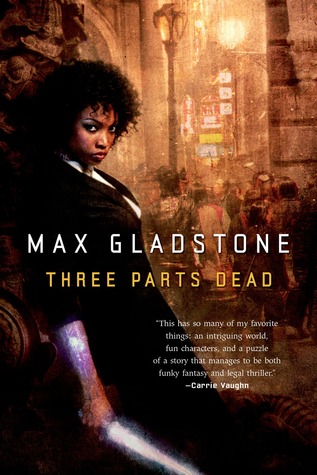
#CBR5 Book 131. "Thee Parts Dead" by Max Gladstone
Page count: 336 pages
Rating: 4 stars
Tara is a newly hired first year associate with the firm of Kelethres, Albrecht and Ao, and on her very first assignment, she needs to help resurrect a god. Kos, the fire god of Alt Coulumb, has mysteriously died (he may have been murdered) and if he cannot be brought back within the month, the power he supplied to the city will shut down, and there will be chaos.
Abelard is the cleric who was on duty when Kos died, and he is naturally having a bit of a crisis of faith, which he handles by chain-smoking incessantly. He is asked to aid Elayne Kevarian (Tara's boss) and Tara with the case, which also seems to involve a murdered judge, supposedly exiled gargoyles, and the re-appearance of Tara's old mentor, who's also responsible for her being expelled from the Hidden Schools before graduating. There are mysterious things afoot in Alt Coulumb - but who has the most to benefit from the death of Kos? How far are they willing to go to stop him being resurrected and restored to power?
This is not an easy book to classify. It's alternate reality urban fantasy, meets mystery meets steampunk. There are magical systems, and different religious beliefs. There's the necromantic Craft, and the strange legal battles that take place before a case can be settled. The necromancers seem to be part lawyers, part magic wielders. We discover the rules and customs of the world gradually, and the information is sometimes portioned out sparingly, not giving the reader the full story until a long way into the book.
The characters are distinctive, and complex, and not always admirable or likable, but they're never not interesting. I loved the world building and the rules for the use of magic. That gods are powered by the belief of their worshippers is nothing new, but that a god can be the source of power for an entire city is a cool and unusual idea. I liked Tara's ambition, I loved Elayne's cool ruthlessness, and I liked Abelard's genuine faith and devotion. Max Gladstone is a very entertaining writer, and having recently discovered that this is not a stand alone book, and that the next book in the series is out now, I will absolutely be reading more of his work.
Rating: 4 stars
Tara is a newly hired first year associate with the firm of Kelethres, Albrecht and Ao, and on her very first assignment, she needs to help resurrect a god. Kos, the fire god of Alt Coulumb, has mysteriously died (he may have been murdered) and if he cannot be brought back within the month, the power he supplied to the city will shut down, and there will be chaos.
Abelard is the cleric who was on duty when Kos died, and he is naturally having a bit of a crisis of faith, which he handles by chain-smoking incessantly. He is asked to aid Elayne Kevarian (Tara's boss) and Tara with the case, which also seems to involve a murdered judge, supposedly exiled gargoyles, and the re-appearance of Tara's old mentor, who's also responsible for her being expelled from the Hidden Schools before graduating. There are mysterious things afoot in Alt Coulumb - but who has the most to benefit from the death of Kos? How far are they willing to go to stop him being resurrected and restored to power?
This is not an easy book to classify. It's alternate reality urban fantasy, meets mystery meets steampunk. There are magical systems, and different religious beliefs. There's the necromantic Craft, and the strange legal battles that take place before a case can be settled. The necromancers seem to be part lawyers, part magic wielders. We discover the rules and customs of the world gradually, and the information is sometimes portioned out sparingly, not giving the reader the full story until a long way into the book.
The characters are distinctive, and complex, and not always admirable or likable, but they're never not interesting. I loved the world building and the rules for the use of magic. That gods are powered by the belief of their worshippers is nothing new, but that a god can be the source of power for an entire city is a cool and unusual idea. I liked Tara's ambition, I loved Elayne's cool ruthlessness, and I liked Abelard's genuine faith and devotion. Max Gladstone is a very entertaining writer, and having recently discovered that this is not a stand alone book, and that the next book in the series is out now, I will absolutely be reading more of his work.
Thursday, 31 October 2013
#CBR Book 130. "Love and Other Scandals" by Caroline Linden
Page count: 384 pages
Rating: 2.5 stars
Miss Joan Bennet is dangerously close to being on the shelf, and the only thing close to romance she is experiencing is in literary form. Her mother keeps dressing her in the height of fashion, yet her with her tall, curvy figure, she looks like an idiot. At social gatherings and balls, she's a constant wallflower. She'd love to be noticed, by anyone at all. Except possibly Lord Tristan Burke, her brother's best friend and a notorious rake. Lord Burke thinks Joan is a bossy Fury, who's made it her life's mission to torment her brother as much as possible. But when Joan's parents have to go to the seaside for Joan's mother to convalesce, and Joan's brother is sent away to see to repairs on the family estate, he asks Lord Burke to make sure Joan stays out of trouble.
Joan's eccentric and slightly scandalous aunt comes to stay with her, and soon Joan has a new and improved wardrobe which flatters her rather than makes her look like a gaudy umbrella. Lord Burke, who has already discovered that the best way to shut his best friend's bossy and opinionated sister up is by kissing her senseless, is suddenly starting to consider whether he may not have to change his mind about what a chore it is to have to entertain her while her family are out of town.
I really liked Caroline Linden's The Truth About the Duke trilogy, which I read earlier this year. Romance is also a good choice for the 24 hour Read-a-Thon, as the books tend to be frothy and easy to read. There just wasn't all that much to this book. Having finished this book about two and a half weeks' ago, I was actually having to struggle to remember the plot for the two paragraphs of summary. There is no great conflict. Joan and Tristan met for the first time as children, because Tristan is Joan's brother's best friend. Tristan was orphaned and raised by his horrible relatives, and has always envied the Bennet family their closeness. He's a rake, he doesn't think he wants commitment. Joan reads romance, in particular a smutty story in eagerly awaited instalments called 50 Ways to Sin (yes, exactly. See what she did there?) and thinks she knows what to expect from romance and sex because of it. They bicker, then Tristan kisses her once to shut her up (because that's always charming) and from there it's pretty much insta-lust.
There was nothing much to distinguish any of the characters or make me care about them and their romance. Caroline Linden isn't a bad writer, as such, so there were some fun descriptions and some witty banter on occasion, but every time I was starting to think that maybe the book wasn't so meh after all, up popped a mention of the 50 Ways to Sin again, and made me want to rage-quit the book. By no means a bad romance novel, merely mediocre, and really rather forgettable. If you want good romance to read, give this one a miss, and take a look at my Top 100 romances instead.
Rating: 2.5 stars
Miss Joan Bennet is dangerously close to being on the shelf, and the only thing close to romance she is experiencing is in literary form. Her mother keeps dressing her in the height of fashion, yet her with her tall, curvy figure, she looks like an idiot. At social gatherings and balls, she's a constant wallflower. She'd love to be noticed, by anyone at all. Except possibly Lord Tristan Burke, her brother's best friend and a notorious rake. Lord Burke thinks Joan is a bossy Fury, who's made it her life's mission to torment her brother as much as possible. But when Joan's parents have to go to the seaside for Joan's mother to convalesce, and Joan's brother is sent away to see to repairs on the family estate, he asks Lord Burke to make sure Joan stays out of trouble.
Joan's eccentric and slightly scandalous aunt comes to stay with her, and soon Joan has a new and improved wardrobe which flatters her rather than makes her look like a gaudy umbrella. Lord Burke, who has already discovered that the best way to shut his best friend's bossy and opinionated sister up is by kissing her senseless, is suddenly starting to consider whether he may not have to change his mind about what a chore it is to have to entertain her while her family are out of town.
I really liked Caroline Linden's The Truth About the Duke trilogy, which I read earlier this year. Romance is also a good choice for the 24 hour Read-a-Thon, as the books tend to be frothy and easy to read. There just wasn't all that much to this book. Having finished this book about two and a half weeks' ago, I was actually having to struggle to remember the plot for the two paragraphs of summary. There is no great conflict. Joan and Tristan met for the first time as children, because Tristan is Joan's brother's best friend. Tristan was orphaned and raised by his horrible relatives, and has always envied the Bennet family their closeness. He's a rake, he doesn't think he wants commitment. Joan reads romance, in particular a smutty story in eagerly awaited instalments called 50 Ways to Sin (yes, exactly. See what she did there?) and thinks she knows what to expect from romance and sex because of it. They bicker, then Tristan kisses her once to shut her up (because that's always charming) and from there it's pretty much insta-lust.
There was nothing much to distinguish any of the characters or make me care about them and their romance. Caroline Linden isn't a bad writer, as such, so there were some fun descriptions and some witty banter on occasion, but every time I was starting to think that maybe the book wasn't so meh after all, up popped a mention of the 50 Ways to Sin again, and made me want to rage-quit the book. By no means a bad romance novel, merely mediocre, and really rather forgettable. If you want good romance to read, give this one a miss, and take a look at my Top 100 romances instead.
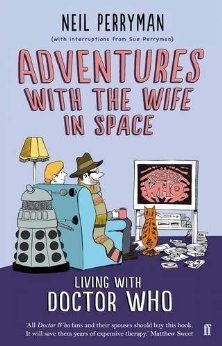
#CBR5 Book 129. "Adventures with the Wife in Space: Living with the Doctor" by Neil Perryman
Page count: 304 pages
Rating: 5 stars
Disclaimer! I was given an ARC from Faber & Faber via NetGalley in exchange for a fair and impartial review. I was absolutely delighted to get to read it before the release date (it's out now), but the husband and I had already pre-ordered a copy, which will hopefully be arriving in the post any day now.
From Goodreads, because it explains the premise of the book really well:
Neil loves Sue. He also loves Doctor Who. But can he bring his two great loves together? And does he have the right?
In January 2011, Neil Perryman set out on an insane quest to make his wife Sue watch every episode of the classic series of Doctor Who from the very beginning. Even the ones that didn't exist anymore. And so, over the next two and a half years, Sue gamely watched them all: William Hartnell (the Miserable Git);Patrick Troughton (the Scruffy Drunk); John Pertwee (the Pompous Tory); Tom Baker (the Mad One); Peter Davison (the Fit One); Colin Baker (the Court Jester); Sylvester McCoy (the Crafty Sod) and Paul McGann (the One-Night Stand). The result was a wildly successful and hilariously revealing blog called Adventures with the Wife in Space.
But the adventure continues. From awkward years at school, terrified of giant insects, Daleks and rugby players, to even more awkward years as an adult, terrified of unexpected parenthood and being called a Whovian, here Neil tells the all too true story of life as a Doctor Who fan. Funny, honest and surprisingly brave, he also captures perfectly the joys - and fears - of sharing the thing you love with the people you love.
Adventures with the Wife in Space is, at its heart, the story of Doctor Who, and its fans, seen through the eyes of two people - one who knows almost nothing about the programme and another who knows way too much.
Like Sue Perryman, I too am the wife of a life-long Doctor Who fan. While now the show is so huge and popular that even Norwegian tabloids write stories speculating on the identity of the new Doctor, and now about the upcoming 50th anniversary special, and the teenagers I teach discuss the relative merits of Matt Smith, David Tennant, Amy, Rory, Rose and Donna, I had never heard of the show, until I went to university in Scotland. Several of my friends there liked it, and showed me episodes on grainy VHS-tapes. I didn't think it was bad, as such, but it was no Buffy the Vampire Slayer or Babylon 5.
Then I met my husband. We met, while still at St. Andrews, in 2000. Long before the show was relaunched so successfully in 2005. I didn't really hear all that much about the show until it was coming back, and the husband was full of anticipation and dread. What if it was as bad as the TV movie? When my husband (then still the boyfriend) moved to Norway to live with me in 2005, the first few episodes had aired. He was very enthusiastic and wanted me to watch them with him. I was sceptical, but quickly came around and am now a big fan of the newer series. The husband, like Neil and Sue, has watched every single episode of the old series, even the reconstructed lost ones, and literally cried tears of joy when the news broke about nine missing episodes being found and reconstructed. He can, and will, go on at great length about the show, and which episodes he'd recommend you start with and which episodes of the various Doctors are his favourites and so forth. He's shown me a wide selection of episodes of the classic series, and I've sat, half watching out of the corner of my eye while busy doing other things, countless others.
So when Neil launched the blog, the husband, already a fan of Neil's podcast work with Tachyon TV, started reading it aloud to me, as Neil and Sue watched their way through the series. He'd usually focus on their summaries of stories I'd seen, but I also got to experience some of the stories first through the eyes of the Perrymans. So when the book was announced, it was an obvious pre-order for us. I knew it was probably going to be entertaining, because the writing on the blog was usually very funny. I had no idea how laugh-out-loud hilarious much of it would be, though, and how sweet and honest and touching reading about young Neil's love for the show, and later his love for his wife. Obviously, having followed the blog, I felt like I knew a bit about them, but I suspect the book will be a great read to people who've never heard of the blog, or Neil Perryman, or frankly, don't know that much about Doctor Who. It's not so much a book about a nerdy TV show, as much as the story of a devoted fan of that show, and anyone who's really been a fan of something, should be able to identify at least partly with Neil and appreciate this book.
Even if you're not a passionate fan of something, but just share your life with one, because you will recognise your loved one in Neil's story of himself. I'm a big fan of Doctor Who, and am very invested in it being good, but it hasn't been an important part of my life since I was a child, and I can never know what it's like to have the same favourite show when you're seven as when you're in your thirties (or even older), and to have lived for years when it was off the air, and then seeing it resurrected to huge international popularity and acclaim, becoming the BBC's flagship and loved by new generations. My husband has that, and still gets a bewildered happy look when I talk about my pupils discussing the show on their lunch break. What I'm trying to boil this down to is: the book is great! I had high expectations of it, because the blog is also very good, but it surpassed all of them. I laughed, I was moved to hints of tears in parts of it, and if we hadn't already pre-ordered a copy, the husband and I would do so immediately after both finishing the ARC. I will buy it as gifts for several of our friends. That's how much I liked it, and I will recommend it to anyone who will listen.
Rating: 5 stars
Disclaimer! I was given an ARC from Faber & Faber via NetGalley in exchange for a fair and impartial review. I was absolutely delighted to get to read it before the release date (it's out now), but the husband and I had already pre-ordered a copy, which will hopefully be arriving in the post any day now.
From Goodreads, because it explains the premise of the book really well:
Neil loves Sue. He also loves Doctor Who. But can he bring his two great loves together? And does he have the right?
In January 2011, Neil Perryman set out on an insane quest to make his wife Sue watch every episode of the classic series of Doctor Who from the very beginning. Even the ones that didn't exist anymore. And so, over the next two and a half years, Sue gamely watched them all: William Hartnell (the Miserable Git);Patrick Troughton (the Scruffy Drunk); John Pertwee (the Pompous Tory); Tom Baker (the Mad One); Peter Davison (the Fit One); Colin Baker (the Court Jester); Sylvester McCoy (the Crafty Sod) and Paul McGann (the One-Night Stand). The result was a wildly successful and hilariously revealing blog called Adventures with the Wife in Space.
But the adventure continues. From awkward years at school, terrified of giant insects, Daleks and rugby players, to even more awkward years as an adult, terrified of unexpected parenthood and being called a Whovian, here Neil tells the all too true story of life as a Doctor Who fan. Funny, honest and surprisingly brave, he also captures perfectly the joys - and fears - of sharing the thing you love with the people you love.
Adventures with the Wife in Space is, at its heart, the story of Doctor Who, and its fans, seen through the eyes of two people - one who knows almost nothing about the programme and another who knows way too much.
Like Sue Perryman, I too am the wife of a life-long Doctor Who fan. While now the show is so huge and popular that even Norwegian tabloids write stories speculating on the identity of the new Doctor, and now about the upcoming 50th anniversary special, and the teenagers I teach discuss the relative merits of Matt Smith, David Tennant, Amy, Rory, Rose and Donna, I had never heard of the show, until I went to university in Scotland. Several of my friends there liked it, and showed me episodes on grainy VHS-tapes. I didn't think it was bad, as such, but it was no Buffy the Vampire Slayer or Babylon 5.
Then I met my husband. We met, while still at St. Andrews, in 2000. Long before the show was relaunched so successfully in 2005. I didn't really hear all that much about the show until it was coming back, and the husband was full of anticipation and dread. What if it was as bad as the TV movie? When my husband (then still the boyfriend) moved to Norway to live with me in 2005, the first few episodes had aired. He was very enthusiastic and wanted me to watch them with him. I was sceptical, but quickly came around and am now a big fan of the newer series. The husband, like Neil and Sue, has watched every single episode of the old series, even the reconstructed lost ones, and literally cried tears of joy when the news broke about nine missing episodes being found and reconstructed. He can, and will, go on at great length about the show, and which episodes he'd recommend you start with and which episodes of the various Doctors are his favourites and so forth. He's shown me a wide selection of episodes of the classic series, and I've sat, half watching out of the corner of my eye while busy doing other things, countless others.
So when Neil launched the blog, the husband, already a fan of Neil's podcast work with Tachyon TV, started reading it aloud to me, as Neil and Sue watched their way through the series. He'd usually focus on their summaries of stories I'd seen, but I also got to experience some of the stories first through the eyes of the Perrymans. So when the book was announced, it was an obvious pre-order for us. I knew it was probably going to be entertaining, because the writing on the blog was usually very funny. I had no idea how laugh-out-loud hilarious much of it would be, though, and how sweet and honest and touching reading about young Neil's love for the show, and later his love for his wife. Obviously, having followed the blog, I felt like I knew a bit about them, but I suspect the book will be a great read to people who've never heard of the blog, or Neil Perryman, or frankly, don't know that much about Doctor Who. It's not so much a book about a nerdy TV show, as much as the story of a devoted fan of that show, and anyone who's really been a fan of something, should be able to identify at least partly with Neil and appreciate this book.
Even if you're not a passionate fan of something, but just share your life with one, because you will recognise your loved one in Neil's story of himself. I'm a big fan of Doctor Who, and am very invested in it being good, but it hasn't been an important part of my life since I was a child, and I can never know what it's like to have the same favourite show when you're seven as when you're in your thirties (or even older), and to have lived for years when it was off the air, and then seeing it resurrected to huge international popularity and acclaim, becoming the BBC's flagship and loved by new generations. My husband has that, and still gets a bewildered happy look when I talk about my pupils discussing the show on their lunch break. What I'm trying to boil this down to is: the book is great! I had high expectations of it, because the blog is also very good, but it surpassed all of them. I laughed, I was moved to hints of tears in parts of it, and if we hadn't already pre-ordered a copy, the husband and I would do so immediately after both finishing the ARC. I will buy it as gifts for several of our friends. That's how much I liked it, and I will recommend it to anyone who will listen.
Subscribe to:
Posts (Atom)