Showing posts with label 1980s. Show all posts

Sunday, 8 October 2023

CBR15 Book 49: Tomorrow and Tomorrow and Tomorrow" by Gabrielle Zevin

Page count: 482 pages
Audio book length: 13hrs 52 mins
Rating: 4 stars

CBR15 Bingo: North America

I've been hearing about this book since it came out. So many people I know on the internet and whose opinions I trust have read, reviewed and absolutely loved it. So I feel bad only rating it four stars, but for all that that the story and the characters appealed to me, there was something that kept making me prioritise other things over listening more to the audio book, and I never really fully emotionally connected with this one.

There are so many reviews out there of this book already, so I don't want to spend too much time on the plot. Sam and Sadie become best friends playing video games in a hospital while Sam is recovering from an awful car accident, which leaves him permanently crippled, while Sadie's sister is being treated for cancer. Because of an unwise decision of Sadie's, they drift apart, only to meet again as college students at Harvard. They immediately reconnect and decide to start designing a video game together. Aided by Sam's charming and rich roommate Marx, the three become a force to be reconned with in the video game world.

We learn about Sam and Sadie from flashbacks and flash-forwards. Both are fiercely loyal and love each other deeply, but are also easily hurt, terrible at communicating with one another, and stubborn enough that through the years, a lot of misunderstandings which could have been solved by SIMPLE conversations keep them from being there fully for one another. Marx is the person who tries to mediate between them and also keep their personality quirks from completely ruining any chance they have of success.

For all that I spent a lot of time wanting to smack either Sam, Sadie, or both of them on the back of the head and shout at them to stop being so self-centred, and maybe talk to the other about what actually bothered them, they also felt like real people to me. Marx was clearly the character I loved the most, and without him in the narrative, I'm not sure I would have continued past the first third or so of the novel. 

I've never been a big gamer, myself, but grew up watching my brothers play console games and have spent a lot of the last 23 years watching my husband play games as well. You don't need to know or care anything about video games to read this book, although I suspect reading about the designing and programming of games might add an extra level of enjoyment for those who know about these things. I like learning new things while reading fiction, and the insight into graphics engines and the like was fascinating to me. 

I don't love this book passionately as so many of my fellow Cannonball reviewers, but it made me feel a full range of emotions and at one point made me ugly cry and I will happily recommend it to others because it's a very well-written book. It also made me miss my best friend a lot, because reading about close friendships inevitably does just that. 

Judging a book by its cover: I love the paperback cover, with its bright rainbow colours, contrasting the almost black-and-white feel of the iconic image of Hokusai's Great Wave. The image drew me to first pick up the book and that's the job of cover design. So well, done art department. 

Crossposted on Cannonball Read. 

Wednesday, 5 July 2017

#CBR9 Book 60: "Life Moves Pretty Fast: The Lessons We Learned from Eighties Movies" by Hadley Freeman

Page count: 352 pages
Rating: 3 stars

It's been about a month since I finished this, and I've long since had to return my copy to the library, so Goodreads is going to have to help me here:

From Vogue contributor and Guardian columnist Hadley Freeman, a personalized guide to eighties movies that describes why they changed movie-making forever - featuring exclusive interviews with the producers, directors, writers and stars of the best cult classics.

In Life Moves Pretty Fast, Hadley puts her obsessive movie geekery to good use, detailing the decade's key players, genres, and tropes. She looks back on a cinematic world in which bankers are invariably evil, where children are always wiser than adults, where science is embraced with an intense enthusiasm, and the future viewed with giddy excitement. And, she considers how the changes between movies then and movies today say so much about society's changing expectations of women, young people, and art - and explains why Pretty in Pink should be put on school syllabuses immediately.

From how John Hughes described Molly Ringwald, to how the friendship between Dan Ackroyd and John Belushi influenced the evolution of comedy, and how Eddie Murphy made America believe that race could be transcended, this is a "highly personal, witty love letter to eighties movies, but also an intellectually vigorous, well-researched take on the changing times of the film industry." (The Guardian)

This was the most recent book club entry in the Cannonball Book Club, where the theme was movie related non-fiction. It wasn't the book I voted for, but book clubs are all about expanding ones horizons and reading things you wouldn't necessarily pick yourself, so I downloaded it from the library and started reading. Sadly, on the day of the actual book club discussion, I was feeling unwell, and not really able to take part as much as I would have liked. Of course, now it's been over a month since I finished the book, and while I kept thinking I should take notes to remember my opinions, that didn't really happen. So this review is going to be rather rambling, as I try to articulate what I thought and felt while reading it.

The first essay, about Dirty Dancing and sexuality on film, especially that of women, was really fascinating to me. While I straight up disagree with Freeman on a lot of points she makes in the book, it was really interesting to read about this movie (a film I only saw when I was closer to twenty than in my teens, and therefore never really saw the swoon-worthiness of the film, unlike many of my contemporaries). Having read Freeman's essay, I'd like to rewatch the movie, looking at its portrayal of female agency and the like. Freeman makes several points in the book in various essays about how "women's movies" don't really get made anymore, and I sadly think she's right. Unless movies can appeal to a wide range of demographics, they are unlikely to be greenlit now.

Like Freeman, I grew up in the eighties and nineties, but I didn't consume movies the way she clearly did. While I love watching movies and agree with her on the greatness of so many films, I was almost first and foremost a reader, and would therefore rarely obsessively watch the same movies again and again. As I mentioned above, she makes a lot of good points, but I never really felt that "Lessons we learned from eighties movies" was really what this book was about. If the book had been called "one film geek's opinions on eighties movies", it would have been a much more accurate title, but I suspect she'd have had a harder time getting the book published.

Because I didn't take notes, I can't really remember which bits of the book annoyed me the most. This isn't the best of reviews, so many other, more eloquent Cannonballers have reviewed the book already over on the group blog. I'm not regretting that I read the book, and it made me very eager to go seek out some of the eighties classics I've never seen, but unlike some pop culture non-fiction I've read, I'm unlikely to ever revisit this one.

Judging a book by its cover: My main gripe with the cover is the subtitle: The lessons we learned from eighties movies, because I really don't think Freeman manages to fully commit to her "thesis statement" so to speak. In so many cases, she just talks, very subjectively, about what she thinks of these movies, without there being any obvious "lessons learned" at all. The cover design, evoking old VHS tapes and their many colourful covers is a nice touch, though. Having grown up in the 1980s, just like Freeman, the cover was a good little piece of nostalgia.

Crossposted on Cannonball Read.

Monday, 23 January 2017

#CBR9 Book 3: "Aristotle and Dante Discover the Secrets of the Universe" by Benjamin Alire Sáenz

Page count: 368 pages
Audio book length: 7 hrs 29 mins
Rating: 4.5 stars

Aristotle "Ari" is a conflicted teenager growing up in El Paso in the late 1980s. He's sixteen and a loner, but doesn't really mind his lack of friends. He's very close to his mother, whose a high school teacher (not at Ari's school), but wishes he could talk to his dad, a Vietnam vet about, well, anything really. The youngest of his family, Ari's twin sisters are much older than him and his brother is in prison, never spoken about by anyone in the family. There are no pictures, his name is never mentioned, and Ari can't help but wonder about him constantly.

The summer when he's sixteen, Ari makes his first real friend, Dante. They meet at the public pool, when Dante offers to teach him how to swim. Dante is pretty much Ari's polar opposite. He's outgoing and talkative, questioning everything. He's positive where Ari is melancholy. Yet the two boys connect. They spend pretty much the whole summer together, until a bad accident puts Ari in the hospital. Dante's family move to Chicago for a school year, but the boys keep in touch by writing letters.It's clear that both of the boys do more developing and figuring out of who they're becoming when they're apart.

When Dante and his parents move back to El Paso, he's worried that Ari will no longer be his friend. Dante has been experimenting with kissing while he was in Chicago and has pretty much figured out that he only wants to be kissing boys. He's worried that Ari won't be his best friend anymore. He's worried about telling his parents and disappointing them, because he's absolutely crazy about them. Can Ari and Dante's friendship survive these new realisations?

I'd heard about this book in several places. It was very favourably reviewed by several review sites I frequent, like The Book Smugglers and Forever Young Adult. I put it on my TBR list, and as is so often the case, more or less forgot about it. Then earlier this month, fellow Cannonballer JCoppercorn wrote another very positive review, and because I had been browsing Audible, I discovered that Lin-Manuel Miranda was the narrator of the audiobook. This pretty much made the book a must-buy and I've been very happily listening to it for the past week.

This book, you guys. It's so good! I've seen some complaints that the dialogue wasn't entirely realistic and that sixteen/seventeen-year-olds don't speak the way Dante and Aristotle do, but as a reader of a lot of YA fiction, I would say that this is more often the exception than the rule. Frankly, I teach fifteen/sixteen-year-olds and none of them, male or female, are even half as articulate as any fictional teen I've every come across in fiction.

Frankly, the close, extremely functional relationship these young men had with their parents was probably unrealistic too, but it added to my enjoyment of the book. Both Ari's and Dante's parents are pretty much the greatest, even though Ari's dad isn't exactly the most talkative or emotionally demonstrative of people. Dante's parents both more than make up for that, though, and I found myself being vaguely jealous of how great, understanding, supportive and insightful all these adults were. Way better than any of my parents during my coming of age, and my Mum was pretty super. Not that they always said or did the right thing. As mentioned already, Ari's father is rather distant and taciturn, still stoically dealing with the aftermath of his time in Vietnam, even a decade and a half later. Neither of Ari's parents (or his sisters) will in any way acknowledge the existence of his older brother, who went to prison when Ari was four. Ari feels the lack of his brother deeply and cannot understand why his family won't ever tell him a thing about him.

The book is told from Ari's point of view and we only ever see Dante and the other characters through his eyes, with the exceptions of the letters Dante sends him while he lives in Chicago. Every so often, there are Ari's diary entries, but most of the story is just about a year and a half of his life, while he is growing up, changing and desperately trying to figure out who he is and what is going to become of him. Friendship is a new and occasionally difficult thing for Ari. Expressing his emotions and figuring out what he wants is even more so. He's frequently troubled by bad dreams, where his fear of being left behind by the men who mean something to him (his father, his brother and Dante) is painfully obvious.

It's clear that while Dante is much more outgoing and sociable than Ari, he hasn't really had a lot of close friends either. So both boys become the other's best friend, while still trying to figure out what that entails, as well as what becoming men is all about. Add to that the questions surrounding their identities as Mexican (Ari looks a lot more Mexican than Dante, both have parents who have become educated and don't necessarily fit into their traditional communities anymore) and in Dante's case, the questions surrounding his sexuality. While he's in Chicago, Dante clearly does his best to try to figure out exactly who and what he likes, while Ari reads his letters and feels uncomfortable about a lot of these things. Luckily, Dante's realisations about his sexuality doesn't get in the way of their continued friendship once he and his parents move back to El Paso.

This book made me laugh, and cry both happy and sad tears. It's such a lovely book and I'm glad I finally read it. The only reason I'm not giving it 5 stars is that it really does take Ari way too long to get over himself and figure out what matters to him in the end. When your parents have to sit you down and have a serious conversation with you before you wise up, it's gone a bit far. Again, not unrealistic, teenagers are really very clueless, but I still wish the book had continued on a little bit longer after it's current end point. The narration by Lin-Manuel Miranda is excellent (I hadn't expected anything else). Goodreads tells me that there will be a sequel at some future date (as of yet there is no release info) , and I cannot wait to find out what happens next with these lovely guys and their families.

Judging a book by its cover: I love pretty much everything about this cover, just as I love pretty much everything about the book. The font used for the title, the illustrations that look like someone has scribbled or doodled over much of it. Ari's red pickup truck and the lonely landscape that he enjoys so much. It's a really good cover and captures some of the feel of this book excellently.

Crossposted on Cannonball Read.  

Sunday, 21 August 2016

#CBR8 Book 87: "Our Endless Numbered Days" by Claire Fuller

Page count: 396 pages
Rating: 4 stars

Peggy Hillcoat is the daughter of a famous German concert pianist and an English survivalist, who despite the disapproval of his wife keeps stockpiling supplies in a shelter in their garden and preparing for the worst. Only eight years old, she doesn't question what is happening when her father takes her away from their big house in London while her mother is away on tour. He takes her to the German countryside, to a delapitated cabin remote in the mountains, explaining that this is their home now and that there's been a terrible disaster, they are the only ones left in the entire world.

Peggy is distraught that she'll never get to see her mother or her school friends again, but soon settles into her new reality, helping her father as best she can to get the cabin livable and gathering the supplies that they need to survive. The book begins in 1985, nine years later, when Peggy has been returned to her mother and is trying to adapt to a very different life once more. Little by little the readers discover the reasons her father took her away in the first place, and the details of the years she spent in the lonely wilderness with only the woods and her imagination for entertainment.

Because the book begins in 1985, after Peggy is returned to her mother, the reader is never in doubt that she will survive, even when the story gets really tense and dramatic. Living off the land in a primitive mountain hut is not easy at the best of times, but Peggy makes it clear in her recollections that she and her father were badly prepared for their first winter and I had flashbacks to reading The Long Winter by Laura Ingalls Wilder, when she and her family are trying their hardest not to starve to death.

While much of Peggy's adolescence is filled with whimsy and her frolicking in the woods, it is quite clear that her father is a seriously unstable man and that he truly comes to believe the lie he told his daugher. Even early on in the novel it is obvious that something really bad happened before Peggy was returned to civilisation and discovered that her father lied to her all those years. As the book progresses, the suspense increases and my sense of dread with it.

This is a really good book, already highly rated by five other Cannonballers. It's probably not the relaxing holiday read I was looking for, rather a haunting and suspenseful story that will stay with me for a long time.

Judging a book by its cover: The edition I read is pretty much black and white, and black is absolutely the dominant colour. The darkness is very suitable for the contents. The centre of the picture is a simple cabin, surrounded by spindly trees - probably Die Hutte, where Peggy spent most of her adolescence. Despite the picture being very simple, it conveys something ominous and sinister, which again is very apt for this book.

Crossposted on Cannonball Read.

Wednesday, 27 March 2013

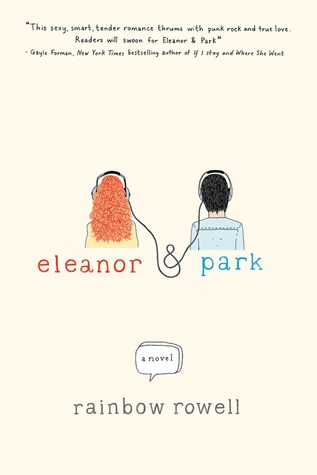
#CBR5 Book 32. "Eleanor and Park" by Rainbow Rowell

Page count: 336 pages
Rating: 4.5 stars

The year is 1986. Park doesn't fit in amongst the other kids in high school or in his own family. While both he and his brother are half Korean, you wouldn't know it to look at his already taller younger brother. Park listens to Joy Division, The Smiths and The Cure, and reads comic books reverently. He feels like he can never quite measure up to the expectations of his very manly father. He's not exactly popular, but he's not a complete outcast either.

Not like the new girl, Eleanor, who is chubby, with bright red hair, and dresses in strange combinations of goodwill clothes. Quickly gaining nicknames like "Bozo" and "Big Red", it's clear that Eleanor won't be winning any popularity contests, and Park isn't thrilled when she ends up sitting next to him on the school bus, and keeps showing up in his honours' classes. Slowly, but surely, a friendship blossoms, as Eleanor starts reading Park's comic books over his shoulder. Soon Park is silently lending her comics, and this leads to conversations, and further topics of conversations and mix tapes and soon, Park and Eleanor live for the moments when they see each other again on the bus or in class.

For Eleanor, the escape she finds in Park's comic books and the mix tapes is all that's keeping her going. Her home life is one of constant tension, sharing a tiny room with hardly any siblings. Her stepfather is prone to drink and violence, and has her mother and younger siblings cowering. Eleanor occasionally wonders if she should ask the well-meaning guidance counselor at school for a toothbrush, but knows that bringing any kind of unwanted attention to her home life is only going to end in misery. Having already been thrown out of the house once, living away from her siblings for nearly a year, she's desperate just to keep her head down and stay unnoticed.

Teenage romance is always fraught with drama, but with two protagonists who are so different from their peers, there are a number of obstacles, especially the fact that no one in Eleanor's family must know that Park even exists. The book is wonderfully written, with constantly alternating points of view from both Park and Eleanor. Rowell captures the joy and terror of first love, but throughout the book, I couldn't shake the underlying sense of impending doom, as glimpse by glimpse, the reader (and Park) is given insight into just how awful Eleanor's daily existence is, and horrible strain she's under at home.

Eleanor and Park are both wonderful characters, and you feel so deeply for both of them, crossing your fingers for their happy ending. I had very high expectations for this book, what with Attachments being one of my top three books in 2011. That book made me deeply happy, this is a darker and more challenging book to read. Because I tend to get so deeply emotionally invested in the books I read and the characters I care about, it was much harder for me to read this one. Eleanor and Park are exactly in the age group I teach now, and it scares the hell out of me that none of the adults in this book picked up on just how bad Eleanor's situation is. I'm also glad to say that bullying like she goes through would never be allowed in the school where I work, by teachers of the majority of pupils. I highly recommend this book, but be warned that it goes to some pretty dark places, and it made me cry towards the end.

Disclaimer! I recieved a review copy of this book from St. Martin's Press through NetGalley. I also liked the book so much I bought and paid for my own e-copy of the book. That should tell you how good it is.