Showing posts with label racism. Show all posts

Saturday, 18 January 2025

CBR17 Book 4: "Kvit Norsk Mann" (White Norwegian Man) by Brynjulf Jung Tjønn

Page count: 93 pages
Rating: 4 stars

Nowhere Bingo 2025: A poetry collection

The author of this poetry collection was adopted from South Korea by a childless Norwegian couple when he was three years old. Throughout this rather short, but very impactful poetry collection, he writes about his constant feeling of exclusion and lack of belonging. As a child of Asian descent in a small western Norwegian village surrounded by white people, he obviously stood out among the other children. Adopted by farmers to take over their farm when they grew old, he turned out to be entirely unfit for the task, with his grass allergy, lactose intolerance and breaking out into a rash every time he touched the wool of the sheep on the farm. Many of the poems deal with his feelings of inadequacy because he was brought to Norway from the other side of the world, named for his grandfather and unable to continue the long family tradition of farming. 

Even as an adult, he never really feels like he fits in, as despite him growing up in Norway, people keep asking him "Where are you really from?", confusing his identity with other Asian people, side-eyeing his relationship with his white girlfriend (then wife). He writes absolutely heart-breaking poems referencing three young Norwegians with a non-white background (two of them adopted like him) who died in racially motivated killings. He doesn't feel like he properly fits in in Norway, but has no actual connection to Korea either. 

Back in 2021, I read a short essay collection by a woman whose mother is Norwegian and whose father is Gambian. While reading these poems, I kept being reminded of the short and brutally honest ways in which Lundestad Joof shared the difficulties she keeps facing as a biracial woman in Norway. Both authors explore the difficulties of being non-white in an almost overwhelmingly white country, which for all its progressive views, excellent social benefits and efforts towards inclusivity, still has a long way to go before the majority of the population gets over its often very unintentional racism. 

Since I'm currently teaching 10th graders, I am absolutely going to have them compare and contrast some of these texts, hopefully giving them more perspectives on contemporary life for a lot of minorities in Norway. If I'm lucky, some of them might even come up with some clever stuff to impress whomever is grading their final exams in a few months. 

Judging a book by its cover: The cover is very stark and simple, with a black background and only the title of the book and the name of the author featured. In class, the students had to discuss the colour choices here: the title "Kvit Norsk Mann" is in yellow - the colour the author describes himself as in several of the poems, while the name of the author is in white - the colour the author claims he always aspired to be growing up. I doubt these colour choices are coincidental. 

Crossposted on Cannonball Read

Tuesday, 17 October 2023

CBR15 Book 61: "Class Act" by Jerry Craft

Page count: 249 pages
Rating: 4 stars

Drew Ellis goes to the prestigious Riverdale Academy Day School, but unlike a lot of his more privileged classmates, he feels like he has to work way harder and he still might not get the same opportunities that they do. While a lot of his fellow students live in enormous mansions, Drew lives alone with his grandmother (who has to work almost constantly to provide for him). He also knows that no matter how good his grades are or which school he attends, most people are only going to see the colour of his skin. Of course, his friends Jordan and Liam have their own problems to deal with.

This is a companion novel to New Kid, which I haven't read. The good news is that you don't need to have read that book to enjoy this one, but I suspect I would have gotten even more out of this if I'd also read the first book in the series.

For our Cannonball Book Club in October, we continued last year's success of banned books, this time focusing on graphic novels. I had already read the other two we selected, This One Summer by Mariko and Jillian Tamaki and Gender Queer by Maia Kokabe, so this was the only one left for me to read. Thankfully the Oslo public library had a copy, so I was able to read it before our online discussion and Zoom meeting.

This is very highly rated on Goodreads, and I liked it a lot. I'm very much not the intended target audience, and had I been younger, I might have rated it even higher. As always when we read banned books, I am utterly baffled as to why anyone would think this was a bad thing for young people to read. This shows a very nuanced portrayal of several young individuals from very different family backgrounds and how they all, even when they might seem to have no worries, might not have perfect lives. What a terrible thing for tweens to read, apparently.

Judging a book by its cover: Craft is an excellent artist, and shows inside the comic that he's capable of drawing in a number of styles. I really like the playful cover, with some of the characters being juggled, along with the demands and responsibilities Drew faces daily. 

Crossposted on Cannonball Read

Sunday, 8 October 2023

CBR15 Book 51: "All Boys Aren't Blue" by George M. Johnson

Page count: 320 pages
Rating: 4 stars

CBR15 Bingo: Queer Lives

In July, the Forever Young Adult Reading Challenge prompt was Banned Books. Since All Boys Aren't Blue was the second most banned book in America during the 2021-2022 school year, only beaten by Gender Queer, and I'd had the book on my digital bookshelf for a while, it felt like a suitable book to choose. This book was also one of the book club selections last year for the Cannonball book club, when we did banned books (this year we did banned graphic novels) and I never got round to reading it back then. But now I have.

All Books Aren't Blue is a memoir aimed at young adult readers, written by queer activist George M. Johnson (they/them). The book is about growing up Black and queer, and always feeling different but not having the words to express it. Johnson wanted to give black and queer youths growing up now more of a vocabulary to talk about their own experiences. Johnson said in an interview with NPR that although the book has been banned or challenged by more than 26 school districts, it still has more defenders than detractors, and he doesn't regret writing the book. They say that "students have publicly said on record that works like mine have saved their lives, works like mine have helped them name their abusers, works like mine have helped them come to terms with who they are and feel validated in the fact that there is somebody else that exists in the world like them,"

I am a white, middle-aged, cis-gendered woman, so the experiences Johnson writes about in this memoir were entirely different from anything I experienced growing up in a privileged middle-class family in Norway. I am deeply grateful that books like this exist, so youths in similar situations to Johnson, black and/or queer, can see that they are not alone out there. I am grateful that I can learn and expand my own understanding of the lives of others because it's only through being open and interested that we continue to grow and improve as people. I am glad that there are still a lot more parents,  educators, and/or librarians out there working to get this book out to young people than there are trying to repress and ban this book. 

Judging a book by its cover: The beautiful flower crown that Johnson is wearing on the illustrated cover of this book feels very joyful, and it certainly caught my eye and made me read more about it the first time I saw it. 

Crossposted on Cannonball Read. 

Thursday, 5 October 2023

CBR15 Book 47: "Jingo" by Terry Pratchett

Page count: 414 pages
Rating: 4.5 stars

CBR15 Bingo: Politics (the word is used 18 times over the course of the novel)

Official book description:
It isn't much of an island that rises up one moonless night from the depths of the Circle Sea -- just a few square miles of silt and some old ruins. Unfortunately, the historically disputed lump of land called Leshp is once again floating directly between Ankh-Morpork and the city of Al-Khali on the coast of Klatch -- which is spark enough to ignite that glorious international pastime called "war." Pressed into patriotic service, Commander Sam Vimes thinks he should be leading his loyal watchmen, female watch-dwarf, and lady werewolf into battle against local malefactors rather than against uncomfortably well-armed strangers in the Klatchian desert. But war is, after all, simply the greatest of all crimes -- and it's Sir Samuel's sworn duty to seek out criminal masterminds wherever they may be hiding...and lock them away before they can do any real damage. Even the ones on his own side.

Terry Pratchett was a genius. I don't really think that many people who know about his long career, even people who have never even read his books, would dispute that. What started out as tongue-in-cheek parodies of classical fantasy tropes in the early Discworld novels soon became something more and deeper and much more clever than anyone had expected it to be. In total (when including his middle grade books The Amazing Maurice and his Educated Rodents and the Tiffany Aching books), there are 41 Discworld novels. There's also a number of spin-off books, like The Science of Discworld, The Folklore of Discworld, cook books, diaries, you name it. 

In the latter half of the series (this book is nr 21 of 41), a lot of the already well-written and entertaining books start to become somewhat sharper and more satirical. Pratchett used his incredibly popular authorial voice to highlight and criticise a lot of modern society, and in this book, the thing he is both angry about and wants to highlight is the absolute absurdity of most international conflicts and wars breaking out at the drop of a hat, usually because the other people (who are different from us and foreign and suspect and threatening) have in their possession that our country wants, or vice versa. 

In this book, Commander Sam Vimes of the Ankh-Morpork City Watch is trying to solve a murder and prevent an international crisis, and subsequent war with Klatch (think any Middle Eastern country or culture you can imagine). Suddenly, all the Klatchians who have been living and working hard in the city are seen as suspect and threatening and a fervour of patriotism is rising among the nobility. War seems to be right around the corner, and it seems like it would be good to ease the tensions between the two nations before actual fighting breaks out.

The City Watch novels are the subsection of Discworld novels that on the surface read as police procedurals. Even this book, that covers geo-political conflict, has a murder mystery at its core. With each subsequent Watch book, Samuel Vimes reluctantly seems to rise in social status, and he also seems to be getting angrier, with good reason. The further up in society he rises, the more he finds to be absolutely furious about. 

I enjoyed the other two Watch novels I re-read recently, but Jingo is a step up, in general. The only reason I'm not giving it a full five stars is because I know there are later books in the series that are even better, and I have to save the top rating for them. This is absolutely not the best book in the series to start with, but once you're more familiar with Pratchett and the Discworld, it's one of the books that shouldn't be missed. 

Judging a book by its cover: The Josh Kirby covers are always quite busy, with a lot of details. I like the shades of green on this one. 

Crossposted on Cannonball Read.

Sunday, 9 April 2023

CBR15 Book 14: "Legendborn" by Tracy Deonn

Page count: 544 pages
Rating: 4.5 stars

Bree Matthews applied to an early admissions residential program at the same college that her mother attended, only to discover that her mother strongly objected to her going there. They had a blistering argument, and Bree's mother died in a car accident before they had a chance to settle things. Bree blames herself for her mother driving when angry. Her grief and guilt are overwhelming, so Bree hopes that being away from home is the best way forward. She has barely arrived at the college before witnessing a magical attack at a party. An imperious young man calling himself 'Merlin' attempts to wipe her memory, but fails to do so.

The incident instead makes Bree remember something strange from the night her mother died when she and her father were told the news in the hospital. Bree is certain that there was a Merlin (it's a title that all powerful wizards sworn to protect the Legendborn share) there as well, manipulating her and her father's memories. She becomes determined to find out what really happened to her mother, and if that means infiltrating the secret society calling themselves the Legendborn, then she'll do so. She discovers that Nick, her college-appointed tutor, has connections to the society and persuades him to help her get selected as an initiate. 

After being accepted as an initiate of the Legendborn, in part because of Nick's sponsorship of her (he's the son of the current leader, and his rejection of the group has long upset a lot of people) Bree discovers that magic is very much a real thing, most of the members of the Legendborn are descendants of the knights of King Arthur (Nick and his dad are apparently directly descended from King Arthur himself), and they are fighting a war to prevent demons from escaping from another realm to overwhelm the world and humanity. She also discovers that the reason she seems able to withstand the Merlin's mindwiping is that she comes from a long line of witches herself, and the root magic she has access to is very different from that of the Legendborn. Of course, the Merlin is convinced that she is possibly a demon herself and refuses to trust her. 

Having finished this back in February, there are quite a few elements of the story that are now a bit hazy to me. So I'm going to list what I liked and what didn't work so well for me.

I liked:
- This took a lot of the tropes of YA fantasy and in part subverted them, and in part just did something new and interesting with them. Yes, Bree is a lot more powerful than she initially seems and she has access to two different kinds of magic. She's also a very conflicted young woman who struggles with rage and grief and figuring out how to move forward after her mother's death. 
- The way the casual racism Bree has to deal with a lot of the time isn't brushed over or ignored. Also how the history of chattel slavery is explicitly tied into the various powers that Bree is discovering within herself. The flashbacks to her various descendants were very interesting, if rather harrowing.
- The whole 'descendants of King Arthur' have their own secret society and are protecting humankind from demons and evil was pretty well done.
- The reveal towards the end of the story absolutely makes me interested in reading more of the series. 
- This book gets rather violent in places and the danger the characters faced felt very real. Always good to see that not everyone is protected by plot armour.

What I didn't like:
- The insta-love between Nick and Bree. Come on, children, you've barely met. Even with the proximity to danger, you shouldn't head over heels that quickly.
- The inevitable love triangle. I like everyone involved outside of the forced romantic situation, but I don't really care who ends up with whom (although it would be very progressive and surprise the heck out of me if the other two parties decided to hook up and leave Bree as the forgotten party altogether). 

Having waited until book two was out, I now have to decide if I want to read book two and have to wait for heaven knows how long for book three to come out, or whether I'm going to wait patiently until the trilogy is completed. It worked out well for me with The Scholomance, so we'll see how it goes. 

Judging a book by its cover: I think this cover is stunning. Even if this book hadn't gotten very good reviews all over the place, this very spooky and cool cover (which captures Bree perfectly) would have made me pick up the book. 

Crossposted on Cannonball Read. 

Friday, 1 July 2022

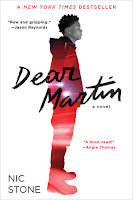
CBR14 Book 9: "Dear Martin" by Nic Stone

Page count: 226 pages
Rating: 4.5 stars

Justyce McAllister is a seventeen-year-old with a bright future, thanks to his grades and being lucky enough to have a mother who has worked herself to the bone to send him to the prestigious prep school in Atlanta. Then one evening, when trying to help his extremely drunken ex-girlfriend get home safely (she's half-black, but looks more like her Norwegian mother than her black dad), he's detained by a very aggressive cop who's convinced he was trying to carjack and abduct the girl. Even after the girl's actual parents show up at the scene to protest, the cop is reluctant to let Justyce go and the scars the episode give him aren't limited to the bruising on his wrists that take weeks to heal. 

Justyce suddenly finds himself becoming a lot more aware of race relations and especially the micro-aggressions that he and his fellow black students at the school (there aren't many) suffer, as well as how cases of police violence against black youths are being presented in the media, not to mention tried in the courts. His best friend Manny has a rich CEO father and lives a life of privilege very different from what Justyce has experienced growing up. Manny has a bunch of white friends and doesn't seem to understand exactly why Justyce suddenly seems to see racism everywhere. The fact that Manny's frequently insensitive friends can hold him up as a black success story to prove that, sure, there's equality now, doesn't exactly help matters. Justyce begins to spend more time with his debate partner, valedictorian S-J (Sarah Jane). She's Jewish, so a lot more used to having to fend off insensitive comments and micro-aggressions than Manny.

Justyce starts a journal, where he tries to model his life more on the teachings on Martin Luther King Jr, by writing letters to the dead preacher. This seems to work for a while, but all thoughts of journalling are gone from Justyce's mind after he and Manny go driving one evening, blasting their music loudly on the speakers, and a deeply unfortunate encounter with an angry off-duty cop ends with Manny dead at the wheel. Even more traumatic than being wrongfully arrested, Justice now needs to process surviving where his best friend didn't. He's gone from reading the headlines to becoming one himself, and the event leaves him shaken and deeply conflicted. 

My fellow English teachers and I taught this book in school along with The Hate U Give, and the two novels feature a lot of the same themes. Novels written by young black women, dealing with gun violence, racism and police brutality, with protagonists who are more or less the token black teens at their schools, with all the challenges that brings. Our tenth-graders could choose if they wanted to read this book, The Hate U Give or both (none of them chose both, unsurprisingly). One of my colleagues prefers this book to Angie Thomas', as she feels that the longer novel deals with too many themes that distract from the central message. As someone who really loved how Thomas wrote about Starr and her family, as well as the journey of personal development Starr had to go through after her friend Khalil is murdered by a cop, I think that novel still has the edge for me. This book is shorter, and doesn't spend as much time on the community and people around Justyce. Both books are excellent, and very important novels for readers interested in the #blacklivesmatter cause and the challenges sadly faced by a lot of young African Americans today.

One benefit for us teachers when using this as part of the curriculum, this novel doesn't have a movie adaptation that the kids can watch and then claim that they've read the book. In the subsequent group talks we had on the topic, it was very clear who had actually read and finished their assigned novels when we spoke about Dear Martin, the ones who hadn't just taken the easy way out and watched the film. Also published in 2017, I don't think Stone's novel has gotten the praise and attention that The Hate U Give did, which is a shame, because both novels are great and this book deserves just as big a readership as Thomas'.

Judging a book by its cover: A relatively simple cover, with a mostly white background and a young, black man in silhouette. I like how you see red lights like police sirens shining through the body of the young man, hinting at the contents of the book.

Crossposted on Cannonball Read. 


Monday, 26 July 2021

#CBR13 Books 22-23: "Eg snakkar om det heile tida" by Camara Lundestad Joof and "Ikkje ver redd sånne som meg" by Sumaya Jirde Ali

Eg snakkar om det heile tida (I talk about it all the time)
Page count: 94 pages
Rating: 5 stars

Official book description:
I call a friend. 
Did the man in the bar call me a black b*tch when I didn't want to give him my number? That time we had arranged to drink beer, but we drank tequila instead?
She goes quiet.
No. He called you the n-word.
Thank you, I say. Thank you for remembering.

I talk about it all the time is a witness statement, an appeal and a personal examination. Camara Lundestad Joof is born in Norway, with a Norwegian mother and Gambian father. This book describes how the racism she constantly experiences infects her everyday life and controls her thoughts. She searches her memories. What if she remembers something incorrectly, how will anyone believe her? How many details do you have to remember to seem credible? Does she believe in herself? And can she ever be free of the question of skin colour?

Ms. Joof is a stage performer and dramatist who works with documentary stage shows and deals with intersectionality, de-colonialism, and the criticism of common societal norms. While she is born and raised in Norway, and her mother is Norwegian, she has faced absolutely staggering acts of racism for much of her life. This short work of non-fiction is a series of short vignettes, some only a paragraph or two long, some covering a few pages, where she gives the reader insight into only a selection of all the 
insults, slurs, prejudice and micro-aggressions she faces on a daily basis.

I read this essay collection as part of my job, as we Norwegian teachers were looking for short and engaging texts in "nynorsk", a written variant of Norwegian that secondary and high school kids here are required to learn. For those students who don't live in one of the geographical areas where the language variant is the majority written language, there tends to be a lot of complaints and grumbling, and getting the pupils motivated to learn and write gets harder with each passing year, as English becomes more and more dominant in society. Nevertheless, the excerpts we used from this collection certainly sparked a lot of discussions, and also gave a lot of our minority background kids a chance to talk about difficult and unpleasant experiences they, friends or family members have faced over the course of their young lives. 

While I was able to borrow this book for free through the school, I bought my own copy, as I was deeply affected by Ms. Joof's words and her understandable anger, sense of despair and just disappointment that despite not ever wanting to, she keeps having to "talk about" new racist and prejudical experiences all the time. While Norway is a wonderful place to live in many ways, we have a long way to go when it comes to dealing with racism.

Ikkje ver redd sånne som meg
 (Don't be afraid of people like me)
Page count: 92 pages
Rating: 3.5 stars

Official book description: 
"It's only now, as a twenty-year-old, that I understand how crushing the 22nd of July was to me. To my identity. I was thirteen years old, and I did not escape the political. I carried it with my entire being"

Sumaya Jirde Ali came to Bodø (in the North of Norway) as a child and was treated like everyone else, she felt that she belonged. In this book she recounts the carefree days of her childhood. She tells about the schock when she heard about the terrorist attack in Oslo on the 22nd of July 2011 and what it did to change her self image and beliefs about belonging. She describes the feelings of shame and self contempt, of becoming dehumanised, and the need to belong. We also get insights into what she does to counteract hate, keep her spirits up and stand up for what she believes. 

I read this back in April (yup, that's how far behind I am on my reviews right now) and it feels very strange to review only a few days after the tenth anniversary of the terrible tragedy that features so prominently in this little book. As a teenager, Ms. Ali, whether she wanted to or not, was forced to face up to the knowledge that Anders Bering Breivik, the white supremacist who ended up killing a total of 77 (8 with a bomb in the centre of the Oslo government district, 69 at Utøya, a small island where the Labour Party Youth Association were having their annual summer camp) did it because he believed it was wrong for Norway to accept immigrants like her and others like her. While this horrific terrorist attack was so shocking and devastating to the Norwegian public, this book highlights how much worse it must have been for people with an immigrant background. Ms. Ali came to Norway as a young child, her family were refugees, she didn't ask to move here. However, after the events in July 2011, despite a relatively idyllic childhood in the North of Norway, she very much did not want to stay here. She had terrible guilt, just because of her immigrant status and the colour of her skin. 
 
As someone not directly affected by the terrorist attack, it's staggering to me how many people had their lives irrevocably changed by it, and still deal with the aftermath. Ms. Ali eventually accepted that her family were not going to listen to her pleas about moving back to Somalia, and got involved in public debates and tried to make a difference with her life - which sadly has led to her facing a lot of harassment in public and online. Like Ms. Joof, she's had to have police protection on occasion, and she admits to now having several mental health issues, anxiety among them, because of all the verbal persecution she has faced. 

Both of these books are short essay collections as part of a series called Norsk Røyndom, which translates as Norwegian secrets. The series asked a number of prominent members of society from a number of minority and discriminated groups to write and tell their stories. As well as these books about racism and racial harassment, there are books covering disability, LGBT+ issues, religion in modern society and other kinds of otherness in Norway today. It's a very informative and interesting project and I suspect I will seek out more after seeing the high quality of these two books. 

Crossposted on Cannonball Read. 

Thursday, 20 May 2021

#CBR13 Book 15: "The Devil Comes Courting" by Courtney Milan

Page count: 416 pages
Rating: 5 stars

Disclaimer! This was an ARC granted to me by the author, which has in no way influenced my review. I had also pre-ordered the books many months ago, because Courtney Milan is an auto-buy for me, every time.

Amelia Smith is a Chinese woman raised by English missionaries in China. When she was just a little girl, her birth mother, a woman fleeing during one of the many conflicts in the country, asked Mrs. Acheson, the woman who Amelia has thought of as her mother ever since, to help her child and take care of her. Amelia has faint memories of her birth mother asking her to wait for her, promising to return, but it's been nearly two decades and Amelia has long since given up hope. In her mid-twenties, she has already been widowed once, after a marriage to a much older missionary who worked in India. Now it looks like marriage to another missionary is imminent, although she hasn't actually met the man himself, only his prim and officious mother. Amelia didn't particularly enjoy marriage, and isn't exactly happy about the thought of another one to a complete stranger. So she fairly jumps at the chance at a different fate when an unusual job offer is presented to her.

The alternative fate in question comes thanks to Captain Grayson Hunter, an African American man in Asia to lay cables for an overseas telegraph line. He's told by Amelia's brother that Amelia has a brilliant mind and criminally underestimated potential, so comes to the town where she lives to find her. He doesn't actually know the person he's looking for is a woman at first but doesn't let his initial attraction to Amelia get in the way of his business plans. He finds her beautiful and enthralling, but what he desires most is her mind and the possibility that she may be able to find a way to encode Chinese characters for his telegraph network, a feat no one has yet to achieve. Grayson is used to burying his true emotions and pushing on to make his business plans become a reality, not just in matters of romance and sexual attraction, but also with regards to the serious losses he has suffered so far in his life. A relationship between him and the intriguing Mrs. Smith would be impossible, so he tries his best to ignore their obvious mutual attraction and chemistry. 

The Devil Comes Courting is the third full novel in The Worth Saga, published a full three years after the second novel in the series, After the Wedding. The Worth family, who we first meet in Once Upon a Marquess are mostly side-lined in this story, which focuses on Captain Grayson Hunter, brother of the hero in After the Wedding, and his ambitious plans to establish a world-spanning telegraph network. Unfortunately, most of the people he laid the initial plans with, including two of his brothers, are now dead and Grayson suffers terribly from survivor's guilt. We do have a member of the Worth family as a secondary character in the story - young Benedict Worth is now seventeen years old, and has left his home in England, where he was always miserable (your noble father and brother being convicted of treason will make life a lot less fun). He is now working for Captain Hunter under the pretense of looking for his sister Theresa, who ran off to Asia many years ago in search of their previously unheard-of half-sister. He doesn't feel like he can return to Europe until he has exhausted his search, so he diligently looks (but not too hard) for his sister in every port they come to. Captain Hunter assigns him to be Mrs. Smith's liaison in Shanghai and the two strike up a close friendship.

In her afterword, Ms. Milan says that this is the novel she structured her entire series to centre around. That probably explains why neither Once Upon a Marquess nor After the Wedding, the two first books in the series, felt entirely up to her gold standard of historical romance writing. However, I would gladly take ten slightly underwhelming (but still good) romances if the result I get is this masterpiece of a novel. Apparently, it's her longest novel yet, clocking in at over 400 pages. It doesn't feel long at all, the pages just fly by and both Amelia and Grayson are such amazing protagonists to spend time with, so you don't even mind (too much) that for much of the story they are separated and often on the other side of the world from one another. Grayson spends a lot of his time on ships, getting telegraphic cable pulled across the ocean floor. Amelia is stuck in Shanghai, trying to puzzle out a way to encode Chinese for the telegraph, since Grayson's dream is that the telegraph should make communication available for everyone, both in the interior of China and around the world. 

One of the obstacles in the way of their telegraphic empire is, in fact, to convince Chinese officials to allow telegraph lines within China, not exactly an easy task when the Chinese (pretty rightfully, in many cases) saw foreigners as barbarians and had two European-caused wars in their recent past to make the animosity towards outsiders even greater. Luckily, both Amelia and Grayson are brilliant and driven and work diligently both together and apart to achieve their goals, which means they have both professional and personal triumphs to celebrate by the end of the book.

There are so many issues covered in this book, so much interesting and unusual history explored and I'm not going to lie, I cried several times, both sad and happy, moved tears. Amelia and Grayson are impossible not to love, both separate and together, and they've both been through a lot throughout their lives. Amelia, already separated from her birth family and believing them to be lost forever, comes to realise several difficult truths about her new adopted family that forces her to reassess entirely who she believed herself to be and what she's going to do with her life going forward. Grayson, as I mentioned earlier, suffers terribly from survivor's guilt and believes that his surviving family, especially his mother, only sees his dead brothers and laments their deaths whenever he's around. So he ignores his family's frequent requests that he visit them in the States and spends most of his time away, laying telegraph cables. He believes he may finally find some peace and satisfaction if he finishes what he and his dead brothers started, and is prepared to go without close personal relationships or affection until that dream is achieved.

Courtney Milan is my favourite historical romance writer currently working. Every time she releases a new book, it's a treat, and this book just blew me away with how good it was. It almost rivals my absolutely favourite of her books, The Suffragette Scandal. Once I reread it, who knows, it may even overtake it? I'm only sorry that my hectic personal life and struggles with depression and executive dysfunction mean it has taken me so long to review the book. This should be read by absolutely everyone - you don't even need to have read anything by Milan before, it works marvelously on its own. This will clearly be in my top 10 at the end of the year. 

Judging a book by its cover: While I'm really not a fan of the continued tradition of "find a stock image of a woman in a wedding dress and then colour it in with any colour required to make a period-style dress, sort of" on these covers, at least this one is better than whatever was going on with After the Wedding, which might be the worst cover on any Courtney Milan novel ever. There's also the fact that Asian protagonists feature front and centre on romance covers, so yay for that, no matter how anachronistic the dress she's wearing is. 

Crossposted on Cannonball Read

Saturday, 6 June 2020

#CBR12 Book 25: "Queenie" by Candace Carty-Williams

Page count: 336 pages
Audio book length: 9 hrs 45 mins
Rating: 4 stars

Official book description:
Queenie Jenkins is a 25-year-old Jamaican British woman living in London, straddling two cultures and slotting neatly into neither. She works at a national newspaper, where she’s constantly forced to compare herself to her white middle-class peers. After a messy break up from her long-term white boyfriend, Queenie seeks comfort in all the wrong places…including several hazardous men who do a good job of occupying brain space and a bad job of affirming self-worth.

As Queenie careens from one questionable decision to another, she finds herself wondering, “What are you doing? Why are you doing it? Who do you want to be?”—all of the questions today’s woman must face in a world trying to answer them for her.

I'm not the first Cannonballer to read Queenie and thanks to the reviews of others, I knew that the only thing this book seemed to have in common with Bridget Jones' Diary is that they are both about young British women with a supportive friend group. I suspect a lot of people who picked up the book based on such a comparison would have been shocked, and quite possibly put off. Poor Queenie is a mess, personally and professionally. Her white boyfriend has broken up with her, but she keeps telling herself that they are just on a temporary break and will be getting back together again after some months apart. From Queenie's own flashbacks to the relationship, not only did her boyfriend's family contain several blatant racists, but they were never a particularly healthy couple and it's probably best in the long run for Queenie to be rid of him.

Not that she realises this, and she deals with being single by pretty much hooking up with and having unprotected sex with increasingly more awful and unsuitable guys (including one who is really violent towards her). She wants to be taken seriously at work and write about serious issues like racism, police brutality and the gentrification of previously immigrant-rich areas, but also comes in late, takes super long lunches, spends a lot of her day on social media and is generally a hot mess. Despite all this, her boss really does seem to want to keep giving her chances. Queenie also has a group of loyal and supportive friends (the chat group is called "the Corgis", which is just super cute) who keep trying to be there for her, even as she keeps spiralling further and further into bad decision territory.

One of the major issues in Queenie's relationship with her unsuitable boyfriend was that she would have nightmares and occasionally freak out when he touched her. It becomes clear the further into the book we get that Queenie's mother also made bad choices with regards to men, and a violent stepfather in Queenie's past has left her deeply traumatised. She's currently estranged from her mother but has grandparents who take her in and try to help her when she can no longer to afford her flat. Several of the nurses at the free clinic that Queenie has to keep visiting because of her impulsive and unprotected hook-ups start showing concern for her and recommend that she see a therapist. It's made very clear that in the Jamaican culture, you don't go talking to strangers about your problems, and it takes Queenie a really long time to convince herself (not to mention her concerned grandparents) that this is a necessary step in her road towards healing and self-improvement.

I finished this book in early March, before the corona pandemic really erupted in the western hemisphere and the world changed completely. Reviewing it now, as multiple cities in America have literally been burning and there are protests all over the world to protest police brutality and to express solidarity with #blacklivesmatter, I wonder what Queenie would think if she were a real character and saw what was happening? Would she feel hopeful? Would she fear that it was only a momentary distraction and soon the world would have moved on, allowing the systemic racism to continue?

For the first two thirds at least, this book is dark and miserable and there are graphic descriptions of emotional and physical abuse and some of Queenie's sexual encounters could probably be classified as rape. She keeps making terrible choices, both personally and professionally and if I'd started this book a month later, in the midst of lock-down with all the worries about corona and my anxiety constantly spiking, I'm genuinely not sure I would have been able to finish the book. It's certainly NOT a light, frothy, comedic romp about a woman just trying to find love. It's a harrowing description of an individual in crisis with a lot of undiagnosed mental issues, and we follow along until she hits rock bottom. If you can get through the difficult parts, I can assure you that the book goes to a much more hopeful and encouraging place once Queenie starts accepting that she needs professional help, and needs to start loving herself and staying away from her terrible life choices.

I'm very glad that I read the book. I really liked the narrator and being fore-warned, I knew I was going to have to get through some unpleasant stuff before Queenie began to work towards a better life for herself. I will say that times are tough and depressing right now, and if you're looking for some light escapism, this is not the book for you. It's an excellent story, but very unpleasant in places.

Judging a book by its cover: I've seen this cover with a bright, almost neon-pink background and this warm orange-red one. In both, you have the same central image, an elaborate hairdo of intricate braids piled on top of a young woman's head. We don't get to see her face, only her hair and an ear with some piercings. I love how it looks as if the title is woven into the braids, like some sort of ornamentation in itself. Queenie is very protective of her hair (and why shouldn't she be?), yet she keeps having to suffer micro-aggressions like people touching it without her permission. So it's a good choice to have the hair featured on the cover of the book.

Crossposted on Cannonball Read.

Monday, 29 July 2019

#CBR11 Book 54: "We Are Never Meeting in Real Life" by Samantha Irby

Page count: 288 pages
Audio book length: 9 hrs 17 mins
Rating: 4 stars

#CBR11 Bingo: The Collection

Official book description:
Sometimes you just have to laugh, even when life is a dumpster fire. With We Are Never Meeting in Real Life., "bitches gotta eat" blogger and comedian Samantha Irby turns the serio-comic essay into an art form. Whether talking about how her difficult childhood has led to a problem in making "adult" budgets, explaining why she should be the new Bachelorette--she's "35-ish, but could easily pass for 60-something"--detailing a disastrous pilgrimage-slash-romantic-vacation to Nashville to scatter her estranged father's ashes, sharing awkward sexual encounters, or dispensing advice on how to navigate friendships with former drinking buddies who are now suburban moms--hang in there for the Costco loot--she's as deft at poking fun at the ghosts of her past self as she is at capturing powerful emotional truths.

Things I knew about Samantha Irby before reading this book:
- Literally NOTHING.

Things I now know about Samantha Irby, having finished her book (in audio, she reads it herself):
- Her narration is not as good as Jenny Lawson's, but she's pretty good at it anyway.
- She's black, queer and describes herself as fat
- She has a number of medical issues that, among other things, make it impossible for her to have children
- Even if she could have children, she wouldn't want them anyway
- She grew up in Chicago and lived there for much of her life
- Her childhood was really quite awful (poverty, abuse, drunken, dead beat dad)
- Scattering her father's ashes on a road trip to Nashville did NOT go as planned
- She doesn't know how to make a budget and often spends money irresponsibly
- She worked as a receptionist at an animal hospital for more than 11 years
- She's convinced me that I never want to be the receptionist at an animal hospital
- She's bisexual, and has been in serious relationships with both men and women
- She (as of the writing of this book) now seems to live somewhere rural with her wife and said wife's children from a previous relationship
- She's very funny, and seems to not give many f*cks about anything much at all
- I should probably check out some more of her stuff.

If I knew nothing about Samantha Irby, why did I decide to read this book? This year, despite seeming to struggle to read even half as much as in previous years, I am taking part in a large number of reading challenges (I may have a serious reading challenge addiction), including the "Diversify Your Reading" challenge, where each month is dedicated to a specific genre. This month, it's humour, and since I had seen this book recommended by several Cannonballers in the past, and Jenny Lawson also speaks highly of it, it seemed like a good choice. That it also fits into the "Collection" square for Bingo is an additional bonus.

I like a good, clever internet blogger and anyone who appeals to a number of Cannonballers and the amazing Ms. Lawson is probably worth some more of my time. This was a fun, quick read and can be recommended to others who are looking for a non-fiction collection for the Bingo.

Judging a book by its cover: The book has an eye-catching bright yellow background and a scruffy-looking kitten that seems to be complaining about something. I'm assuming this is supposed to be Helen Keller, Samantha Irby's mean and dysfunctional cat, who she talks about at some length in the book. Bright colours and a cute animal is more than enough to get a person to pick up a book, so it's not a bad choice.

Crossposted on Cannonball Read.

Monday, 4 March 2019

#CBR11 Book 6: "Born a Crime: Stories of a South African Childhood" by Trevor Noah

Page count: 304 pages
Audio book length: 8 hrs 44 mins
Rating: 4 stars

In this very engaging autobiography, Trevor Noah opens up about growing up in South Africa, born from a black Xhosa mother and a white Swiss father at a time when this was literally a crime punishable with several years in prison. The Apartheid regime ended while Noah was still young, but his childhood was still deeply affected by the fact that he was a mixed race child in a society where the races were not supposed to mix at all, to the point where his mother had to walk behind her own child and a mixed race woman when they were out in public, so no one would guess at their family relationships.

Noah's parents obviously were never married (as this was completely out of the question), but he has several stories of his mother's eventual marriage to his alcoholic, violent stepfather, and the dramatic and truly astounding consequences this eventually had for his family. One of the impressions I came away with is just what a formidable lady Noah's mother was (and probably still is), and what an unusual upbringing he had as a result of his mixed race parentage. As well as sharing a lot of childhood recollections that could have been merely depressing and sad if recounted in a different, less humorous light, Noah gives his reader/listener a lot of interesting facts about the colonisation of South Africa, the Apartheid period and huge changes the country went through once the racist system of segregation was dissolved.

I didn't really have a lot of prior knowledge or experience with Trevor Noah, having not really watched The Daily Show much after he took over after Jon Stewart. I'd seen him in a lot of clips on the internet, naturally, but got this audio book mainly because of several glowing recommendations from various people I know on the internet. I didn't really know what to expect, but have enjoyed a lot of celebrity autobiographies in the past without a lot of foreknowledge of the people in question, and figured this would fall in the same category. I did not really expect for the book to be as educational as it turned out to be. Noah is five years younger than I, which means that all the things he talks about happened within my lifetime. Reading is so incredibly important to help us learn about different places and times and to learn to empathise with people who have different experiences from our own. Noah's childhood stories took place within my lifetime, but on the other side of the world, and it's amazing what a difference that can make.

I'm so glad I used one of my Audible credits on this book. I can recommend it highly, even if you don't think that the life story of a sometimes glib talk show host is something that might interest you.

Judging a book by its cover: Making the cover look like a wall mural on the wall in South Africa is a nice touch. I like the cracked concrete wall and the rather informal pose of Noah's portrait, as well as the African woman in the foreground, looking directly at his face.

Crossposted on Cannonball Read.

Saturday, 26 January 2019

#CBR11 Book 2: "Becoming" by Michelle Obama

Page count: 480 pages
Audio book length: 19 hrs 3 mins
Rating: 4 stars

During the eight years of Barack Obama's presidency, it became clear to me that Michelle Obama was a statuesque and beautiful woman, who was also clearly intelligent, caring and wanting to make a difference alongside her husband. Being part of the first African American Presidential couple in the White House and basically raising her young daughters more or less in the public eye cannot have been easy. Nevertheless, I didn't know all that much about Michelle Obama, which was why this autobiography was so interesting to me.

The book is divided into three sections - the first covers Michelle's childhood and early life, growing up in Chicago. The second section covers her life with Barack Obama from they met until he became president of the Unites States, and the third is all about their life in the White House. To me, the first two thirds of the book were absolutely the most fascinating. Of course hearing stories about being the First Lady, trying to get used to the Secret Service, travelling the world and meeting heads of state and famous people was interesting, the more compelling narrative to me was what made Michelle Obama the formidable woman she is.

Some of the things revealed in this memoir was probably more well known to an American audience. But to a Norwegian, who frequently tries to avoid too much current event news and especially politics (because even before 2016, it was pretty damn depressing), much of the things I learned in this book were new to me. I knew Michelle was from Chicago, but nothing much about her family background. I knew both she and Barack had legal training, but not that Michelle never really enjoyed the profession and how much more suited she was to different work. I knew very little about their life together before they became known on the world stage. It was a revelation to me that her two little girls are both the product of IVF. I suspect I will always feel kinship with women all over the world who, like me, have gone through fertility problems, and it made me feel a bit closer to this very impressive and accomplished woman.

I didn't realise just how against her husband's political career Michelle actually was, as she always seemed like such a supportive and enthusiastic spouse.  I can't really blame her for not wanting to share her husband with first a large constituency and then the entirety of the United States. Staying optimistic, idealistic and brave in the face of so much harassment and abuse online, both during her husband's campaigns and his time in office. She states outright towards the end of the book that she has no intention of EVER running for any kind of political office, and who can blame her? I think the Obamas have already sacrificed more than enough, thank you very much.

The final third of the book was also difficult to listen to in today's political climate, because the Obamas worked so hard, weathered so much criticism and abuse, because they genuinely wanted to make the United States a better place to live for as many people as possible. And since the election in 2016, that horrible orange toddler currently in the White House, not to mention the spineless, selfish, elitist supervillains in the GOP have done whatever they can to not just undo pretty much everything the Obamas accomplished, but they've made things much worse than before Obama even ran for President. Election night in 2016 was devastating to so many, but I can't even imagine how the Obamas must have felt. Michelle covers it briefly in the book, but doesn't go too deeply into it, exactly because you can tell that it's a very difficult subject for her, and also, because she's classy and still manages to go high when the temptation for mere mortals would be to go low.

If I recall correctly, even though it came out in late 2018, Becoming ended up being one of the best selling books of the year, not just in the USA, but ending up topping the bestseller lists in a lot of other countries world wide as well. I'm not entirely sure what Michelle Obama and her husband are doing with themselves these days (going to guess Michelle is going on a pretty extensive book tour, at least), but I hope they are relaxing and enjoying themselves, still trying to make the world a better place, on a quieter and smaller scale.

Judging a book by its cover: Michelle Obama is a beautiful woman. She looks happy and relaxed in the cover photo for her book. I like the font she's chosen for the title and that there's not too much going on here. The book doesn't need it.

Crossposted on Cannonball Read.

Wednesday, 21 November 2018

#CBR10 Book 99: "Tante Ulrikkes vei" by Zeshan Shakar

Page count: 432 pages
Rating: 4 stars

#CBR10Bingo: Home, Something, Home (this book is set at Stovner in Oslo, three stops away from where I live on the metro. It also concerns exactly the sort of pupils that I teach.)

Two youths, both living in the same tower block in a suburb on the east side of Oslo, in Stovner (where the large majority of inhabitants are immigrants or the children of immigrants). They start out going to the same high school. Starting in the year 2000, the framing device consists of these two teenagers, later young men, being asked to take part in a social studies survey, to map out the formative conditions for children and teens in these eastern suburbs, where the social divide between the white inhabitants of Norwegian descent and the poorer residents (mostly from minority language backgrounds, either first or second generation immigrants from the Middle East, South Asia and/or African countries) keeps getting bigger and more pronounced.

Mohammed ("It is tradition to name the first born Mohammed, and the Prophet is revered by all Muslims, but really, if they are so concerned with me going out and getting a good job and everything, I'm not entirely sure why they would give me that name"), who goes by Mo, writes his answers to the survey as e-mails. He is articulate, intelligent, rather shy and does very well in school. His parents have extremely high expectations of him, and early on, at least, they seem well on course to being fulfilled. Mo does well enough at high school that he wins a special scholarship, established for academically gifted children of immigrants, enabling him to go to University. He even gets to shake the prime minister's hand during the scholarship ceremony.

Our second protagonist, Jamal, doesn't really like to write, so he records his answers on tapes that are sent to the researcher in pre-paid envelopes. His answers are informal, irreverent, full of vernacular slang - a sociolect. His father is out of the picture, after a history of domestic violence. There's just him, his increasingly depressed and ineffectual mother and his much younger little brother, whom Jamal has to step up and help raise. He has to take him to nursery every day and pick him up in the afternoons. He does most of the shopping, and even occasionally attends meetings at the nursery, and later his little brother's school, because his mother isn't really up to the job. While he complains in his reports, he doesn't do it too loudly and swears the researcher to secrecy - no one wants the state to come and take his brother away from the family. After years of struggling through primary and secondary school and getting nowhere, only to find things harder and even more frustrating in high school, one day he has enough and just quits. He gets a job washing cars at a local garage, and is initially, at least, happy to be earning money.

The book follows these two young men over a period of about six years. We see how they view the world, and how they feel about the attitudes towards immigrants prevalent in society. We learn about their hopes, their dreams, their fears and how they feel about their families. Mo studies statistics and economics at the University of Oslo and loves it (at least to begin with). Jamal works at the car wash, gets stoned with his friends, listens to rap music and wants to be a gangster. At the same time, however, he's doing his best to make sure his little brother is fed and that the staff at nursery and later, school, doesn't report that the boy has problems speaking and occasionally wets himself when he's nervous. Jamal gets frustrated at his mother's refusal to be a proper parent.

In addition to winning a prestigious literary award for debutant writers, Tante Ulrikkes vei (the address of the tower block that both the protagonists live in) has sold a phenomenal amount of copies in Norway. A crowd funding effort has ensured that every member of Parliament receives their own copy (which is good, because far too many politicians have no idea what the day to day life of some of the poorer kids in the "wrong part of town" is actually like). It has garnered rave reviews in pretty much everywhere, and once I started reading, I could easily see why. Not only is it a very engaging and well-written book, it's so incredibly important, because the politicians in Parliament are not the only ones who could use an insight in what growing up as the child of immigrants, especially in a both socially and economically disadvantaged families.

Mo's family are not exactly poor, but various circumstances mean they need to rely on support from the government to get by. Tuition fees at Norwegian colleges and universities are less than what it costs to buy a 30-day travel ticket on Oslo public transport, but the scholarship Mo receives allows him to focus entirely on his studies, without needing to work part-time on the side (something he initially suggests doing, but his father is vehemently against. Nothing should take the focus away from his studies, the rest of the family will get by with less, if it means making sure Mo has what he needs at Uni.

Jamal's family, on the other hand, sometimes barely have the money to pay rent and/or get groceries. While he's still in high school, he gets a small stipend to help him, but once he drops out, Jamal has to get a job to help supplement his mother's increasingly meagre benefits. Due to the stigma surrounding mental illness and the fear of child protective services, Jamal and his mother work very hard to hide just how dismal the family's home life actually is, and due to the very poor communication between school, social services and others who could get clued in and intervene (probably making the lives of both Jamal and his brother much better), nothing really changes. For a brief while, Jamal is promised help from a discretionary fund at the local mosque, but after some negative press articles, the mosque loses its additional funding, and it all comes to naught.

Both youths struggle with their families' and society's expectations of them. They are children of immigrants, growing up in Norway, bombarded with two very different and often disparate cultures. Representation is hugely important in fiction, and the two protagonists in this novel could not feel more real to me. In my ten years as a teacher in the Oslo educational system, teaching kids mainly from the east side of the city, I have met several examples of both of these boys. I have seen these kids graduate our secondary school several times.

Some are academically gifted and do well, fulfilling their families' hopes and expectations. Some are gifted and can't take the pressure, dropping out and struggling. Some are like Jamal, functionally illiterate, abrasive, taught to feel inferior and like losers from an early age, because they cannot keep up with the increasingly harder demands both of what they're to learn and how they're to behave in school. They are naturally fed up, and many (especially the boys) drop out of school. Yet others, who get sufficient support, either at school or from other places, manage to find the motivation and eventually mature enough to apply themselves, and end up doing well. I'm never happier than when I meet a former student of mine, often the ones who were very challenging and seen as "trouble", very much like Jamal in this book, and can catch up with them about how they are doing - which tends to be very well indeed.

As of yet, this book is not available in English, but I've read several articles telling me that it will be. There will be an area (or areas) like Stovner, and kids like Mo and Jamal in most cities in most countries around the world. While this book is set in Oslo, the themes it covers are universal.

Judging a book by its cover: The cover is a sort of a pinkish beige, almost the colour of a pale brick. It's very simplistic, with a cover drawing that looks pretty much like something a child would draw if asked what their house looked like. We see a tower block and a small swing set. The rest is blank, except for the title of the novel, which is printed on what looks to be a street sign. This is a novel that has sold on word of mouth, not exactly because of the flashy cover design.

Crossposted on Cannonball Read.

Tuesday, 30 October 2018

#CBR10 Book 92: "The Hate U Give" by Angie Thomas

Page count: 438 pages
Rating: 5 stars

#CBR10Bingo: Fahrenheit 451 (one of the ten most banned or challenged books in 2017)

Starr feels like she's living two lives, and in a way she is. She goes to a prestigious private school along with her siblings, where they are among the only black students. She has a white boyfriend, who calls her "Fresh Princess", thinking she's a bit like Will Smith in The Fresh Prince of Bel Air. She lives in a poor and rough neighbourhood, where drug dealing and gun violence isn't unusual. Her black friends wonder if she thinks she's too good for them. Starr's father spent much of her early childhood in prison, now he runs the local grocery store and admonishes his kids to stay out of trouble.

Starr genuinely tries, but her life is irrevocably changed when she rides home with her old friend Khalil from a party, and they are pulled over by a cop. Khalil is unarmed, but shot by the police officer, right in front of Starr. The cop keeps his gun aimed at the hysterical girl until reinforcements arrive. Starr's uncle is a cop, but now she has trouble trusting anyone in uniform. She has nightmares and is worried about the attention the incident is getting. The media is portraying Khalil as a thug, drug dealer and a gangbanger. The white cop claims he saw Khalil reaching for something, and that he feared for his life. The local community are protesting, and demanding justice for Khalil. Starr is the only witness. She wants to stay anonymous, but she also wants the cop who shot her friend to face consequences.

I got this book shortly after it came out in 2017, and kept hearing amazing things about it. However, I also knew that it was not going to be an easy read, and while I was pregnant last year, it was difficult or downright impossible for me to read anything that was too challenging, so the book remained on my TBR list. During Banned Books week this year seemed like the perfect time to finally read it, especially with the movie version just around the corner (I know it's in cinemas now, but it wasn't yet when I actually read the book).

Not going to lie. This book made me cry, quite a lot. It was a very heavy book to read emotionally, because while it's fiction, the events depicted in this novel are so true to what is happening far too often in America right now. As a close to middle aged white women from a privileged background in a country where the police mostly don't even go armed, Starr's reality is about as far from my life as it's possible to get. I do read the news, though (even though the impulse to bury my head in the sand and put my hands over my ears, humming loudly to block out all sound is strong and growing stronger daily). This is a hugely important book and I'm so glad it exists and is being read and enjoyed as widely as it is.

I'm not the first person to review this book, and I won't be the last. I'm amazed that this is Angie Thomas' debut novel - it's such a powerful and affecting read, with such vivid and interesting characters and such a way to bring the reader along with the events of the story. I loved how with really only one exception (King), no one is really irredeemably bad, they're just victims of circumstance and there are complexities around who they are and why they act the way they do.

I have no doubt that I will watch the movie, and if it's even half as good as the book it's based on, I suspect I will be using the film as a teaching tool in years to come. I don't think I'm going to watch it in the cinema, though, as I suspect I will make a complete spectacle of myself, crying so hard. The trailer was difficult enough to watch. I cannot imagine this book won't in my top ten at the end of the year - everyone should read it.

Judging a book by its cover: I have the UK paperback of this book, the cover of which is probably not as well known as the American original. I still think the simplicity of it works really well. A determined-looking, young black woman in profile, the white title font in stark contrast to the mostly dark rest of the cover. It's not fancy, because it doesn't need to be. This book probably sells itself by now.

Crossposted on Cannonball Read

Monday, 4 July 2016

#CBR8 Book 70: "American Born Chinese" by Gene Luen Yang

Page count: 240 pages
Rating: 4 stars

This book alternates between three different story lines. The first, by far my favourite, is about the Monkey King, who teaches himself all the different branches of Kung Fu until he is not only invulnerable and immortal, but also able to fly, make himself huge, shrink down or shapeshift. He wants to become greater than Tze Yo Tzuh, the God of all the gods, and is instead buried under a mountain for five hundred years because he is too stubborn to change his mind.

The second story is about Jin Wang, who moves from San Fransisco to a neighbourhood with barely any Asians, and is ostracised and bullied as a result. He so desperately wants to fit in, even more so when he falls for one of the American girls in school. His only friend is a kid from Taiwan, Wei-Chen, a geeky boy who also struggles to fit in and has to wrestle with speaking correct English on top of everything else.

The third story seems to be a racist sit-com, complete with awful laugh track, about Danny, recently accepted onto the varsity basketball team. He's quite well-liked and popular at school, but then his cousin Chin-Kee, the worst Chinese stereotype character you can possibly imagine, comes to visit and proceeds to make him more and more embarrassed and freaked out.

The three separate and seemingly unconnected storylines eventually converge into one, and the theme of the whole book seems to be acceptance of one's true self, even in the face of adversity. All three characters dealt with feel alienated or different in their society and fight to change this through various means. I absolutely loved the Chinese mythology bits, and learning more about the Monkey King and his journey towards spiritual peace and acceptance. When I was a student, several of my friends would love to stay up late, watching episodes of Monkey (I only barely remember snippets), but as I kept reading, it became obvious that the mythology behind both was the same.

Having only ever read Boxers and Saints by this author (which was very good, but oh so depressing), I really wasn't sure what to expect. I get what he was trying to do with the Chin-Kee parts, but the super racist stereotype of a Chinese character still made me deeply uncomfortable and I therefore really didn't like those bits too much. Jin Wang was a bit of an idiot on occasion, but as someone who works with teenagers, I know all too well that that is a universal trait, no matter the background of the teen in question. All teenagers are idiots, and being a teenager pretty much always sucks. The hoops they will jump through and the ordeals they will put themselves through to fit in, it astounds me. I'm glad Jin Wang eventually started to see that he would be happier if he accepted his true self, even if he had to have a mythological visitation to do so.

I think I would have been happiest if this entire book was just an illustrated story of the Monkey King and continued with his Journey to the West, without any modern age teenagers or horrible stereotypes at all. The art is absolutely amazing throughout, so expressive.

Judging a book by its cover: The cover is almost all yellow, with line drawings of mountains, clouds and the mountain the Monkey King is buried under in the background. The Monkey King, naturally, looks quite annoyed. On the left-hand side, you see half of little Jin Wang's face in the foreground, clutching one of his beloved robot toys (when he is asked what he wants to be when he grows up, he responds "a Transformer"). Jin Wang and the robot are in colours, otherwise the whole thing is yellow. The back cover has the other half of Jin Wang and his robot and up in the left hand corner, there is a small TV screen with picture of Chin Kee grinning. I like the cover, which captures a lot of the graphic novel in three simple images.

Crossposted on Cannonball Read.