Showing posts with label Terry Pratchett. Show all posts

Thursday, 5 October 2023

CBR15 Book 47: "Jingo" by Terry Pratchett

Page count: 414 pages
Rating: 4.5 stars

CBR15 Bingo: Politics (the word is used 18 times over the course of the novel)

Official book description:
It isn't much of an island that rises up one moonless night from the depths of the Circle Sea -- just a few square miles of silt and some old ruins. Unfortunately, the historically disputed lump of land called Leshp is once again floating directly between Ankh-Morpork and the city of Al-Khali on the coast of Klatch -- which is spark enough to ignite that glorious international pastime called "war." Pressed into patriotic service, Commander Sam Vimes thinks he should be leading his loyal watchmen, female watch-dwarf, and lady werewolf into battle against local malefactors rather than against uncomfortably well-armed strangers in the Klatchian desert. But war is, after all, simply the greatest of all crimes -- and it's Sir Samuel's sworn duty to seek out criminal masterminds wherever they may be hiding...and lock them away before they can do any real damage. Even the ones on his own side.

Terry Pratchett was a genius. I don't really think that many people who know about his long career, even people who have never even read his books, would dispute that. What started out as tongue-in-cheek parodies of classical fantasy tropes in the early Discworld novels soon became something more and deeper and much more clever than anyone had expected it to be. In total (when including his middle grade books The Amazing Maurice and his Educated Rodents and the Tiffany Aching books), there are 41 Discworld novels. There's also a number of spin-off books, like The Science of Discworld, The Folklore of Discworld, cook books, diaries, you name it. 

In the latter half of the series (this book is nr 21 of 41), a lot of the already well-written and entertaining books start to become somewhat sharper and more satirical. Pratchett used his incredibly popular authorial voice to highlight and criticise a lot of modern society, and in this book, the thing he is both angry about and wants to highlight is the absolute absurdity of most international conflicts and wars breaking out at the drop of a hat, usually because the other people (who are different from us and foreign and suspect and threatening) have in their possession that our country wants, or vice versa. 

In this book, Commander Sam Vimes of the Ankh-Morpork City Watch is trying to solve a murder and prevent an international crisis, and subsequent war with Klatch (think any Middle Eastern country or culture you can imagine). Suddenly, all the Klatchians who have been living and working hard in the city are seen as suspect and threatening and a fervour of patriotism is rising among the nobility. War seems to be right around the corner, and it seems like it would be good to ease the tensions between the two nations before actual fighting breaks out.

The City Watch novels are the subsection of Discworld novels that on the surface read as police procedurals. Even this book, that covers geo-political conflict, has a murder mystery at its core. With each subsequent Watch book, Samuel Vimes reluctantly seems to rise in social status, and he also seems to be getting angrier, with good reason. The further up in society he rises, the more he finds to be absolutely furious about. 

I enjoyed the other two Watch novels I re-read recently, but Jingo is a step up, in general. The only reason I'm not giving it a full five stars is because I know there are later books in the series that are even better, and I have to save the top rating for them. This is absolutely not the best book in the series to start with, but once you're more familiar with Pratchett and the Discworld, it's one of the books that shouldn't be missed. 

Judging a book by its cover: The Josh Kirby covers are always quite busy, with a lot of details. I like the shades of green on this one. 

Crossposted on Cannonball Read.

Tuesday, 26 September 2023

CRB15 Book 45-46: "Men at Arms" and "Feet of Clay" by Terry Pratchett

CBR15 Bingo: Nostalgia

Total page count: 733 pages
Rating both books: 4 stars

In Men at Arms, there's a series of mysterious deaths in Ankh-Morpork, and the Patrician, Lord Vetinari, strictly forbids Sam Vimes, the head of the City Watch to investigate, thus ensuring that he will do the exact opposite. Vimes, Carrot, Nobbs and Colon, who used to be the whole of the Watch have been joined by new recruits to diversify the Watch, Cuddy (a dwarf), Detritus (a troll) and Angua (a werewolf, although Carrot believes it to be because she's a woman). As the ragtag group of individuals learn to work together (trolls and dwarfs are sworn enemies), it turns out that the murder is part of a plot to replace Vetinari with a king, since the plotters have discovered who is the rightful heir. As well as 'disobeying' Vetinari and investigating the string of murders, Vimes is also super stressed about his upcoming wedding to Lady Sybil Vimes, the richest woman in Ankh-Morpork (who insists on being traditional and transferring all of her money and assets to Vimes upon their marriage). 

In Feet of Clay, Sir Samuel Vimes, Commander of the ever-growing City Watch (he was both promoted and knighted at the end of the previous book) and his various underlings have to figure out why a museum curator and a priest have been murdered, and why shortly after, a dozen golems, working at various factories around the city very dramatically and publically kill themselves. To add to the complications, someone is clearly trying to assassinate Lord Vetinary, and he keeps getting worse no matter what safety precautions an increasingly more frantic Vimes puts in place. 

Obviously, in each of the books, the rather complicated central mysteries are eventually sold, and at the end of each book, poor Samuel Vimes seems to end up promoted into an even higher social sphere as a reward for his loyal service. The Watch keeps expanding, in Feet of Clay, Cheery Littlebottom, a dwarf from Uberwald (think the location of every Hammer horror movie ever) joins the team as a forensic expert and comes to several conclusions about their identity over the course of the book.

A perusal of my blog shows that back in 2010 I read and reviewed quite a few Pratchett novels. I also reviewed my re-read of Soul Music in 2015 and my revisit of Guards Guards in 2021. The meticulous records of my reading history (a lined notebook where I've written down everything I've read since back in 2007 - it'll survive even if technology fails!) show that while Pratchett is an incredibly important writer to me and his books have brought me so much joy over the years, I haven't really re-read many of his books in the last 10-15 years. My husband and my BFF Lydia have both warned me not to read Raising Steam (his penultimate Discworld novel and the book where it's the most clear that Alzheimers had stolen away too much of his brain) and although we have a lovely hardback copy of it on our bookshelf, I still am not emotionally ready enough to read The Shepard's Crown - his very last novel before he died. Especially not now that I lost my mother this winter. If I read his final book, it becomes irrevocable that he's gone. 

Re-reading these books is absolutely nostalgic for me. I read a lot of them during my student years in St. Andrews in Scotland back in the late 1990s-early 2000s and because Pratchett has always been one of my husband's favourite authors, we had a lot of enjoyment reading the books together in the early years of our relationship. The great thing about Pratchett is how versatile he was as an author. He didn't just write police procedural novels with a fantastical twist like he does with the City Watch novels. Because his creativity and cleverness were so vast, he was able to write very funny, but also sharp, insightful, and frequently satirical books and make a lot of astute observations while doing so. Not to mention his mastery of language. There are so many puns - so many amazing turns of phrase. There really was no one entirely like him. 

Judging the books by their covers: My Pratchett novels are the original paperback editions with cover art by Josh Kirby. I know they've been redesigned several times since. While I don't always agree with the way the various characters get depicted on the covers, it's always fun to see plot elements hinted at on each of the covers. 

Crossposted on Cannonball Read


Friday, 26 February 2021

#CBR13 Book 8: "Guards! Guards!" by Terry Pratchett

Page count: 412 pages
Audio book length: 10 hrs 8 mins
Rating: 5 stars

The Night Watch of the sprawling city of Ankh-Morpork consists of only three people (although people might question if Nobby Nobbs is entirely human) led by the depressed and shambolic Captain Samuel Vimes. No one is more surprised than he when he finds out that they have a new recruit from the mountains who actually volunteed for the Watch. No one ever does that. The fact that young Carrot Ironfunderson claims to be a dwarf, even though he's 6 foot 2 and seems to keep misunderstanding how the city is run is something Vimes really doesn't really have time to worry about. He's busy either getting drunk or recovering from a hangover. 

Then, a series of mysterious incidents around the city leave people entirely vaporised, with wall tiles melted from high heat. Now everyone knows there's no such thing as actual dragons, that they disappeared a very long time ago, but it sure looks like there may be a dragon terrorising innocent (and not so innocent city dwellers). The city's patrician is very clear that the Watch leave the situation alone, no need to investigate and cause critical questions to be asked. One of the reasons why Vimes is the drunken leader of a sad bad of unwanteds, however, is that he doesn't really like to conform to what people expect of him. He enlists the help of Lady Sybil Ramkin, who knows everything there is about the only dragons that SHOULD exists, tiny swamp dragons. 

Not that anyone, let alone Vimes, is very happy when it turns out that there is in fact a big, dangerous dragon threatening the citizens of Ankh-Morpork. Now normally, these sort of situations seem to require a hero to be revealed to slay the dragon, and win the hand of the daughter of the king, but the Patrician doesn't even have a daughter (only an elderly aunt, who doesn't seem to want to marry anyone) and the ransom offered really isn't very high, so none of the regular heroes feel motivated to show up for the job. It might be up to Vimes and his rag-tag squad to save the city, the unlikeliest heroes of all. 

Reviewing a book I really love is much harder than reviewing one I hated or even one that was just fine. Terry Pratchett's Discworld books have been such an important part of life for the last 25 years or so. Reading my first one was a wholly different experience to any other fantasy novel I'd read before, and after moving to the UK for university, and especially after meeting the man who is now my husband (21 years together this year, baby!), the books became even more special to me, as he grew up with the series and loved them all. 

I knew no one else who read them when I was a teen in Norway. In the UK, Pratchett was a best-selling author every time he released a new novel. He did frequent signing tours (which is why many of my books are signed by him - Pratchett used to say it was rarer to find an unsigned copy of his works since he toured so much. My husband even has Good Omens signed by both Neil Gaiman and Terry Pratchett, not as easy a feat, since Gaiman didn't use to tour places near us very often). 

This was the first time I re-read Guards! Guards! for probably 15 years or so. Of the 40+ Discworld novels (if you include the various YA books he also wrote in the world, which I do), this is book 8, and probably the one where the series goes from being an interesting experiment where Pratchett tries to satirise traditional classic adventure novels and fantasy to something truly genius. From this book onwards, the books pretty much all keep getting better and better and sharper and more observant of human nature, modern society, politics, and generally the world at large, all delivered in the guise of humorous fantasy. Only with the last few books, written after the Alzheimer's really started affecting him, is the quality noticeably lower than in the rest. 

There's a number of entry points into the Discworld books, depending on what takes your fancy the most. There are the Death books, the Witches books, the Rincewind (and later Wizards of the Unseen University) books, there are a number of excellent sort of standalone one, like Pyramids or Small Gods. Later in the series, there are the Moist von Lipwig books, and the wonderful YA Tiffany Aching books. Guards! Guards! is the first of the City Watch books. The fact that this, not even the best of the ones featuring those characters, is a five-star book for me should tell you how amazing some of the later ones are. If you're a Pratchett novice, there are a number of guides online for where you could start (I don't really recommend just reading the series in chronological order, as some of the first ones just aren't that good compared to what came later). If you can't be bothered to look up any guides, however, this is a very good place to start. 

Judging a book by its cover: This book was first published in 1989, so it's obviously had a ton of different covers, depending on what country it was published in or what audience the publishers were trying to attact. Most of my Discworld novels have the original cover designs by Josh Kirby, which I can see might appear a bit chaotic and messy to some, but holds a lot of sentimental value to me. 

Crossposted on Cannonball Read


Sunday, 5 April 2015

#CBR7 Book 32: "Soul Music" by Terry Pratchett

Page count: 378 pages
Rating: 4 stars

Susan Sto Helit goes to a boarding school, and for the lessons she's less interested in, she has a tendency to fade into the woodwork - literally. Susan has the ability to fade away, should she so wish it. Turns out, this is because her grandfather is none other than Death, and when he goes missing, Susan, as his closest relative, is required to take over his duties for a while. Being deeply pragmatic and rational, thanks to her first rate education, it takes Susan a while to be persuaded, even when a tiny rat skeleton with a cloak and a scythe and a talking raven, not to mention the big white horse, shows up on her doorstep.

While Susan gets reacquainted with the family history her parents tried to keep from her, something new is sweeping through Ankh Morpork - the Music with Rocks in it. The young bard Imp Y Celyn (who looks a bit Elvish) and his band mates, Cliff the troll and Glod the dwarf become unbelievably popular in record time, thanks to the guitar Imp discovered in a mysterious little music shop shortly after he arrived in the capital. The music is something new and different, it has a beat and you can dance to it, and it makes almost everyone who hears it, completely obsessed. This includes many of the esteemed wizards at the Unseen University. Ridcully, the Arch-Chancellor, is curious and unimpressed, and determined to get to the bottom of what is making his faculty and the majority of citizens in the city to behave so strangely.

Soul Music was the very first Discworld novel I ever read. I found it at my local library, which in the mid-90s didn't really have all that many English books and certainly not a great selection of fantasy. The unusual and colourful cover appealed to me and I suspect the blurb on the back made me curious. The book came out in 94, and since I read the trade paperback, I must have discovered Pratchett sometime after 1995, probably before I'd even started high school. It was a completely different reading experience for me. I remember that I kept reading until far later than was sensible on a school night, because the book didn't have chapters, and as such, it was difficult to force myself to put the book down and stop. Soul Music is not one of the truly great Discworld books, but it will always hold a special place in my heart, because it was my first introduction to the writing of Terry Pratchett.

I was still at work, getting everything ready for my lessons the next day, when my husband called to tell me that Terry Pratchett had died. I'm not ashamed to say, I burst into tears. Of course I knew that it would only be a matter of time, as he suffered from Alzheimer's and had always been very open about wanting to choose his own time to die, but it was still a shock. I cried for quite some time before I was able to return to my duties, and kept bursting into tears on and off for days afterwards, every time I read something online about him and the impact his writing made on so many people. It's the strongest I've been affected by the death of a celebrity, someone I never actually knew personally.

I feel lucky and privileged that I got to meet Pratchett at signings, more than once. My husband has a copy of Good Omens, which is signed by both Terry Pratchett and Neil Gaiman, which, considering Gaiman didn't do signings in the UK all that often, makes us cherish the book for more than just being probably the best book they both wrote. Before he got diagnosed with Alzheimer's, Pratchett would pretty much do a UK signing tour every year. He apparently joked once that it was more unusual to find an unsigned copy of his books than one with his signature in it, but I still think the times that I got to see him, and exchange a few words with him were very special. One of the dwarfs in The Truth is called Gunilla, which is my middle name. When I mentioned this to him at a signing, he smiled and said: "Then you probably know what gender that dwarf is."

Pratchett was a wonderful, important writer and in his Discworld books he managed to satirise so many important issues in our society. In some of his books, he is more angry than funny, but until the last few books of his career, when his brain had really started to go, he is a master of language, of plot construction and of wit. His books have made me howl with laughter, and cry buckets. A few of my favourite books of his, are non-Discworld. Good Omens, which I have already mentioned, was co-written with Neil Gaiman and is an amazing take on the apocalypse. Nation is a YA novel that looks at identity, belief, prejudice and cross-cultural understanding. While he may have been writing in the comedic fantasy genre, that doesn't mean that he didn't have very profound things to say. We are lucky that he was a very prolific writer, so there is a great literary legacy remaining now that he's gone. RIP Terry Pratchett.

Crossposted on Cannonball Read.

Sunday, 6 November 2011

CBR3 Book 84: "Snuff" by Terry Pratchett (Read-a-thon 2011)

Publisher: Harper
Page count: 416 pages
Rating: 3.5 stars
Date begun: October 22nd, 2011
Date finished: October 22nd, 2011

Sam Vimes has been dragged away from the job he loves as the Commander of the Ankh-Morpork City Watch by his well-meaning wife, Lady Sybil, who feels he should get some air and familiarise himself with the estates they own. It doesn't take long before Vimes discovers a dead body and that all manner of foul play and injustice can take place in the idyllic country side, just as much as in the city. Determined to find the killer and set right those things that are wrong, he also needs to see if he can get his hands on a decent bacon sandwich, and possibly find some elephant dung for his precocious son to examine.

While always enjoyable, some Discworld novels are better than others. This is not one of Pratchett's best, and while he takes familiar characters out of their normal haunts, so that they can discover new things about themselves and others, too much of the plot of Snuff felt like a retread of previous novels in the series. In this book we learn that goblins are people too, Sam Jr is obsessed with poo because he is a small boy, and we are Vimes is and always will be a driven police man, and strongly dislikes being a Duke. His manservant is all sorts of awesome, too. Glad he got more to do in this one. Sadly, Pratchett has Alzheimer's, and while I hope he still has excellent and brilliant and original books in him, I'm not sure how many more he is capable of creating.

Sunday, 23 October 2011

Hours twelve, thirteen and thirteen and a half

Off to bed now, I think, having just finished Unclaimed. That's three for three I've read today that I enjoyed. Reviews to follow tomorrow.

If all goes according to my plan, I'll be getting up in time to read for at least another hour and a half tomorrow, as the Read-a-thon won't officially end until 2pm.

Pages read in the last 2,5 hours: 273
Pages read in total: 1203
Books completed so far:
Chime by Franny Billingsley
Snuff by Terry Pratchett
Unclaimed by Courtney Milan

Saturday, 22 October 2011

Hours eight and nine

My, I have been doing a lot of reading. It feels wonderful, especially after not having had a lot of time to read in the last few months. Finally finished Snuff, with a few minutes to spare before the new hour.

Pages read in the last two hours: 159
Pages read in total: 774
Books finished: 2
Chime by Franny Billingsley
Snuff by Terry Pratchett

Just starting: Unclaimed by Courtney Milan

Hours six and seven

Still reading Snuff, enjoying it. Vimes books are nearly always ace, this is no exception. Seems Pratchett has decided to explore the lives of goblins in this one.

Had my dinner, should be able to press on with reading more quickly now, as I have fewer interruptions.

Pages read in the last two hours: 106
Pages read in total: 615
Books completed: 1
Chime by Franny Billingsley

Hour the fifth

Still reading Snuff. Still a bit distracted by husband being Batman. He's going to a friend's for the evening, though, leaving me alone in the flat with the E-reader. So I should get more reading done in the next hour.

Pages read in the last hour: 80
Total pages read: 509
Books read in total: 1

Now I'm going to go make my dinner, and read while the pasta boils.

Fourth hour

Reading Snuff, trying not to get distracted by my husband playing Arkham City. Book is good so far.

Pages read this hour: 61
Pages read in total: 429
Books read: 1

Wednesday, 6 October 2010

CBR2 Book 84: "The Folklore of Discworld" by Terry Pratchett and Jacqueline Simpson

Publisher: Corgi
Page count: 512 pages
Rating: 4 stars
Date begun: September 11th, 2010
Date finished: September 24th, 2010

The Folklore of Discworld is a reference book, co-written by Terry Pratchett and Jacqueline Simpson. Terry Pratchett talks about all the various aspects of folklore in his famous Discworld, while Jacqueline Simpson gives background on the folklore of our human world. Much of the folklore is mirrored or gently twisted in the Discworld. There is fascinating information on fairies, witches, trolls, dwarves, heroes, gods, magic and all sorts of things. It also features a number of very nice black and white illustrations by regular Pratchett artist Paul Kidby, which help enhance the reading experience.

The book pretty much does what it says on the tin. I would not recommend it as an introduction to general folklore if you have not read any Discworld books, as absolutely all the folklore discussed is covered from both our world and Discworld perspectives. But if you are a fan of Pratchett's Discworld, it's a great read. Contrary to what some may belive, it's clearly not just a pointless spin-off made solely to make more cash from Pratchett's already ridiculously popular universe. This is a substantial book, with a lot of cool both fantasy and real world information. It made me curious abut several aspects of our world's folklore, and it further inspired me to re-read most of his witches books while I also dipped in and out of this one.

Monday, 6 September 2010

CBR Book 81: "I Shall Wear Midnight" by Terry Pratchett

Publisher: Doubleday
Page count: 349 pages
Rating: 4 stars
Date begun: September 4th, 2010
Date finished: September 4th, 2010

Tiffany Aching is a witch. This mostly means that she helps women give birth, cuts old ladies' toenails, bandages wounds and helps the dying in the area whose witch she is. She has first sight and second thoughts, meaning that she sees what is really there and thinks twice about what she sees. She does the things that need doing, but that few really think about or get round to doing. People respect her, but lately that respect seems to have changed to fear and suspicion. There are tales about old, eccentric ladies all over the countryside being hounded and killed by paranoid villagers.

The old baron dies, and Tiffany has to go to Anhk-Morpork to give Roland, her childhood friend, the bad news and fetch him back to Lancre. Tiffany once saved Roland from the Queen of the Fairies, but he doesn't remember anymore. Now he has an excessively sniffly fiancée and a battleaxe of a future mother in law, and seems to be making all the wrong decisions. He is suspicious about Tiffany's role in his father's death, and Tiffany finds herself locked up in the dungeon, right next to where they keep the goats.

Something old and very evil is spreading its influence, and Tiffany needs to find a way to stop it, before it gets more innocent old ladies, and herself, killed. She can't ask for help from her fellow witches, as once she's shown herself incapable of dealing with such things, who is really going to trust her to manage anything at all without assistance in the future?

I Shall Wear Midnight is the fourth, and according to Terry Pratchett, final Tiffany Aching book. It's the first of the books to really integrate more into the wider Discworld universe, Tiffany leaves Lancre for a while, goes to the capital, runs into familiar characters from the City Watch. It may be a book written for young adults, but it's also a dark book, and Pratchett does not shy away from writing about the harsh realities of life. The book covers things like domestic abuse, miscarriages, neglect, false accusations, wrongful imprisonment, jealousy and thoughtless hatred. Pratchett never underestimates his audience, and that is probably why he is such a great author, whether he's writing for children or adults.

Tuesday, 23 February 2010

Re-read: "The Colour of Magic" by Terry Pratchett

Publisher: Corgi Books
Page count: 284 pages
Rating: 2 stars
Re-read started: February 19th, 2010
Re-read finished: February 22nd, 2010

My husband has been spending the last month or so pretty much exclusively re-reading the works of Terry Pratchett (he claims to have read lots of other stuff in January, but the only ones I can recall seeing him read are Pratchett ones). He was telling me that I should try re-reading The Colour of Magic, which is Pratchett's first Discworld novel, and probably one of my least favourite. It's one of the few ones I've only read once before. He feels that it's interesting to see a series' origin, and where things come from.

I'm sorry to say that I didn't like it much more on a re-read. While I love many of the Discworld books intensely and think Pratchett is a genius writer, I just don't think the first books of his truly monumental Discworld-series are very good. The Colour of Magic is not unfunny, I certainly giggled and even laughed out loud a few times while reading it, but I just don't think it's very good. In the book, Rincewind, a very inept wizard, who only actually knows one spell, is given the task to guide Twoflower, the Discworld's first tourist, and owner of the fearsome Luggage (a magical trunk on legs who follows its owner everywhere - no matter what) around. During the course of their adventure, Rincewind cheats Death several times, they escape a great fire in Ankh-Morpork, meet and fly on dragons and even see over the rim of the Disc.

Of all the many recurring Pratchett characters, I just can't seem to grow fond of Rincewind. I think he's lame, pure and simple. When he doesn't outright annoy me, he just bores me. Hence, it is very difficult for me to invest in anything that happens to him. With the exception of Thief of Time, all my least favourite Discworld-novels are the ones featuring him. I will probably re-read several of the Pratchett books over the next few months, as it's been quite a while since I read most of the older ones, but I doubt I'll prioritize the Rincewind ones. I've also realized that I if I don't like the early works of an author, I don't have the patience to revisit them if I didn't like them the first time. I would much rather spend time reading the books I actually enjoy.

Friday, 1 January 2010

CBR2 Book 15: "Unseen Academicals" by Terry Pratchett

Publisher: Doubleday
Page count: 400 pages
Rating: 4 stars
Date begun: December 24th, 2009
Date finished: December 26th, 2009

Unseen Academicals is the 37th Discworld-novel Terry Pratchett has written, and as with his other Discworld-books, summing up the many intertwining plot strands in a paragraph or two is not an easy feat. The Patrician of Ankh-Morpork, Lord Vetenari, has decided that the popular excuse for rioting, gang rivalry and violence called foot-the-ball needs to be reformed into something more organized and sligthly less violent. He gives the task to the Wizards of the Unseen University, who have just discovered that the University stands to lose a very large bequest of money if they do not submit a football team and play a match (without using any magic at all!) shortly.

Pratchett has an absolutely staggering cast of characters, and the main ones returning in this novel are the eccentric, rather lazy and disorganized wizards, including the overworked Ponder Stibbons, the Archchancellor Ridcully, and the cowardly Rincewind (now a Professor). He also introduces new characters in the book, such as the dilligent and rather brilliant candle dribbler who works in the University cellars, Mr. Nutt. Mr. Nutt seems to possess a remarkable amount of knowledge about nearly everything, and he is extremely concerned with achieving worth. There is also Glenda the Night Kitchen Cook, who secretly reads romance novels and makes amazing pies (she invented the Ploughman's Pie herself). She is fiercely protective of her stunning but dim friend Juliet, who looks set to become the Disc's first supermodel, and less fond of Mr. Nutt's friend, Trevor Likely, who is vastly talented at kicking a tin can, but promised his dear departed Mum that he would never play football, the game that killed his father.

I was not very excited by the prospect of a book about football (or soccer, to the Americans). But like so many other of Pratchett's books, the book is about so much more than just football, and Unseen Academicals is probably one of his best Discworld-novels in a long time. I laughed out loud frequently (much to the annoyance of people around me), and was delighted with the book.

Monday, 19 October 2009

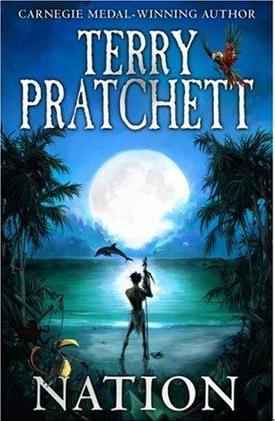
Pre-Cannonball warm-up: Nation


Rating: 5 stars

Terry Pratchett is probably most famous for writing the now 37-long book series The Discworld, which includes such gems as Small Gods, Men at Arms, Hogfather and Nightwatch. He has also co-authored the wonderful Good Omens with Neil Gaiman.

Nation is not set in the Discworld. It is set in a world not that dissimilar to our own. In the Great Southern Pelagic Oceans, on a tiny island of the Mothering Sunday Islands - so tiny, in fact, that it doesn't appear on any naval chart - lies the Nation. Mau is on his way home from the Boys' Island, and when he returns to the Nation there will be a great ceremony and a big feast, and the sharp thing with the knife where you didn't scream - and then he will be a man.

Paddling home in his selfmade canoe, Mau is caught up in an enormous wave. When he makes it back to the Nation, he is the only one left. Now he is neither man nor boy (perhaps a demon ate his soul), the Grandfathers are constantly shouting in his head, and the only other living person on the island is a strange trouserman ghost-girl.

Ermintrude is a young lady, completely unaware that on the other side of the world, a terrible plague has killed the King and one hundred and thirty-seven other people, and her father is now king. She was on her way to meet her father, the governor of Port Meria (himself completely unaware that he know happens to be King), when the ship she was on was caught in the tidal wave which destroyed the Nation. She, and a terribly foul-mouthed parrot, are the only survivors on the Sweet Judy.

Mau is puzzled by the mysterious trouserman ghost girl. Ermintrude, who much prefers to be called Daphne, was brought up well, but has no idea what the etiquette for receiving a loincloth-clad savage to afternoon tea is, especially when the only chaperone she has is the dead Captain Roberts. Neither speaks the other's language, and there is great confusion.

Nation may well be one of the best books Pratchett has ever written, and it is likely to be one of his last ones, as he has now been tragically stricken with Alzheimer's. It's a novel about identity, about belonging, about questioning the Gods and about surviving. It's not as laugh-out-loud funny as some of his earlier novels, but explores difficult and important themes in an excellent young adult novel, that readers of pretty much any age should be able to enjoy.