Showing posts with label Greek mythology. Show all posts

Saturday, 13 December 2025

CBR17 Book 69: "The Song of Achilles" by Madeline Miller

Page count: 369 pages
Audio book length: 11 hrs 15 mins
Rating: 4 stars

Nowhere Book Bingo 25: Reimagining or retelling of a classic
CBR17 Pie Chart Challenge: History

Patroclus is exiled from his father's kingdom after he accidentally kills a boy and is sent into fosterage with King Peleus. Here is where he meets Achilles, whose mother is the sea nymph Thetis. Achilles is supposed to become the greatest warrior who ever lived, and trains diligently to achieve this goal. While they are vastly different, Patroclus and Achilles become sworn companions, and Patroclus accompanies Achilles to train with the legendary centaur Chiron.

The boys stay with Chiron for several years, until they become young men. Their bond deepens, and they become lovers. Unfortunately, their pastoral life is cut short. Helen, rumoured to be the most beautiful woman in the world, has been abducted by Prince Paris of Troy. All the kingdoms of Greece are oath-sworn to accompany King Agamemnon and Menelaus to rescue her. Thetis takes her son and attempts to hide him away in a distant kingdom, since there is a prophecy that if he faces Prince Hector of Troy on the battlefield, he will die. However, Achilles is tracked down and seduced by the chance to fulfil his destiny. He can't become the greatest warrior ever if he doesn't go to Troy. He figures he'll just stay away from Hector, and then he can't be killed.

The quick and decisive victory the Greeks were expecting instead becomes a gruelling siege that lasts over a decade. Agamemnon, the leader of the Greeks, grows ever more resentful of Achilles, who refuses to show him the respect he believes he is owed. The tension and conflict between them keep escalating, eventually ending in tragedy. Prophecies can only be evaded for so long before the gods decide to manipulate matters to end as they have been foretold. 

Ok, fair warning, I'm not going to spoiler tag a myth that is literally thousands of years old. If you don't know the story of Achilles and how and why he eventually met his tragic end, that's really not on me. They even made a big movie starring many hunky men! Of course, in that one, Patroclus is Achilles' "cousin", and they give our dashing hero a female love interest and everything. No homo when you're Brad Pitt. Suffice it to say, in this book, which is frequently found in the top ten of banned books every year, Patroclus and Achilles are NOT cousins. They come of age together, yes, but they are in no way related, and their feelings for one another are most definitely romantic and sexual. Pretty sure no one would bother banning this book if they were just cousins and bros, happily seducing the various priestesses they captured as prizes of war. 

Having finally read this, which I have owned for oh so many years, I won't say that I was disappointed, because it is a very well-written book, but neither was I swept away by the story. Since Patroclus is the narrator of the book, I was idly curious whether he would keep narrating from the afterlife (turns out, I was right!). This is a good book, but I had read so much about how it had people in floods of tears. I felt no such emotions, probably because I knew when I started the book how it would end. Miller's other mythological novel, Circe, affected me much more strongly. I should re-read that and The Odyssey before Christopher Nolan's movie comes out next year. 

Judging a book by its cover: The cover for my audiobook is this fairly simple teal green one, with a golden Greek helmet on it. I much prefer it to the alternate cover with the big shiny golden breastplate. 

Crossposted on Cannonball Read

Saturday, 12 November 2022

CBR14 Book 41 and 42: "Lore Olympus, vol 2 and 3" by Rachel Smythe

Page count: 752 pages
Rating: 4.5 stars

CBR14 Bingo: Adaptation (Rachel Smythe's modern take on the Greek myths - and obviously especially Hades and Persephone is so cleverly done)

So, searching my blog and Goodreads to see what I wrote about Lore Olympus, my current web-comic obsession, I discovered that after finishing volume one in November last year, all I did was leave a two-sentence comment on Goodreads. If I recall correctly, I was pretty solidly burned out last winter, so I'm amazed I posted any reviews in the final months of the year. 
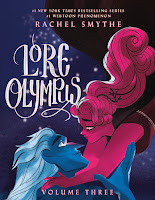
So what's Lore Olympus about, and why did I seek out the webcomic and read an additional hundred and twenty issues after finishing volume 3? Rachel Smythe has taken the entire pantheon of the Greek gods and reimagined them brilliantly. The story begins when Kore, the young goddess of spring, who has been kept extremely sheltered in the mortal world for her entire short life so far, comes to Olympus to study. Her mother, Demeter, has reluctantly agreed to let her go, on the condition that she stays with Artemis, who is known for her chastity and because Kore, or Persephone as she is sometimes known, has received a scholarship via TGOEM, The Goddesses of Eternal Maidenhood (currently consisting of Artemis, Hestia and Athena, but always thrilled to get another member). The innocent Kore ends up at a party at Zeus and Hera's mansion, where Hades is overheard by Aphrodite as describing the young goddess of spring as even more beautiful than the goddess of love, and obviously, Aphrodite takes offense. She orders her son, Eros, to get Kore very drunk and plant her in Hades' car, hoping that this will cause both the maiden and the very serious god of the Underworld some difficulties. Instead, Hades takes our drunken heroine home to sleep it off (he lives alone in a very large, empty house with many dogs he's adopted). There's clearly a mutual attraction between them, but Kore is far too drunk for anything to happen. Hades does gift her a beautiful fur coat that Hera once rejected as a gift.

Hades is appalled when he is told by Hera that Kore/Persephone is only nineteen years old (while the gods don't really age after a certain point, she is actually just out of adolescence and raised almost exclusively in the company of women). As Hades is literally millennia old, he's not exactly going to make a move on a veritable child. Kore is mortified that she got drunk and had to have help from Hades, and when she discovers that he has a girlfriend (his assistant, the very bitchy nymph Minthe). And there's that whole pesky maidenhood promise she made in return for her scholarship. They both squash any pants feelings far down, but develop a flirty friendship.

Artemis tries not to be too overprotective of her new roommate, but unfortunately, her distraction and Kore's innocence and inexperience lead to her being taken advantage of by one of the more unscrupulous and selfish gods early on. Led to believe that she's overreacting when she gets upset, she instead blames herself for the assault and refuses to tell anyone about it (Smythe is very good about trigger warnings throughout the comic, but doesn't shy away from a lot of heavy and important themes). It makes her skittish and uncomfortable around most of the male gods, yet she always feels safe around Hades.

Hera, being the goddess of hearth and home, and blesser of human marriages doesn't entirely agree with her old friend Demeter's way of sheltering Kore/Persephone. She is fully aware how promiscuous most of the male and many of the female gods are (she is after all married to the biggest adulterer in the pantheon), so she decides to test Hades' feelings by orchestrating an internship for Kore in the Underworld. She knows her old friend has been lonely for eons and really doesn't approve of the stormy and often emotionally abusive relationship he has with Minthe. So she makes sure he'll see much more of the goddess of spring than he was planning on. 

So that's basically the setup. Kore comes to Olympus and is overwhelmed. She and Hades form an almost instantaneous connection. In Smythe's story, there is no familial relationship between them at all. Demeter created her daughter herself, without any input from any god, so unlike in actual Greek mythology, Zeus is not her father and Hades is not her uncle. Because I think we can all agree that makes everything a lot ickier. With the exception of Hermes, the messenger of the gods, Koré has barely seen men while growing up and getting used to her powers. The realm of the gods is depicted as basically a modern world with computers, cell phones, cars, television, tabloids, and technology. The human world, where our heroine was raised, however, is portrayed as historical Greece, where the humans are still wearing smocks and togas and work primarily as farmers. So to come to Olympus at the age of nineteen, it's almost as if Kore has time-traveled. She's never had a phone before. She needs to be shown how to use a computer and social media and doesn't know that it's extremely bad to let a guy take compromising photos of you. 

As well as building the very very slow-burn romance between Persephone and Hades, the comic also deals with the rest of the very chaotic Greek gods. Both Zeus and Hades are businessmen, but Hades seems to take his work a lot more seriously. Zeus seems fond of his wife Hera but has mistresses both in Olympus and the human realm. One of the reasons Demeter has kept her daughter so sheltered is that she's used to Zeus dumping whichever nymph he's recently had a tryst with in the human realm with her so that Hera can't find and exact vengeance on said nymphs. She doesn't want her daughter to end up with some serial adulterer. Sadly, her strict ways also leaves her daughter vulnerable to predators.

As well as the current ongoing lives of the gods, we get glimpses into their histories and how they came to power. Smythe's take on the mythology gives the goddesses, nymphs, and other women of the story way more agency than they tend to have in mythology. Hera is a complete badass, Hecate is Hades' formidable right-hand woman and Artemis is a loyal and protective friend to Kore/Persephone. While a lot of the nymphs, like Minthe and Thetis (Zeus' personal assistant and mistress) are presented as rather opportunistic, scheming, and generally rather morally flexible, there is no denying that they are resourceful women who tend to control their own narratives in a very decisive way. 

While some of the gods are rather deplorable (Zeus, Ares, Apollo and Thanatos spring to mind), there are also some who are lovely and do their best to take care of Kore/Persephone and the other goddesses in their lives (Eros and Hermes especially). Hades is obviously everyone's tragic and lonely hero, faithful to his temperamental and rather shrewish nymph girlfriend until her rage and jealousy make it impossible for him to stay with her. He is always respectful of the women around him and tries to fight his attraction for Kore for as long as he can. She is always the one taking the lead when they are together. 

The first volume is mainly set up and introduces the reader to the major players and the world they inhabit. In volumes two and three, the story develops and one of the ongoing mysteries is how young, innocent Kore, goddess of spring, whose name means "Maiden", has come to Olympus also known as Persephone, "Bringer of Death". Thetis, Minthe and Thanatos, who are all upset by the nepotism and special favours they feel Kore has received since her arrival in Olympus, spend a lot of time investigating exactly this. When the truth was revealed at the end of volume three, there was no way I was going to sit around waiting until May 2023 to get more of the story, when so much more was readily available to me online. Now I'm only vexed that there is nowhere for me to log the many issues I've devoured in a very short space of time, which I worked out will probably take me to the end of volume eight once the books are out. And also, now I'm going to have to wait impatiently for new weekly installments, like other long-time fans of the comic.

This review is already very long, and I haven't even raved enthusiastically about Smythe's art style and the very cool way she portrays the various characters. Kore/Persephone is a young, curvy woman with a short pixy cut, completely pink. Her hair has a life of its own and seems to grow every time she feels strong emotion, so she frequently has it trailing all the way to her feet or longer. When she gets angry, her eyes turn completely red. Hades is all blue and in Olympus, he tends to wear sharp suits and has his white hair cut short. In more private moments, he wears hoodies and sweats and he loves swimming. As previously mentioned, he has many dogs, Cerberus obviously being the most well-known. Zeus has long hair and is all purple. Poseidon, the middle brother, is all green and seems to be portrayed as a happy-go-lucky surfer dude who eats a lot. He tries to keep the peace between his two brothers, which isn't always easy. Hera is all yellow, Aphrodite is an almost lavender colour. Eros is a soft pink. Hermes is red, with a shock of wild hair. Apollo and Artemis are also purple, but different shades from Zeus and Aphrodite. Minthe is dark red, while Hecate is a somewhat darker blue than Hades with black hair in a stylish bob. The colours make it much easier to keep track of the constantly changing cast of characters, too, which never hurts.

I absolutely love these comics, and the only reason I haven't rated these volumes five stars is that I know an even more exciting plot is coming down the line. So I'm saving the last half a star for that. I wholeheartedly recommend these to anyone. The relationship between Hades and Persephone is all that is swoony and romantic. There is no abduction or trickery or forced eating of pomegranates here. Just mutual respect and support, as well as a lot of pining, so the first time they actually kiss, I may have cheered out loud. I'm going to continue buying the books (which collect about 25 issues each), but for anyone short of cash, the first 217 issues are available on Webtoon. 

Judging a book by its cover: The covers give you some idea of Rachel Smythe's art style and how she portrays Hades and Persephone. I love these covers, just like I love art style, her skill at storytelling and just everything about this story. 

Crossposted on Cannonball Read. 

Thursday, 24 February 2022

CBR14 Book 2: "Electric Idol" by Katee Robert

Page count: 375 pages
Rating: 4 stars

Psyche Demetriou wishes her mother would stop trying to push her at the most powerful men in Olympus to arrange a solid business alliance. She's used to pretending to be shallow and vain, as well as deaf to all the voices who try to tear her down for her social position or body shape. She misses the quiet life before her mother became hugely powerful and sees the good in everyone, to the point where she spends time patching up dangerous hitman Eros at a party when he arrives late and clearly the worse for wear. Unfortunately, in Olympus, no good deed goes unpunished and Psyche and Eros are caught on camera in what appears to be an amorous embrace. 

Eros has been his mother Aphrodite's hitman, general fixer, and all-round boogeyman since he was still a teenager. By now, he's pretty sure he's killed enough to drown both what is left of his heart and conscience in heinous deeds ordered by his volatile parent. Yet when Aphrodite orders him to murder Psyche, as she's upset both by the positive press the woman is getting and Demeter's matchmaking attempts, Eros finds that he has had enough. Psyche showed him gentleness and kindness when no one else would have dared, and he rationalises that if they get married, she will be safe, as Aphrodite would never have her own daughter-in-law murdered. 

Given the choice between death or a marriage of convenience to the frightening, but utterly gorgeous Eros, Psyche doesn't really feel she has any choice but to accept. They agree to stay married until Aphrodite is no longer in power, and Eros promises he will do everything in his power to protect her and keep her safe. They need to present the union as an impulsive love match for the ages, but Psyche is mostly worried about how she's going to persuade her sisters to believe that she's suddenly so smitten with Eros that she'd marry him on next to no notice.

Last summer, I was lucky enough to be granted an ARC for Ms. Robert's Neon Gods, the first book in this series of Greek mythology-inspired contemporary romances. I've checked out some of her erotic reimaginings of Disney villains and other characters, and while they were fine, they didn't really tempt me to read more. With her Dark Olympus books, however, I'm really intrigued at world building and cast of characters she's establishing. 

The actual world-building is a bit vague, mostly a big modern city divided into an upper and a lower half, with most of the power divided between thirteen very powerful individuals, named after the Greek pantheon. Only a few of the positions, like for instance Zeus and Hades, are hereditary, the others are assigned. The old Zeus died at the end of the previous novel, now his son is Zeus, and looking for a wife, who will automatically become Hera. Both Demeter and Aphrodite are extremely influential and wield a lot of power, but if they die or are removed, they are not automatically replaced by a family member, someone non-related can easily assume the name and mantle of power. It's established that one of the points of contention between Demeter and Aphrodite is that Demeter was elected by the people of Olympus by popular vote, and Aphrodite is clearly a woman who doesn't deal well with jealousy, and frequently punishes people she feels have offended her by sending her son to send a bloody, or lethal message. Eros has clearly long been uncomfortable with being his mother's weapon of choice, and when he's tasked to cold-bloodedly murder an innocent woman who recently showed him vulnerability and kindness, just because his mother is annoyed with her mother, he decides that he needs to draw a line.

As far as I can tell from her Twitter, Katee Robert has a lot of books planned in this series, and I'm totally OK with that. We mainly spend each book almost wholly focused on the main couple, but a little bit about the wider world and some supporting characters also flesh out the stories. Eros and Psyche aren't complete strangers, having appeared in the same social circles for years. Eros hasn't really shown anyone his true self, though, and Psyche has a very firmly established public persona, which doesn't always match up with the home-loving and sweet person she really is. She's not exactly thrilled with the thought of marrying Eros, but if the only other option is death, she's pragmatic enough to agree. Even before letting their guards down towards each other, the couple certainly share a strong physical attraction, which means Eros can pretend to himself that the only reason he's suggesting the match is so he can sleep with Psyche. 

I'm not sure which of the two books I've read in the series so far I prefer. I really liked Persephone and Hades in Neon Gods (and love their cameo appearances here). Both novels are more than entertaining (and steamy) enough that I'll be waiting with bated breath for more installments. There's some very interesting developments set up in this story, and I can't wait to see how things play out in future books.
 
Judging a book by its cover: I think the first cover mock-up for this book featured an ornate gilded mirror, which was fine, but the final cover is so much more eye-catching. I really like the glowing jewel heart - and considering that the hero supposedly is very stone-hearted, the image fits on several levels. 

Crossposted on Cannonball Read. 

Monday, 9 August 2021

#CBR13 Book 29: "Neon Gods" by Katee Robert

Page count: 391 pages
Rating: 4 stars

CBR13 Bingo: Mythic (while this is pretty much a straight-up contemporary romance/erotica, the mythological influences are very much there throughout the book)

This book was granted to me as an ARC through NetGalley in return for an honest review. It's available now.

Persephone Dimitriou is a society darling, living in the lap of luxury in a stylish highrise in the city of Olympus. Her mother is Demeter, head of one of the thirteen ruling houses and while she seems to care for her four daughters, she clearly cares for ambition and power all the more. Persephone puts on a sunny and glamorous front and counts the days until she turns twenty-five when she will access her trust fund and bribe someone to get her out of Olympus forever. Imagine her shock when she is ambushed at a big society party with a public proposal from Zeus, heads of the thirteen houses himself (and a widower whose three previous wives all disappeared without a trace). Zeus makes Persephone's skin crawl and she leaves the party as soon as she's able, running away into the night to get away.

She finds herself chased by two of Zeus' henchmen towards the river Styx, the almost impossible to cross border between the glamourous upper city and the dark and neglected undercity. Utterly terrified, she forces herself to run across one of the few bridges, even as her feet are bleeding and her lungs are running out of air. A dark, mysterious stranger catches her and warns away her assailants, then bundles her up and literally carries her away to his home. The mystery man turns out to be none other than Hades, the believed to be dead scion of the thirteenth house. It's in the interest of the rulers of the other eleven houses (Hera doesn't rule her own house, that is the courtesy title that Zeus' wife holds) that Hades is kept as a shadowy sort of boogeyman, who only a few know of. He doesn't ever cross the river Styx to get to the upper city, they stay away from the lower city and his territory. 

Hades already hates Zeus with every fiber of his scarred being. The only survivor of a horrible fire that killed his parents when he was a child, Hades has been a ruler of his house since he was very young, and he's spent most of his time making sure that the inhabitants of the undercity are safe and protected, and that he has contingency plans for whatever the other members of the Thirteen might come up with to mess with his people. He never expected to bring pretty princess Persephone half frozen to death with bleeding feet into his kitchen, furious about being abducted one minute and proposing an alliance and a very tempting bargain the next morning. Persephone has figured out that Hades hates Zeus, and what better way to stay safe from him (and provoke him massively in the process) than by offering herself to Hades as his lover. If she makes sure she is publically associated with Hades for the last three months of winter until she turns twenty-five, she's pretty sure Zeus will consider her damaged goods and no longer wish to marry her. Hades gets a chance to thumb his nose at his greatest enemy by "stealing" that which Zeus considers his by right.

While Zeus always made Persephone feel deeply uncomfortable, Hades makes her feel safe and clearly means to protect her, even from her own worst impulses. He's not at all impressed with her refusal to rest and wait for her feet to heal or her tendency to go for days without proper meals when she's stressed or processing things. While Hades may have the public persona of some dark lord of the seedy underworld, he's clearly a deeply lonely, physically and emotionally scarred man who protects all those he feels responsible for be they the various inhabitants in lower Olympus, his loyal staff...or Persephone.

Having had to make sure to hide her observant nature and sharp intelligence behind a facade of a beautiful, vacuous socialite in the years since her mother ascended to the position of Demeter, Persephone is both surprised and delighted to be able to be herself around Hades, even when that means being intentionally provoking and baiting him. She was drawn to him from the moment she first fell into his arms and rather eager at the chance to share his passions, even the darker, more public expressions of his desires. She agrees to his dominance when they are in public, but finds herself treated fully as a valued equal when they are alone together. With each passing week, the time they have left together becomes shorter and both Persephone and Hades fall more and more hopelessly for one another. Persephone has risked everything, including possibly the safety of her three beloved sisters,  to find freedom away from Olympus - there is no future for her and Hades long term. Or is there?

I'd heard positive buzz about Neon Gods on various romance review sites, so jumped at the chance to get an ARC from Netgalley. As readers of my reviews know, while I probably still read more than most people I know (outside the Cannonballers, a huge amount of people who read WAY more than me), I am reading so much less than I have in previous years. I've already abandoned several reading challenges because I'm just never going to be able to keep up with them. I certainly wasn't expecting to pretty much devour this book in the space of fewer than 24 hours. The first few chapters are a bit slow and set up Persephone's desperate situation. Once she flees across the river Styx, however, I was utterly hooked and read far longer into the night than planned, and then ignored pretty much everything except seeing to the well-being of my child the following day. Luckily, at three and a half now, he is perfectly able to entertain himself for some amount of time, both inside and outside (I can read while he's building trains or digging in a sandbox) and since he doesn't usually get a lot of TV, an afternoon of Octonauts was a real treat for him. Sexy kissing book for Mummy, animated oceanography cartoon for him. Win-win. 

I know that Katee Robert has written a series of erotica featuring a whole bunch of Disney characters and their smexy interactions. I read the first one, featuring Jasmine and Jafar, last year, but never really cared all that much, even if the levels of steam were rather higher than I tend to find in my novels. This new series, called Dark Olympus is apparently set in another part of the same world. It's a contemporary romance, with a dark edge, and as someone who has always loved the Hades and Persephone myth, it was a lot of fun to see how Robert retold it. It doesn't hurt that I loved both Hades and Persephone, as individual characters and as a couple. They compliment each other beautifully and their chemistry is off the charts. 

The world-building that is established, with the glossy, celebrity-obsessed glitz of the upper Olympus, reminding me a bit of the description of the Capitol in The Hunger Games, without the televised fight to the death of a bunch of teenagers every year. There's still the ruthless, powerful rulers of the elite and a complete disconnect between the upper and lower city. In the lower city, Hades' domain, people seem to live much simpler, yet probably more rewarding lives, much of the old architecture is preserved and while the place is believed to be filled with thieves, bandits, and sexual perversion, it's mostly just full of folks minding their own business, all worshipping the ground Hades walks on since he's willing to do whatever it takes to keep them all safe. They all seem to welcome Persephone since it's obvious that she is great for Hades.

While all of Demeter's daughters have separate fathers, they are incredibly close and have each chosen their own way to survive in the spotlight of being a scion of a ruling house. Taking some liberties with the actual mythology, Robert has made Callisto, Psyche, Persephone, and Eurydice sisters in this world. The four women adore each other and feel very protective towards one another, so Persephone obviously has to keep her sisters updated about her whereabouts and the truth of her situation. I liked the close bonds between the women and will be interested to see where the series goes next (seems to be the story of Psyche and Eros, which has a lot of elements of one of my favourite fairy tales East of the Sun, West of the Moon, so I'm pretty much one-clicking as soon as the book becomes available for pre-order). 

This book has a compelling romance between a cheerful, sunshiny heroine who isn't always all that sunny and a seemingly very grumpy, but very caring and protective hero who both enjoy some kink as well as a lot of more regular smexy times. Both protagonists appear to be bi and think back to same-sex relationships they have had in the past. There are frolicking puppies and a secret greenhouse garden, a lot of banter, and a compelling story surrounding the main romance as well. 

If you like modern retellings in your romance, this is a really good one and worth checking out. 

Judging a book by its cover: Very fitting for a book about the king of the underworld, the cover is in dark blue and purple tones, with a throne-like leather armchair front and centre. Hades does in fact have a throne of sorts, and it sees some pretty steamy action over the course of the story. 

Crossposted on Cannonball Read.  

Tuesday, 23 February 2021

#CBR13 Book 5: "Lore" by Alexandra Bracken

Page count: 532 pages
Audio book length: 15 hrs 47 mins
Rating: 4 stars

Official book description:
Every seven years, the Agon begins. As punishment for a past rebellion, nine Greek gods are forced to walk the earth as mortals, hunted by the descendants of ancient bloodlines, all eager to kill a god and seize their divine power and immortality.

Long ago, Lore Perseous fled that brutal world in the wake of her family's sadistic murder by a rival line, turning her back on the hunt's promises of eternal glory. For years she's pushed away any thought of revenge against the man--now a god--responsible for their deaths.

Yet as the next hunt dawns over New York City, two participants seek out her help: Castor, a childhood friend of Lore believed long dead, and a gravely wounded Athena, among the last of the original gods.

The goddess offers an alliance against their mutual enemy and, at last, a way for Lore to leave the Agon behind forever. But Lore's decision to bind her fate to Athena's and rejoin the hunt will come at a deadly cost--and still may not be enough to stop the rise of a new god with the power to bring humanity to its knees. 

Melora "Lore" Perseus has been trying to stay away from the brutal world she was raised in after her entire family was ruthlessly slaughtered seven years ago just as the previous Agon was about to end. She's living in a Brooklyn brownstone left to her by the kindly old man she worked as a caretaker for, who passed away about six months ago. Her only friend is Miles, a young man completely unaware of her dangerous background. Now it seems, her past is determined to catch up with her. She discovers that her old friend Castor didn't die of leukemia after all, but is in fact not only strong and healthy but has taken on the mantle of Apollo after the last Agon. She also finds the goddess Athena brutally stabbed on her literal doorstep and when the goddess offers her a bargain that will allow her revenge on the man who is responsible, Lore is reluctant at first but realises that she can't really refuse. She agrees to bind her fate to that of Athena, so giving her extra strength and resources. However, if either of the two dies, the other one will too.

Over the course of the next week, Lore and Athena work together to try to track down the man who has taken on the power of Ares and is systematically trying to wipe out all other gods (or those who have their power now) in the Agon. They are aided by Castor, his friend Evander and Miles, who insists on helping, even though he's the only mortal not trained from childhood in this strange deadly tournament. As they work on achieving their goal, Lore comes to discover that her childhood goal of becoming a legend may be achievable after all, but it will only come after even greater cost than she has already paid.

I don't know if this book is being marketed with 'Percy Jackson meets the Hunger Games', but it probably should be. The concept of the story, the Agon, is explained at the beginning of the book. I don't entirely remember why the descendants of all the great heroes have to keep hunting down the occasionally fully mortal Greek gods in order to earn power and glory, but that's the world we find ourselves in here. A world that sadly still considers only male fighters truly worthy, and which won't allow any women to be the head of a house and very few as acceptable as Hunters. Until her family was killed at the end of the last Agon, Lore was determined to prove everyone wrong and become legendary. After she found her father, mother, and two younger sisters brutally slaughtered in their small New York apartment, however, she determined to have nothing more to do with the Agon or the rivaling families vying for power. 

While Lore has spent most of the last seven years estranged from the world she once knew and is quite lonely, she has a very solid friendship with Miles, and it's good to see her reconnecting with Castor, Van (Evander) and later her old friend Iro as well. These teenagers have all been raised with some truly warped values and this last round of the Agon seems to be making all of them, not just Lore, realise that the old traditions cannot continue. Changes need to be made.

This book seems to be entirely stand-alone, which is unsual in and of itself nowadays. I enjoyed it and found the mix of Greek mythology, action adventure and death race interesting and enjoyable. The audio book is narrated by Fryda Wolff, who does a good job with the sprawling cast of characters. 

While I think this book absolutely fits into the YA genre with many of its character archetypes and plot beats, it should probably be recommended for older readers, as there are some really very violent scenes throughout. I remember being surprised that Pierce Brown's Red Rising series was being marketed as YA, and this is a bit in the same vein. Lore, Castor, Evander and Miles have neither of them turned twenty yet, but a lot of the themes and action set pieces are distinctly gory. So be aware of that.

Judging a book by its cover: I have always found Medusa a very fascinating character, and this cover, where a statue appears to be coming to life and staring straight at the reader was one of the things that first struck me when I decided to check out the book. Any cover image arresting enough to make me interested in picking up and reading the book has done its job well. 

Crossposted on Cannonball Read. 

Tuesday, 23 July 2019

#CBR11 Book 51: "Circe" by Madeline Miller

Page count: 400 pages
Audio book length: 12 hrs 8 mins
Rating: 4 stars

#CBR11 Bingo: Remix 

Official book description:
In the house of Helios, god of the sun and mightiest of the Titans, a daughter is born. But Circe has neither the look nor the voice of divinity, and is scorned and rejected by her kin. Increasingly isolated, she turns to mortals for companionship, leading her to discover a power forbidden to the gods: witchcraft.

When love drives Circe to cast a dark spell, wrathful Zeus banishes her to the remote island of Aiaia. There she learns to harness her occult craft, drawing strength from nature. But she will not always be alone; many are destined to pass through Circe's place of exile, entwining their fates with hers. The messenger god, Hermes. The craftsman, Daedalus. A ship bearing a golden fleece. And wily Odysseus, on his epic voyage home.

There is danger for a solitary woman in this world, and Circe's independence draws the wrath of men and gods alike. To protect what she holds dear, Circe must decide whether she belongs with the deities she is born from, or the mortals she has come to love.

I really didn't know a whole lot about Circe before coming to this book. I read The Odyssey in my first years of university in Scotland, when I studied Classics (so much more entertaining than that snooze fest The Aeneid), where Circe of course appears in a whole chapter, famously turning most of Odysseus' men into pigs. Of course, the power of Odysseus' charisma was such that by the end of his visit on Circe's island, she was pretty much his devoted handmaiden.

Madeline Miller, award-winning author of The Song of Achilles (which I also need to read, but I just can't deal with unhappy endings right now), goes through the known myths about Circe and gives the tales her more modern and feminist interpretation. I think we all know that being a woman in any Greek myth is pretty much the pits. It's also been clear throughout history that any woman who dares to stand up for herself, show independence and power of her own is probably going to be feared and vilified. So it's no wonder that Circe, a strong, independent woman who had the temerity to transform drunken sailors into beasts would become a cautionary tale.

As I said, I didn't really know anything about Circe except that she found Odysseus' men "turn into pigsable". So it was really interesting to discover that she was apparently responsible for turning fellow nymph Scylla into the terrifying sea monster that murdered so many sailors (again, only prior knowledge comes from The Odyssey), that she was the sister of Aeetes, keeper of the Golden Fleece or Pasiphae (and therefore maternal aunt to the Minotaur of Crete). Madeline Miller writes about how Circe and her famous siblings came to discover their knack for sorcery, why Circe was exiled and isolated on her island of Aiaia (where she's really rather happy - her father's court wasn't exactly kind to her).

Circe the daughter of a god and a nymph, and while she apparently has the voice of a mortal, she is immortal and eternal like the other Greek gods. She has centuries in which to perfect her magic arts. When travelling to Crete to help her sister deliver the monster the island would become so famous for, she also befriends the craftsman Deadalus, who gifts her a loom. She has frequent visits from Hermes, and after Odysseus and his men finally leave her island, she has a son to raise (according to Wikipedia, the myths suggest that Odysseus actually gave Circe two sons - I guess Miller thought one boy was enough trouble to deal with).

In some of the sections of the book, not a lot happens - it's just Circe on her island thinking and discovering things. I can see how that might get boring for some readers, but I thought this book was great. I especially liked the final bit, when Circe's son brings Telemachus and Penelope back with him to Aiaia. The famous poem about Odysseus doesn't really dwell on what happens once your father/husband comes back after several decades of war, having lost about half of the promising young men on the island and proceeds to murder the other half. PTSD is a terrible thing, and Homer's epic doesn't really talk about what comes next.

I listened to Circe in audio book. Perdita Weeks is an excellent narrator, with a very soothing voice. This book has already won multiple awards and been favourably reviewed by many Cannonballers. I can just add my recommendation to the list.

Judging a book by its cover: So, confession time - I don't really like the colour orange. Like, at all. But I see why it's such an effective colour to use, it's warm, bright, draws the eye. So I can't really blame them for choosing to make the stylised woman's head and the sheaves of grain on this cover that colour. Especially since on old Greek pottery, the patterns are often an orangey brown against black. It makes sense - but I still don't like the colour orange.

Crossposted on Cannonball Read.