Showing posts with label graphic novel. Show all posts

Saturday, 10 August 2024

CBR16 Book 41: "Laura Dean Keeps Breaking Up with Me" by Mariko Tamaki and Rosemary Valero-O'Connell

Page count: 304 pages
Rating: 5 stars

Nowhere Books Bingo - Graphic novel

Official plot summary, because once again I have waited to long to review the book: Laura Dean, the most popular girl in high school, was Frederica Riley's dream girl: charming, confident, and SO cute. There's just one problem: Laura Dean is maybe not the greatest girlfriend.

Reeling from her latest break up, Freddy's best friend, Doodle, introduces her to the Seek-Her, a mysterious medium, who leaves Freddy some cryptic parting words: break up with her. But Laura Dean keeps coming back, and as their relationship spirals further out of her control, Freddy has to wonder if it's really Laura Dean that's the problem. Maybe it's Freddy, who is rapidly losing her friends, including Doodle, who needs her now more than ever. Fortunately for Freddy, there are new friends, and the insight of advice columnists like Anna Vice to help her through being a teenager in love.

This is one of those books that I heard a lot about when it came out and bought as soon as it was available in paperback (I don't like reading comics and graphic novels digitally), then put on my bookshelf and forgot. Since we have a full floor to ceiling bookshelf dedicated entirely to comics and graphic novels, once something is shelved there, it's no longer out in the open to remind me. I probably shouldn't have waited years to read it, but at least it didn't disappoint once I got to it.

The only other graphic novel I've read by Mariko Tamaki was This One Summer, which was lovely, but had a subplot that hit a bit too close to home for me and made it a rather painful reading experience for me. This one, with its focus on (tragic) romance and friendship was more to my taste. I started reading it during a day I actually had quite a lot to do and had only intended to make a start on it, but instead ended up having to rearrange my schedule, because I once I started, I couldn't really put it down. In This One Summer, the illustrations are done by Mariko's sister Jillian, here she collaborates with Rosemary Valero-O'Connell, who captures the characters beautifully. A really good story accompanied by bad art can be enjoyed, but it's so much better when both the writing and art are both high quality.

Teenagers are often rather self-centred and selfish, caring mostly about themselves and their own issues and as such, Freddy felt very realistic. She is happy to hang out with her friends, but because she's so caught up with her own drama, she doesn't really seem to notice or care about what is happening with others. She has gotten used to her friends, including her best friend Doodle, always being there for her, listening to her and supporting her through her multiple dumpings and getting back together again with Laura Dean, but not really that Doodle and the others are clearly getting frustrated with the constant back and forth, and Freddy's complete inability to see how bad Laura Dean is for her. 

Personally, I couldn't really see what was supposed to be so great about Laura, but then I'm an asexual lady in my forties, who spends much of my working year around teenagers and their drama, so I try to live a very drama free existence the rest of the time. I shared the frustration of Freddy's friends that she would wake up and smell the toxic girlfriend sooner, but I suppose there would have been a lot less plot if the book was 'I'm sick of Laura Dean using me and stringing me along, so I'll dump her once and for all and get on with my life'. 

I think Freddy's friend Doodle was my favourite character, and I felt really bad for her, trying to support Freddy through yet another inevitable break-up with the same person, while she herself really needed a friend and support because of a complicated and sad situation of her own. The rest of the supporting cast (with the exception of Laura Dean, who is clearly the antagonist, of sorts) also added to my enjoyment of the book. 

While Freddy herself had me rolling my eyes possibly one time too many, this book in some ways reminded me of Heartstopper, because it's a story of relatable and realistic-seeming teens, many of whom are queer, including the protagonist, but it's not about awkwardly coming out, or having to struggle for acceptance among parents and friends. These teens are just allowed to be who they are, without facing hatred and bullying. I'm glad I finally read this, and will be recommending it to others looking for a quick read. 

Judging a book by its cover: The cover gives a little taste of Rosemary Valero-O'Connell's art, and while it only shows the back of Laura Dean, her jacket, posture and haircut all suggest her cool mean-girl attitude. We only get to see one eye of Freddy's, which looks a bit anxious and unsure. It's a really well-done image. 

Crossposted on Cannonball Read. 

Sunday, 31 December 2023

CBR15 Book 103: "Heartstopper, vol 5" by Alice Oseman

Page count: 336 pages
Rating: 4 stars

Nick and Charlie are closer than ever, but despite what their friends think, they still haven't done THAT. Lately, it's probably all either can think about, but it's a big step and neither wants to pressure the other.

Nick is also a year older than Charlie, and is having to consider which Universities he's going to apply to next year. His first inclination is living at home and going to his local Uni, so he'll be close to Charlie, but he goes on a road trip with Elle and Tara, and discovers that there are very appealing places elsewhere in the country too. Elle finds her dream University, and it will mean a long distance relationship with Tao. Can Nick and Charlie manage the same?

Mr. Farouk is encouraging Charlie to apply for Head Boy in his final year, saying that a lot of students at the school could use a role model like him. He also wants to have the occasional sleepover at Nick's, but his mother is feeling overprotective and her reluctance causes tension between them. In the end, she agrees that he can stay over at Nick's once he's done with exams.

Charlie, not exactly the most extroverted or confident, thanks to all the bullying, also agrees to play drums for a queer band during the end-of-year summer féte. It's a much more public role than he's ever been in before, and he's both nervous and excited about the opportunity.

I hadn't realised that there was going to be a volume of Heartstopper out this year, so finding out that this was coming out in December was a pleasant surprise (even more that I found the book at half price at a shop in the UK while visiting my parents-in-law for Christmas). As it turns out, I had already read a lot of the issues collected in this book online on Tapas. The only reason I hadn't read all of them is that I took a break so more issues of the webcomic could be collected (one issue a week is too short). Oseman has announced that volume 6 will be the final one, and I'm now thinking that I may just stop reading the webcomic, so as not to be spoiled for the ending. 

I love this comic. It's so heartwarming and cute and the issues in this book are very low angst, even with questions of long-distance relationships being discussed. Nick and Charlie and their friends are such great characters and I'm glad queer youth have some nice examples of LGBTQIA fiction to comfort them. 

Judging a book by its cover: All the other covers have shown Nick and Charlie from the back, getting a bit closer with each volume. This is the first one where they are actually fully embracing, and I think the image is adorable. 

Crossposted on Cannonball Read

Tuesday, 17 October 2023

CBR15 Book 61: "Class Act" by Jerry Craft

Page count: 249 pages
Rating: 4 stars

Drew Ellis goes to the prestigious Riverdale Academy Day School, but unlike a lot of his more privileged classmates, he feels like he has to work way harder and he still might not get the same opportunities that they do. While a lot of his fellow students live in enormous mansions, Drew lives alone with his grandmother (who has to work almost constantly to provide for him). He also knows that no matter how good his grades are or which school he attends, most people are only going to see the colour of his skin. Of course, his friends Jordan and Liam have their own problems to deal with.

This is a companion novel to New Kid, which I haven't read. The good news is that you don't need to have read that book to enjoy this one, but I suspect I would have gotten even more out of this if I'd also read the first book in the series.

For our Cannonball Book Club in October, we continued last year's success of banned books, this time focusing on graphic novels. I had already read the other two we selected, This One Summer by Mariko and Jillian Tamaki and Gender Queer by Maia Kokabe, so this was the only one left for me to read. Thankfully the Oslo public library had a copy, so I was able to read it before our online discussion and Zoom meeting.

This is very highly rated on Goodreads, and I liked it a lot. I'm very much not the intended target audience, and had I been younger, I might have rated it even higher. As always when we read banned books, I am utterly baffled as to why anyone would think this was a bad thing for young people to read. This shows a very nuanced portrayal of several young individuals from very different family backgrounds and how they all, even when they might seem to have no worries, might not have perfect lives. What a terrible thing for tweens to read, apparently.

Judging a book by its cover: Craft is an excellent artist, and shows inside the comic that he's capable of drawing in a number of styles. I really like the playful cover, with some of the characters being juggled, along with the demands and responsibilities Drew faces daily. 

Crossposted on Cannonball Read

Saturday, 5 August 2023

CBR15 Book 35: "Gender Queer" by Maia Kokabe

Page count: 240 pages
Rating: 5 stars

CBR15 Bingo: Picture This (can also be used for Queer Lives)

Official book description:
In 2014, Maia Kobabe, who uses e/em/eir pronouns, thought that a comic of reading statistics would be the last autobiographical comic e would ever write. At the time, it was the only thing e felt comfortable with strangers knowing about em. Now, Gender Queer is here. Maia's intensely cathartic autobiography charts eir journey of self-identity, which includes the mortification and confusion of adolescent crushes, grappling with how to come out to family and society, bonding with friends over erotic gay fanfiction, and facing the trauma of pap smears. Started as a way to explain to eir family what it means to be nonbinary and asexual, Gender Queer is more than a personal story: it is a useful and touching guide on gender identity—what it means and how to think about it—for advocates, friends, and humans everywhere.

Despite this being a pretty obvious pick to read during Pride month, I actually finished Gender Queer in May. I got it from the library and was going to save it for June. I was just curious and started reading a few pages. After about four pages, I didn't put the book down until I was finished. I am cis-gendered and straight, so for me, a lot of this was just learning to understand about someone else's experiences. I'm also asexual, though, and know how long it took me to discover that this was an actual thing and not just that I was some sort of aberration, so I can understand both why this was a difficult book for Kokabe to write and illustrate, but also why it felt important for em to share eir experiences, so that others in eir situation (or similar ones) could see that they are not alone out there. 

The internet tells me that in 2023, this book has been banned from shelves in more American states than any other book, because of its subject matter, and illustrations. The book deals with Kokabe's journey exploring eir gender and sexuality, and because the memoir is graphic, there are also pictures. I didn't think anything was particularly graphic or shocking, and some of the topics explored, like body dysphoria and discomfort with periods or gynecological exams, I suspect would be just as applicable to a lot of cis-gendered people as trans-gendered or non-binary individuals. 

The deeply puritanical and backward thinking of people who ban or challenge books never fails to surprise and depress me. I'm assuming that the justification for wanting this removed from shelves is that it might turn kids gay, or non-binary or something? I'm in my early forties and it wasn't until my mid-thirties that I even knew that asexuality was something that existed. I know how uncomfortable I felt until I realised that this was an actual orientation, and not just me being weird. Questioning one's gender identity and not feeling comfortable in one's body must be a million times worse. Books like this, which can show teens and adults that there are others out there that feel the same are hugely important and can change and even save lives. So this book should not be banned. It should probably be taught in schools, at least for older teens and college students. Only a day or two after finishing the library copy I had borrowed, I went out and bought a copy for myself, so I can lend it to friends. That's how important I think this book is. 

I applaud Kokabe's bravery, and reading about eir intense discomfort of being referred to as a 'young lady' or having people use the wrong pronouns has made me try to be better about using more neutral pronouns with the students I teach because you never know which of them might not be comfortable being lumped in with other cis-gendered, binary classmates. I am sorry to say that I still need to work on remembering not to misgender my non-binary and/or trans-gendered friends on occasion, but I am trying to be more sensitive to these issues. 

Judging a book by its cover: I really like both covers of this book, the one on the original edition and the one on the hardback special edition. Both covers feature two versions of Kokabe, one a more youthful and innocent depiction, the other an older, more reflective one. E is a very good artist, and subsequently, the cover illustrations are evocative and tell a story in their own right. 

Crossposted on Cannonball Read. 

Saturday, 12 November 2022

CBR14 Book 41 and 42: "Lore Olympus, vol 2 and 3" by Rachel Smythe

Page count: 752 pages
Rating: 4.5 stars

CBR14 Bingo: Adaptation (Rachel Smythe's modern take on the Greek myths - and obviously especially Hades and Persephone is so cleverly done)

So, searching my blog and Goodreads to see what I wrote about Lore Olympus, my current web-comic obsession, I discovered that after finishing volume one in November last year, all I did was leave a two-sentence comment on Goodreads. If I recall correctly, I was pretty solidly burned out last winter, so I'm amazed I posted any reviews in the final months of the year. 
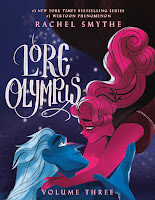
So what's Lore Olympus about, and why did I seek out the webcomic and read an additional hundred and twenty issues after finishing volume 3? Rachel Smythe has taken the entire pantheon of the Greek gods and reimagined them brilliantly. The story begins when Kore, the young goddess of spring, who has been kept extremely sheltered in the mortal world for her entire short life so far, comes to Olympus to study. Her mother, Demeter, has reluctantly agreed to let her go, on the condition that she stays with Artemis, who is known for her chastity and because Kore, or Persephone as she is sometimes known, has received a scholarship via TGOEM, The Goddesses of Eternal Maidenhood (currently consisting of Artemis, Hestia and Athena, but always thrilled to get another member). The innocent Kore ends up at a party at Zeus and Hera's mansion, where Hades is overheard by Aphrodite as describing the young goddess of spring as even more beautiful than the goddess of love, and obviously, Aphrodite takes offense. She orders her son, Eros, to get Kore very drunk and plant her in Hades' car, hoping that this will cause both the maiden and the very serious god of the Underworld some difficulties. Instead, Hades takes our drunken heroine home to sleep it off (he lives alone in a very large, empty house with many dogs he's adopted). There's clearly a mutual attraction between them, but Kore is far too drunk for anything to happen. Hades does gift her a beautiful fur coat that Hera once rejected as a gift.

Hades is appalled when he is told by Hera that Kore/Persephone is only nineteen years old (while the gods don't really age after a certain point, she is actually just out of adolescence and raised almost exclusively in the company of women). As Hades is literally millennia old, he's not exactly going to make a move on a veritable child. Kore is mortified that she got drunk and had to have help from Hades, and when she discovers that he has a girlfriend (his assistant, the very bitchy nymph Minthe). And there's that whole pesky maidenhood promise she made in return for her scholarship. They both squash any pants feelings far down, but develop a flirty friendship.

Artemis tries not to be too overprotective of her new roommate, but unfortunately, her distraction and Kore's innocence and inexperience lead to her being taken advantage of by one of the more unscrupulous and selfish gods early on. Led to believe that she's overreacting when she gets upset, she instead blames herself for the assault and refuses to tell anyone about it (Smythe is very good about trigger warnings throughout the comic, but doesn't shy away from a lot of heavy and important themes). It makes her skittish and uncomfortable around most of the male gods, yet she always feels safe around Hades.

Hera, being the goddess of hearth and home, and blesser of human marriages doesn't entirely agree with her old friend Demeter's way of sheltering Kore/Persephone. She is fully aware how promiscuous most of the male and many of the female gods are (she is after all married to the biggest adulterer in the pantheon), so she decides to test Hades' feelings by orchestrating an internship for Kore in the Underworld. She knows her old friend has been lonely for eons and really doesn't approve of the stormy and often emotionally abusive relationship he has with Minthe. So she makes sure he'll see much more of the goddess of spring than he was planning on. 

So that's basically the setup. Kore comes to Olympus and is overwhelmed. She and Hades form an almost instantaneous connection. In Smythe's story, there is no familial relationship between them at all. Demeter created her daughter herself, without any input from any god, so unlike in actual Greek mythology, Zeus is not her father and Hades is not her uncle. Because I think we can all agree that makes everything a lot ickier. With the exception of Hermes, the messenger of the gods, Koré has barely seen men while growing up and getting used to her powers. The realm of the gods is depicted as basically a modern world with computers, cell phones, cars, television, tabloids, and technology. The human world, where our heroine was raised, however, is portrayed as historical Greece, where the humans are still wearing smocks and togas and work primarily as farmers. So to come to Olympus at the age of nineteen, it's almost as if Kore has time-traveled. She's never had a phone before. She needs to be shown how to use a computer and social media and doesn't know that it's extremely bad to let a guy take compromising photos of you. 

As well as building the very very slow-burn romance between Persephone and Hades, the comic also deals with the rest of the very chaotic Greek gods. Both Zeus and Hades are businessmen, but Hades seems to take his work a lot more seriously. Zeus seems fond of his wife Hera but has mistresses both in Olympus and the human realm. One of the reasons Demeter has kept her daughter so sheltered is that she's used to Zeus dumping whichever nymph he's recently had a tryst with in the human realm with her so that Hera can't find and exact vengeance on said nymphs. She doesn't want her daughter to end up with some serial adulterer. Sadly, her strict ways also leaves her daughter vulnerable to predators.

As well as the current ongoing lives of the gods, we get glimpses into their histories and how they came to power. Smythe's take on the mythology gives the goddesses, nymphs, and other women of the story way more agency than they tend to have in mythology. Hera is a complete badass, Hecate is Hades' formidable right-hand woman and Artemis is a loyal and protective friend to Kore/Persephone. While a lot of the nymphs, like Minthe and Thetis (Zeus' personal assistant and mistress) are presented as rather opportunistic, scheming, and generally rather morally flexible, there is no denying that they are resourceful women who tend to control their own narratives in a very decisive way. 

While some of the gods are rather deplorable (Zeus, Ares, Apollo and Thanatos spring to mind), there are also some who are lovely and do their best to take care of Kore/Persephone and the other goddesses in their lives (Eros and Hermes especially). Hades is obviously everyone's tragic and lonely hero, faithful to his temperamental and rather shrewish nymph girlfriend until her rage and jealousy make it impossible for him to stay with her. He is always respectful of the women around him and tries to fight his attraction for Kore for as long as he can. She is always the one taking the lead when they are together. 

The first volume is mainly set up and introduces the reader to the major players and the world they inhabit. In volumes two and three, the story develops and one of the ongoing mysteries is how young, innocent Kore, goddess of spring, whose name means "Maiden", has come to Olympus also known as Persephone, "Bringer of Death". Thetis, Minthe and Thanatos, who are all upset by the nepotism and special favours they feel Kore has received since her arrival in Olympus, spend a lot of time investigating exactly this. When the truth was revealed at the end of volume three, there was no way I was going to sit around waiting until May 2023 to get more of the story, when so much more was readily available to me online. Now I'm only vexed that there is nowhere for me to log the many issues I've devoured in a very short space of time, which I worked out will probably take me to the end of volume eight once the books are out. And also, now I'm going to have to wait impatiently for new weekly installments, like other long-time fans of the comic.

This review is already very long, and I haven't even raved enthusiastically about Smythe's art style and the very cool way she portrays the various characters. Kore/Persephone is a young, curvy woman with a short pixy cut, completely pink. Her hair has a life of its own and seems to grow every time she feels strong emotion, so she frequently has it trailing all the way to her feet or longer. When she gets angry, her eyes turn completely red. Hades is all blue and in Olympus, he tends to wear sharp suits and has his white hair cut short. In more private moments, he wears hoodies and sweats and he loves swimming. As previously mentioned, he has many dogs, Cerberus obviously being the most well-known. Zeus has long hair and is all purple. Poseidon, the middle brother, is all green and seems to be portrayed as a happy-go-lucky surfer dude who eats a lot. He tries to keep the peace between his two brothers, which isn't always easy. Hera is all yellow, Aphrodite is an almost lavender colour. Eros is a soft pink. Hermes is red, with a shock of wild hair. Apollo and Artemis are also purple, but different shades from Zeus and Aphrodite. Minthe is dark red, while Hecate is a somewhat darker blue than Hades with black hair in a stylish bob. The colours make it much easier to keep track of the constantly changing cast of characters, too, which never hurts.

I absolutely love these comics, and the only reason I haven't rated these volumes five stars is that I know an even more exciting plot is coming down the line. So I'm saving the last half a star for that. I wholeheartedly recommend these to anyone. The relationship between Hades and Persephone is all that is swoony and romantic. There is no abduction or trickery or forced eating of pomegranates here. Just mutual respect and support, as well as a lot of pining, so the first time they actually kiss, I may have cheered out loud. I'm going to continue buying the books (which collect about 25 issues each), but for anyone short of cash, the first 217 issues are available on Webtoon. 

Judging a book by its cover: The covers give you some idea of Rachel Smythe's art style and how she portrays Hades and Persephone. I love these covers, just like I love art style, her skill at storytelling and just everything about this story. 

Crossposted on Cannonball Read. 

Thursday, 10 November 2022

CBR14 Book 40: "Monstress, vol 1: Awakening" by Marjorie Liu and Sana Takeda

Page count: 202 pages
Rating: 2 stars

CBR14 Bingo: Monster (there are several monsters in this story, both humanoid and not)

Official book description:
Set in an alternate matriarchal 1900's Asia, in a richly imagined world of art deco-inflected steampunk, MONSTRESS tells the story of a teenage girl who is struggling to survive the trauma of war, and who shares a mysterious psychic link with a monster of tremendous power, a connection that will transform them both and make them the target of both human and otherworldly powers.

So total honesty here. This was my local fantasy/sci-fi book club pick for March. Yup, nearly eight months ago. I read the first three issues, then got incredibly distracted by something or other, I don't even remember what anymore, and just left the trade paperback lying unattended until I finally got round to finishing the book in the middle of October, because it seemed like the easiest way to complete the "Monster" bingo square. Also, I was annoyed at myself for not finishing what is basically six issues of a comic book, something I can normally get through in about an hour. 

Splitting my reading of the story this way means that I barely have any memory of what happened in the earliest issues, and my comprehension of the later issues was somewhat hampered by me just spending some time re-reading. As the blurb says, the story is set in an alternate history, in turn of the 20th Century Asia, where instead of the majority of society being ruled and controlled by men, women are in power. So far, so cool. There's clearly been some sort of horrific war, and there are humans and talking cats and strange animal/people hybrids. There seems to be an organisation of powerful women who take the shall-we-say non-standard people captive and perform horrific experiments on them. Our heroine is a young woman called Maika Halfwolf, who is now an orphan and has suffered a bunch of trauma due to the wars. She only has one arm and is the Monstress of the title because some sort of scary life-sucking monster has taken up residence inside her, and they are now battling for control. 

For those with a weak constitution or sensitivity issues, there are probably a whole host of trigger warnings in this story. I recall there being horrific violence all over the place and generally a lot of unpleasantness, which is why I put the comic down in the first place. At the same time, this series has a lot of critical acclaim and has won a bunch of very prestigious awards over the years, so I should probably go back and give the book a new chance at a later date when I'm in a better headspace. The art by Sana Takeda is next-level and so beautiful that some of the unpleasantness just gets even more visceral. However, at this juncture, the book gets only 2 stars from me, because I pretty much finished the first volume out of stubbornness and remember very few details about the story at all. 

Judging a book by its cover: Sana Takeda's art really is breathtaking. While I probably should have given this book more dedicated attention, there is no denying that the art is amazing, and this cover image is very eye-catching. 

Crossposted on Cannonball Read. 

Tuesday, 1 November 2022

CBR14 Book 34: "Mooncakes" by Suzanne Walker and Wendy Xu

Page count: 256 pages
Rating: 4 stars

CBR14 Bingo: Cozy (this is a super-sweet YA comic. While there are some dark themes, the main vibe here is absolutely cozy.) 

Nova Huang (she/her) is an orphaned young witch, although she sees the ghosts of her parents during each major holiday, and sometimes just when they feel she might need advice or a good talking to. She lives with her two grandmothers, who sell books of both the mundane and magical varieties. 

Tam (they/them)  on the other hand, seems to have been on their own for a long time. They had to run away from home once things got too bad there, and now they're back in the town they were happy as a child, but there is sinister magic threatening the place, and Tam knows they need to use their werewolf magic somehow in order to banish it. 

Nova's grandmothers are very powerful witches and used to dealing with supernatural threats, but even they find the demon presence in the woods impossible to vanquish. The best they can do is try to empower Nova and Tam to manage the task instead. 

This book has been on my shelf for far too long (at some point, it also appears to have sustained some pretty bad water damage to the latter half of the book. Neither my husband nor I can remember it happening, and it kind of sucks, because it meant the last few pages were stuck together and difficult to separate). It's a super sweet book aimed at young adults, which possibly hits every square on the diversity bingo card. Nova is a person of colour, cis-gendered, bisexual, and uses hearing aids in both of her ears to hear properly (her grandmothers have had to adapt her magic so that the technology and magic don't interfere with each other). Nova is raised by a lesbian couple, who seem perfectly accepted and loved in their little society. Tam is a non-binary lesbian werewolf. Both of the young protagonists have coming-of-age challenges to deal with on top of their growing feelings for one another. 

The story is relatively fast-paced and while there is danger lurking, it never feels too perilous. The art is gorgeous and the romance between the main characters is very sweet. Nova has a large, diverse and very supportive family (several members are of the supernatural persuasion). I loved that although her parents are dead, they are still an active part of her life as ghosts, she just doesn't see them all the time. 

My original intention was to use this for the "dough" square of the bingo card, because of the title. Sadly baking and baked goods play such a small part in the story that I decided it probably fit better for "cozy". I don't think I've ever spent as much time changing and rearranging my original plan for the book bingo as I have this year. It's a good thing I have such a big book collection, usually, there is more than one book that works for each of the squares.

Judging a book by its cover: Look at the cuteness of this cover! You can see why I thought baking was going to play a bigger part in the story. The cover gives you an idea of Wendy Xu's art style, which really enhanced the story for me. 
 
Crossposted on Cannonball Read. 

Saturday, 22 October 2022

CBR14 Book 29: "Ti kniver i hjertet" (Ten knives in the heart) av Nora Dåsnes

Page count: 250 pages
Rating: 3.5 stars

Tuva is about to start seventh grade (age 11-12 here in Norway) and is very much looking forward to seeing her best friends Linnea and Bao and catching up after a long summer apart. She shares all of her hopes and fears writing and drawing in her diary. 

When she gets back to school, however, nothing is as she was expecting. Linnea has a boyfriend now, and doesn't really want to hang out, playing in their secret treehouse in the woods. She just wants to talk about boys, and lipgloss and tries to make Tuva figure out who her type is. Bao wants nothing to do with all the talk about boys and girly stuff, and soon Tuva is torn between her two best friends.

Tuva isn't all that interested in boys or makeup, she still likes listening to music and playing in the woods and spending time with Bao. But she's also rather dazzled by Linnea's pretty older sister, who has an Instagram account and wants to be an influencer. In the really rather difficult phase between being a child and a young adult, Tuva is easily swayed by ideas of how a girl should behave, who and what she should like. She doesn't want to have to pick sides when her two friends seem to have diametrically opposite viewpoints. Then a new girl starts in her class, and Tuva begins to feel some of the stuff Linnea has been going on about - but can a girl really be "her type"?

While there is a hint of queer romance in this story, the main themes are the difficult friendships between girls and the very confusing process of coming of age, when you're no longer exactly a carefree child, when hormones make you confused and you're not quite old enough to be a teenager either. This is Nora Dåsnes' debut graphic novel, aimed at at a younger audience than her YA graphic novel Ubesvart Anrop. The themes here are less heavy than the collective grief of a nation, survivor guilt and depression, but they are still important for young readers to face head-on. 

As a teacher in secondary school, I teach kids in 8th to 10th grade. They come to our school when they are 12 or 13 years old, and many are still very immature and rather childish. By the time they graduate at the end of 10th grade, they are 15 or 16 and have gone through massive changes, both physically and emotionally. It's both a fascinating and deeply frustrating age to be responsible for their learning. While these girls are a year younger than the kids I teach, it's really not just a myth that a lot of girls mature faster than boys (by no means all, but in many cases). So it seems realistic that this sort of identity crisis between who one is and who one is going to become might happen earlier for a lot of girls. 

I thought this was a stand-alone story, but it turns out that Dåsnes had been working on a sequel for a while now, showing the further adventures of the three girls. In the new book, which was released only a few weeks ago, Bao gets involved in school politics to save the river and woods behind the school, so it sounds like one of the major themes is environmentalism. It's nice to know that someone is making engaging and well-told stories for middle graders. I hope that Dåsnes has a long and successful career ahead of her.

Judging a book by its cover: I like Dåsnes' art and the cover gives a good idea of what it looks like. It's a cute cover with inviting colours. 

Crossposted on Cannonball Read. 


Saturday, 30 October 2021

#CBR13 Book 51: "Ubesvart anrop" (Unanswered call) by Nora Dåsnes

Page count: 283 pages
Rating: 4.5 stars

Official book description (translated by me):
Oslo, late summer 2011

Barely a month after the terror attacks on the 22nd of July, Rebekka and Fariba are starting high school. Rebekka doesn't know any of the people who died, and thinks she should be one of the ones who are ready to claim back their peace of mind. So when Fariba signs up for the Labour Party Youth Movement, Rebekka tries to get involved with drama club, with Daniel with the curly hair, with parties and school and friends. 

The only problem is that Rebekka thinks about it (the 22nd of July) all the time. 

Unanswered call is a graphic novel about being a teenager in the time after the 22nd of July. It's a story about looking for reason in the face of the unreasonable, about being an outsider, about grief and anxiety. About how hard it is to reach out to one another, and how important it is when we manage it. 

It's been ten years since one very determined and angry Norwegian man planted a car bomb in the very heart of the capital, right outside the building where the prime minister's office is located. At 3:25 pm on the 22nd of July 2011, the bomb went off and caused tremendous amounts of damages. The sound of the explosion and the shock wave resulting from it could be felt all over greater Oslo, and even in some neighbouring counties. A total of eight people are killed, nine people were critically injured and more than two hundred sustained physical injuries in some way. Pretty much every window in the buildings nearby is shattered. Police and emergency services work quickly to try to evacuate as much of the area as possible and the police start working on figuring out the culprit and motive for the attack.

As it turns out, the bomb was just a distraction, if a frightfully effective one, at that. The terrorist, 32- year-old Anders Behring Breivik (he has since changed his name) was already on his way out of Oslo when the bomb went off and by 5:20 pm, he had made his way to Utøya, a small island about an hour's drive from the capital, where the Labour Party Youth Movement held their annual summer camp. He was dressed as a police officer and told the driver of the boat that took people out to the island (it is still only accessible by boat) that he was there to help secure the island after the attack in the capital. He was finally arrested at 6:35 pm, having wandered the idyllic little island shooting, killing or injuring as many people as possible. After his rampage, 69 of the 564 people on the tiny island were dead. The youngest victim was only 14. 32 of the dead were under 18. As well as the people who died, about 32 people were critically injured and there are hundreds of people, direct victims or their loved ones, who even now live with the physical and psychological trauma that the event caused.

I was also 32 years old when it happened, and while I didn't know anyone directly involved in any of the attacks, it's one of those events that has left scars. I still get affected talking about it or reading about the event. In about a week's time, the 10th graders in my school are all going to visit Utøya, where there is now a visitor's centre, and we're in the process of teaching them more about the attacks and their aftermaths. The kids I teach were only 5 at the time it happened, so for most of them, it's not in any way as affecting or upsetting for them as it is for me and several of my colleagues. Let's just say I'm probably going ugly cry when we have to watch the Norwegian film version of what happened later this week, and I suspect I'm going to be very shaken by the visit to the island as well.

This graphic novel came out earlier this year, and the author/artist was herself about to start high school about a month after the attacks took place. The entire country was still reeling, and the feelings of collective grief and trauma were strong. The book features three different teenagers, and the ways in which they try to go about their lives, trying to process the shocking events and pretending to be unaffected, despite being everything but. Rebekka, our androgynous protagonist, suffers occasional panic attacks and spends a lot of time online doing research to try to figure out why one young man got angry enough to perpetrate something so horrific. Fariba, her best friend, gets involved with youth politics and joins the youth organisation that was so cruelly targeted on the island. She wants to ensure that the world is a better place going forward. Daniel, the slightly older student Rebekka meets as part of drama club is more of a supporting character, but he, like so many others, is having trouble just moving on. 

This proved to be an excellent book to introduce the students to, as the art is very clear and easy to follow and a lot of the story is told by wordless panels and the body language and facial expression of the characters. While most of the panels are done in a bluish grey and white, all the flashbacks that characters have to the 22nd of July, thinking about where they were during the attack, are in a vivid red and white. Even the students who really struggle with reading managed to read and comprehend the story perfectly well, and we had some really good discussions as a result. 

Myself, I read the whole book in less than an hour. I borrowed it at our school library, planning to check it out a week or two before we were going to talk about it in class, and after looking at a few pages, I was sucked in and read the whole thing in one sitting. I think my only complaint about the book is that the ending feels rushed, and a lot of the story threads wrap up a little bit too quickly and neatly for my taste. I wish the author would have added ten-twenty more pages to make the ending a bit less sudden, but otherwise, this was an excellent read and I may buy myself a copy once it's released in paperback. 

Judging a book by its cover: The cover shows the book's protagonist, Rebekka, as well as her best friend Fariba and Daniel, the boy that Rebekka fancies. The cover gives a good impression of the art style the author uses throughout the book. 

Crossposted on Cannonball Read.

Thursday, 21 October 2021

#CBR13 Book 42: "Through the Woods" by Emily Carroll

Page count: 208 pages
Rating: 4.5 stars

CBR13 Bingo: Shelfie

In five creepy stories ranging from the historical to more recent times, writer and artist Emily Carroll gives us her take on proper spine-tingling fairy tales. Accompanied by her absolutely beautiful art, the tales are all the more chilling because of the illustrations. This absolutely qualifies as a graphic novel, or probably more accurately a graphic short story (or fairy tale) anthology. Some of the stories are short, some are longer, all managed to truly unnerve me, while also entertaining me greatly. 

In Our Neighbour's Place (this one is probably my favourite), three sisters of varying ages are left alone at home in their cabin in the woods while their father goes hunting. His final instructions are to take refuge in the neighbour's house if he is gone for more than three days and nights, which he is. As the food and water supplies dwindle, both the elder and younger sister disappear from the house, after talking dreamily about a man outside in a wide-brimmed hat. In the end, the middle sister, the tale's narrator, has no choice but to follow her sisters out into an unknown fate.

A Lady's Hands are Cold sees a young woman married off to a rich man and goes to live in his big house, where she wanders the beautiful rooms and the manicured grounds and every night hears a sad, plaintive and unnerving song. None of the staff seem to understand what she is asking about, although all are clearly upset by her questions. When her husband leaves for a hunt, the lady decides to go looking for the source of the mysterious singing. She quickly realises she should possibly have left matters as they were.

His Face All Red is a tale of brotherly jealousy and a hunting accident gone terribly wrong (the hunt seems to be a common motif in these stories). One brother is haunted by his actions, and try as he might, he cannot undo what he has wrought.

In My Friend Janna a young woman recounts the tale of her best friend from childhood, a woman she was so close to they might have been sisters. Janna worked as a spiritual medium and our narrator was the hidden figure in the walls that assisted her in making the crowd believe in the supernatural. One day, the young women find a dead hare at the side of the road. Janna touches it, her friend doesn't, and after that, Janna is never quite the same. She appears genuinely haunted, but there's no such things as ghosts and supernatural spirits, are there?

While all the previous stories have a much older historical setting, the final tale, The Nesting Place, appears to be set in the early 20th Century, where Bell, a teenage girl goes to stay with her adult brother and his new fiancee Rebecca while on holiday from boarding school. Rebecca is beautiful and gracious, but there seems to be something slightly odd about her. The elderly housekeeper tells Bell that when Rebecca was a girl, she disappeared in the woods and was missing for three days. She warns Bell to be careful when wandering alone in the forest. Since everyone tells her that Rebecca never goes into the woods anymore, Bell is surprised to see her soon-to-be sister-in-law wandering there one day. She follows, and discovers exactly why her brother's intended doesn't seem entirely like everyone else.

I was given this beautiful hardback as a Christmas present by my husband back in 2014, and it has graced my bookshelves entirely ignored and overlooked since. It's been packed up and moved from one flat to another, all without me giving it a chance because I wasn't sure I was up for a horror collection. Nevertheless, when this year's bingo came around, and there was a square for a shelfie, I figured this gorgeous hardback would finally have its day. More like a few hours (I could have finished it quicker, but I needed a break between each story to process the words and the art and savour the pleasant unease each story evoked in me).

Ms. Carroll's art style, especially some of the ways in which she depicted people as similar to that of Kate Beaton, although while Ms. Beaton does most of her work entirely in black and white, Ms. Carroll uses colours, if mostly a mix of muted browns and dramatic black, white and red. 

Now that I finally read the book, I tried to find out what else Ms. Carroll has published. She doesn't seem terribly prolific, although there is a horror comic from 2019 that I may have to try to track down. Through the Woods is well worth checking out, both for the scary stories and the wonderful art. 


Judging a book by its cover: A simple, yet effective image in stark black, white and red, with the moon front and centre makes the cover of the book very striking. 

Crossposted on Cannonball Read. 

Wednesday, 6 October 2021

#CBR13 Book 39: "Paper Girls, vol 1" by Brian K. Vaughn and Cliff Chiang

Page count: 144 pages
Rating: 3.5 stars

CBR13 Bingo: Gateway

It's just after Halloween 1988, and four 12-year-old newspaper delivery girls have a very unusual night, full of surprises, peril, and unexpected occurrences.

I went into Paper Girls knowing literally nothing about it except that it was written by Brian K. Vaughan and illustrated by Cliff Chiang, both artists whose work I've liked in the past. Did I know it was set in the late 1980s? Nope. Did I know the protagonists were pre-teens? Big old no. Had I given the title or contents much thought? No, again. I'd just heard a lot of people say it was good, and when the first volume was on offer at my local nerd emporium (where I get pretty much all of my comics, dead tree fantasy and/or sci-fi books, Funko Pops, pop culture-inspired tat and tabletop wargaming paraphernalia for the husband), I picked it up and decided to read it this summer.

I have a turbulent relationship with the creative works of Brian K. Vaughan. I read and mostly enjoyed a lot of his Y: the Last Man, until he made some choices, especially regarding the fate of one of my favourite characters in the final volume that I still have not forgiven him for. He also wrote that absolutely rubbish lions of Baghdad zoo comic, which I literally threw across the room in exasperation. However, he then earned a LOT of forgiveness for Saga, although the jury is out on how much trouble he's in at the moment since the title is STILL on hiatus and my charitable thoughts towards him could go either way, depending on how the series continues (those of you who have read Saga, vol 9 know what I'm referring to). So I was a bit wary about picking up a new title from him.

I've enjoyed Cliff Chiang's art in both Brian Azzarello's run on Wonder Woman and in Ms. Marvel. He still does good work here. 

Volume 1 collects the first six issues of Paper Girls, which I read in an afternoon in mid-July (yes, that is how far behind on reviews I am right now - go corona brain crossed with depression! No initiative at all here). I enjoyed what I read, but was also massively confused, as I honestly had no preconceptions about what I'd be reading, but I certainly hadn't expected a sort of Stranger Things crossed with The X-Files. There is a lot of set-up in these six issues, much of it very muddled, and while I'm sure it will all become more clear once I read more (because I was hooked enough that I will pick up at least the following two volumes to give it a chance), as of now, I didn't really think I could rate this any higher than I have. I thought it fit well into the Gateway square, as it was my gateway into this new comics universe. 

Judging a book by its cover: See, I don't think the girls on this cover look 12! One of them is smoking, for heaven's sake! Yes, yes, I know a whole bunch of individuals started smoking early in the olden days, but I still wasn't expecting this foursome of tough-looking young ladies to be as young as they are. So possibly Cliff Chiang's cover art could have been more clear? Possibly I just needed to do the bare minimum of research about the comic before picking it up? Anyways, I blame this cover for being surprised at how young our protagonists are. 

Crossposted on Cannonball Read. 

Sunday, 3 October 2021

#CBR13 Book 38: "Heartstopper, vol 4" by Alice Oseman

Page count: 353 pages
Rating: 4 stars

CBR13 Bingo: Reader's Choice (replaces Landscape)

Charlie and Nick are getting crazier and crazier about each other, they still haven't actually declared their feelings fully for one another. That's one hurdle that can be monumental in any relationship, let alone between already insecure teens. While Nick's Mum is incredibly supportive, he still hasn't come out to his Dad, who is going to be visiting soon, and based on his brother, he's not sure how his father is going to react. 

Then there's the rather more worrying realisation that Nick has come to - he's pretty sure that Nick is suffering from disordered eating to a degree where he won't be able to handle it by himself. Their relationship is still new and fresh enough that that's not a conversation that's fun to have. 

While Heartstopper volumes 1-3 are mostly incredibly comforting and uplifting reading, Oseman doesn't shy away from more serious topics, and by now, in volume 4, she's fully established the various romantic and more platonic relationships and can delve into some darker territory. Coming out to a distant parent and having to deal with an eating disorder definitely qualify as darker. Not that I needed to worry, the topics are covered with the same deft touch and sensitivity that Oseman showed in her first three volumes. I continue to love this graphic novel series, and will be buying new volumes as long as Oseman chooses to write them. 

As well as the continuing romantic adventures and struggles of Nick and Charlie, the comic is full of their friends and family members, as established in the first three books. At the end of this volume, there is also a little bonus comic showing glimpses of the romance of the two male teachers who found each other on the Paris trip in volume 3. 

Judging a book by its cover: It shouldn't come as a surprise to anyone that this is a romance comic, based on the image on the cover. For unwary readers, the LGBTQ+ topic may be surprising, but I doubt many people start with volume 4 of something and are therefore very aware of what they're getting.

Crossposted by Cannonball Read. 

Thursday, 31 December 2020

#CBR12 Book 102: "The Prince and the Dressmaker" by Jen Wang

Page count: 288 pages
Rating: 4.5 stars

Official book description:
Paris, at the dawn of the modern age:

Prince Sebastian is looking for a bride―or rather, his parents are looking for one for him. Sebastian is too busy hiding his secret life from everyone. At night he puts on daring dresses and takes Paris by storm as the fabulous Lady Crystallia―the hottest fashion icon in the world capital of fashion!

Sebastian’s secret weapon (and best friend) is the brilliant dressmaker Frances―one of only two people who know the truth: sometimes this boy wears dresses. But Frances dreams of greatness, and being someone’s secret weapon means being a secret. Forever. How long can Frances defer her dreams to protect a friend? Jen Wang weaves an exuberantly romantic tale of identity, young love, art, and family.

Sebastian has just turned sixteen. He wants to be a dutiful son and does his best to please his parents, but he really doesn't feel comfortable with all the match-making they're suddenly doing. He doesn't dare tell anyone that in the evenings, alone in his chambers, he likes dressing up in women's clothing. At his birthday ball, he sees a young, confident noblewoman wearing a very avant-garde dress. He knows what he needs to do.

Frances is a young seamstress, and about to lose her job. Instead of listening to the wishes of the noble lady PAYING for the dress she was making, she asked the young lady who would be wearing the outfit what she would like and designed a frock accordingly. It was unusual and shocking and her employer is furious. Luckily, as she's about to be shown the door, a tall gentleman arrives at the dress shop to enquire who made the dress in question, and discovers it was Frances. He offers her a huge sum of money to leave her job at the dressmaker's (not really a problem, as she was seconds away from being fired) and come work for an anonymous employer. While Frances is nervous, she doesn't really have any choice. 

During their first meeting, Frances' employer wants her to be blind-folded. Frances explains that she can't really fully do her job if she can't see who she's designing for, so her employer appears wearing a thick veil instead. However, some clumsiness and unfortunate timing means the veil is ripped off during the meeting, and her mystery employer is revealed to be none other than Prince Sebastian. He expects her to run off, disgusted, but instead, she is intrigued. She doesn't really care why he wants to wear or why, she just wants a chance to design some stunning and original outfits.

Sebastian starts going out at night, donning a wig and wearing Frances' amazing creations. He takes the name lady Crystallia and very rapidly becomes a fashion icon. Soon, Frances is seeing her creations recreated everywhere, but no one knows that she is the designer of the beautiful outfits and she has no chance of ever becoming famous and making a grand career as long as no one must connect the prince's personal dressmaker with lady Crystallia's creative modiste, lest they figure out lady Crystallia's true identity. 

One benefit of being strapped for time and needing to read things that I could get through quickly at the end of the year is that I've been able to read more of the comics/graphic novels on my TBR list, including this one. I saw some reviewers on Goodreads criticise the fact that it's never addressed as part of the story how Sebastian identifies. Are they trans, non-binary, or in some other way gender-fluid? Does Sebastian not want to get married because of his/their sexual orientation, or is it just that sixteen really is quite young to have a parade of young, accomplished ladies presented to you and be asked to make a choice that will impact the rest of your life. Sebastian's parents may not have started out as a love match (this is never addressed), but they clearly have an affectionate and strong partnership now and seem to be good role models to aspire towards in a relationship sense. As teenagers, many are still questioning and determining their true identities. Asking someone to decide who they're going to spend the rest of their life with at that age is unfair, whether the individual is straight or queer.

The story is lovely, sad in places, but ultimately very heart-warming. The art is absolutely stunning, and I'm glad the illustrations were in colour, so I could fully appreciate Frances' design genius in Crystallia's gorgeous outfits throughout. This is set in a sort of alternate turn of the century (the 19th to the 20th, that is, not 20th to the 21st), where royalty and noble titles are becoming a bit more obsolete, and modern inventions and department stores are beginning to emerge. It also seems to be a world in which royal parents are surprisingly accepting and progressive, given a bit of time to think and reflect.

My main complaint is that I wanted more romance - which is barely present at all! Whine, whine, whine. Still, it's a lovely story with amazing art. I'm glad this was one of the last things I read in this dreaded year.

Judging a book by its cover: The cover gives you a really nice impression of Jen Wang's art style in the book, with the silhouette of Lady Crystallia sort of looming over prince Sebastian and Frances. 

Crossposted on Cannonball Read. 
 

#CBR12 Books 99-101: "Heartstopper, vol 1-3" by Alice Oseman

Total page count: 992 pages

Heartstopper, vol 1: 4.5 stars
Charlie, a highly-strung, openly gay over-thinker, and Nick, a cheerful, soft-hearted rugby player, meet at a British all-boys grammar school. Friendship blooms quickly, but could there be something more...?

Charlie Spring is in Year 10 at Truham Grammar School for Boys. The past year hasn't been too great, but at least he's not being bullied anymore. Nick Nelson is in Year 11 and on the school rugby team. He's heard a little about Charlie - the kid who was outed last year and bullied for a few months - but he's never had the opportunity to talk to him.
They quickly become friends, and soon Charlie is falling hard for Nick, even though he doesn't think he has a chance. But love works in surprising ways, and sometimes good things are waiting just around the corner...

For my birthday this year, my BFF Lydia (I miss you, babe!) sent me the first three volumes of Heartstopper, which I hadn't even heard of before, but have come to realise has become quite the big deal. Beginning as a web comic, where the author managed to kickstart enough funds to self-publish the first volume, she now has a publishing deal with Hachette UK. The comics are also available to read online in a number of places before they're collected in paperback. 

Charlie and Nick, the protagonists of Heartstopper, first appeared in one of Alice Oseman's YA novels, about Charlie's older sister. I'd not read anything by Oseman before now, but based on these sweet and heart-warming comics, I need to check out her YA fiction as well. 

Volume 1 of Heartstopper shows us Charlie and Nick at school and show us their growing friendship, which develops into mutual infatuation (although it takes a long time for the two to admit it to one another). Charlie seems to be the only openly gay pupil at his school and faced quite a lot of bullying when he was accidentally outed the previous school year. Now, he's not really being directly targeted but doesn't exactly feel confident. He keeps hooking up with Ben in secret but is starting to realise that Ben is just toying with him, and has no intention of leaving his girlfriend or coming out as bi. 

Charlie has a few close friends but isn't exactly popular. So he's rather wary when handsome Nick Nelson from the rugby team asks him to try out for the team. Apart from being a very fast runner, Charlie isn't exactly an athletic star, but he discovers that he's quite good at rugby, and the other boys on the team seem to accept him. Of course, Charlie's crush on Nick is pretty immediate, but Nick is straight and nothing can come of it, so he just pines in silence, occasionally venting to his friends. 

To begin with, Nick just really likes spending time with Charlie, but comes to realise that he's spending more and more time with the younger boy. He feels like he can be entirely himself in Charlie's company, something that isn't always the case in high school. They keep hanging out, mostly alone, and Nick needs to start re-assessing what he believed about himself and who he's attracted to.

This volume contains chapter 1 and 2 of Nick and Charlie's story, and ends in quite the cliffhanger.

Heartstopper, vol 2: 5 stars
Nick and Charlie are best friends. Nick knows Charlie's gay, and Charlie is sure that Nick isn't.

But love works in surprising ways, and Nick is discovering all kinds of things about his friends, his family ... and himself.

Heartstopper is about friendship, loyalty and mental illness. It encompasses all the small stories of Nick and Charlie's lives that together make up something larger, which speaks to all of us.

Thankfully, Lydia sent me all three volumes, so I could dive straight into the second one - no waiting. Charlie and Nick get over the confusion and awkwardness at the end of the first volume, and decide to see where things are going. Nick isn't really ready to openly admit to his same-sex attractions yet though, and Charlie is terrified that Nick might face anything like the bullying he himself did last year, so the boys agree to keep their relationship secret. 

Charlie's friends have noticed how much time he's spending with Nick, but since they don't know how far the relationship has actually developed, they're worried that Charlie is just torturing himself by spending lots of time with a straight boy he can never have. 

Heartstopper, vol 2 deals with Nick's realisation that he's probably not entirely straight, since all he wants to do is spend time with Charlie and kiss him constantly, to making peace with the idea of being bisexual and coming out to someone. Chapters 3 and 4 are even sweeter and this is an even more heart-warming volume than the first. 

Heartstopper, vol 3: 5 stars
In this volume we’ll see the Heartstopper gang go on a school trip to Paris! Not only are Nick and Charlie navigating a new city, but also telling more people about their relationship AND learning more about the challenges each other are facing in private…

Meanwhile Tao and Elle will face their feelings for each other, Tara and Darcy share more about their relationship origin story, and the teachers supervising the trip seem… rather close…?

Coming out is a gradual process. Just because Nick has told one family member that he's bisexual and Charlie's his boyfriend, doesn't mean that he's ready to be out to the whole world yet. Nevertheless, he and Charlie start gradually telling some of Charlie's friends. In this volume, which is one long chapter 5, the boys' school is going on a trip to Paris along with the neighbouring girls' school, where several of their friends go. Being limited to all-girls' or all-boys' rooms is a lot less of a problem if you're dating someone of the same gender as yourself. 

Charlie has held off telling his friend Tao about his relationship with Nick, mainly because he suspects the reason he was accidentally outed all over school a year ago is that Tao spoke a bit too loudly about him on one occasion, and the news spread from there. However, Tao is the last of the friend group to know Charlie and Nick's real relationship status, Charlie can't really keep the secret any longer. There is briefly some hurt feelings, but Tao is preoccupied with his own crush and fairly quickly forgives Charlie for keeping secrets. 

Charlie and Nick keep discovering new sides to the other, and Charlie confesses some of how difficult the time during his bullying was. He confesses to having self-harmed on occasion. Spending whole days in one another's company, Nick also starts noticing how little and how infrequently Charlie actually eats and begins to be concerned about his boyfriend. 

These comics are really well-told and drawn and the cast keeps being gradually expanded to include more of Nick and Charlie's friends and family members. The books are effortlessly diverse, both in terms of race, gender identity and sexual orientations. I don't know if Alice Oseman herself is queer or if she just does a lot of research, but she seems to write a very realistic and respectful depiction of what coming out gradually actually entails, as well as the trauma that can be caused by bullying and harassment. The teenagers depicted here feel very real, and behave in believable ways. I can see why this comic has become such a success.

Now that I'm all caught up, I'll have to wait for the release of volume 4, which isn't out until May. I guess I can check out some of Oseman's other books while I wait.

Judging the books by their cover: It took me quite some time to find an image featuring all three covers. I like that the boys are facing away in all three images and that you see how their relationship changes and develops over the course of the series, from platonic school friends with mutual crushes in the first one to a tentative couple in the second and more confident, open boyfriends in the third. 

Crossposted on Cannonball Read. 

#CBR12 Book 97: "Fangirl, the Manga: Vol 1" by Sam Maggs and Rainbow Rowell

Page count: 216 pages
Rating: 4 stars

Cath Avery thought she'd be sharing a room with her twin sister Wren when they went to college (isn't that the benefit of having a twin?), but her sister has cut her hair into a cute pixie cut and is looking forward to reinventing herself at college. She's already friends with her roommate and can't wait to move away from home and their anxious father.

Cath, on the other hand, is deeply outside of her comfort zone. Online, she's an undisputed queen, an incredibly prolific and popular fanfic writer. Her Simon Snow fanfics are read by thousands of people all over the world. Now she needs to get used to all sorts of new things, like how to talk to her intimidating, beautiful roommate or said roommate's charming and gregarious boyfriend. She's taking an advanced writer's class, even though she's just a freshman, and her professor is asking a lot of her. She needs to find the courage to actually go have a meal in the cafeteria. She should probably also find out why Wren is so determined to distance herself from her.

It can come as no secret to anyone who has read my reviews over the years that I'm an unashamed Rainbow Rowell fan. She's one of my favourite authors currently writing, and of all the books she's written, Fangirl is probably the one that speaks the most directly to me and mirrors much of my own early time at university. I have read the book four times and own it in audio, e-book and paperback. That book gave me Cath and Levi and Reagan, not to mention the first appearances of Simon and Baz (although I love Rowell's own versions, I'm not quite as fond of Gemma T. Leslie OR Cath's versions). 

So there really was no question that I needed to own and read the manga version, as well, cleverly adapted by Sam Maggs and illustrated throughout by the talented Gabi Nam. There was little doubt that I was going to like this a lot - unless massive amounts were altered, which of course is not the case. It's strange reading a story I know so well in a graphic format, but I think Nam has captured the characters really well. The similarities and huge differences between Cath and her twin Wren are especially well done. You can see that they are identical, yet they have such very individual looks. Reagan, Levi, and the various versions of Simon and Baz are also a lot of fun to see on the page.

My biggest gripe with this is that it was too short! The second part doesn't even have a release date yet and I'm not sure whether it's been confirmed how many volumes there will be (I suspect four because it's a pretty big book, but hoping for three - manga is expensive!). So now I'm going to have to be impatiently waiting for the next volumes of this, while I'm also pining away for the final Simon Snow book (out in July!)

Judging a book by its cover: I really love Gabi Nam's art throughout the manga, and this image of Cath just captures her so well. I also really like the warm, yellow colour of the background, not to mention the autumn leaves swirling around Cath. 

Crossposted on Cannonball Read. 

Monday, 12 October 2020

#CBR12 Book 74: "Solutions and Other Problems" by Allie Brosh

Page count: 528 pages
Rating: 5 stars

Back in 2013, Allie Brosh published Hyperbole and a Half named after the blog she kept (and has finally updated with a new post!). I pre-ordered the last book and bought it as a Christmas present for pretty much every single person my husband and I knew that year (now our own copy seems to have mysteriously gone missing - which distresses me). Allie's blog (we are clearly on first-name basis, and would be great friends if we ever met) and her book meant a lot to me, frequently made me laugh until I gasped and allowed me to lose many hours on the internet, just reading her older entries. So many of her posts and drawings are now memes.

Then, suddenly, Allie just seemed to vanish entirely from the internet. She stopped updating her blog. Her rumoured second book failed to appear and no one really knew what had happened to her. Because of her honest portrayal of depression and anxiety, there was every possibility that something serious was to blame for her complete disappearance from the web. Until earlier this year, when suddenly this book, Solutions and Other Problems had a cover and a confirmed publishing date and I think I genuinely screamed with joy - because it meant that no matter what else had happened, Allie was alive and had completed another book and was ready to share her thoughts with the world again.

You'd best believe I pre-ordered this the very second I saw the news. I feared that with the usual Covid-delays, my book wouldn't make it here in time for the release day, but I was wrong. Even if this book had been a series of blank pages with the occasional gibberish scrawled on them, I would have happily paid for the book, because I'm so relieved and happy that Allie is OK (in a manner of speaking) and ready to engage with the internet again. She posted one chapter of the new book on her blog. If this doesn't make you laugh like a loon until your stomach hurts, then maybe her way of telling stories isn't for you. 

For anyone wondering what happened to Allie, and why she's been gone for so long - it all gets explained in the book. Not everything she writes is laugh-out-loud funny. Like Jenny Lawson, Allie Brosh balances the hilarious and the tragic really well. She was honest about her struggles with depression and mental illness in the last book. When I reviewed her first book back in 2013, I had only the memory of my years of depression back at Uni and during my first years in Edinburgh. Now I'm fighting my way through another fairly major depressive episode and trying to navigate therapy and I feel like some sort of toxic rage monster has taken over my body and is slowly poisoning me and making me unable to control my thoughts and emotions. So this book probably meant even more to me now than Allie's first book did back in 2013. 

From what I can gather from my Facebook updates feed, I am not the only one who pre-ordered and has happily consumed this book. For those like-minded people who love Allie and her wonderful way with words (and illustration), she is also updating her Facebook page with pictures, sketches, little videos, and many other things to show her fans more of what she's been up to in the seven years since she last appeared "in public". 2020 has been a very difficult year, this book and Allie Brosh's reappearance feels like a true blessing.

Judging a book by its cover: Oh Allie and your strange little MS Paint style self-portraits, I've missed you so much! Before I read the book, I thought this image was of childhood Allie, but it turns out I was wrong. I don't really want to say anymore so as not to spoil anything. 

Crossposted on Cannonball Read. 

Friday, 1 November 2019

#CBR11 Book 78: "Pumpkinheads" by Rainbow Rowell and Faith Erin Hicks

Page count: 224 pages
Rating: 4 stars (Malin), 2.5 stars (Mark)

#CBR11 Bingo: Two heads are better than one

For two months of the year, all through high school, Deja and Josiah are best friends, while working at the local Pumpkin Patch extraordinaire. For four years, from the start of September until Halloween, they've been dutifully serving customers in the Succotash hut, and sharing pretty much everything with one another for those two months. Once they go back to school, they don't really interact.

This year is different. Deja and Josiah are seniors, and will be going to college next year. They're not returning to the Pumpkin Patch next year, so this is their last shift together. Josiah (Employee of the Month for each year he's worked there - with one vexing exception) believes it's going to be a normal shift, but Deja has a clever plan. Instead of letting Josiah mope over a big pot of succotash, they're going to have an adventure. It's finally time for Josiah to pluck up the courage to talk to the girl from the Fudge Shoppe who he's had a crush on for his entire time at the Pumpkin Patch, and along the way, Deja intends to eat as many of the various delicious snacks the various food stands the Patch has to offer.

The course of true love never did run smooth, and finding the elusive girl of Josiah's dreams turns out to be quite the quest. Deja and Josiah get to visit pretty much all of the sights around the Pumpkin Patch, and they also need to stay out of the way of the out of control runaway goat.

Having completed this book, the only Rainbow Rowell I have not yet read is her Runaways comics run. I will get there, have no fear. Any long time reader of my reviews, will know by now that Rainbow Rowell is one of my favourite authors currently writing books (sharing the coveted top spot with Ilona Andrews and Courtney Milan). Obviously this book was on my wish list as soon as I heard it was being created, and my lovely husband gave it to me for my birthday. It therefore seemed like a nice book for the two of us to review together, since I needed a co-writer to fill the last square of my Bingo Card. Let's just say that we had different opinions about the book. I'll pass the word along to my other half, shall I?

Mark: So, I like Rainbow Rowell, I like good young adult literature, I like comics, and I know Malin really enjoyed this, which is usually a good sign (our tastes are pretty divergent at times,  but it’s pretty rare for me to dislike something Malin rates highly). This should be a gimme, right?
Well…errr….actually, not so much. I didn’t actively *dis*like it, but it left me a lot more cold than I’d expected, and I’ve spent a few days since reading the book trying to figure out why.

Part of it is definitely the art. It’s not bad, by any means – the panel-to-panel storytelling is excellent, which is always a priority for me. But there’s a major problem with the character design, so far as I’m concerned. It was, as the afterword makes clear, a deliberate stylistic choice to make the two central characters look several years older than they’re supposed to be – there’s even an early sketch of what they originally looked like, and it was a lot closer to their ‘actual’ ages. But, in what I can only assume is a tribute to the late and sadly lamented Sideshow Luke Perry’s career-making, epoch-defining role in Beverly Hills 90210, Faith Erin Hicks consistently draws the lead male character, 17-year old Josiah, as though he’s being played by an actor in his mid-30s.

That’s not uncommon in comics, and there are good reasons to do it. But for this particular story, I think it becomes a problem, because Josiah is, to put it politely, a bit crap. Passive to the point of cowardice, self-absorbed to the point of narcissism, and entirely too willing to let his – far more capable and accomplished – female friend lead him, literally hand-in-hand, through life’s obstacles. It’s an all-too-common archetype, and while it’s a relatively common trap that socially awkward, shy, male teenagers can fall into – and, hopefully, work their way out of as they get older – it’s also, when it lingers into later life (as it all too frequently does), utterly toxic. And Josiah, in this book, looks too old for these character flaws to be as sympathetic or endearing as I suspect they’re intended to be. And then, at the end, he gets rewarded for it. I suspect it was intended to be a tale of growth – of him learning to be better, more self-confident, and all of that good stuff. But – and again, this is partly down to the art – I didn’t read it that way. It’s not a critique of the style, at all - cartoonish art like this can be incredibly expressive, and Hicks does a lovely job here with much of the characters’ body language, in particular. But the facial expressions given to Josiah aren’t, to my eyes, drawn with enough nuance or precision to really tell the story of that sort of internal change clearly enough. Sometimes, less is actually less.

I can see how, at a script level, this is a fairly cute story about teenage insecurity, friendship between very different personality types, and the bittersweet nature of that last, transitional stage of adolescence. But – almost entirely down to that one artistic choice – it reads, to me, like the story of a smart, capable, self-assured woman who takes on the responsibility of showing a hapless man how to be a less shit version of himself. And we’ve got too many of those stories already. Teenage boys, and especially teenage girls, deserve better. It’s a knee-jerk reaction, but it really did damage my ability to enjoy the book. It’s also, clearly by design, a very slight, inconsequential tale. That can be charming in its own right, but it means that there simply isn’t enough *there* that could have grabbed me hard enough to overcome the (subjective) obstacle presented by the art. Coupled with the fact that the setting – while extremely vivid and well-crafted, both visually and narratively – isn’t one that I particularly identify with, and you’ve got a book that, for reasons that have little to do with its actual quality, didn’t connect with me at all.

It’s well written, and (with the above-mentioned caveats) largely very well-illustrated. I’d like to read more work illustrated by Faith Erin Hicks – as I said, her panel-to-panel storytelling is crisp and clear, and she does a lovely job of evoking both the setting and the various characters (it’s a gratifyingly diverse cast, with a far wider variety of physical ‘types’ on display than is all-too-frequently the case in comics). But ultimately, it wasn’t for me. And…well, that’s OK. Not everything has to be aimed at me (and hey, I’m a middle-aged white man. Far too many things are aimed at me already). But, given how much I’ve enjoyed everything else Rainbow Rowell has written, I was still a little disappointed.

Malin: I will admit that I read through the book fairly quickly one afternoon and unlike my husband, who is a very analytical reader, I tend to read on much more of a surface level. While I see what Mark means about it being a rather slight story, I thought it was a sweet little adventure between friends and both the story and the art really evoked the best things about the autumn for me, the crisp air, colourful foliage, bundling up in cozy jumpers and coats (without having to wear quite the thickness of layers that you have to in winter), the comfort of certain foods or a nice cup of hot chocolate.

While I see why Mark was frustrated and a bit exasperated with Josiah, of all the characters in this comic, he's possibly the one I identify with. If I worked at a Pumpkin Patch, I would totally be the same, a bit too much of a goody two shoes, rule abiding, shy, kind of staying on the outskirts of things, because actually talking to people, especially someone I had a crush on, would be both exhausting and terrifying. I too need the brave, adventurous, extroverted friend to drag me along on adventures (this role has been filled by my BFF Lydia and/or my husband Mark for the last three decades, in Lydia's case, or two, in Mark's case) and make me take chances and really experience things. I am far too terrified of leaving my comfort zone, left to my own devices. So I see where my other half is coming from, but that is not the way this story read to me.

Is Deja way too awesome for Josiah? Yeah, she probably is. She's clearly the bee's knees (although being her friend might also be a bit exhausting at times) and I love her confidence, positivity, go-getting attitude. But I suspect a lot of people who don't know us very well wonder why my tall, handsome, charming, extroverted, eloquent and confident husband is married to someone who's as mousy, shy, introverted, and risk averse (and possibly quite dull seeming) as I am. So I'm all for pairings that seem mismatched on the surface.

Could there have been more depth and complexity to the story? Yes, probably. But I was never really expecting Watchmen-level subtlety or sophistication here. It's a cheerful autumnal adventure aimed at YA readers, celebrating friendship and romance and tasty fairground treats and fun. Reading this book made me happy - I liked the art and especially appreciated a lot of the background stuff going on throughout the story. I always love reading acknowledgements, and it's clear that this project was a great way for Rowell and Hicks to create something with a friend, and that they had a great time working together. I can see where my husband is coming from, but my take on this book is a much more positive one. I also really want to check out more of Faith Erin Hicks' work, I know she's done other graphic novels by herself and also written a YA novel now, if I'm not mistaken.

Judging a book by its cover: I think, overall, that Faith Erin Hicks' art throughout the book is very cute and mostly appropriate for the story. As my husband has pointed out, he thinks many of the characters are drawn to look older than the characters actually are, which is a bit of a shame, but it's still a very nice cover (although since it says Rainbow Rowell up there, I would have bought the book even if the entire thing was covered with actual spiders).

Crossposted on Cannonball Read.