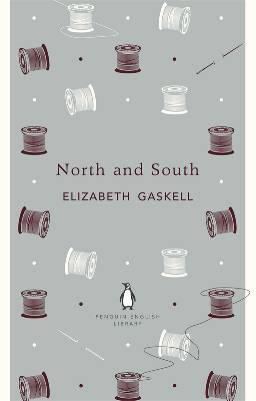
Showing posts with label adapted into TV. Show all posts

Sunday, 3 May 2026

CBR18 Book 24: "Platform Decay" by Martha Wells

Page count: 256 pages
Rating: 4.5 stars

Monthly Keyword 26: Decay

Thank you to Tor Books and NetGalley for this ARC. My opinions are my own. This book is out on May 5th, 2026.

Murderbot (who has installed a mental health module now, and keeps doing Emotion checks on itself) is on a rescue mission on a large artificial planet controlled mostly by Barish-Estranza. What starts out as needing to find and escort three people from the hostile territory becomes a lot more complicated when Murderbot is forced to agree to locate and rescue an additional group of people, some of whom are juveniles (I love how Murderbot refers to children) as well. As you can imagine, Murderbot, who is deeply uncomfortable with most people, is especially discomforted by children. 

I don't really want to go into further details about the plot of this one, because it's much better if you don't know too many specifics. As is often the case with new instalments of The Murderbot Diaries, this book starts very abruptly, and it takes a few chapters to understand what is really going on. And that's part of the joy of it. I won't reveal who Murderbot has been sent to rescue, and it would be a major plot spoiler to reveal who is in the second group.

It's been years since System Collapse was released, and to say that I was excited when I discovered I had been granted an ARC for this is an understatement. High-pitched squeals of excitement may have been heard by the rest of my family, and there may have been some bouncing up and down on the sofa. However, I also knew that if I read it immediately, I would forget a lot by the time I needed to review it, so I saved it until just before release, so everything would be fresh in my memory. 

Murderbot's voice (which is not for everyone, I have come to realise) is so clear from the very first page, and even when you're not exactly sure what is happening, it's just so comforting to be back in Murderbot's presence and let the story wash over you. I loved Murderbot's new Emotion checks (it has been through some stuff in the past few books) and how it is begrudingly forced to admit to itself (and us, the readers) that it has people it cares about now. That being a rogue and lonely SecUnit isn't exactly the best way to be.

This book is very funny, but also emotional and action-packed and as always, deeply anti-capitalist. I laughed a lot while reading it, and while Murderbot would clearly hate it, it is still my favourite snarky artificial intelligence. 

Judging a book by its cover: For the entire series, the covers have been Murderbot, in its distinctive suit, clearly in the middle of some action. Sometimes, the location is in space; sometimes, it's obviously on a planet. On some, Murderbot has company; on others, it is alone. On this cover, Murderbot appears to be in a shaft of some sort, with a ladder. It gives the reader a hint of what's going on in the story, without spoiling anything. 

Crossposted on Cannonball Read. 

Saturday, 2 May 2026

CBR18 Book 23: "Margo's Got Money Troubles" by Rufi Thorpe

Page count: 320 pages
Audio book length: 10 hrs 21 min
Rating: 4 stars

Nowhere Book Bingo 26: Adapted into movie or TV show (on Apple+ now)

19-year-old Margo Millet has an ill-advised affair with her English professor at college and gets pregnant. Against the advice of absolutely everyone, including her mother (a former Hooters waitress), she decides to keep it. Unfortunately, being pregnant and then a young single mother isn't especially attractive on the job market, and before she knows it, two of her roommates have also moved out, because they just can't handle the noise and the whole baby being there now of it all. She's at her wits' end, and while she loves her son, Bodie, she's also pretty sure she's made a huge mistake.

Then her estranged father, Jinx, a retired pro-wrestler, shows up on her doorstep and asks her if he can stay at hers, after yet another round in rehab. Since she needs both rent money and help with child care, she agrees to let him stay. She also decides to try making money through OnlyFans, where she uses advice from Jinx to craft her online persona. Soon she's making enough money to keep her head above water, but her English professor is threatening to sue her for sole custody of Bodie and her mother, who is getting married to a Christian pastor, threatens to disown her if she doesn't shut down her OnlyFans account immediately.

This book came highly recommended from many of my online friends, so when I saw it in an audiobook sale, I picked it up, despite being a bit dubious about the pastel-coloured cover and the unusual plot synopsis. Contemporary fiction with serious real-world problems?  Ill-advised affairs with your lecturer? Desperate young single mother? OnlyFans? Was this really a book I was going to enjoy? As so often happens, I then forgot I owned the book for quite a long time, until I read the announcement that the book was being turned into a TV series on Apple+, starring Elle Fanning, who also narrates the audiobook.

Apple+ has proven itself to be very good at adapting books I like in the past (I promise I am not being paid for this; I wish I were so lucky), and since I prefer reading the source material before seeing the adaptation, reading this in March seemed like a good idea. Since I listened to it in audio, it took me about a week to get through it, but I suspect that if I'd been reading it with my eyes, I would have got through it a lot faster. Despite its many serious issues, it is ultimately a very uplifting book. Margo may be young (and discovers fast that having a baby is for life, not just for Christmas), but she's very clever, and because of her unusual family situation (Jinx wasn't exactly a stable feature in her life growing up), she's learned to be independent and resourceful. She does the very best she can for her baby, even if that means coming up with creative ways to make people pay her for nudes on the internet. 

While two of Margo's roommates leave, one of them stays behind and even starts helping Margo in her new "working from home" career. Suzie is into fantasy cosplay and is able to lend Margo outfits and advise her on makeup and video ideas. She gets along well with Jinx, as well, which helps. Margo eventually meets and makes friends with other OnlyFans creators, and starts having actual fun when she comes up with a storyline involving a strange and horny space alien to attract more followers.

I wouldn't say that female empowerment is one of the main themes of the story, but it is absolutely a factor. Margo refuses to be dismissed by her baby daddy and his rich and condescending family just because she is young and does online sex work. She proves herself a fit and capable mother both to the custody lawyers and eventually to the CPS (who have had an anonymous tip that Margo's home life may not be safe for Bodie). 

Since I had seen the trailer for the show before I got around to reading the book, it was pretty difficult to create my own mental images for the characters. With Elle Fanning already voicing Margo in the audio, it would have been harder to picture her as someone else. Michelle Pfeiffer as her mother and Nick Offerman as her father also seem like spot-on casting, so I didn't mind them being my mental images for Shyanne and Jinx, either. Ironically, now that I have finally read the book, I'm too busy with correction work to actually watch the show until later this year. I'm glad I listened to the book when I did, though. 

Judging a book by its cover: Before I read the book, I always thought this was a really strange image to choose for the cover of the book. Now that I have read the book, I see how perfect it is, and how well it captures poor Margo's utter exhaustion.

Crossposted on Cannonball Read. 

Sunday, 9 November 2025

CBR17 Book 68: "One of Us is Lying" by Karen M. McManus

Page count: 368 pages
Rating: 4.5 stars

CBR17 Bingo: School (The Breakfast Club with murder. So much high school drama)

On a Monday afternoon, five high schoolers find themselves in detention after someone planted phones in their bags. They all claim the phones are not theirs, but the teacher is not listening. There is Cooper, the star athlete, with a promising career in baseball ahead of him. There is Addy, always perfectly put together and the homecoming princess. There is Nate, the school's bad boy, who is on probation for dealing drugs. There is Bronwyn, most likely to become valedictorian and hoping for a spot at Yale, where several generations of her family have studied. And finally, there is Simon, who runs the school's extremely accurate, and frequently cruel, gossip app. Everyone follows it, and while he may ruin reputations in the process, Simon never lies.

Less than an hour later, only four remain, after Simon is taken to the hospital after suffering severe anaphylactic shock. Strangely, while everyone was scrambling to try to save him, he didn't appear to have an EPIPen in his bag, and every single EPIPen in the school nurse's office was also found to be missing. By Monday evening, Simon is dead. The cause of death appears to have been peanut oil at the bottom of the paper cup he drank from, just before he collapsed. It was well known at school that he was deathly allergic to peanuts. The police don't think his death is accidental, and as the four remaining students from detention are questioned by the police, it becomes clear that Simon had planned to reveal a deep, dark secret about each of them the next day, so they all have motives for wanting him dead. He just hadn't had time to post the entry yet, but it's there on his computer for them all to see. 

Four teens, who previously barely spoke to one another, are now cast into the spotlight, all suspects in a murder investigation. Is one of them a ruthless murderer, or did someone else manage to sneak inside the classroom while everyone in there was distracted by a collision in the parking lot?

Mostly, I only read historical mysteries, set in the Victorian era, with lady sleuths. However, this year, not only have I read a lot more mysteries in general (24 so far), but the majority of them have been contemporaries. Thanks are due to Richard Osman and Karen M. McManus. This book was entertaining and twisty enough that I immediately ignored my planned TBR list for October to read the two sequels (which I won't be reviewing, because I don't need to). Book 1 is still the best, book 2 was a bit weaker and book 3 was pretty good again. 

McManus alternates chapters for each of the protagonists, the Bayview Four, as they come to be known in all the news reports. It allows us to share in their fears and insecurities, and makes us as readers understand why Simon revealing their secrets would be so devastating to them. One of them is likely an unreliable narrator, because it wouldn't be much fun if we found out who the killer was too early in the story. Very shortly after Simon dies, someone starts writing anonymous Tumblr posts claiming to be Simon's killer, revealing things that it seems only someone in the detention room would know. It also becomes obvious that Simon must have shared his password with someone, because all those secrets Simon didn't have time to reveal before his death are published, showing the world exactly what may have motivated one (or several) of the Bayview Four to want to poison Simon.

I've read quite a few mysteries, so there were a couple of twists in the story that I had predicted before they were revealed, but part of why this book is so entertaining isn't even the central mystery, it's getting to know Bronwyn, Nate, Addy and Cooper, and seeing these four very different people form an unlikely friendship because they are now murder suspects. It was also why I wanted to keep going with the series, I really liked all of them, and wanted to find out what more was in store for them.

I saw on the internet that this book was also turned into a TV series. It looks like they made big narrative changes to the story, though, which did not appeal to me. There are far too many good things out there that I don't have the energy or will to watch right now, I'm not going to watch a disappointing adaptation of a book I really enjoyed. 

If you're not put off by YA books and want a fun, slightly twisty read, this is worth picking up. 

Judging a book by its cover: I have the UK paperback cover, and I much prefer it to the American cover with the four faces in a grid (where the faces are all cut out, creepy much?) This is sparse and elegant, and while the tag lines are a bit hokey, they fit with the contents of the book. 

Crossposted on Cannonball Read. 

Sunday, 31 December 2023

CBR15 Book 103: "Heartstopper, vol 5" by Alice Oseman

Page count: 336 pages
Rating: 4 stars

Nick and Charlie are closer than ever, but despite what their friends think, they still haven't done THAT. Lately, it's probably all either can think about, but it's a big step and neither wants to pressure the other.

Nick is also a year older than Charlie, and is having to consider which Universities he's going to apply to next year. His first inclination is living at home and going to his local Uni, so he'll be close to Charlie, but he goes on a road trip with Elle and Tara, and discovers that there are very appealing places elsewhere in the country too. Elle finds her dream University, and it will mean a long distance relationship with Tao. Can Nick and Charlie manage the same?

Mr. Farouk is encouraging Charlie to apply for Head Boy in his final year, saying that a lot of students at the school could use a role model like him. He also wants to have the occasional sleepover at Nick's, but his mother is feeling overprotective and her reluctance causes tension between them. In the end, she agrees that he can stay over at Nick's once he's done with exams.

Charlie, not exactly the most extroverted or confident, thanks to all the bullying, also agrees to play drums for a queer band during the end-of-year summer féte. It's a much more public role than he's ever been in before, and he's both nervous and excited about the opportunity.

I hadn't realised that there was going to be a volume of Heartstopper out this year, so finding out that this was coming out in December was a pleasant surprise (even more that I found the book at half price at a shop in the UK while visiting my parents-in-law for Christmas). As it turns out, I had already read a lot of the issues collected in this book online on Tapas. The only reason I hadn't read all of them is that I took a break so more issues of the webcomic could be collected (one issue a week is too short). Oseman has announced that volume 6 will be the final one, and I'm now thinking that I may just stop reading the webcomic, so as not to be spoiled for the ending. 

I love this comic. It's so heartwarming and cute and the issues in this book are very low angst, even with questions of long-distance relationships being discussed. Nick and Charlie and their friends are such great characters and I'm glad queer youth have some nice examples of LGBTQIA fiction to comfort them. 

Judging a book by its cover: All the other covers have shown Nick and Charlie from the back, getting a bit closer with each volume. This is the first one where they are actually fully embracing, and I think the image is adorable. 

Crossposted on Cannonball Read

Wednesday, 11 October 2023

CBR15 Book 58: "Folk med ångest" (Anxious People) by Fredrik Backman

Page count: 350 pages
Rating: 5 stars

#CBR15 Passport Challenge: Books from different countries (set in and written by a Swedish author, read in Swedish)
CBR15 Bingo: Europe (see description for Passport Challenge)

Official book description (translated by me):
Folk med ångest (literally translated as People with anxiety, official English title Anxious People) is an unusually messy comedy about a hostage drama during an apartment showing, where a failed bank robber locks themselves in with an overly enthusiastic realtor, two bitter IKEA-addicts, a mean multimillionaire, a sad lady, a very pregnant woman, an infuriating git, and a rabbit's head. Eventually, the robber gives up and releases all the hostages, but when the police storm the apartment it is...empty. In a series of dysfunctional witness statements afterwards we get to hear everyone's versions of what happened, whereupon a classic puzzle mystery unfolds around the questions: How did the robber escape? Why is everyone so angry? And what is really WRONG with people nowadays?

This book is incredibly funny, whimsical, and uplifting. It also made me genuinely cry more than once because it's also about depression and desperation and sometimes feeling so bad and/or helpless that you just want to jump off a bridge. It's about loss, grief and loneliness. It's a work of fiction about made-up people, but based on the acknowledgments at the back of the book, it's absolutely grounded in personal experience, so the various characters feel real, with flaws and foibles. The book is about the importance of having someone in your life, be it friends, family members, or a good neighbour. 

The official book description doesn't give too much away, except for the rather unusual premise. Like others who have already reviewed this book, I really don't want to go into too much detail about the plot, because some of the joy of reading this book is discovering its twists and turns and having the story unfold before your eyes. The plot is non-linear, with seemingly unrelated little vignettes interspersed with police interrogations, the occasional flashback, and the omniscient author giving us necessary background information about the characters when it becomes pertinent to the reader. There is a mystery element to the book, but anyone expecting a mystery novel is probably going to be disappointed. 

The only other book of Backman's I've read so far is Björnstad, which is quite different from this in length, story, and impact. Yet both books show Backman's mastery of language and his skill at creating incredibly interesting characters, even some who are really rather despicable - they nevertheless feel complex and alive. While I was reading this book, several of my colleagues commented that the Netflix adaptation is very entertaining, although neither of them had actually read the book, so couldn't speak for how faithful the show actually is. I've purposefully chosen to read the book first, but now that I've finished it, I may spend the next week binging the show as well, because it would be fun to see how this twisty story got translated to the screen. 

This is only my second Backman novel, but based on the first two, I will be slowly consuming his other books, depending on which I can get from the library first. Might have to look up some sort of list to make sure the next one doesn't make me literally ugly-cry in parts, though.

Judging a book by its cover: The cover looks somewhat surreal, and has a number of absurd components, all of which actually play a part in the story. There is indeed a man with a giant bunny head on the toilet, there are citrus fruits in decorative bowls, there's a desperate robber with a gun. When I first saw it, it also made me incredibly curious to read the book. In comparison, the English cover is rather boring, with two people standing with their backs to the reader. This cover represents the farcical elements of the story in a much better way.

Crossposted on Cannonball Read

Tuesday, 10 October 2023

CBR15 Book 55: "Lessons in Chemistry" by Bonnie Garmus

Page count: 400 pages
Rating: 5 stars

#CBR15 Passport Challenge: Books recommended by friends

Elizabeth Zott is a chemist struggling to be taken seriously by her male colleagues at a lab in the 1960s. She never completed her degree because her academic advisor raped her, but her lack of degree in no way means she's not intelligent. Despite her brilliant mind, her male co-workers either treat her as nothing more than a lab assistant or steal her research and present it as their own. The one exception to this is Calvin Evans, another brilliant mind, although even more anti-social than Elizabeth. After a couple of rather unfortunate first run-ins, the couple actually begin to talk to each other and their natural chemistry proves very combustive.

However, life doesn't always play fair, and Elizabeth, who never wanted to settle down with any man and certainly never wanted children, finds herself a single mother trying to make a living from the private lab she built in her home. She's doing her best to encourage her precocious daughter, aided only by her faithful dog, Sixthirty, and eventually, a lonely housewife from across the street. Through a series of unlikely events, she becomes a television star, presenting the afternoon cooking show Supper at Six. Elizabeth refuses to talk down to her audience and uses scientific chemistry terms when explaining her recipes (“combine one tablespoon acetic acid with a pinch of sodium chloride”), and her unlikely approach seems to spell television success. While her producer is both baffled at her technique and terrified of her blunt honesty, yet staunchly supportive nonetheless, the station manager is not as happy with Elizabeth's unconventional presenting style or lack of respect for men in general.

Having read several very glowing reviews of this, I decided to put it on my wishlist for last year's Cannonball Book Exchange. Imagine my surprise when I got a lovely hardback edition (it was even signed) from the lovely Witcherwill/Mythili. I do hope she enjoyed the Pratchett books I sent her. As is so often the case, however, even if I own a book, I don't immediately start reading it. I had every plan of getting to it this year and therefore added it to my Cannonball Passport Challenge. Anyone who has followed my blog for some time knows I cannot resist a reading challenge, and will do almost everything in my power to complete as many as possible over the course of a year. It still took me until September to finally read the book, and once I started it, it was one of those books where I pretty much resented everything that took my attention away from it. I loved it so very much, and it's always much harder to write good and articulate reviews of books that I adore. I will happily savage a book I disliked, but with books like this, I just want to flail and scream at everyone I meet to read it (I have in fact insisted that two friends and four colleagues do just that).

I wanted to finish the book before the Apple TV+ adaptation aired, and as always with adaptations, I'm wary. I think Brie Larson will do an excellent job as Elizabeth, because she's a very good actress, but I'm not sure I trust them to fully capture just how good this book is. The trailer makes it look as if they've made quite a few changes, but I will try to keep an open mind. Should it be absolutely panned, I just won't watch it and pretend it never existed in the first place.

This is most likely going to be in my top 3 books of the year. It's an international bestseller and this is well deserved. It's funny and sad and infuriating and moving and I almost wish I hadn't already read it, so I could go back and read it again for the first time. Thank you so much, Mythili, for the gift of this book. 

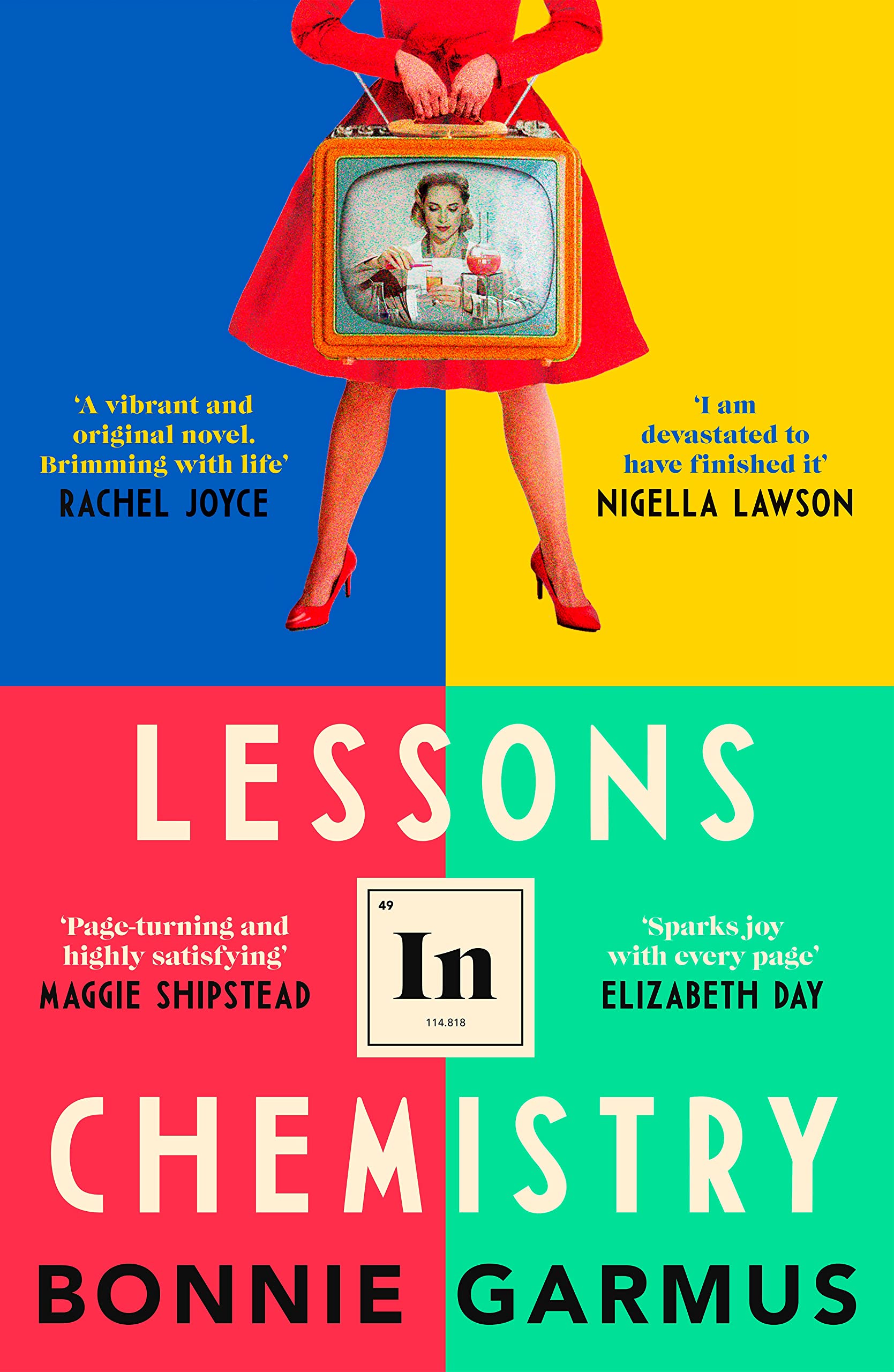
Judging a book by its cover: I think both covers for this book are somewhat misleading as to the sort of story you're actually getting. The American cover has a peach-coloured cover with just the hints of a woman's face, with cat's eye glasses and bright red lips. It makes the book look light-hearted and frivolous. The primary colours that make up the cover for the UK edition also seem to indicate a much more playful story, especially when you have the lady in the cheerful dress holding a television at the top. I'd heard good things about this book but was surprised at the actual contents after seeing the two covers. 

Crossposted on Cannonball Read

Sunday, 24 October 2021

#CBR13 Book 44 : "Björnstad (Beartown)" by Fredrik Backman

Page count: 470 pages
Rating: 4.5 stars

CBR13 Bingo: Sports Ball (could easily also be used as Rec'd, since a lot of Cannonballers have read and reviewed it favourably)

Official book description:
People say Beartown is finished. A tiny community nestled deep in the forest, it is slowly losing ground to the ever encroaching trees. But down by the lake stands an old ice rink, built generations ago by the working men who founded this town. And in that ice rink is the reason people in Beartown believe tomorrow will be better than today. Their junior ice hockey team is about to compete in the national semi-finals, and they actually have a shot at winning. All the hopes and dreams of this place now rest on the shoulders of a handful of teenage boys.

Being responsible for the hopes of an entire town is a heavy burden, and the semi-final match is the catalyst for a violent act that will leave a young girl traumatized and a town in turmoil. Accusations are made and, like ripples on a pond, they travel through all of Beartown, leaving no resident unaffected.

Beartown explores the hopes that bring a small community together, the secrets that tear it apart, and the courage it takes for an individual to go against the grain. In this story of a small forest town, Fredrik Backman has found the entire world.

See, if even if the actual blurb hadn't mentioned a violent act against a young girl (I'm sure you can all imagine what kind of an act this is, taking place at a party full of drunken teenage athletes and the girls that admire them), this book, when not making it super clear just how essential ice hockey as a sport and especially the junior team full of promising seventeen-year-olds are to the survival of the rather remote Björnstad (literally translated as Beartown), is foreshadowing something terrible happening from very early on. 

The book is slow to start, and at first I really wasn't sure why I needed to "get to know" quite so many different characters, as the point of view in this book changes constantly between both major and more minor characters. We see the world through the eyes of several of the hot shot hockey players, through the eyes of the ex-pro hockey coach who doesn't want to fire his aging mentor despite the wishes of the team sponsors; his successful lawyer wife, who as a working mother with her own thriving career really doesn't fit well with the other wives and mothers of the town; their cheerful musician daughter; her loyal best friend (with a troubled home life); the junior coach who's looking at a pretty guaranteed promotion once the junior team most likely wins the championship, but also through the eyes of one of the former youth athletes, now a washed-up alcoholic; the agoraphobic owner of the local sports pub and others. 

Nevertheless, I kept reading, and Backman certainly made me aware of all aspects of the little community and the hopes that all of these disparate people had pinned to a few sports games. Two things are made clear very early - if the junior hockey team doesn't win the championship, any chance at revitilising the town's failing economy is completely gone, and something very bad is going to happen to the head coach's daughter at some point. As we get closer to the victory party where the terrible deed is going to take place, I was grimly determined to keep reading until I got past the bad part, just so I could get it out of the way. Imagine my surprise when I looked up, noticed that more than three hours had passed and I suddenly had only about a third of the book left. That's the advantage of the rapidly changing points of view, you keep seeing events from more than one angle and after having "inhabited" all of these different people for the first third you really feel involved in all of their hopes and dreams and their humanity and you suspect you know exactly how bad the fallout's going to be.

In reviews, I've frequently seen Backman referred to as a funny writer. This book is a pretty solid slice of social realism, but I can see why he's such a popular author, with so many fans worldwide. I don't really care about sports at all, certainly not ice hockey. I only vaguely knew the rules before reading this book, yet understood the plays described perfectly.  I personally also suck at all kinds of physical exercise - I will never reach the level of skill these young athletes, even the reserve players, yet I understood their ambition and drive. The three very different coaches, the weary school teacher, the pub owner - they felt like people I might meet walking down the street. 

Backman writes about doing a lot of research and talking to a lot of sexual assault survivors, and I think he writes about the unforgivable acts at the party and its terrible aftermath very sensitively and well. While you might imagine this book being very "male-centric", the women of Backman's book are also all distinctive and never feel like tired stereotypes. One of the hockey players lost his father at a young age, and has as a result been raised by his widowed mum and three older sisters, all very formidable. There is the coach's wife, his daughter, her best friend, not to mention several other women, both likable and rather pitiful in these pages, and again, they all felt like Backman was writing about people who actually exist.

I had not imagined a book about sexual assault and small town hockey would engross me this much. Sadly, I had to return the second book to the library before I had a chance to read it, and am still waiting for a new chance to pick it up. I know Backman has confirmed that there will be a third book to finish the series, so now I may wait until that's out and binge the final two parts in one go. 

Judging a book by its cover: I've seen a number of different covers for this book, but this is the one that was on the library copy I had. The two scenes shown on the cover might not look very exciting, but they're both taken directly from the novel and while I wasn't too impressed with it at first, I now really like the cover design. 

Crossposted on Cannonball Read. 

Wednesday, 29 July 2020

#CBR12 Book 49: "The Last Wish" by Andrzej Sapkowski

Page count: 360 pages
Audio book length: 10 hrs 27 mins
Rating: 3.5 stars

#CBR12 Bingo: Repeat (since I've already covered the Adaptation square)

Geralt of Rivia is a Witcher. This means he roams about the countryside, travelling from place to place, killing monsters for profit. To become a Witcher, he was taken from his family as a child, and long training, magic and special potions make him a strong, fast and highly efficient killer. Based on the stories in this collection, it seems that once, there were a lot more Witchers, now they are rare and unusual, and Geralt is often feared and reviled by the villagers who hire him to help them. 

Geralt seems to have very few friends, with the exception of the bard Dandelion. He also seems to rest up at a convent, confiding his adventures to the Mother Superior every so often (this seemed to be the framing narrative of the stories).

I have very little knowledge of or experience with the popular series of games that were adapted from this. Nor have I yet started the Netflix series, despite the fine figure of Henry 'OMGHISGL' Cavill starring as Geralt. So I cannot tell you how accurate an adaptation of the source material the show is. I've heard good things, and while I found the frame narrative of this short story collection a bit confusing, I liked the way the author took various elements of folklore and established fairy tales and gave them his own twist. The original Polish books were written in the 1990s, and I wish the portrayal of women was a bit more nuanced. I've heard that the female characters of the TV show are quite varied, interesting and complex - so that's probably a good update.  

I listened to this in audio, and because it consisted of a series of short stories, it took me a few months to get through it. The narrator is generally fine, but I didn't much care for the way he does Geralt's voice, which becomes a bit of a problem when Geralt is the main character of the stories. I found the stories interesting enough that I'll probably get round to reading the rest in the future, but I'm not feeling any immediate need. 

Judging a book by its cover: Obviously, for something that has been out for as many years as this book, published in a number of countries and languages, there are also many different covers. After the Netflix series was produced, there are also several different tie-in covers available. On mine, Geralt is in the middle of fighting some legendary beastie, possibly a dragon. It looks dynamic and exciting. 

Crossposted on Cannonball Read. 

Thursday, 12 December 2019

#CBR11 Book 86: "Midnight Crossroad" by Charlaine Harris

Page count: 320 pages
Audio book length: 9 hrs 26 mins

Official book description:
Welcome to Midnight, Texas, a town with many boarded-up windows and few full-time inhabitants, located at the crossing of Witch Light Road and Davy Road. It’s a pretty standard dried-up western town.

There’s a pawnshop (someone lives in the basement and is seen only at night). There’s a diner (people who are just passing through tend not to linger). And there’s new resident Manfred Bernardo, who thinks he’s found the perfect place to work in private (and who has secrets of his own).

Stop at the one traffic light in town, and everything looks normal. Stay awhile, and learn the truth...

I really have read a LOT of Charlaine Harris' books. For my sins, I managed to force myself through the entirety of her Sookie Stackhouse series, just to see how it would end, long after I derived any enjoyment from them anymore. I've read her Lily Bard books, where apparently the character Bobo Whinthrop originates (I don't remember him, or much of the plot of the books at all). I have also read all of her Harper Connolly books, where Manfred Bernardo first appears (I vaguely remember him, but nothing of consequence). Generally, I find Harris' books perfectly entertaining while I'm reading them (except some of the later Sookie books, that pretty much just annoyed me), but shortly after reading them, I remember little to nothing of the plots.

Midnight Crossroad, which was adapted into the TV series Midnight, Texas on NBC (cancelled after two seasons) features a bunch of peculiar individuals living in the little town of Midnight in, you guessed it, Texas. Manfred Bernardo, a genuine psychic who makes his living telling fortunes over the phone and internet, moves there after the death of his grandmother. His new landlord is Bobo Winthrop, owner of the local pawnshop. One of Bobo's other tenants is a vampire, who lives with a gorgeous, but apparently very dangerous woman who travels a lot. There's Fiji Kavanaugh, who is a very powerful witch, but hides her actual powers by running a magic shop full of nick knacks. She has a talking cat. There's a nice gay couple, the rather strange reverend who gives non-denominational services at the local chapel (and conducts a lot of pet funerals), and Manfred falls pretty hard for Creek Lovell, the beautiful young woman whose overprotective father runs the gas station.

Harris' books always have a mystery element to them, as well. In this book, there's a group of neo nazis trying to harass Bobo, because they believe he knows the location of his crazy grandfather's legendary weapons arsenal. There's also a dead body found about a third of the way through the story, which turns out to belong to Bobo's ex-girlfriend, who he believed got sick of him and just up and left him one day. No one really believes that Bobo is guilty of murdering her, but it still takes quite a lot of time to figure out the guilty party.

As well as having been on my TBR list for years and years, this book fit into my Monthly Keyword Challenge in October. I listened to it on audiobook and it was perfectly fine, but really nothing more than that. Now, a month and a half later, I am hard pressed to remember any particular details - although I really did like Fiji's cat a lot - and the lisping way the narrator voiced him. My records show that over the years, I've acquired the entire series in various e-book sales, so I will most likely read the second two books eventually, as well, but I'm in no particular hurry to do so.

Judging a book by its cover: As with a lot of books, this one comes with several different versions of cover art. I think I like this one, with it's weird, crooked bird's eye view (which gives me a headache if I look at it for too long) of parts of the little town is my least favourite. Still, I own it in e-book, so it's not like I'll actually look at the cover a lot. I suspect Harris could sell books no matter what the cover art actually looks like.

Crossposted on Cannonball Read

Saturday, 3 August 2019

#CBR11 Book 59: "A Study in Scarlet" by Sir Arthur Conan Doyle

Page count: 124 pages
Rating: 3.5 stars

#CBR11 Book Club: Classics

Spoiler Warning! There WILL be mild spoilers for the plot of this story (which is from 1887, so you know, if you wanted to know the details, you've had enough time to look them up or just read the damn story). This is also the Cannonball Book Club selection for August, so I'm going to assume that most people who are interested in participating will read the book before then. If, however, you have NOT read the book yet, maybe skip this review until you have done the required reading. Proceed at your own risk.

So, for those, who like me, have never actually read A Study in Scarlet (I know I'm not the only one), a brief summary of the plot: Doctor John Watson is injured on service in Afghanistan and honourably discharged with a pension. Because he doesn't have a ton of money to live on, he requires someone to share a lodging with. A friend introduces him to the rather peculiar Sherlock Holmes, who for all his strange interests seems to be a perfectly fine living companion.

It turns out that Mr Holmes is a consulting detective, and will solve cases for people using the method of deduction. He usually only needs to hear the particulars of a case from the people who come to see him to solve their little problems, and this is how he supports himself. He is very proud of his intellect and proves to Watson that his methods are sound. Watson accompanies Holmes when he is approached by the police in a strange murder case.

A man has been found in an abandoned building. There is blood on the floor, but none of it is from the victim. The victim has not been robbed, he has all his money and valuables and there is even a woman's wedding band by the corpse. There are no signs of a struggle, but in a different room of the house from where the corpse was found, someone has scrawled "Rache" on the wall in blood. The two detectives on the case each have different theories. Holmes is smugly certain that he will solve the mystery easily for them, yet the two policemen will get all the credit from the authorities and public.

Within three days of first visiting the scene of the crime, Holmes has proven to Watson that his methods work brilliantly, and the murderer is in police custody (after having been lured to Watson and Holmes' lodgings). Watson, furious that his friend will not get proper credit, decides to write down and publish their adventure.

When we voted for book club this time, I voted for Jane Eyre. It came second, and this won out instead. I have never actually read any of the original Sherlock Holmes stories, and I don't even entirely know why. I love Victorian-set novels featuring lady sleuths, I tend to very much enjoy the modern TV and movie adaptations about one of the most famous literary detectives of all time, and I have even read a number of modern YA retellings. Yet, I seem to have convinced myself that the original source material would be dull and probably rather objectionable, owing to the sexism, racism, the belief in the superiority of the British Empire and so forth.

As it turns out, I was both correct and incorrect in my assumptions. For much of this story, I was a lot more entertained than I was expecting to be. While I have not seen the first episode of the BBC Sherlock series, A Study in Pink, for many years (the one starring Cumberbatch and Freeman), I have seen it enough times that I remembered the major plot beats. It was fun to see what the modern adaptation had chosen to keep from the source material, and which things were entirely different.

I will say that I actually thought the motive of the murderer was WAY better in A Study in Scarlet than in Moffatt's modernised TV adaptation. Can't really say that I was super happy about the fridging of a young lady (I am never going to be), but you have to respect the drive, tenacity and determination of a guy who is so sworn to vengeance and retribution that he spends the next twenty years of his life, and chases the guilty over quite a lot of two continents, refusing to give up, even when his own health is at risk. The method and elaborate staging of the crime scene, especially of the first murder, is also very well done.

What I didn't like so much was the incredibly clunky change of pace in the second half of the novel, when our intrepid investigators have in fact caught their man, and the novel decides to take the reader on an extended, slow and not all that interesting flash back to America, containing a rather ludicrous and false portrayal of Mormonism. It seems that Conan Doyle later in life admitted that he had been misled about the Church of the Latter-Day Saints, and he may also have issued an apology, but to a modern reader, it still smacks of poor research and unfortunate sensationalism (which is exactly the sort of thing I was worried about when reading something written by a man in the late 19th Century - their views were certainly not progressive or open-minded).

I don't think the structure of the book benefits from having an extended and drawn-out flashback for five out of the book's fourteen chapters, just as the story is getting really exciting. Especially when so much of what is relayed in those chapter is just patently false misinformation about a religious faith not that many of the readers in the United Kingdom necessarily knew all that much about at the time of the book's publication. Having a bit of the murderer's back story explored helps to understand his motive, but we didn't need a full third of the book devoted to this, one chapter would have been more than enough.

In the end, I was pleasantly surprised by this reading experience. It also doesn't hurt that the winning book for book club ended up being about a quarter of the length of the book I voted for. While it would have been nice to have an excuse to re-read Jane Eyre again, I'm not at all sorry I was finally pushed out of my comfort zone to read this - and I may in fact seek out some of the shorter (and hopefully slightly better structured Sherlock Holmes stories) in the future.

After reading this, it's was also amusing to discover that while neither of the Guy Ritchie movies (with Robert Downey Jr as Holmes and Jude Law as Watson) are based directly on the Conan Doyle stories, Downey Jr's portrayal of the detective may be the closest to what Holmes is like in the source material. Both he and Cumberbatch's characters spend a fair amount of time deducing, something Johnny Lee Miller's Holmes from what the husband and I have dubbed The Adventures of Mr. Elementary and Joan (because it really is more of a mystery of the week procedural with private detectives rather than a plausible adaptation of Sherlock Holmes - no one spends any time deducing, and they just do a lot of actual investigating). Reading this did make me want to catch up on the recent seasons that we're behind on, which isn't a bad thing, in itself.

Judging a book by its cover: Since it was originally published in the late 19th Century, this book has had a wide variety of covers over the years. This is from one of the Penguin editions, and features magnifying glasses and measuring tapes, both of which Sherlock Holmes frequently employs during his thorough searches of crime scenes.

Crossposted on Cannonball Read.

Saturday, 24 November 2018

#CBR10 Book 100: "The Cuckoo's Calling" by Robert Galbraith

Page count: 550 pages
Rating: 4 stars

#CBR10Bingo: Award Winner (LA Times Book Prize for Mystery/Thriller 2013 and an Anthony Award for Best Audio Book in 2014)

Supermodel Lula Landry topples from her third floor balcony and cracks her head open on the snow-covered pavement far below. Strangely, the paparazzi that were surrounding her apartment building earlier in the evening were nowhere to be seen when it happened. After careful investigation, the police rule the death a suicide, although the tabloids have all manner of conspiracy theories, the most popular being that she was murdered by her equally famous boyfriend. Lula's adopted brother disagrees with the police's verdict and is willing to pay a large amount of money to Cormoran Strike, a private detective and war veteran.

As Strike has recently broken up with his girlfriend of many years and is literally living in his office, knowing full well that he's about to have to declare bankruptcy, the case comes as a bit of a lifesaver. Nevertheless, he's not sure that his new client isn't delusional, and nobly tries to pass on the case to begin with. Lula's brother is adamant, and Strike is persuaded to look into the death, quickly discovering that there are things that the police seem to have missed and a lot of conflicting stories surrounding the event.

Along as an assistant, Strike has Robin Ellacott, as temporary secretary sent by an agency (because he forgot to tell them he couldn't afford anyone anymore) who turns out to be a lot more skilled and efficient that any of his previous ones. She's just got engaged to her long time boyfriend, who can't really see why Robin wants to keep working for Strike when she has a lot of other attractive job offers available. Robin seems to really enjoy her forays into investigating and gathering information, however, and while Strike is initially doubtful about even having her in the office (where they both pretend that it's not obvious that he's sleeping every night), he comes to really value her help.

I don't suppose it's much of a spoiler that Lula didn't, in fact, commit suicide. It wouldn't be a very good, or especially long, book if she did. PI checks if police's theory is correct. It is. The end. No one would bother reading that, no matter how famous the author was.

Because of course, as everyone knows by now, this is the first mystery novel that J.K "one of the richest people in the world" Rowling wrote, under a pseudonym. The book had been published, sold pretty well and received a fair amount of good reviews before the truth came out and the sales rocketed.

I'm one of these people who likes the Harry Potter books just fine, but they were not a transformative experience for me, and I don't love them as wholeheartedly and fiercely as a lot of my friends, both in real life and online. When ruthlessly culling my book collection when we moved, I got rid of all but the first three, because with book 4, the series starts getting needlessly bloated (book 5 is especially bad) and I just don't see myself wanting to reread them any time soon. When Gabriel is old enough, if he's interested in fantasy (which I hope to God he is, or we may have to leave him in the woods and try for another) we can always get copies at the library (or I can buy them second hand at a charity shop).

OK, my digression about HP over - I wasn't really sure what to expect from this book. As Cannonball Bingo turned into a bit of a challenge for me to tackle some books that have been on my backlist for a long time, it seemed like the right time to finally read this one. I used to love mysteries  as a teenager and in my early twenties and read them all the time. As I got older and the world has gotten more depressing, I find myself unable to deal with blood, gore misery and horribleness (which sadly often features in mysteries nowadays) and I want my escapism with a guaranteed happy ending. With the exception of J.D. Robb's futuristic In Death books or the occasional Victorian lady solves crimes with some handsome and probably surly gentleman by her side (all of these have a strong romantic element), I don't really read mysteries anymore.

I liked my first taste of Cormoran and Robin enough that I am curious to keep going with this series. This book could just as easily have been a "Cannonballer Recommends" choice, there are certainly enough of Rowling/Galbraith's fans among the other Cannonballers. While it can take me a good long while, I usually eventually get round to anything so beloved by others on the group blog. I already own the second book in the series, but doubt I'll get round to reading it until sometime next year. Having grown up watching British set mystery series on telly with my Mum, I'm also curious about the TV adaptations now. Can't watch it until I'm caught up with the books, though, don't want to be spoiled.

Judging a book by its cover: Since this book has been out for a good long while now, it's had a number of covers over the years. My copy is the original British paperback, I'm pretty sure, with a fairly generic city at night cover. There's some fancy buildings, a cast iron fence in the foreground, a hunched man in an overcoat walking away from us (I'm assuming this is Cormoran Strike himself), with a fancy streetlight casting the whole thing in a golden and atmospheric glow. I much prefer this to the more recent "TV series" tie-in covers.

Crossposted on Cannonball Read.

Sunday, 31 December 2017

#CBR9 Book 124: "Jessica Jones: Alias, vol 1" by Brian Michael Bendis and Michael Gaydos

Page count: 216 pages
Rating: 4 stars

From the blurb:

Meet Jessica Jones. Once upon a time, she was a costumed superhero...but not a very good one. Her powers were unremarkable compared to the costumed icons that populate the Marvel Universe. In a city of Marvels, Jessica Jones never found her niche.

Now a chain-smoking, self-destructive alcoholic with a mean inferiority complex, Jones is the owner and sole employee of Alias Investigations - a small, private-investigative firm specialising in superhuman cases. When she uncovers the potentially explosive secret of one hero's true identity, Jessica's life immediately becomes expendable. But her wit, charm and intelligence may just help her survive another day. 

Back when this comic came out in 2001, it was called Alias. I can only assume that the new title, adding Jessica's name, was done after the premiere and success of the Netflix series from 2015 (was it really that long ago already?), to allow new readers to more easily find their way to the comic. Ironically, of course, the show had to be called Jessica Jones as there was already an action show starring a female character out there called Alias. This book was a Christmas present from my husband last year, because of all of the Marvel TV shows with their many cool characters, Jessica Jones is probably my favourite, and he wanted me to be able to read the comics the show was based on.

For those who have watched the show, the character we meet in the pages of this book will be very familiar, even if the two cases she works on over the course of the nine issues collected here are different. Jessica is a loner, she's bitter, sarcastic, self-destructive and mean. She doesn't particularly enjoy her job, but needs to pay the bills somehow. She smokes, drinks too much and swears a lot. While she has a very suspicious nature, she is still fooled by a crying woman coming to her for help. It turns out that the case she's hired for, locating a missing woman, is in fact a ploy to potentially unmask a very famous superhero (and get him implicated in a murder case). The whole plot seems to be set in motion to discredit the current president. Jessica is none too pleased about being used, but refuses to provide a proper alibi for herself by releasing the tape she has proving her whereabouts when the missing woman she was hired to locate turned up dead (but which will also reveal the hero in question's identity).

For Jessica's second case over the course of the book, a distraught woman shows up at Jessica's office trying to locate her husband, Rick Jones, who she claims is somehow related to Jessica (this is news to our heroine) and a former superhero sidekick who may now be in terrible danger. While she's unsure of how wise it is to get involved, Jessica nevertheless takes the case.

While I really enjoyed and read through all nine issues of this book very quickly, I especially miss some of the supporting characters from the Netflix show in this book. There is no Trish here, Malcolm is basically an over-eager fan who pops up in Jessica's office occasionally and asks to be allowed to be her assistant, and Luke Cage only makes a brief (but rather memorable appearance).

I know that a lot of things only borrow loosely from their source material, and I suspect that much of what ended up on the TV show will happen later in the comics. In 2018, I clearly need to get further trades of Alias to see where the stories become more similar.

Judging a book by its cover: Since I watched the Netflix series first, in my head, Jessica Jones looks like Krysten Ritter. But you know, I guess the original artist gets to decide what she looks like to the creators. Can't really argue with it. It's not the most thrilling of covers. I'm not sure it would make me pick up the book unless I was already interested.

Crossposted on Cannonball Read.

Monday, 1 May 2017

#CBR9 Book 36: "The Handmaid's Tale" by Margaret Atwood

Page count: 370 pages
Audio book length: 12 hrs 08 mins
Rating: 5 stars

There's been a whole bunch of reviews posted for this book already, so I'm not going to spend a lot of time recapping the plot in my own words. Goodreads can help me out here:

Offred is a Handmaid in the Republic of Gilead. She may leave the home of the Commander and his wife once a day to walk to the food markets whose signs are now pictures instead of words because women are no longer allowed to read. She must lie on her back once a month and pray that the Commander makes her pregnant, because in an age of declining births, Offred and the other Handmaids are valued only if their ovaries are viable. Offred can remember the years before, when she lived  and made love with her husband, Luke; when she played with and protected her daughter; when she had a job, money of her own and access to knowledge. But all of that is gone now...

I've kept putting off this review, because I know it's going to be a really difficult one to write and I want to do the book justice. Obviously, I had heard of The Handmaid's Tale long before Hulu announced that they were going to adapt it into a mini-series (the first episodes of which are now available to view, not that I have the emotional strength to do so yet). One of my favourite works of literary fiction of all time is The Blind Assassin, another of Atwood's novels, but this is probably still her most famous and well-known work, all the more so now that it's become all too terrifyingly timely.

Written back in 1986, the book was meant to be a work of speculative fiction, a dystopian sci-fi with a more feminist bent than 1984 or Brave New World (Atwood herself claims this book isn't really just about women's rights, but human rights, and I wonder why it's so scary to her to be furthering the feminist cause). Who knew that with the current political climate, this book feels more scarily prescient now than ever before. The grim dystopian future of this novel seems to be lurking just around the corner, much more likely to come to pass now, than in 1986, when the book was written.

As I already mentioned, I don't think I in a stable enough place emotionally to watch the TV adaptation. Listening to the book (this is the new all-cast edition), for the most part narrated by Claire Danes, was difficult enough. To begin with, in the first chapters, the dry, slightly detached way Danes narrates Offred's words felt a bit off-putting, but I understand why she chose to do it the way she has - it gives the readers the impression our narrator may be in shock or emotionally cut-off in some way, which I suppose you might be if your days were those of Offred and the other Handmaids.

Stripped of everything, even her name, Offred is nothing but a walking womb. She's not allowed to smoke or drink alcohol, she's fed a nutritious, rather unexciting diet to ensure she stays healthy. She has to go for a walk every day to stimulate the circulation. Every month, there is "the Ceremony", where she has to lie in the lap of the Commander's wife, holding the hands of a woman who clearly resents her presence, and be raped by the Commander, in order to conceive a child. It's suggested in the book that each Handmaid is living on borrowed time. If she doesn't successfully conceive within three years, she's sent away to "the Colonies" to clear away nuclear waste, along with the other undesirables in society.

Women have no rights in the Republic of Gilead. While Serena Joy, the Commander's wife, lives a life of privilege, she cannot give birth herself, hence the need for a Handmaid. While she's rich and prominent, the house and all the money belongs to her husband, the Commander. She's not allowed to read or make any of her own decisions and is in many ways more confined and house-bound than Offred, who at least gets to walk outside once a day (never alone, always in the company of another Handmaid). Women are divided into three categories. The wives, the Marthas (domestic servants, no good for childbearing) and the Handmaids - women who before the fall of the old society had proven their fertility, but were considered fallen in some way. Only the most prominent members of Gilead can be assigned a Handmaid. Poorer men can have econo-wives (not much was said about these women).

In a society where the American government is already trying to police women's reproductive rights, limiting the rights to abortion and contraception, where Vice President Mike Pence states that he cannot have a meal alone with a woman who's not his wife, and wealthy Western women travel to India or other poor countries to have women act as surrogates for them, the grim reality of this novel no longer really feels like speculative fiction, but a glimpse into a future we must fight to avoid. It no longer seems like a strange and unlikely scenario, which is obviously why both the novel and the TV adaptation feels all the more important right now.

I cannot say that this book was a pleasant reading experience and while listening to it, I pretty much had it confirmed why I've put it off for so long. It's a terrifying and harrowing story, and not at all meant to be easily digested entertainment. I wanted to have read the source material before watching the TV adaptation, though, and it feels like this book should be required reading for everyone. I'm just worried some people will see it more as the blueprint for the new and controlling society they want to introduce, rather than as a warning.

Judging a book by its cover: There's been a lot of editions published of this book over the years, and the covers are almost always excellent. My Audible audio edition has a very simple cover, with the bright red background and the silhouette of a handmaid, the only white being her distinctive hood and the lettering. It's a very stark, yet nevertheless effective image. This book doesn't need a fancy cover to sell its contents.

Crossposted on Cannonball Read.

Tuesday, 27 December 2016

#CBR8 Book 125: "Greven av Monte Christo (The Count of Monte Cristo)" by Alexandre Dumas

Page count: 945 pages
Rating: 4.5 stars

Young sailor Edmond Dantés is well-meaning, kind and really rather naive, wanting nothing more than to make enough money to take care of his elderly father and marry his beloved Mercedes. There are other, less well-meaning people in his life who want what he has and are prepared to frame Dantés for treason to get these things. While celebrating his engagement to Mercedes, Dantés is arrested, charged with aiding in a plot to restore the exiled Napoleon to the throne. The anonymous scheming may have come to nought, except a letter in Dantés' possession frames the father of the judge who hears his case, and said man decides that the best thing to do is burn the letter, and lock Dantés away, before the precious judge is implicated in the scandal. So thanks to a drunken, malicious prank and an unscrupulous judge, Dantés is locked up away in a dark dungeon for fourteen years, where he nearly goes mad, while his father dies alone and destitute and his Mercedes marries another.

Dantés probably would have lost his mind if not for the friendship with another prisoner, the Abbot Feria, who, when trying to dig an escape tunnel, instead ends up in Dantés' cell. The two strike up a friendship and Feria, a very learned man, teaches the fairly inexperienced sailor everything he knows. He listens patiently to Dantés' story of how he ended up being imprisoned, and explains exactly how he will have ended up being framed, turning Dantés' thoughts immediately to escape and revenge. Initially, the two are planning to escape the prison together. But the Abbott is old and sick and dies before they have a chance to get out. He tells Dantés of a great treasure, hidden away on the island of Monte Cristo. Once Dantés escapes, he goes there, and discovers riches beyond his wildest dreams. After fourteen years, with everyone who ever knew him believing him long dead, Dantés can start truly plotting his revenge.

Ten years after the escape, the mysterious and brooding Count of Monte Cristo appears in Paris and soon the lives of three prosperous and successful gentlemen start falling apart completely.

I'm convinced that it is more than twenty years since I first read this book, when I was still young and patient and felt that the longer the book, the better, frankly (this was back when I also happily read my mother's three volume edition of Les Misérables in about four days while stuck at my gran's in the west of Norway, a book I only got about a third of the way through once I tried re-reading it a few years back. To be fair, this was a time long before wifi and smart phones, the only thing to do when in the west of Norway was to read. What else was I going to do, hang out with my douchy cousins, or worse yet, my little brother?) When the Cannonball Book Club poll for Classics ended up picking the LONGEST book of all of the ones nominated (I want to point out that I picked The Age of Innocence by Edith Wharton - at a neat 350 pages), it wasn't like I had a choice but to read the book, and I certainly wasn't going to opt for some abridged version. That would be cheating. This is also why this book will now forever be known to me as the book that ate November.

I actually started it in mid-October, but it became really obvious that as long as I was allowing myself to read other books as well, I was just never going to get through the nearly thousand pages of 19th Century French adventure fiction. Hence the only books I finished in November except this, were the ones I listened to in audio. In the end, I completed the book on November 30th, the day before our book club discussion. The Norwegian translation I read was done in the 1950s, but was thankfully not too difficult to get into, once I got used to some of the more old-fashioned terms. The first third or so, until Dantés finally escapes prison and goes to the island to find the treasure, moves along at a fair clip and is quite exciting. The problem came when he returns after ten years, and Dumas spends a lot of time re-establishing all the characters (who obviously no longer go by the same names they did at the beginning of the book, that would be far too easy) and setting the stage for Dantés' truly masterful revenge scenario. Once the book really gets going on that, it's all pretty thrilling, right up until the end.

It's not for nothing that this is known as one of the great revenge stories of all time. It was also, obviously written in a time when books like this, sold in instalments, were the big network entertainments of their day. Over the course of eighteen months, people would only get sixty pages at a time. That's a long time to wait to see how Dantés deals out righteous vengeance on the guys who did him wrong and made themselves rich and successful thanks in part to his misfortune. I wish I could say that I read it, considering where the instalment breaks would have been and fully aware of how the entertainments of our day have changed (all points covered in our excellent book club discussion), but I totally didn't. I mainly just forced myself through it, in between correcting a LOT of essays and audio book listening, wanting to get through the early Paris sections, where I had to use Wikipedia to help me keep track of the names of all the various parties, their many family members and how exactly they were soap operaishly connected to one another through double dealing, scheming and adultery, so I could understand everything fully once the Count's plan really kicked into gear.

While I don't love it as much as I did when I was a teenager, it's still a great book and for a book written in the mid-19th Century, it has an interestingly varied portrayal of both male and female characters. I was especially excited to see that Dumas apparently thought nothing of having Eugénie Danglars, the daughter of one of the men who wronged Dantés, escape the whole sorry revenge plot by running off with her companion on what I'm assuming will be one heck of a lesbian bohemian adventure. Valentine Villefort, one of the other prominent ladies, is so good and kind and true she makes your teeth hurt, but a lot of the other ladies, not least Mercedes, Dantés' lost love, are very impressive in their own right, this is not just a book about dudes.

While I was initially despairing, as it felt like that my November was pretty much this and correction work, I'm very glad that the Book Club pick did end up being this book, so that I got a chance to finally re-read it. I'd kept telling myself I was going to, and then never getting round to it, because it's sooo long. I also have plans to watch the TV adaptation starring Richard Chamberlain (clearly the go-to actor for Dumas adaptations in the 1970s - as well as playing Dantés, he was Aramis in the Musketeers movies directed by Richard Lester and he also starred in the dual role in The Man with the Iron Mask), but as New Year's is rapidly approaching, I needed to get these reviews completed - no time to watch movies before I blog. I honestly don't know what the abridged versions of the novel leave out, it seemed to me that once you with hindsight can see what is being set up, even the parts of the novel that dragged while reading them were really quite important. I would therefore recommend that you allow yourself the time to read the full version if you try the book. It's worth the effort, I promise.

Judging a book by its cover: For years and years and years, I've been a member of what is called the Norwegian Book Club, which is more of a subscription service for books than an actual club where people get together to read the same book every month and discuss it. It should also be noted that because a) Norwegian hardback books are terribly expensive and b) I barely ever read Norwegian books, I automatically cancel the books of the month every single time. I get the e-mail, I go to the website, I cancel the books. Very occasionally, i use the accompanying website to buy presents for people. All of this is to explain that my two volume edition of Greven av Monte Christo (which is the Norwegian name for the book) is one that I got when I became a member many many years ago, and the cover is nothing very exciting. A silhouette of a man. The background on volume one is dark blue, the background on volume two is golden yellow. Apart from that, they are identical.

Crossposted on Cannonball Read. 

Sunday, 15 November 2015

#CBR7 Book 115: "4:50 from Paddington" by Agatha Christie

Page count: 351 pages
Audio book length: 7 hrs 8 mins
Rating: 2 stars

On her way by train to visit her old friend Jane Marple for Christmas, Mrs Elspeth McGillicuddy is shocked to realise that she's witnessing a murder in the train running parallel. A tall, dark man in a dark coat is strangling a blond woman in a fur coat and there is nothing Mrs McGillicuddy can do. As soon as the train stops, she notifies the ticket inspector and the station master of what she saw, and when she arrives at Miss Marple's, the two talk to the police and report the crime.

No one else appears to have witnessed anything amiss, however. No dead bodies have been found on the train, and no women have been reported missing. There are suggestions that perhaps Mrs. McGillicuddy imagined what she saw, but she is adamant she witnessed a crime, and her friend Miss Marple, far too experienced with the dark deeds that people commit, believes her. Once her friend leaves to visit her children after Christmas, Miss Marple starts her own investigation. She discovers that the train the murderer would have been on comes to a sharp turn shortly before it enters the station in the town of Brackhampton. There is a sloping hill where a body could easily have been dumped.

As Miss Marple is old and incapable of going around to snoop for a dead body herself, she engages the assistance of a young friend, Miss Lucy Eyelesbarrow, a highly intelligent and competent woman whose made a name for herself as the perfect domestic servant. She can perform the duties of housekeeper, cook, nursemaid or nanny for the people she works for, always leaving the household much better off than it was when she left. Because of her dedication and skill, she's in high demand, but has some free time because of the holidays and Miss Marple's problem intrigues her. She manages to secure a post with the Brackenthorpe family, who live in the manor where Miss Marple suspects the body has been hidden. When Lucy finds the dead woman in an antique sarcophagus in one of the manor's outbuilding, there are several mysteries that need to be unravelled. Who is the dead woman, who none in the Brackenthorpe family claim to recognise? How did she end up hidden in their barn? And last, but not least, who murdered the young woman?

Lucy Eyelesbarrow acts as Miss Marple's eyes, ears and legs in the case, while the godson of Miss Marple's good friend, Inspector Craddock, is in charge of the investigation on behalf of the Scotland Yard. As in most good Agatha Christie mysteries, there's a fairly large cast of characters who could all be guilty of the murder, and the blond woman on the train is not the only one who ends up dead.

This audiobook was bundled with The Man in the Brown Suit, a kind gift from my BFF Lydia. As a young teenager, I voraciously devoured all the Agatha Christie novels in Norwegian translation in my local library, and I was pretty sure I'd read most of the books in her bibliography. I know I much preferred the stand-alones and the Poirot books to those with Miss Marple, and at no point when listening to this book, did I remember anything that made it likely I'd read it before. They do all blend together a bit, but I really think this was the first time I came across this particular story. While Agatha Christie didn't really write any bad books, this one very much suffered from being listened to right after one of my all-time favourites. While Lucy was an engaging enough character and Miss Marple obviously is a very clever old lady, a sedate manor mystery set in the English countryside set shortly after Christmas just cannot compete with Anne Beddingfeld's adventures in South Africa with diamond theft, cruise ships, civil unrest in South African and dashing young men in brown suits.

Crossposted on Cannonball Read.
Wednesday, 9 July 2014

#CBR6 Book 69: "Emma" by Jane Austen

Page count: 496 pages
Audio book length: 16 hrs 39 mins
Rating: 4 stars

So does anyone actually need me to recap the plot of Emma, a nearly two hundred year old classic which has been adapted any number of times, currently as a successful YouTube webseries in Emma Approved? To be fair, I'm not sure even half of my actual real life friends have read this book, so I'll be nice to you.

Emma Woodhouse is twenty-one, the youngest daughter of a prosperous country gentleman and her governess, Miss Taylor, who more or less raised her from she was very little, has just married Mr. Weston. Emma, happily full of herself and far too prone to take credit for anything fortuitous that happens near her, claims that she made the match between the two, and wants to continue her occupation as the neighbourhood matchmaker by finding a wife for Mr. Elton, the local parson. Mr. George Knightley, the Woodhouses' closest neighbour, whose brother John is married to Emma's sister Isabella, believes this to be a terrible idea and is the only one who's not afraid to tell her so.

Emma also needs a new companion, as her erstwhile friend is off sorting out a household of her own. She takes the young Harriet Smith, one of the boarders of the local girls' school under her wing, and intends to improve her social standing enough that she will make a suitable spouse for Mr. Elton. She certainly doesn't want Harriet to marry the well-to-do farmer, Mr. Martin, who seems very smitten with her. Emma herself doesn't intend to ever marry, although most of her friends and acquaintances seem to believe she and Frank Churchill, Mr. Weston's son from his previous marriage, would make a very handsome and suitable couple.

Jane Austen famously described Emma Woodhouse as "a heroine no one but myself will much like", and Emma really is an obnoxious brat, especially in the first third of the book. Her mother died when she was only a few years old, and it's quite clear that neither her father nor Miss Taylor ever really managed to curb her impetuousness and stubbornness. Mr. Knightley, sixteen years her senior, seems to be the only one in her life who is willing to risk her displeasure by telling her the harsh truths that she clearly doesn't want. She claims that he loves to find fault in her, but in reality, he's the only one who's not afraid to acknowledge that she's spoiled, with very poor self-insight and that she's too young to really know what's best for those around her.

The good thing about Emma is that she does learn from her mistakes, eventually. Plus, because she is such an insufferable know-it-all in the first half of the novel, the reader actually delights in her being wrong and making poor decisions. It's clear that she's in no way malicious, she's just always been able to boss everyone else around her into agreeing with her, either because of her position in society or the force of her personality. She's young and has lived a fairly sheltered and extremely privileged life, but her fairly spectacular failures in match-making force her to mature and grow as a person. I still think she has a ways to go by the end of the novel, but she's no longer someone I want to slap. And even at her worst, Emma Woodhouse is at least not Fanny Price, the dullest and wettest of all the Austen heroines, hands down.

I decided to re-read Emma, which I last read at University, when taking English lit courses, because I'm enjoying Emma Approved so much at the moment. I was curious to remind myself how the original story really goes and wanted to mentally prepare myself on what's to come. Bonnie and The Chancellor's recent Cannonball reviews didn't hurt either. I'm glad I did revisit it, as I responded to it quite differently now, twelve years later. I had completely forgotten the bit towards the end where Knightley confesses that he may have actually been in love with Emma since she was thirteen years old (when he will have been 29 - not cool, George). I'm pretty sure I don't remember that from my previous reading of the book, and I'm not ok with that bit. Emma is not my favourite of Austen's works, first place will always belong to Pride and Prejudice, but it's a great book and I'm so glad I revisited it.

Crossposted on Cannonball Read.

Saturday, 16 November 2013

#CBR5 Book 135. "North and South" by Elizabeth Gaskell

Page count: 544 pages
Audio book length: 18hrs 18 mins
Rating: 5 stars

Young Margaret Hale's life is turned on its head when her father, a parson from the South of England, renounces his position because he experiences a crisis of faith. He moves his anxious wife and dutiful daughter to the factory town of Milton Northern, where he's going to work as a tutor. The town, a bustling result of the Industrial Revolution, is full of cotton mills, soot and smoke, a stark contrast to the pastoral idyll of the Southern English countryside. With the loss of Mr. Hale's living, the family is in severely reduced financial circumstances, (not helped by the fact that they keep sending money to Margaret's brother who is wanted for mutiny in England, and as a result living in exile in Spain) and can't really afford more than a modest lifestyle. Margaret bravely adapts fairly quickly, but her mother never feels happy or comfortable in Milton and her health gradually deteriorates.

In Milton, the main social interaction the Hales have is with Mr. John Thornton, a mill owner who leases from Mr. Hale's best friend, Mr. Bell (Margaret's godfather). Thornton's father drove his family into debt and further caused scandal when he committed suicide. Thornton had to quit school, and take a position as a shop clerk to support his sister and widowed mother. Putting aside most of what he earned, he slowly and quietly worked to repay all his father's debts and became a respected and formidable man in Milton. His mother is a proud and arrogant woman who loves her son fiercely, constantly worried some fortune-hunting young miss will get her claws into him.

Mr. Hale tutors Mr. Thornton, and they develop a close friendship. Margaret initially has difficulties relating to him, however. Thornton thinks Margaret is very beautiful, but aloof, distant and too caught up in her sheltered and genteel way of thinking, while she thinks Thornton is cold, arrogant, coarse and too hard on his workers. Before Margaret moved with her parents to Milton, she lived with her wealthy aunt in London for ten years, until her cousin Edith married an army captain and moved to Corfu. In the north, she has very few friends. Mrs. Thornton is dismissive of the Hales, and Miss Hale is spoiled, self-centred, vain and not in any way interested in the prim and serious Miss Hale. The only friends Margaret makes are of a lower class than her, Mr. Higgins and his consumptive daughter Bessie, and they become more of a charity project for her than confidantes and support to her.

I was surprised at how useless both of Margaret's parents are. Her father upends his family's entire life because of a point of principle, but once they arrive in Milton and it turns out that their new life is going to be difficult and not at all what he'd planned, he withdraws into his studies and teaching, leaving poor Margaret to deal with the complicated practicalities of managing the household with their meagre finances, the inability to secure extra help in the house, her mother's depression and deteriorating health and the worry about Frederick. She sees the deep love between her parents, and because of that, she won't accept a marriage proposal from a man she doesn't love. Shortly after leaving her aunt's house in London, she rejects the proposal of Mr. Lennox, her cousin Edith's brother-in-law, as she cannot see him as anything but a friend. So when Mr. Thornton is persuaded by his mother and sister that Margaret must be infatuated with him, he proposes, and is vehemently rejected. By the time Margaret is ready to reconsider his advances, a number of coincidences and complications has made Thornton believe that she loves another and is lost to him.

I discovered the BBC adaptation of North and South, with the darkly handsome Richard Armitage (currently most famous as the broodingest exiled dwarf king evah in The Hobbit) and the lovely Daniela Denby-Ashe a few years ago, but it's taken me until now to actually read the novel. I got the audio book narrated by the excellent Juliet Stevenson, who varies between crisp arch tones for the southern characters and wonderful northern accents. I was surprised at how nuanced the book is, for a Victorian novel, both Margaret and Thornton's feelings are very clearly depicted. I really hadn't expected so much insight into the emotions of both main characters. Gaskell's novel is typical of the time, showing a lot of social responsibility, with the social developments after the Industrial Revolution, the clashes between the factory owners and the workers, the hardship of a strike and so forth, but it doesn't feel like it's sermonising and lecturing the reader. I will absolutely be reading more Gaskell in future.