Page count: 186 pages
Rating: 4 stars
#CBR10Bingo: Two Heads Are Better Than One
So my final review of #CBR10Bingo requires some assistance, and I will be joined by my husband Mark ("Hello!"), who also gave me the book we're co-reviewing. I figured I should start with some background. I hadn't watched any of the now hugely popular children's television program Doctor Who until I went to University in Scotland in the late 1990s, early 2000s. Of course, this was because at that point, the show wasn't actually on the air, and anyone who wanted to watch it, or get other friends interested in it, probably had to own the show on VHS.
Some of my Scottish friends did their best to introduce me to a bunch of sci-fi. Before going to St. Andrews, I'd really only watched Babylon 5. (They managed a lot better with Doctor Who than with Star Trek. Even being showed a bunch of episodes of both The Next Generation and Deep Space Nine, I wasn't really all that interested). If memory serves, I was shown Spearhead from Space with Jon Pertwee, the Third Doctor and The Curse of Fenric with Sylvester McCoy, the Seventh Doctor (there were probably more, but those are the two I can clearly remember). Nevertheless, I hadn't really watched all that much of it before it was relaunched in 2005, even though it was one of my then-boyfriend, now-husband's favourite shows. As well as being a huge fan of the modern show, in the 18 years my husband and I have been together, I've now also watched a lot of the classic series (but by no means all, probably not even half). I also really enjoy the Verity! podcast - Lynne M. Thomas, one of the contributors to that show, co-edited Chicks Dig Time Lords, and the anthology also features essays from several of the other "Verities". I should probably let my husband contribute a bit, though, shouldn't I?
(cracks fingers)
(Right. This is on now, right? Is this on? Can you hear me at the back? Yes? Good)
OK. So, my Good Lady Wife asked me how long I have been a fan of the Popular British Children's Television Programme Doctor Who. The answer is...quite a while. Yessirreee. Several of your Earth whiles, plus a few more. Since the mid-1980s, to be specific, then a bit more in the 1990s. I can politely but firmly assure you that being a Doctor Who fan during the '90s, when the show wasn't even on the air, was not a surefire way of winning friends. But I stuck with it, thanks largely to a comprehensive lack of anything better to do, and my patience was rewarded in 2005 when the show finally returned to the airwaves. Only this time around, I had a proper, human female, girlfriend to watch it with. The novelty still hasn't entirely worn off.
Is that why you gave me this book for Christmas last year? You wanted me to share in the geeky experiences of long time fans of the show, many of whom are either people whose voices I've heard on podcasts, or authors whose books I've read and enjoyed?
Well, "share in the geeky experiences" is definitely a nicer way of putting it than my usual choice of "bathe together in the stinky nerd-mud of mutual shame", so thanks for that. But...well, sort of yes, and sort of no. After nearly two of your Earth Decades together, we've bonded over our mutual nerdery in many ways, and our respective fondness for The Popular British Children's Television Programme Doctor Who is only one of them. But it's still a biggie, as witnessed by your earlier reviews of Doctor Who In An Exciting Adventure With The Daleks, Adventures With The Wife In Space, and The Dying Days (which I just went back and verified was my first Cannonball for CBR2!) . And given how much we both enjoy the Verity! podcast, and its still-more-noteworthy-than-it-really-should-be emphasis on a female perspective on this show we both love, I thought this might appeal to you.
Plus, you know, I wanted to read it myself. But not in a Homer-buying-Marge-a-bowling-ball sort of way. Honest.
I'll give you the benefit of the doubt. The book is an anthology containing essays, articles and interviews, and being mostly a fan of the new show, and not super involved in all levels of the fandom (fan fiction, the comics, the fanzines, podcasts, conventions etc.), there were absolutely some bits that didn't really resonate with me, simply because I had very little frame of reference for them. I think the entries that worked the best for me were the ones that talked about sharing the show with family, like those of Carole E. Barrowman (John Barrowman/Jack Harkness' sister), Amy Fritsch (who talks about introducing the show to her daughter, named for actress Elisabeth Sladen, and taking her to conventions). My favourite essay in the whole collection is probably the one by Verity! contributor Lynne M. Thomas, who talks first about how she married a huge fan, and discovered just how warm and accepting the Doctor Who fandom is when they had their disabled daughter). That contribution genuinely had me in tears, I was so moved. Deborah Stanish, another Verity! wrote a good one, and I also enjoyed some from famous fantasy/sci-fi writers Seanan McGuire (who was apparently in love with Adric as a teenager, not to mention thinking the show was a documentary for a while, because it ran on PBS) and Mary Robinette Kowal.
There were quite a few entries I was mostly indifferent about, or that didn't interest me all that much because I've never, for instance, read fan fiction of any kind (so essays covering that were unlikely to thrill me). There are several interviews, which seemed a bit like filler to me, but my least favourite essays were probably the one by Jackie Jenkins about a Bridget Jones type character included in Doctor Who Magazine and Kathryn Sullivan's essay about fanzines (soo dull). What about you, husband o' mine?
Well, I'm grudgingly forced to publicly acknowledge our mutual compatibility - and we both know how much I hate doing that - by admitting that Lynne Thomas' essay was probably my favourite thing in the book too, for reasons relating largely to its obviously heartrending loveliness. I also shared your disinterest in the "Jackie Jenkins" piece (although when it comes to that one I may have to play the "NO GREATER NERD" card and point out that I was failing to be amused by JJ's "what if Bridget Jones But a Doctor Who Fan" gimmick long before you even met me). But yes, Lynne's piece was absolutely lovely - now that the two of us are BONDED FOREVER by our parental duties to a child who will, with any luck, grow into a formidable Doctor Who fan in his own right, it resonated with me in ways that may not have been quite so powerful a couple of years ago.
I also thoroughly enjoyed Verity! host Liz Myles' essay on the experience of being a Doctor Who fan both pre- and post- the 2005 revival, which resonated with me in ways that I suspect largely passed you by. Although Liz and I obviously differ on many specifics - why would anybody, however tentatively, even try to ship the 5th Doctor and Tegan, for example, when the manifestly superior pairing of Tegan/Nyssa is right there, leaping out of the screen and begging to be noticed? - I nonetheless recognise a great many of my own experiences in her story, in much the same frustrating-but-familiar way I experience whenever I'm shouting at the radio in furious agreement with her contributions to the Verity! podcast (Oh, Liz. How dare you be so obviously right, in such an ever-so-slightly wrong way/so obviously wrong, in such an ever-so-nearly-right way! It makes me SO MAD).
So in conclusion, while the husband may in fact have bought me the book as a Christmas present at least 50% because HE wanted to read it (and considering when he went out for the last presents last year, something like 10-15% desperation, just needing to find something appropriate for my last present), I was actually happy to receive it, interested in reading it and ended up very much enjoying most of it. Sadly, the essays only cover the modern series up to the announcement of Matt Smith as the newest Doctor, there's nothing about his era on the show, Peter Capaldi, or obviously the current Doctor, Jodie Whitaker (whom I love, even if the quality of the show in general right now is...questionable). If Mad Norwegian Press were to publish another anthology with similar essays for the Steven Moffat years, I would love to read it.
Hey, does this mean I get the last word? Awesome. I want it to be "bogeys".
Also, while I obviously wholeheartedly deny any implication of desperation attached my purchase of this present, I'm very glad you enjoyed it as much as you apparently did. Given that this book ends on a note of what I would politely suggest may be termed "unwarranted optimism" regarding the potential feminism of the then-impending Steven Moffat era (while I think there are more credible feminist arguments to be made in defence of Moffat's writing than are sometimes acknowledged, I also think it's worth admitting that...well, there are also some good reasons why "defensiveness" might be considered the default stance on that front), I'd also be interested in reading the sister book Chicks Unravel Time, in which several of the same contributors (and a few others of considerable interest to you, not least Diana "those books about that sexy Highlander and his marginally-less-sexy time-travelling wife you love so much" Gabaldon) continue to get their collective Who geek on, alongside you at some point. But don't worry, I'll buy that one for myself. Or let you buy it for yourself. Whichever happens first.
Oh, and "bogeys". Always, and forever, "bogeys".
Judging a book by its cover: The cover is very cute, with a ton of geeky Doctor Who references, obviously. I really like the art style. The title is on the psychic paper, the girl is wearing the old fashioned 3D-glasses used by the Tenth Doctor, and obviously she's got one of the long knitted wool scarves made so famous by the Fourth Doctor. Finally, she has a TARDIS key on a string around her neck.
Crossposted on Cannonball Read.
Showing posts with label CBR10Bingo. Show all posts
Showing posts with label CBR10Bingo. Show all posts
Saturday, 1 December 2018


Thursday, 29 November 2018
#CBR10 Book 103: "Attachments" by Rainbow Rowell

Rating: 5 stars
#CBR10Bingo: So Popular!
This is my second re-read of Attachments. I first read it back in 2011, and my original review can be found here. Considering how much I loved the book back then (and still do), it's a fairly short and unenthusiastic review. But it'll give you the basics of what the book is about.
When it came to selecting a book for the "So popular!" square, all ten choices (among the most reviewed books of the ten years on the Cannonball blog) were ones I'd already read at least once. Some, like Divergent, The Girl on the Train and Gone Girl, I really just didn't feel like reading again. Some, I'd already read more than once, and it seemed unnecessary to revisit them. I had decided to reread Eleanor & Park, the only Rainbow Rowell novel that I've only read once before. However, only about fifteen pages in, the main reason why I've never really wanted to pick it back up (and why it's my lowest rated of all of her books) started upsetting me too much (Eleanor's incredibly horrible home life, especially her awful stepfather) and I realised that I just had to pick one of the other books on the list if I was to be able to complete my bingo card.
Hence I picked up Attachments once more. Goodreads helpfully showed me that it's been more than five years since I last read it and I was interested in seeing if I still loved it. Short answer, yes. I am a huge fan of the romantic comedy as a genre and am so very ready for it to come back into popularity (Netflix seems to be doing what they can to help, I am grateful). This book would make a great film, as long as it was adapted by the right people. I'd be terrified that they'd mess something up and ruin it, but recently, there's been a lot of good romantic book adaptations, so with any luck, I'd end up with something that was possibly EVEN better than the source material (like Crazy Rich Asians or To All the Boys I've Loved Before)
This was Rowell's debut novel, and when I read it, I had no idea that she would become one of my favourite writers, with each and every new book just resonating with me on a special level. In each and every one of her books, there seems to be scenes that speak directly to me, and in some, I possibly identify a little bit too much. The book where this most holds true, is Fangirl, but with this book, I see so much of myself and my best friend Lydia in Beth and Jennifer's friendship. While they e-mail each other daily, she and I became friends through letters (because this was in the before times, when the internet was not readily available and we had to wait weeks for a letter from the other one). Now of course, we have not one, but two different Facebook chats going (one also includes our husbands) at any given time and we try to video chat at least once every week or so. Technology is a wonderful thing. If we worked in the same place, though, we would totally be sending the sort of e-mails that Beth and Jennifer exchange, and you'd best believe we'd trigger any filter that looked for inappropriate words or content.
I absolutely adore this book, and the fact that I can still be friends with Lydia, even if she found the book "just ok" is a testament to the length and strength of our connection. Cause not loving Rainbow Rowell should quite possibly be some sort of deal breaker. Are Lincoln's actions in the book a bit uncomfortable? Yes. This is addressed within the story. Is the fact that he falls in love with Beth without even knowing what she looks like still super romantic? Yes. Does it all possibly end a little bit too conveniently? Probably, but that's a staple of the romantic comedy genre.
Rereading Attachments made me feel the need to immediately listen to my audiobook copies of Fangirl and then Carry On right after. I have no intention of reviewing either of those books again, because frankly, having just returned to work a little over a week ago, I'm pretty much constantly tired and it's a miracle I'm getting any reading, let alone blogging done. Suffice to say, I still love them just as much as before too. I will at some point be at a place where I'm mentally and emotionally strong enough to tackle Eleanor's home life in Eleanor & Park again and then I will reread that too. But I'm not there yet.
Judging a book by its cover: I have the UK paperback of this book, and much prefer it to the original American edition with the paperclips and empty office chairs. I like the bright colours and the little silhouettes, although I'm not entirely sure why the little man character is wearing a suit, something I'm pretty sure Lincoln never had to do, working the night shift and mainly reading other people's e-mails.
Crossposted on Cannonball Read.
Saturday, 24 November 2018
#CBR10 Book 100: "The Cuckoo's Calling" by Robert Galbraith

Rating: 4 stars
#CBR10Bingo: Award Winner (LA Times Book Prize for Mystery/Thriller 2013 and an Anthony Award for Best Audio Book in 2014)
Supermodel Lula Landry topples from her third floor balcony and cracks her head open on the snow-covered pavement far below. Strangely, the paparazzi that were surrounding her apartment building earlier in the evening were nowhere to be seen when it happened. After careful investigation, the police rule the death a suicide, although the tabloids have all manner of conspiracy theories, the most popular being that she was murdered by her equally famous boyfriend. Lula's adopted brother disagrees with the police's verdict and is willing to pay a large amount of money to Cormoran Strike, a private detective and war veteran.
As Strike has recently broken up with his girlfriend of many years and is literally living in his office, knowing full well that he's about to have to declare bankruptcy, the case comes as a bit of a lifesaver. Nevertheless, he's not sure that his new client isn't delusional, and nobly tries to pass on the case to begin with. Lula's brother is adamant, and Strike is persuaded to look into the death, quickly discovering that there are things that the police seem to have missed and a lot of conflicting stories surrounding the event.
Along as an assistant, Strike has Robin Ellacott, as temporary secretary sent by an agency (because he forgot to tell them he couldn't afford anyone anymore) who turns out to be a lot more skilled and efficient that any of his previous ones. She's just got engaged to her long time boyfriend, who can't really see why Robin wants to keep working for Strike when she has a lot of other attractive job offers available. Robin seems to really enjoy her forays into investigating and gathering information, however, and while Strike is initially doubtful about even having her in the office (where they both pretend that it's not obvious that he's sleeping every night), he comes to really value her help.
I don't suppose it's much of a spoiler that Lula didn't, in fact, commit suicide. It wouldn't be a very good, or especially long, book if she did. PI checks if police's theory is correct. It is. The end. No one would bother reading that, no matter how famous the author was.
Because of course, as everyone knows by now, this is the first mystery novel that J.K "one of the richest people in the world" Rowling wrote, under a pseudonym. The book had been published, sold pretty well and received a fair amount of good reviews before the truth came out and the sales rocketed.
I'm one of these people who likes the Harry Potter books just fine, but they were not a transformative experience for me, and I don't love them as wholeheartedly and fiercely as a lot of my friends, both in real life and online. When ruthlessly culling my book collection when we moved, I got rid of all but the first three, because with book 4, the series starts getting needlessly bloated (book 5 is especially bad) and I just don't see myself wanting to reread them any time soon. When Gabriel is old enough, if he's interested in fantasy (which I hope to God he is, or we may have to leave him in the woods and try for another) we can always get copies at the library (or I can buy them second hand at a charity shop).
OK, my digression about HP over - I wasn't really sure what to expect from this book. As Cannonball Bingo turned into a bit of a challenge for me to tackle some books that have been on my backlist for a long time, it seemed like the right time to finally read this one. I used to love mysteries as a teenager and in my early twenties and read them all the time. As I got older and the world has gotten more depressing, I find myself unable to deal with blood, gore misery and horribleness (which sadly often features in mysteries nowadays) and I want my escapism with a guaranteed happy ending. With the exception of J.D. Robb's futuristic In Death books or the occasional Victorian lady solves crimes with some handsome and probably surly gentleman by her side (all of these have a strong romantic element), I don't really read mysteries anymore.
I liked my first taste of Cormoran and Robin enough that I am curious to keep going with this series. This book could just as easily have been a "Cannonballer Recommends" choice, there are certainly enough of Rowling/Galbraith's fans among the other Cannonballers. While it can take me a good long while, I usually eventually get round to anything so beloved by others on the group blog. I already own the second book in the series, but doubt I'll get round to reading it until sometime next year. Having grown up watching British set mystery series on telly with my Mum, I'm also curious about the TV adaptations now. Can't watch it until I'm caught up with the books, though, don't want to be spoiled.
Judging a book by its cover: Since this book has been out for a good long while now, it's had a number of covers over the years. My copy is the original British paperback, I'm pretty sure, with a fairly generic city at night cover. There's some fancy buildings, a cast iron fence in the foreground, a hunched man in an overcoat walking away from us (I'm assuming this is Cormoran Strike himself), with a fancy streetlight casting the whole thing in a golden and atmospheric glow. I much prefer this to the more recent "TV series" tie-in covers.
Crossposted on Cannonball Read.
Wednesday, 21 November 2018
#CBR10 Book 99: "Tante Ulrikkes vei" by Zeshan Shakar

Rating: 4 stars
#CBR10Bingo: Home, Something, Home (this book is set at Stovner in Oslo, three stops away from where I live on the metro. It also concerns exactly the sort of pupils that I teach.)
Two youths, both living in the same tower block in a suburb on the east side of Oslo, in Stovner (where the large majority of inhabitants are immigrants or the children of immigrants). They start out going to the same high school. Starting in the year 2000, the framing device consists of these two teenagers, later young men, being asked to take part in a social studies survey, to map out the formative conditions for children and teens in these eastern suburbs, where the social divide between the white inhabitants of Norwegian descent and the poorer residents (mostly from minority language backgrounds, either first or second generation immigrants from the Middle East, South Asia and/or African countries) keeps getting bigger and more pronounced.
Mohammed ("It is tradition to name the first born Mohammed, and the Prophet is revered by all Muslims, but really, if they are so concerned with me going out and getting a good job and everything, I'm not entirely sure why they would give me that name"), who goes by Mo, writes his answers to the survey as e-mails. He is articulate, intelligent, rather shy and does very well in school. His parents have extremely high expectations of him, and early on, at least, they seem well on course to being fulfilled. Mo does well enough at high school that he wins a special scholarship, established for academically gifted children of immigrants, enabling him to go to University. He even gets to shake the prime minister's hand during the scholarship ceremony.
Our second protagonist, Jamal, doesn't really like to write, so he records his answers on tapes that are sent to the researcher in pre-paid envelopes. His answers are informal, irreverent, full of vernacular slang - a sociolect. His father is out of the picture, after a history of domestic violence. There's just him, his increasingly depressed and ineffectual mother and his much younger little brother, whom Jamal has to step up and help raise. He has to take him to nursery every day and pick him up in the afternoons. He does most of the shopping, and even occasionally attends meetings at the nursery, and later his little brother's school, because his mother isn't really up to the job. While he complains in his reports, he doesn't do it too loudly and swears the researcher to secrecy - no one wants the state to come and take his brother away from the family. After years of struggling through primary and secondary school and getting nowhere, only to find things harder and even more frustrating in high school, one day he has enough and just quits. He gets a job washing cars at a local garage, and is initially, at least, happy to be earning money.
The book follows these two young men over a period of about six years. We see how they view the world, and how they feel about the attitudes towards immigrants prevalent in society. We learn about their hopes, their dreams, their fears and how they feel about their families. Mo studies statistics and economics at the University of Oslo and loves it (at least to begin with). Jamal works at the car wash, gets stoned with his friends, listens to rap music and wants to be a gangster. At the same time, however, he's doing his best to make sure his little brother is fed and that the staff at nursery and later, school, doesn't report that the boy has problems speaking and occasionally wets himself when he's nervous. Jamal gets frustrated at his mother's refusal to be a proper parent.
In addition to winning a prestigious literary award for debutant writers, Tante Ulrikkes vei (the address of the tower block that both the protagonists live in) has sold a phenomenal amount of copies in Norway. A crowd funding effort has ensured that every member of Parliament receives their own copy (which is good, because far too many politicians have no idea what the day to day life of some of the poorer kids in the "wrong part of town" is actually like). It has garnered rave reviews in pretty much everywhere, and once I started reading, I could easily see why. Not only is it a very engaging and well-written book, it's so incredibly important, because the politicians in Parliament are not the only ones who could use an insight in what growing up as the child of immigrants, especially in a both socially and economically disadvantaged families.
Mo's family are not exactly poor, but various circumstances mean they need to rely on support from the government to get by. Tuition fees at Norwegian colleges and universities are less than what it costs to buy a 30-day travel ticket on Oslo public transport, but the scholarship Mo receives allows him to focus entirely on his studies, without needing to work part-time on the side (something he initially suggests doing, but his father is vehemently against. Nothing should take the focus away from his studies, the rest of the family will get by with less, if it means making sure Mo has what he needs at Uni.
Jamal's family, on the other hand, sometimes barely have the money to pay rent and/or get groceries. While he's still in high school, he gets a small stipend to help him, but once he drops out, Jamal has to get a job to help supplement his mother's increasingly meagre benefits. Due to the stigma surrounding mental illness and the fear of child protective services, Jamal and his mother work very hard to hide just how dismal the family's home life actually is, and due to the very poor communication between school, social services and others who could get clued in and intervene (probably making the lives of both Jamal and his brother much better), nothing really changes. For a brief while, Jamal is promised help from a discretionary fund at the local mosque, but after some negative press articles, the mosque loses its additional funding, and it all comes to naught.
Both youths struggle with their families' and society's expectations of them. They are children of immigrants, growing up in Norway, bombarded with two very different and often disparate cultures. Representation is hugely important in fiction, and the two protagonists in this novel could not feel more real to me. In my ten years as a teacher in the Oslo educational system, teaching kids mainly from the east side of the city, I have met several examples of both of these boys. I have seen these kids graduate our secondary school several times.
Some are academically gifted and do well, fulfilling their families' hopes and expectations. Some are gifted and can't take the pressure, dropping out and struggling. Some are like Jamal, functionally illiterate, abrasive, taught to feel inferior and like losers from an early age, because they cannot keep up with the increasingly harder demands both of what they're to learn and how they're to behave in school. They are naturally fed up, and many (especially the boys) drop out of school. Yet others, who get sufficient support, either at school or from other places, manage to find the motivation and eventually mature enough to apply themselves, and end up doing well. I'm never happier than when I meet a former student of mine, often the ones who were very challenging and seen as "trouble", very much like Jamal in this book, and can catch up with them about how they are doing - which tends to be very well indeed.
As of yet, this book is not available in English, but I've read several articles telling me that it will be. There will be an area (or areas) like Stovner, and kids like Mo and Jamal in most cities in most countries around the world. While this book is set in Oslo, the themes it covers are universal.
Judging a book by its cover: The cover is a sort of a pinkish beige, almost the colour of a pale brick. It's very simplistic, with a cover drawing that looks pretty much like something a child would draw if asked what their house looked like. We see a tower block and a small swing set. The rest is blank, except for the title of the novel, which is printed on what looks to be a street sign. This is a novel that has sold on word of mouth, not exactly because of the flashy cover design.
Crossposted on Cannonball Read.
Saturday, 17 November 2018
#CBR10 Book 97: "Between the Bridge and the River" by Craig Ferguson

Rating: 2 stars
#CBR10Bingo: #CannonBookclub
I voted for this book in the most recent Book Club poll because Craig Ferguson's autobiography is hugely enjoyable and one of the best ones I've read/listened to (I have the audiobook, narrated by Ferguson himself), and as a result, I was curious and excited at the chance to read a work of fiction by him. Unlike some who have already reviewed this book (by now quite a few, I'm yet again behind on my reviews), I didn't really watch a lot of Ferguson's stuff as a late night host (although I've seen quite a few fun interviews he's done on YouTube and the song he did about Doctor Who). I'm not sure exactly what I was expected from the book (the blurb is not very informative), but it certainly wasn't what I actually got.
This book was a completely different reading experience from most things I've read (and as long time followers of my blog know, I read quite a lot). It's a whole bunch of things, all of them weird and strange, none of them particularly enjoyable. There's a road trip element, there's magical realism, surrealism, there's various literary allusions (to Dante's Divine Comedy, among other things). It's a satire covering celebrity culture, organised religion and cults, the media and there's a whole load of swearing, other coarse language and violence. Sadly, the only characters Ferguson sees fit to develop in any way are all male, women are all given short shrift, but if they're lucky they escape being sexually violated and/or murdered. There is so much misogyny, sexism, homophobia (there may have been transphobia too, I'm not going back to check) and racism in this book. Ferguson seems obsessed with sex and/or violence and while I'm sure he intended it as edgy and provocative, wanting to shock the reader - it all just comes across as needlessly vulgar and quite sad.
I struggled to get into the book, not really caring for any of the various male protagonists, but once I got a ways into the book, I kept going mainly out of morbid curiosity as to how Ferguson was going to tie everything together (and in the vain hopes that the book would eventually get better). While taking part in the book club discussion, I discovered that this book was initially intended to be the first part in a series. While I stubbornly read this book to the end (and don't blame any of the readers who had to put it down partway through), I most certainly would not have read a sequel.
I said in my review of The Dud Avocado that the late AlabamaPink and I certainly appear to have a vastly different taste in books. This book just confirmed it, and I must admit, if we're doing Book Bingo again next year (which I REALLY hope we do), I hope that we aren't forced to read any more of the books she got through during her painfully cut-short year of reviewing. At least, since I am lucky enough to have access to my American BFF's New York library login, I was able to get this as a loan, and didn't have to pay money for it. I suspect my review would be a lot angrier if I'd have to part with money to read this.
Judging a book by its cover: The book was in parts disgusting, boring or just very, very odd - the cover is simply boring. I'm not entirely sure what it's supposed to be showing - someone falling over and looking up at their hand and foot while doing so? It's not great, but then, neither is this book, so if it keeps people away from it - bonus?
Crossposted on Cannonball Read.
Thursday, 8 November 2018
#CBR10 Book 95: "The Long Way to a Small, Angry Planet" by Becky Chambers

Rating: 4 stars
#CBR10Bingo: Cannonballer Recommends (this was a CBR Book Exchange gift from Yesknopemaybe (my paperback copy), it has also been favourably reviewed by MathildeHoeg, ingres77, dAvid, badkittyuno, belphebe, emmalita, narfna and faintingviolet, among others)
Rosemary Harper is trying to escape her old life and doesn't want anyone tracking her down. She pays a lot of money to get a new identity and gets a job on a run-down and patched up spaceship, where no one from her old life would ever think to look for her. Aboard the Wayfarer, with its eclectic, but mostly affectionate crew, she finds a sense of community and a found family she never knew she was missing.
What starts out as mostly routine space travel becomes a lot more dramatic when the crew get an amazing, yet dangerous, job opportunity. Hired to make a wormhole tunnel to a distant planet, currently involved in a vicious civil war, could make the crew a huge amount of money. They have to survive to spend their earnings, though.
Science fiction is a genre I really would like to enjoy, but which I keep struggling with. Every so often, a book or a series comes along that I genuinely enjoy, but so much of the time, the genre just leaves me cold, or maybe bored out of my mind. I also much prefer sci-fi on screen, on TV or film. I tried reading Leviathan Wakes, the first book in The Expanse series, and it just didn't do anything for me. The TV series, on the other hand, I'm hugely enjoying (to the point where I am now furious, because the husband and I are halfway through season 2, and they suddenly yanked it from Norwegian Netflix - how am I going to get the rest of it now?) and it brings the characters and story alive for me in a way the book just didn't.
When I first heard about this book, there was only the one book in the series. There are now three, and in the time since I got the first book on sale, a whole bunch of people whose opinions I trust and respect have reviewed it in glowing terms. Frankly, a book that seems to appeal to so many different people just has to be good, right? So it was an obvious choice for my "Cannonballer Recommends" square (especially since I've been trying to cull my ever expanding TBR list a bit while planning the reads). Nevertheless, I was worried that I was going to be a lone voice who didn't see what all the fuss was about.
Happily, this book worked for me and I enjoyed it a lot. I know I own the second book in the series as well, and am now looking forward to getting to read that in the near future. I suspect that the kind of sci-fi that works for me, is the strongly character driven stuff. Yes, this book features a dangerous tunnelling mission into unknown space and there are potentially hostile aliens who could harm our crew, but that is all secondary to the relationships between the actual crew members and the various interpersonal events that take place. While the ship and the various alien planets are obviously described, not that much time is spent on the technical aspects of things and boring tech stuff. This book cares much more about the various people aboard the Wayfarer, who we get to know through the eyes of Rosemary, and the people and androids they interact with on various planets and ships along the way.
There are absolutely dramatic events that take place over the course of this book, but I cared more about how they impacted on the characters I came to know and enjoy, than for the events themselves. Because I really enjoyed the crew, even the more disagreeable members, I could happily just keep reading about them bimbling about in space. I was sad to discover that the next books, while set in the same universe and sort of loosely connected with this book, don't actually focus any more on the crew of the Wayfarer. Still, Becky Chambers writes sci-fi that I enjoy, so I will give the other books a chance as well. It's not often that I find something I'm excited to read more of in this genre (Narfna's going to be so excited!), so I need to stick with the things that actually work for me.
Thank you, Yesknopemaybe, for my book (you had no idea of knowing I already owned an e-book copy of it). Having now read and enjoyed it, I'm delighted to have a physical copy I can lend to my non e-book reading friends.
Judging a book by its cover: I have two copies of this book, with two different covers. The e-book that I got in an e-book sale back in 2016 has this lovely cover design, with the soaring sky above a tiny, lone person in silhouette. I love this cover. My paperback has the newer cover, which feels like it's pretty much all clunky font and no grace or elegance. I'm assuming the publishers chose the redesign for a good reason, but as far as I can tell, some versions of the sequels also have the pretty, sky-filled cover designs still, so clearly some markets prefer these to the "giant font" ones.
Crossposted on Cannonball Read.
Tuesday, 30 October 2018
#CBR10 Book 93: "This One Summer" by Mariko and Jillian Tamaki

Rating: 4 stars
#CBR10Bingo: Snubbed- it won the Eisner Award in 2015, but was also nominated for a whole host of other things that it lost out on.
Spoiler warning! There will be some spoilers for the plot of this book (which I knew next to nothing about going in, myself), because it will be impossible for me to discuss the contents of the story and my reaction to it without referring to certain plot points in detail. If you want to approach this without knowing anything, maybe skip this review or at least the paragraphs I've tagged.
Every summer Rose and her parents go to Arwago Beach. They have their set rituals and it's Rose's favourite time of the year. Her friend Windy is also there, and she and Rose are inseparable all summer. Something is different this year, though. There's a tension between Rose's parents and they keep fighting when they think Rose can't hear them. For a while, Rose's dad actually leaves, so there's just Rose and her mum at the cabin. Rose is also a lot more fascinated by what the older teens of the area are up to, which creates a certain friction between her and Windy.
This could easily have been a pick for the "Fahrenheit 451" square of the CBR10Bingo, as it was the most banned and challenged book in America in 2016. People get upset and offended by the strangest things. Yes, this book features teenagers drinking (and possibly taking drugs, I forget) and having sex and it also features teenagers dealing with the consequences of said actions. I would thing a realistic depiction of youths doing what young people are wont to do, and an exploration of what that could lead to would be something to welcome. There are a number of good discussions to be had based on the events of Rose's summer.
Here be spoilers! I didn't really know much about the plot specifics of this book. I knew it was very critically acclaimed and that it had been banned and challenged. It was a Cannonball Book Exchange gift from MathildeHoeg in 2016. Based on the cover, I thought maybe it dealt with LGBTQ issues (but no, Rose and Windy are not lesbians). Instead it deals with teen pregnancy, which I suppose is why it's so horrifying to some.
The subplot that really affected me, however, and which made me very glad that I didn't read this when I actually got the book, is the one regarding Rose's mother and the reason she no longer seems herself and refuses to go swimming any longer, and why she's arguing a lot with Rose's dad. Turns out, Rose's parents have been dealing with fertility problems for years, which has been taxing their relationship a lot, and Rose's mother is still getting over a miscarriage, which happened while she was in a pool. Eventually, she does go in the water, for a very important reason, but I don't want to spoil the specifics of that, as well.
I feel very grateful that in the many years that my husband and I struggled with fertility problems and I kept resolutely not getting pregnant, no matter what we tried - various fertility monitors, diets, exercise plans and later several courses of IVF, complete with invasive hormone treatments, painful injections, gruelling egg extractions and a substantial financial drain, I never miscarried. I didn't get excited about the possibility of life growing inside me, only to have to deal with knowing that the pregnancy was cut short. I just never conceived (until I finally did - he will be nine months old next week!). Nevertheless, reading about Rose's mother's quiet grief absolutely did me in. I don't think that's an issue that will affect most readers, but to me, especially because I didn't know to even expect it, that storyline really gut punched me and made the book a very different reading experience than expected. End spoilers!
This One Summer is a lovely coming of age story, wonderfully written by Mariko Tamaki and possibly even more beautifully illustrated throughout by her sister Jillian. Rose and Windy's escapades over the summer are fun to share, Rose's curiosity about the older teens is very natural, and I found the parents' amused reactions to their daughters' antics very relatable at this stage in my life. Highly recommended for anyone who likes good writing and pretty artwork.
Judging a book by its cover: Jillian Tamaki's art is excellent throughout the book and the cover beautifully captures the magic of summer when you're young. Friendship, freedom, the chance to bathe and relax. The art was one of my favourite things about this whole book.
Crossposted on Cannonball Read.
#CBR10 Book 92: "The Hate U Give" by Angie Thomas

Rating: 5 stars
#CBR10Bingo: Fahrenheit 451 (one of the ten most banned or challenged books in 2017)
Starr feels like she's living two lives, and in a way she is. She goes to a prestigious private school along with her siblings, where they are among the only black students. She has a white boyfriend, who calls her "Fresh Princess", thinking she's a bit like Will Smith in The Fresh Prince of Bel Air. She lives in a poor and rough neighbourhood, where drug dealing and gun violence isn't unusual. Her black friends wonder if she thinks she's too good for them. Starr's father spent much of her early childhood in prison, now he runs the local grocery store and admonishes his kids to stay out of trouble.
Starr genuinely tries, but her life is irrevocably changed when she rides home with her old friend Khalil from a party, and they are pulled over by a cop. Khalil is unarmed, but shot by the police officer, right in front of Starr. The cop keeps his gun aimed at the hysterical girl until reinforcements arrive. Starr's uncle is a cop, but now she has trouble trusting anyone in uniform. She has nightmares and is worried about the attention the incident is getting. The media is portraying Khalil as a thug, drug dealer and a gangbanger. The white cop claims he saw Khalil reaching for something, and that he feared for his life. The local community are protesting, and demanding justice for Khalil. Starr is the only witness. She wants to stay anonymous, but she also wants the cop who shot her friend to face consequences.
I got this book shortly after it came out in 2017, and kept hearing amazing things about it. However, I also knew that it was not going to be an easy read, and while I was pregnant last year, it was difficult or downright impossible for me to read anything that was too challenging, so the book remained on my TBR list. During Banned Books week this year seemed like the perfect time to finally read it, especially with the movie version just around the corner (I know it's in cinemas now, but it wasn't yet when I actually read the book).
Not going to lie. This book made me cry, quite a lot. It was a very heavy book to read emotionally, because while it's fiction, the events depicted in this novel are so true to what is happening far too often in America right now. As a close to middle aged white women from a privileged background in a country where the police mostly don't even go armed, Starr's reality is about as far from my life as it's possible to get. I do read the news, though (even though the impulse to bury my head in the sand and put my hands over my ears, humming loudly to block out all sound is strong and growing stronger daily). This is a hugely important book and I'm so glad it exists and is being read and enjoyed as widely as it is.
I'm not the first person to review this book, and I won't be the last. I'm amazed that this is Angie Thomas' debut novel - it's such a powerful and affecting read, with such vivid and interesting characters and such a way to bring the reader along with the events of the story. I loved how with really only one exception (King), no one is really irredeemably bad, they're just victims of circumstance and there are complexities around who they are and why they act the way they do.
I have no doubt that I will watch the movie, and if it's even half as good as the book it's based on, I suspect I will be using the film as a teaching tool in years to come. I don't think I'm going to watch it in the cinema, though, as I suspect I will make a complete spectacle of myself, crying so hard. The trailer was difficult enough to watch. I cannot imagine this book won't in my top ten at the end of the year - everyone should read it.
Judging a book by its cover: I have the UK paperback of this book, the cover of which is probably not as well known as the American original. I still think the simplicity of it works really well. A determined-looking, young black woman in profile, the white title font in stark contrast to the mostly dark rest of the cover. It's not fancy, because it doesn't need to be. This book probably sells itself by now.
Crossposted on Cannonball Read
Wednesday, 24 October 2018
#CBR10 Book 91: "The Coincidence of Coconut Cake" by Amy E. Reichert

Rating: 3 stars
#CBR10Bingo: Delicious
From Goodreads:
In downtown Milwaukee, Wisconsin, Lou works tirelessly to build her beloved yet struggling French restaurant, Luella’s, into a success. She cheerfully balances her demanding business and even more demanding fiancé…until the morning she discovers him in the buff—with an intern.
Witty yet gruff British transplant Al is keeping himself employed and entertained by writing scathing reviews of local restaurants in the Milwaukee newspaper under a pseudonym. When an anonymous tip sends him to Luella’s, little does he know he’s arrived on the worst day of the chef’s life. The review practically writes itself: underdone fish, scorched sauce, distracted service—he unleashes his worst.
The day that Al’s mean-spirited review of Luella’s runs, the two cross paths in a pub: Lou drowning her sorrows, and Al celebrating his latest publication. As they chat, Al playfully challenges Lou to show him the best of Milwaukee and she’s game—but only if they never discuss work, which Al readily agrees to. As they explore the city’s local delicacies and their mutual attraction, Lou’s restaurant faces closure, while Al’s column gains popularity. It’s only a matter of time before the two fall in love…but when the truth comes out, can Lou overlook the past to chase her future?
Set in the lovely, quirky heart of Wisconsin, The Coincidence of Coconut Cake is a charming love story of misunderstandings, mistaken identity, and the power of food to bring two people together.
A lot of people have chosen to review cookbooks for the "Delicious" square of the bingo. I figured that this book, which had I got in an e-book sale more than two years ago, would probably fit the bill nicely. There's certainly more than enough descriptions of food and cooking in it.
I must admit, I liked Lou's close friendship with her two co-workers better than her developing relationship with Al. The conflict here is of course what will happen once Lou discovers that Al wrote the scathing review that is causing her restaurant to tank? My main problem with the book, why it's 3 stars and no more, despite the very charming descriptions of Milwaukee as a setting and all the lovely food that Lou cooks and/or Al experiences, is that I didn't much care whether they got together at the end. I was more invested in Lou's two co-workers. I also very much liked John, Al's colleague and would love to read a romance with him as the hero.
This book is perfectly ok, but didn't leave much of a lasting memory for me. I don't regret buying or reading it, but am glad I got it on sale. I would not recommend paying full price for it. There is a recipe for Lou's famous coconut cake included, for those who actually like coconut (I sadly am not a huge fan).
Judging a book by its cover: As mentioned above, I am not a huge fan of coconut, so a coconut cake would not really be my sort of thing. The delectable looking cake on this cover really makes me wish I did like it, though, and crave cake in general. I'm not sure keeping a cake on top of a pile of newspapers (I'm assuming these to be Al's reviews) is the best idea, but what do I know? I don't run a restaurant.
Crossposted on Cannonball Read.
Monday, 22 October 2018
#CBR10 Book 90: "Crazy Rich Asians" by Kevin Kwan

Rating: 3 stars
#CBR10Bingo: The Book was Better?
Spoiler Warning! This has already been reviewed a ton of times - there will be some vague spoilers, but nothing that should ruin the film or the book for anyone.
Rachel Chu is an economics professor in New York. Her boyfriend of two years, Nick Young, a history professor at the same university, invites her to go to Asia with him for the summer, to attend his best friend's wedding. Rachel has no idea that Nick's family is one of the wealthiest and most influential in Singapore and that most of his family, friends and acquaintances are going to label her a scheming gold digger and treat her as such. Aided by her old college roommate, Peik Lin, Rachel does her best to navigate the difficult social situations she finds herself thrown into, while her clueless boyfriend just enjoys being home and showing her off to everyone.
I spent most of September in New York with my best friend Lydia and her family. As the movie adaptation of Crazy Rich Asians didn't even have a Norwegian release date yet (still doesn't, as far as I can see), I knew one of the things I wanted to do while there, was go to the cinema to see this lavish rom com, so full of talented and attractive Asian actors. In preparation, I read the book (I always try to read the source material before I see a movie adaptation), but I found it hard going at times. It is rare that the film is better than the book, but in this case, the answer to "Was the book better?" is a resounding NO.
First of all, while the main story of the book is about Rachel and Nick, Kevin Kwan doesn't really seem to want to write a cohesive romance about these two people from vastly different backgrounds. Rachel and Nick's story seems quite incidental to him, when he instead can describe the behaviours and excesses of all sorts of people connected with or to Nick. Because the author spends so much time with other characters, that Rachel and Nick sort of get forgotten about for large parts of the book.
There are so many descriptions of extreme wealth and so many brand names flaunted (I wonder if Kwan got product placement money for any of it, can you get that in a book?), and really, pretty much all the characters, with few exceptions, are completely and utterly awful. In the book, Rachel, who is so well portrayed by Constance Wu in the film, is pretty much a blank slate and doesn't seem to have a lot of personality, nor spine. Book Nick is so used to his tremendous privilege and completely oblivious to the fact that Rachel might face a hard time from pretty much everyone, a fact pointed out to him both by his cousin Astrid and his friend Colin, the groom of the society wedding of the year. He just ignores their warnings and it takes him far too long to wake up and smell the mistreatment of the woman he claims to love. While Rachel is still way too good for him in the film, the creators have done a much better job of making movie Nick a believable love interest, and his grovelling towards the end was very well done. The biggest emotional surge I felt was all about Eleanor's gesture, however, which I was not expecting.
The filmmakers have streamlined a lot of the plot and focused it more on Rachel and Nick. They've extremely wisely bulked out the appearances of Peik Lin, Rachel's old college roommate, portrayed excellently by Awkwafina in the movie. The bitchy cousin Oliver has also been given a bigger part, while most of Nick's horrible relatives and acquaintances are wisely sidelined. His imperious mother Eleanor is given a lot more humanity in the film, possibly because Michelle Yeoh is a goddess and can do no wrong. Astrid's story, which is in turns just dull but also soap opera crazy in the book, is MUCH better handled in the movie, and I'm so glad she was given agency and independence and dealt with her own problems in the film, rather than get "rescued" by her ex-boyfriend.
The book was perfectly OK, but nothing special or memorable. I feel no need to read the next two books in the series, mainly because I suspect they will be much the same as this one. The film, on the other hand, was so good! I am all for the return of the big budget romantic comedy, and a lavish Hollywood production that also gives Asian actors a showcase, so much the better! If the movie ever gets a Norwegian release, you can be sure I will be seeing it again, and I hope they film the sequels as well. While I have no interest in reading the books, I'll happily see them on the big screen, as the filmmakers have shown they can take a fairly middling source material and turn it into gold.
Judging a book by its cover: The cover I had for the book really isn't one that there's a lot to comment on - it's a shiny, sparkly golden background with shock pink letters for the author's name and the title. It's quite clear that these books are marketed towards women, rather than men.
Crossposted on Cannonball Read.
Sunday, 21 October 2018
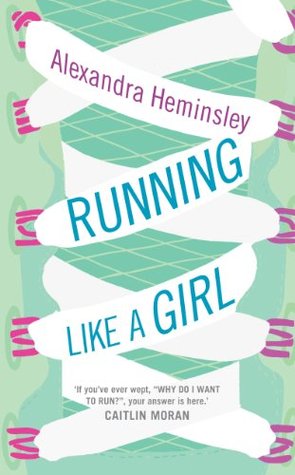
#CBR10 Book 89: "Running Like a Girl" by Alexandra Heminsley
Rating: 4 stars
#CBR10Bingo: Not My Wheelhouse (the book is a) non-fiction and b) about running - neither of these things are in my usual wheelhouse)
I was at a bit of a loss as to which genre or book to choose for the "Not My Wheelhouse" square on the CBR10 Bingo card, because while I primarily read romance, paranormal fantasy and YA (especially at the moment), I do try to branch out into other fiction genres every so often, and while I don't read them as often any more, I wouldn't consider science fiction or mystery or general historical and/or contemporary fiction outside my "wheelhouse". I could go for horror, but that would have meant reading an actual horror novel. I keep putting off Locke and Key, vol 5 because those books freak me out a little and I'm assuming Joe Hill has something really bad planned for the conclusion of the series.
So I settled on non-fiction. I heard about this book several years ago and added it to my TBR list. I'd completely forgotten about it until I started looking through my unread books and the non-fiction books on my TBR list on Goodreads. I am fascinated by people who run. A close friend of mine, whose youngest daughter is about three months older than my little boy, recently ran her first half marathon since giving birth and set a new personal record for time. I've known her since we were both 15 and when she told me a few years ago that she'd started long distance running, I thought she was kidding. Before she had to have her hip replaced, my mother-in-law also used to run long distance races. Before they had children, my sister and brother-in-law used to run together, for fun (I honestly don't know if they do anymore, going to guess it's difficult for them to find the time with two very rambunctious little girls). It was completely alien to me why anyone would do this, yet so many people not only do it regularly, but feel better because of it.
Alexandra Heminsley's book gave me a lot more insight into the mind of a runner. She didn't start out as one, but eventually bored by gyms and yoga, decided to start training for a marathon and initially barely managed to run as far as a block. Ms Heminsley's story of how she trained and managed to complete her first marathon, even when she thought she was going to fail, then almost stopped running, but ended up running a second one and how she just kept going from there is funny, engaging, at times very moving and I suspect it might be motivating to some. She doesn't hold back on the challenges she faced along the way and the setbacks that made her want to give up on occasion. Apparently, her father used to run, and she recounts how she stubbornly refused to listen to advice from him when she herself started doing it, only to realise that she was missing out on a lot of good tips when she finally did relent and start talking to him about her new past time.
The first three quarters of the book is Ms Heminsley's story about her running career, culminating with her running a women's only marathon in San Francisco. She'd almost given up her training and her intention of going, until she realised just how recently, women weren't even allowed to run these races and found new inspiration to keep going. The final quarter is all practical advice to anyone who wants to take up running - which shoes to pick, how to select the correct sports-bra, other gear to get, how to get started etc. While anyone with two legs can run, it makes it easier if you have the right attitude and equipment and don't completely overdo it when you start out.
I would like to say that having read this, I now want to get myself a pair of running shoes and get out there to get fit, but while I have tremendous respect for Ms Heminsley and the other people in my life whom I know enjoy running, I am also pretty certain I'm not likely to start training for long distance races anytime soon. Swimming is still my preferred form of exercise. Completing a 5K race at some point might be fun though?
Judging a book by its cover: I am ashamed to admit that it took me not just a first and a second glance, but a slightly confused third, before I realised what the cover is actually depicting. I love the mint and teal colour (two of my favourite colours) and once I figured out that the white strips are in fact supposed to be laces, that the whole thing is supposed to look like the top of a laced up running shoe, I was rather impressed with the design. Before I figured that part out, I thought the white bits were ribbons or banners or something, which made a lot less sense.
Crossposted on Cannonball Read.
Wednesday, 17 October 2018
#CBR10 Book 87: "The Dud Avocado" by Elaine Dundy

Rating: 2 stars
#CBR10Bingo: AlabamaPink
Sally Jay Gorce is a young woman of independent means, thanks to the benevolence of a rich uncle. He's given her enough money to live comfortably abroad for two whole years, no strings attached, as long as she comes back and tells him about her adventures at the end of the two years. Not needing to hold down a job or really do anything at all for the money, means Sally Jay spends her time flitting about Paris, taking a lover, drinking and partying. When her older diplomat lover starts getting a bit too demanding, she convinces herself that she's in love with an acquaintance from back home, who directs plays.
The Cannonball Read is founded in memory of AlabamaPink, who back in 2008 was going to compete with her friend Prisco to be the first to read and review 100 books in a year. Sadly, struck down by cancer, AlabamaPink only managed to review eleven books before she died. One of the books is the upcoming November book club selection for the CBR book club, giving participants in the CBR10Bingo a selection of ten other books to read and review for this square. I have purposefully not looked at her review of the book, but picked this as it didn't seem too long and seemed fairly critically acclaimed.
If I'm to believe Goodreads, this book is a cult hit, and described as charming, sexy and hilarious. Groucho Marx wrote Ms Dundy an enthusiastic fan letter. All I can say is that book reviewers in the late 1950s and I have very different opinions about what those adjectives mean. I suppose a young, unmarried woman in the late 50s being frank and open about her sexuality, not hiding the fact that she enjoys it and having casual flings like a male protagonist would was unusual and refreshing.
Nothing much of anything actually happens in the book. In many ways it reminded me of The Catcher in the Rye, although Sally Jay, while frustrating on occasion, is approximately a million times more engaging and enjoyable to read about than stupid, self-important Holden Caulfield. Still, both books are about a young protagonist just going about their life, not really much of anything happening. To get through both books, I had to resort to skimming passages after a while. Despite being relatively short, the book took me nearly two weeks to get through.
Having now looked over AlabamaPink's review, it is clear she liked it A LOT more than I, and we have extremely different tastes in books. It certainly makes me more wary about the next book of "hers", I'll have to read - Craig Ferguson's novel.
Judging a book by its cover: Didn't like the book all that much and I think the cover is dull. A naked, young woman looking up at the camera - all her naughty bits tastefully covered by either her or the avocado green (I see what they did there) square with the title and author's name. I suppose the woman's open gaze is supposed to connect with the reader or some such? It's just not very interesting, much like the book it belongs to.
Crossposted on Cannonball Read.
Friday, 5 October 2018
#CBR10 Book 85: "A Duke by Default" by Alyssa Cole

Rating: 1.5 stars
#CBR10Bingo: Cover Art
Spoiler warning! This review will discuss plot points from the book in detail, because it is impossible for me to list the many ways in which this book did not work for me without mentioning them. If you are unfamiliar with Scotland, Edinburgh and couldn't care less about the British peerage, then maybe these things will not bother you. Nevertheless, be warned that you may get spoilers if you continue with my review after the bold text further down.
New York socialite Portia Hobbs arrives in Edinburgh to complete an apprenticeship with a sword maker. Unfortunately, her new boss seems to be trying his very best to avoid her and while he's very hot, he also seems to be severely lacking in social skills. One of the reasons Portia has decided to go to a different continent for a while is that she was pretty much a hot mess in her old life - drinking too much, sleeping around and hurting friends and family members. She's determined to be a new and better Portia, and that person doesn't sleep with her boss. So she does her best to help out his flagging business while waiting for him to teach her what she's actually there to learn.
Tavish "Tav" McKenzie loves making swords and daggers, and as well as running Bodotria Armoury, he gives free fighting lessons to underprivileged kids and tries to make a difference in the rapidly gentrifying community. He doesn't entirely see why his brother hired him an apprentice, and he certainly wasn't expecting a posh and sexy American to show up, with tons of ideas of how he can improve his business through an improved social media presence. While he finds Portia very attractive, Tav is aware both of the difference in their ages and the fact that he's her boss. He's not intending to act on his attraction to her, and so instead tries to keep her at a distance by being as gruff as possible.
When Portia accidentally reveals on social media that Tav may in fact be the son of a duke, his life is suddenly changed completely and Portia feels responsible. Used to high society, she's determined to coach him in etiquette, so he can assume his rightful position, if that's what he wants to do.
I really wanted to like this. I did. I'd heard such good things about it on several romance review sites. The cover is beautiful. I think diversity in romance writing is incredibly important and Alyssa Cole cares about geeky stuff and complex and interesting female characters. Sadly, however, this book was not the book to win me over. I find it baffling that Ms Cole, who clearly writes very well researched historical romances set during the American Civil War shows such appalling lack of research skills when she writes in a contemporary setting.
Things that made it impossible for me to like this book:
- The book is set in Edinburgh. I have lived there for two years. Several of my dear friends still live there. The husband and I visit it often. The area most of the story takes part in is a fictional area called Bodotria, when it is clearly meant to be Leith, which is an actual, rapidly gentrifying section of Edinburgh. I cannot for the life of me understand why Ms Cole had to make up a new part to set her story in.
- The "Scottish" accents. Don't get me started on the fun interpretation of colloquial Scottish vernacular that many of the characters, including Tav speak.
- Turns out, Tav's biological dad (who his mother decided to leave because she was a poor, Chilean refugee and their union would never have worked out) is a duke. Not just any duke, however, a Royal Duke. The Duke of Edinburgh, in point of fact. This is where any suspension of disbelief I had went up in a fiery inferno of fury, because 1) The only royal dukes in Great Britain are directly related to the current monarch - in this case, Queen Elizabeth II. None of them are Scottish.This can be easily discovered with a quick Google search. 2) The Duke of Edinburgh is a title that has only existed three times in the history of the UK. The current, contemporary one is Prince Phillip, consort to aforementioned Queen Elizabeth II. 3)
There are in fact several Scottish dukedoms that Ms Cole could have used instead, but I can only surmise that since the title of this series of books is Reluctant Royals, a normal duke (still the highest order of peerage after the actual royals in the UK) wasn't good enough and had to make up a fictional royal dukedom to give to Tav's bio dad. Why in the world she couldn't just invent a new dukedom, rather than the one belonging to the man MARRIED to the current Queen is anyone's guess. How no one in Ms Cole's editing team didn't think to take her aside and say: "You know the Duke of Edinburgh is the Queen's husband, right?" seems like dereliction of duty of the highest order.
But Malin, I hear you say, it's only a romance novel. Why does this bother you so much? The answer, dear reader, is that if Alyssa Cole wanted her hero to have a Scottish duke as a father, she could have made up a title instead - like she made up a fictional part of Edinburgh. If this is in fact set in some alternate reality, where there is no Queen Elizabeth II (although the Queen featured later in the book sure seemed a LOT like her) and her husband is not the Duke of Edinburgh, then she should have made this a hell of a lot more clear.
- Tav is utterly undeserving of Portia (even as much of a mess as she seems to think she is). He treats her appallingly for much of the book and thoroughly deserved to be pepper sprayed by her. I don't care that he's nice to down on their luck local children if he can't treat a woman in his employ with basic respect and decency.
- Portia is supposed to be in Edinburgh to apprentice to a sword smith. She makes ONE sword in her three months there! Apart from that, she's Tav's secretary/PR-person/social media rep.
- It would have been nice if the villain of the story was slightly less of a racist stereotype, but this is so far down my list of grievances to be negligible.
- For all that Portia claims to be a hot mess and discovers through online tests that she most likely suffers from ADHD, she sure is beautiful, fit, personable and extremely competent at everything she sets her mind to.
Things I actually liked:
- Tav's sister in law, Cheryl, is adorable and runs a Chinese takeaway out of a little kiosk painted to look like a TARDIS. It's called Doctor Hu's.
- Portia, for all that she is almost too perfect (no matter what she tells herself), was very likable and I wanted better for her than Tav. Her family (minus the sister, who could be WAY better at communicating) is clearly awful and she should cut her toxic parents out of her life for good.
- Portia's friends all seemed pretty great. Not enough that I want to go back and read the first book in the series, but both Nya and Naledi were fun supporting characters.
- Prince Johan (of made up European principality - see, if you can make up new parts of Edinburgh and Europe, you can make up alternate peerage as well, Ms. Cole), who seems to be the hero of the next book in the series.
Sadly, based on this book and the rage it produced in me, I'm not sure I'm going to check out any more of the Reluctant Royals series. I'm frankly slightly reluctant to read any more Alyssa Cole at all, despite having enjoyed (but not loved) two of her historicals. I may give her a new chance in time, though.
Judging a book by its cover: Long before this book came out, I was interested in it because of the pretty cover. Having now read the book, I think the cover may in fact be one of the best things about it. The cover models look pretty much like the characters they're supposed to portray and I absolutely love both the hair and the warm shades of the dress on the female cover model.
Crossposted on Cannonball Read.
Friday, 21 September 2018
#CBR10 Book 84: "Magic Triumphs" by Ilona Andrews

Rating: 5 stars
#CBR10Bingo: This is the end
This is the tenth and final book in a long running series. As such, there may be spoilers for the contents of at least previous books, as well as mild spoilers for the plot of this one. More importantly, it is NOT the place to start. The proper place to begin is Magic Bites. The book is a bit rough, but stick with it, this series is among the best paranormal fantasy out there.
I've spent more than eleven hours on a train from Canada today, and then more than an hour getting back from Penn Station, so I'm going to just cut and paste the official blurb here, because my brain is too muddled to come up with a decent summary of my own:
Kate has come a long way from her origins as a loner taking care of paranormal problems in post-Shift Atlanta. She's made friends and enemies. She's found love and started a family with Curran Lennart, the former Beast Lord. But her magic is too strong for the power players of the world to let her be.
Kate and her father, Roland, currently have an uneasy truce, but when he starts testing her defenses again, she knows that sooner or later, a confrontation is inevitable. The Witch Oracle has begun seeing visions of blood, fire, and human bones. And when a mysterious box is delivered to Kate's doorstep, a threat of war from the ancient enemy who nearly destroyed her family, she knows their time is up.
Kate Daniels sees no other choice but to combine forces with the unlikeliest of allies. She knows betrayal is inevitable. She knows she may not survive the coming battle. But she has to try.
For her child.
For Atlanta.
For the world.
I've been reading these books for nearly a decade (started the series in 2009), so it's a rather bittersweet thing to finally get to the end. Nevertheless, it was time for Kate and Curran's adventures to reach an end point, but the authors leave the door open for further adventures in the universe they've created. Already promised - two more books about Hugh and Elara (intriguingly set BEFORE their appearance in this one. While there were some things I didn't think worked so well, and the pacing of the plot is uneven (the ending feels really rather rushed), but overall, I thought this was an incredibly satisfying final chapter to the series.
Things I thought could have been done better:
- While I really like that the authors subverted the readers' expectations by having our intrepid heroes facing off against a different big bad than we'd been led to believe, it might have been good to drop hints about the existence and possibility of said threat somewhat earlier in the series (and no, hinting at the ultimate villain's henchpeople and creatures in the first Hugh book is not enough, as not everyone will necessarily have read that one).
- The whole subplot with the realtors constantly calling Kate and Curran and them getting increasingly more annoyed was a cute gag that was taken too far. That whole story line could have been cut without any of the overall plot suffering.
- I also agree with my fellow Cannonballer Emmalita that questioning whether the Pack (now led by Jim) would even for a second consider allying with Roland is dumb, because the answer to that question was always going to be no.
Things I really liked:
- Conlan (while my husband and I agree that it's not a great name) was a delight. Ilona Andrews, in my opinion, excel at writing children without ever turning them into annoying plot moppets. A precocious toddler who's also a giant kitten was always going to appeal to me, but Kate as a frazzled mother was extra enjoyable now that I myself have a child (who thankfully can barely wiggle across the floor when put down, although he flops from back to belly like a champ).
- The resolution of Kate's whole Roland problem. The book was never going to end with Kate nobly sacrificing herself to kill her dad, and the way the authors found a solution to neutralise Roland for good was a creative one.
- Hugh and Elara's appearance. I've always liked Hugh, even when he was the villain. Now that he pretty much fulfils the role of Kate's older brother in her super dysfunctional family dynamic, I like him even more.
- The fact that even though there's not one, but two, really very serious threats facing Kate and her people, the book didn't feel too dark and there were enough light hearted and funny moments along the way.
While I'm sad that the series is at an end, I'm glad the final volume was a satisfying one, wrapping up most of the loose ends, while still leaving enough things open to write potential spin-offs further down the line. I'm also very glad that there are more Hugh books, as well as Hidden Legacy books from the authors in the near future.
Judging a book by its cover: As Kate Daniels covers go, this isn't bad, but really, this series is not blessed with decent cover art at any point, and I have genuinely lost count of how many different dark haired women with a sword who have portrayed Kate on these covers by now.
Crossposted on Cannonball Read.
Tuesday, 18 September 2018
#CBR10 Book 83: "Kilmeny of the Orchard" by L.M. Montgomery

Rating: 1 star
#CBR10Bingo: This Old Thing (published in 1910)
Spoiler warning! There will be a number of spoilers for the plot of this book, because the only way I will be able to fully vent my spleen on this atrocious piece of writing is by going into minute detail about the MANY things I found dumb, objectionable or downright offensive in this book. You might as well allow yourself to be spoiled, this book is bad and you don't actually want to waste time reading it.
Eric Marshall has just graduated college and knows that his future is secure. He is going to work for his wealthy father, but before he starts in the family business, he agrees to help out an old school friend for a while. Substituting as a teacher on Prince Edward Island for a season, Eric settles in nicely, popular among the locals.
One day, wandering in an overgrown and abandoned orchard, Eric comes across a beautiful young woman playing the violin. Kilmeny Gordon is mute and has lived an extremely sheltered life on the farm belonging to her aunt and uncle. There was a scandal surrounding her birth and until Kilmeny's mother died a few years ago, the girl was barely allowed outside the house. At first, she's scared of Eric, but they begin to get to know one another, and it doesn't take too long for Eric to realise he wants to make Kilmeny his wife.
When one of the squares for CBR10Bingo required me to read a book published before 1918, I pondered for a while. Then, inspired by my love for L.M. Montgomery's Anne of Green Gables books, her Emily books, and The Blue Castle, I decided to see if she'd written any other books I could try. This one fit the bill, being published in 1910. When I recently mentioned to my BFF Lydia that I'd read a more obscure Montgomery novel, she exclaimed: "It wasn't Kilmeny of the Orchard, was it? That book is awful!" How I wish I'd spoken to her BEFORE I read this book.
Let's start by listing the positives. It wasn't very long, so I was able to finish it rather quickly, even though I deeply regretted my choice from early on. I'm pretty sure I've found my "Worst book of 2018". I desperately hope that nothing I read for the rest of the year is worse than this book. It will also allow me to really get my vitriol on in my review, which tends to make for amusing reading for others, and an easier time writing for me. That's about it. I can't think of anything else positive. No, wait, there are two pretty decent female supporting characters in the book. Marshall's landlady and Kilmeny's aunt are both good (no, I'm not going back to check their names - I've wasted enough time on this book already).
So why was this such an awful reading experience? To begin with, my expectations of L.M. Montgomery's work, based on the books mentioned above, had not prepared me for something quite this dismal. I loved the Anne and Emily books growing up, and was utterly delighted by The Blue Castle. There is NOTHING delightful in this book.
Eric Marshall is a rich, privileged dude bro, utterly convinced of his own greatness and superiority. He comes across a young woman (who he keeps referring to as "a child", even though it's established early on that she's 18 and he's 24, certainly not a terrible age difference back in the early 20th Century) who is initially scared of him, and keeps meeting her in secret, unbeknownst to her family, and has to be lectured by his landlady about why this is an inappropriate and dishonourable thing.
Kilmeny Gordon is an orphan. Her mother, the apple of her father's eye, married a man her family disapproved of and then discovered that he was probably a bigamist. She had no idea about this when she married him, but there was a scandal nonetheless. Returning to her family, she gave her father the silent treatment for months after she felt judged by him, refusing to speak even when he made himself more sick on his own death bed to plead with her to forgive him. Kilmeny's family believe that is why she's been mute her entire life. Despite being apparently completely exquisitely beautiful (this seems to be the first thing everyone is struck by upon first seeing her), Kilmeny believes herself to be ugly, because her angry, bitter mother always told her so, and made sure there were no mirrors in the house so the girl could see her reflection. Living an extremely sheltered life, Kilmeny uses a little slate to write on, and otherwise "expresses herself through her violin". Not that she's ever been tutored in playing it, you understand, but she nevertheless plays it wonderfully and makes up beautiful little tunes that spellbind Eric.
Eric, who keeps thinking of Kilmeny as a "darling child" is of course extremely taken with her beauty and grace and general awesomeness, and keeps meeting with her in the abandoned orchard near her aunt and uncle's farm. After a stern talking to by his landlady, he realises that he has to do the right thing and go speak to her relatives, as consorting with a young unmarried lady every evening is deeply inappropriate and creepy. Of course, he kisses her (entirely without her consent) before he ever gets to that point.
Of course, by the time he goes to see Kilmeny's guardians, their cranky foster son ("of Italian descent" and therefore clearly seen as terribly volatile and almost a bit sub-human), who's been spying on Kilmeny and Eric's meetings (because of course he too has a creepy crush on her, that she's entirely unaware of), has tattled and they've locked her in her room and are none too happy to see Eric. Once he exclaims that he wants to marry Kilmeny (despite her terribly inconvenient muteness, he's such a champ!), they are pretty much mollified. However, Kilmeny, for all that she claims to return Eric's feelings, refuses his proposal, as he couldn't possibly be saddled with a mute woman for a wife.
Oh noes, how could this book ever get a "happy" ending, I hear you ask. Well, don't fret. Of course one of Eric's best friends is an amazing doctor who specialises in vocal maladies. He comes to examine Kilmeny (again being utterly transfixed by her beauty), and claims there is nothing actually wrong with her, but that she will need some sort of sharp shock to be induced into speaking. When her cousin/foster brother/creepy stalker gets overcome with jealousy and is about to bludgeon Eric to death with an axe, Kilmeny fears for him enough that she shouts out a warning. The dastardly Italian is overpowered (and flees town in the night shortly after, never to be heart from again), and Kilmeny, who has never spoken a single solitary word before in her life, can miraculously speak. Fluently and with no difficulty, because of course she can.
There is one last hurdle in the way of our young couple's happiness. Eric's father believes him to have fallen for some country temptress only interested in his fortune. He comes to the town to dissuade his son from what he believes to be an inappropriate match - but it's ok! He has only to lay eyes on the comely Kilmeny (seriously, he doesn't even SPEAK to her) before he welcomes her to the family.
Seriously, this book is utter dreck. It's sexist, racist, patronising, it weirdly fetishises Kilmeny's muteness, innocence and ability to play violin. The whole backstory about Kilmeny's parentage and childhood is bonkers and then there's her cousin/foster brother, apparently abandoned on her aunt and uncle's farm by itinerant Italians when he was a baby. So he's been raised by them, alongside her, but creepily believes that he will be able to marry her, and becomes crazy jealous when he realises she loves someone else. His sullen behaviour is written off as due to his unfortunate background and no one seems to concerned that he was about to axe murder someone. This book is extremely bad, yet somehow has an average rating of 3.69 on Goodreads (with nearly 6000 ratings).
I did just remember one more positive thing - I didn't have to pay a penny for the book. It's available free from Project Gutenberg. Even free, it's not worth your time. Stay away from it, if you value your time, even a little bit.
Judging a book by its cover: This book has had a number of covers over the years, this is the one that was attached to the free edition I downloaded. Some things seem accurate - Kilmeny is female and has dark hair. She loves flowers and picks a lot of them. Apart from that, this woman looks WAY too old to be Kilmeny, she's got a strange buxom matronly thing going with what she's wearing - generally I dislike this cover. But it's ok, because I very much dislike the book it's attached to as well.
Crossposted on Cannonball Read.
Subscribe to:
Posts (Atom)