Showing posts with label 1950s. Show all posts

Sunday, 13 November 2022

CBR14 Book 44: "Madam, Will You Talk?" by Mary Stewart

Page count: 264 pages
Rating: 3 stars

CBR14 Bingo: Question (the book's title is a question and there is a central murder mystery where the identity of the murderer is in question)

Young widow Charity Selborne is on holiday in the south of France with her friend Louise and they really have little planned except to enjoy the good food, nice drinks, beautiful scenery, and long drives. In Avignon, Charity befriends a young English boy who is also staying at the hotel, offering to take him with her on tours of the local tourist spots, as his stepmother doesn't seem inclined to do so. She certainly wouldn't have expected this act of friendship would get her embroiled in the final act of a complicated criminal conspiracy, involving attempted murder, actual murder, kidnapping, and more. 

Once Charity meets the boy's imperious and brooding father, who may very well be a psychotic murderer, she finds herself fleeing through multiple French towns to get away from the man, who is determinedly seeking the whereabouts of his son. Charity is worried for the safety of the boy and keeps trying to get away from the possible madman, who seems relentless in his pursuit of her. Once Charity gets sick of running and furiously confronts her pursuer instead, they actually sit down and talk and she realises just how much danger the boy and his arrogant father are in. Charity and the framed man begin to work together to find out exactly what the vast plot consists of, why someone tried to frame Richard Byron (the suspected murderer) for a crime he didn't commit and then when he was acquitted, murder him instead. Why are the conspirators now using Byron's son as bait to get him to come to France? Is Charity going to be their next victim, now that she's involuntarily gotten involved?

A while back, there were a ton of Mary Stewart's mystery novels on sale online. As any e-book under $2.99 that I haven't actively heard bad things about is more or less a must-buy for me, I now have a fairly large selection of her books. When I needed a book that fits into the Question square of this year's Bingo, it seemed like a good candidate. I hadn't realised that this was in fact Mary Stewart's debut novel, which has become somewhat of a classic and laid the groundwork for her long career as a mystery writer in the second half of the 20th Century.

For fear of spoiling a nearly 70-year-old book, the romance subplot in this book is absolutely bonkers. When Richard Byron first meets Charity Selborne and realises that she knows where his son is, he believes her to be part of the criminal conspiracy that has been plaguing him for ages. He manhandles her, threatens her, calls her a b*tch (so charming), and is in general very unpleasant. She outsmarts him, but their paths keep crossing until he literally chases her through the south of France for several days like some sort of post-World War Terminator. Charity, believing the rumours she's heard that Byron is most likely a psychotic murderer who got acquitted on a technicality, in France to possibly do his own son harm, has no intention of revealing his son's whereabouts to the lunatic. 

Charity is clever and plucky and drives like a fiend, so she escapes him several times until she gets fed up, stops being afraid, and gets angry instead. She yells at him for several minutes, then almost collapses with exhaustion, whereupon he apparently realises 1) that he's been an utter beast for chasing this woman for days and making her very afraid for her own safety and 2) that he totally and completely loves her. Remember, this is after three days of believing her to be part of a criminal plot against him and party in keeping his only child from him. How does her heroine react to his declarations of love? Does she slap him and tell him to get as far away from her as possible? Of course not, silly, she swoons in his arms and apparently returns the affections of a man she believed was an unhinged murderer until earlier the same day. So romantic. The 1950s, people, it was a different time. 

Another way in which it is clear that we have come a long way is how much the characters smoke. They pretty much chain-smoke their way through this story. I'm surprised the kid, David doesn't light up a cigarette when he's off gambolling with his dog. Seriously, when Byron first encounters Charity, and she's a bit out of sorts because of the hot afternoon and thinking about her dead husband (he was shot down during the War), he insists that she have a cigarette to feel better. Because obviously nicotine and tobacco are so healthful. There's mention of smoking with breakfast. At one point, there's a mention of an ashtray on the nightstand of a hotel bed. So glad this is not the norm anymore.

While the romance is preposterously insta-love (SPOILER! They get married less than two weeks after first meeting one another), the actual criminal conspiracy plot is pretty clever. I also really liked Stewart's writing style. David and his loyal pooch did smack quite a bit of plot moppetude, but the descriptions of the various Roman ruins and other interesting sites that Charity visits and the mention of the food were all great. My favourite thing about the novel was probably our heroine herself. Charity is an intelligent and capable woman. She mourns her husband, but not to an excessive degree. She's brave, clever, kind, and drives like an utter fiend. 

I also really liked her friendship with Louise, who accompanies her to France. The friendship between the two women reminded me a lot of myself and my BFF Lydia. Louise is described as plump and friendly, and while Charity is off in the sweltering heat of the French afternoons to explore Roman ruins and archeological sites, Louise prefers to stay back at the hotel, reading in the shade or relaxing by a river, painting. These are vacation goals I can get behind (although I wouldn't even bother with the painting. I would just laze about in a shady back garden, drinking iced grape juice and reading my books. Possibly while snacking on some sort of delicious French pastry). It's also highly likely that Lydia would drag me along with her when going off to visit ruins and other sites of note, exclaiming all the while about how much I'm enjoying myself (whether I am or not). 

I guess starting with the earliest of Mary Stewart's books is a good idea, I've been assured that a lot of her writing is very good, and with some reservations, I also enjoyed this one. So if her writing gets more polished and sophisticated as her career progresses, I suspect I will also enjoy the others of hers I now have waiting for me in my digital library. 

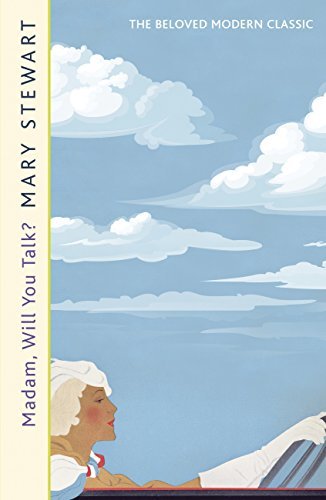
Judging a book by its cover: This very minimalist cover, where you barely even see the heroine (suitably seen behind the wheel of a car) appeals to me. The blue skies give a feeling of summer and I could do with some of that as each day gets progressively darker here up north. 

Crossposted on Cannonball Read

Tuesday, 5 July 2022

CBR14 Book 16: "Last Night at the Telegraph Club" by Malinda Lo

Page count: 415 pages
Rating: 3.5 stars
 
Official book description:
Seventeen-year-old Lily Hu can't remember exactly when the question took root, but the answer was in full bloom the moment she and Kathleen Miller walked under the flashing neon sign of a lesbian bar called the Telegraph Club.

America in 1954 is not a safe place for two girls to fall in love, especially not in Chinatown. Red-Scare paranoia threatens everyone, including Chinese Americans like Lily. With deportation looming over her father--despite his hard-won citizenship--Lily and Kath risk everything to let their love see the light of day.
 
This book turned out to be something very different from what I was expecting, and I'm still not sure if I would have rated it higher and it would have taken me less than almost a month to finish it if it came along at a different time. It certainly keeps appearing on all sorts of "Must Read" lists, and seems both critically acclaimed and highly rated by regular readers. The book description tells us that it's going to be the forbidden love story of two young women in 1950s San Francisco, but while the book also features a Chinese American woman gradually realising that she's falling for one of her classmates, and them sneaking out at night to visit a lesbian bar, it seems almost like a subplot. Lily's identity as a lesbian is a lot less focused on than her place as a Chinese American, bound between personal wishes and desires, and the duty to her family and community, growing up in a paranoid society where the government is in a panic, hunting Communists everywhere. 

Lily's father is a respected doctor, but he nevertheless has his papers taken away because he refuses to confirm or deny one way or another that one of his patients is a Communist. Lily's mother is a nurse, deeply concerned with propriety and making sure that their family's reputation is spotless. Lily's Chinese American friends all only seem interested in dresses, older boys, and dating, while she wants to study advanced math and science and dreams of becoming an engineer, and maybe even going to space one day. The only other girl in her advanced math class, Catholic Kath Miller wants to be a mechanic and a pilot, not exactly your traditional career path for a young woman in the 1950s either. Lily initially strikes up the friendship with Cath because they are the only two girls in their class, but it's revealed late in the book that Cath was aware of and taken with Lily long before they actually became friends, and later more.

This was the Cannonball Book Club book for May, when the theme was AAPI (Asian American and Pacific Islander) writers. We had a vote to decide on the book, and this was my first choice, exactly because I had read and heard so much about it, and thanks yet again to e-book sales, I already had the book on my e-reader. As it turned out, the rather slow start and the somewhat tense subject matter (minority protagonist with a traditional family has homosexual stirrings) meant that when we had out Zoom book club meeting, every single reader had peaked ahead to the ending to see whether it ended in misery or not. If this was a YA romance, that would not be necessary, but the romantic subplot takes second place in Lily's coming of age narrative. Her discovering who she is, what she stands for and who she wants to be going forward is the centre plot of the book. 

In the post scripts at the end of the book, the author mentions that this was a very personal book to her, and it's obvious both from the postscripts and the story that she'd done a ton of research. So much of the research she's done is felt in the writing, to the point that if time travel is ever invented and I happen to end up in 1950s Chinatown in San Francisco, I'll be able to find my way around just fine entirely based on the descriptions in this book. Obviously, part of the joy of reading historical fiction is experiencing another time and place, but here, it did feel a bit as if the author also wanted to make sure that every single piece of historical trivia she'd discovered ended up on the page somehow, a bit to the detriment of the flow of the story. 

This may also be one of those YA books where reading it as an adult becomes a very different experience, because I personally, and pretty much all the others who were reading this for Cannonball book club agreed that the flashback chapters featuring the older characters, Lily's father, mother and aunt, were absolutely fascinating and we wanted more of their stories. So Malinda Lo could probably have a loyal following of fans buying her book about Chinese immigrants to America in the 1950s, as well. The chapters giving us insight into the older generations' lives and perhaps especially what their hopes and expectations had been in contrast to where they ended up were fascinating. 

This is my first book by Malinda Lo. I know she's written several fairy tale retellings with LGBTQ-themes, as well, so I'm sure it will not be the last of her books that I try.

Judging a book by its cover: The absolutely gorgeous cover of this book is one of the first things that drew me to it. It captures the scene and place of the story so perfectly and the contrast between the dark San Francisco streets and the bright neon signs, not to mention the one lamp post illuminating our two lovers is so pretty. I could easily have this cover as a poster for my wall. 
 
Crossposted on Cannonball Read

Wednesday, 17 October 2018

#CBR10 Book 87: "The Dud Avocado" by Elaine Dundy

Page count: 260 pages
Rating: 2 stars

#CBR10Bingo: AlabamaPink

Sally Jay Gorce is a young woman of independent means, thanks to the benevolence of a rich uncle. He's given her enough money to live comfortably abroad for two whole years, no strings attached, as long as she comes back and tells him about her adventures at the end of the two years. Not needing to hold down a job or really do anything at all for the money, means Sally Jay spends her time flitting about Paris, taking a lover, drinking and partying. When her older diplomat lover starts getting a bit too demanding, she convinces herself that she's in love with an acquaintance from back home, who directs plays.

The Cannonball Read is founded in memory of AlabamaPink, who back in 2008 was going to compete with her friend Prisco to be the first to read and review 100 books in a year. Sadly, struck down by cancer, AlabamaPink only managed to review eleven books before she died. One of the books is the upcoming November book club selection for the CBR book club, giving participants in the CBR10Bingo a selection of ten other books to read and review for this square. I have purposefully not looked at her review of the book, but picked this as it didn't seem too long and seemed fairly critically acclaimed.

If I'm to believe Goodreads, this book is a cult hit, and described as charming, sexy and hilarious. Groucho Marx wrote Ms Dundy an enthusiastic fan letter. All I can say is that book reviewers in the late 1950s and I have very different opinions about what those adjectives mean. I suppose a young, unmarried woman in the late 50s being frank and open about her sexuality, not hiding the fact that she enjoys it and having casual flings like a male protagonist would was unusual and refreshing.

Nothing much of anything actually happens in the book. In many ways it reminded me of The Catcher in the Rye, although Sally Jay, while frustrating on occasion, is approximately a million times more engaging and enjoyable to read about than stupid, self-important Holden Caulfield. Still, both books are about a young protagonist just going about their life, not really much of anything happening. To get through both books, I had to resort to skimming passages after a while. Despite being relatively short, the book took me nearly two weeks to get through.

Having now looked over AlabamaPink's review, it is clear she liked it A LOT more than I, and we have extremely different tastes in books. It certainly makes me more wary about the next book of "hers", I'll have to read - Craig Ferguson's novel.

Judging a book by its cover: Didn't like the book all that much and I think the cover is dull. A naked, young woman looking up at the camera - all her naughty bits tastefully covered by either her or the avocado green (I see what they did there) square with the title and author's name. I suppose the woman's open gaze is supposed to connect with the reader or some such? It's just not very interesting, much like the book it belongs to.

Crossposted on Cannonball Read.

Monday, 22 February 2016

#CBR8 Book 19: "The Catcher in the Rye" by J.D. Salinger

Page count: 277 pages
Rating: 1 star

This review will contain spoilers, so if you want to avoid knowing all the details of the sparse and meaningless plot, maybe skip the first couple of paragraphs. 

Holden Caulfield is a self-important, spoiled and worthless little shit. At the start of the book, he is cooling his heels at the fourth boarding school he's been expelled from because he just can't be bothered to even try to apply himself (having failed four out of five subjects completely), and generally bitching about how phony his room mate, dorm mates and teachers are. Holden, ever heard of the pot calling the kettle black? You are that pot. Not content to waste his the money his parents spent on tuition, he also manages to lose all the fencing equipment belonging to the school before he's expelled. because apparently reading a subway map and keeping track of bags of equipment at the same time overloads the fragile little mind of special disenfranchised snowflake Holden.

Having spent a while internally bitching about some of his school friends and being jealous of their luck with the ladies, he picks a fight with his room mate and decides to leave school early, before his parents are alerted to his most recent failure. His grandmother is apparently overly generous, so he has cash to spare and goes by train to New York, where he books himself into a rather sleazy hotel. Here he proceeds to ruminate about girls he's known but never managed to hook up with (probably because they can tell a mile away that Holden is an emo narcissist with an inflated sense of his own self-worth and no apparent sense of humour) and gets beaten up by a pimp after paying a prostitute NOT to have sex with him. He also goes out drinking and hemorrhaging money all over the place. After a couple of days, when he's nearly broke, he goes home to see his little sister. Then he visits an old teacher who seems to have escaped Holden's go to judgement of being too phony, but said teacher may or may not make a pass at him, so Holden flees into the night. He then has some sort of mental breakdown and ends up in an institution, from whence he tells the entire story of the book.

As is hopefully clear from my rating of this book, I absolutely loathed this so-called piece of classic literature. I don't think I've ever seen a better example of the fact that it's not always the worthy texts that survive to become classics. I honestly have no idea how this book is lauded as a great novel or why it speaks to people even today. Holden is absolutely insufferable. He's a whiny, snivelling, spoiled and clueless little brat, who seems to think he is better than everyone around him, adults as well as kids his own age. The only hardship he's ever experienced is the death of his younger brother, apart from that, he's lived a life of ease and privilege and is determined to throw everything he is given away, because growing up is just so, you know, boring.

Not only is Holden absolutely insufferable, and very high on my list of fictional characters I want to knee in the groin and punch in the face (Heathcliff from Wuthering Heights is probably still number one, closely followed by Cathy from that same book). He doesn't appear to undergo any sort of significant development over the course of the book. He starts out a horrible waste of oxygen, and ends the book the same way. The only nice thing I can find to say about him is that he loves his little sister Phoebe, who is about as great a character as Holden is awful.

I seriously, for real, do not understand what is supposed to be so great about this book. What purpose does it serve? Nothing of consequence happens. Holden is atrocious and likes to ramble on about nothing, thinking back to previous events in his life that are also fairly insignificant and amounted to very little. Like so many other teens, he feels alienated from his surroundings and doesn't fit in. Not that he does a thing to change that or to find some sort of purpose. All he does is complain and sulk, and I wanted to slap him so hard his teeth rattled. My colleagues in the English department have decided that all the higher level kids are to read this book when we're embarking on our current topic of Classics, and I just desperately hope that it reads better to teenagers than it did to me. As several of my colleagues seemed rather appalled at my vehement hate for the book, it can be their job to defend its worthiness on the curriculum. None have so far been able to explain in a satisfying way to me why this book deserves to still be read in schools or by anyone, anywhere. Sorry, Mr Salinger, your book is bad and if you weren't dead, you should feel bad. The only upside for me as a teacher that I can think of is that the kids reading the book won't be able to find a movie adaptation they can watch to cheat and thus escape the reading.

I can now tick this book off the list of "books to read before you die". I found it even more pointless and hard going than The Great Gatsby and Anna Karenina (though at least, like Gatsby, it's a blessedly short book, not a massive brick like Anna), but don't loathe it with every fiber of my being like I do Wuthering Heights and Tess of the D'Urbervilles. Although with all those books, I at least see what they bring to literature. This book - nothing. I'm pretty sure it's going to be the lowest rated book I read this year, so at least I got that out of the way early.

Crossposted on Cannonball Read.

Sunday, 3 May 2015

#CBR7 Book 52: "They Came to Baghdad" by Agatha Christie - Cannonball, people!

Page count: 364 pages
Rating: 5 stars

In this book, we meet the adventurous Victoria Jones, a young woman with a knack for lying frequently and convincingly, who shortly after being fired from her most recent position as a mediocre shorthand typist, meets a handsome and charming young man in the park. They strike up a conversation, he confides that he is about to go to Baghdad and asks to take a couple of photographs of her as a memento. Victoria is smitten, and as the young man she's fallen head over heels for is going to be in Baghdad, she needs to go there to. A few days later, her contact at the employment agency calls to confess an American woman needs a companion to accompany her on her journey to the self-same city and Victoria can't believe her luck.

Unbeknownst to Victoria, who just wants to reunite with Edward, the young man in the park, there is a secret international diplomatic summit planned in Baghdad and there are sinister forces who are trying to sabotage it. A heavily disguised agent named Carmichael is dodging assassins all over the Iraqi countryside trying to get proof to his superiors about the conspiracy. An efficient and mysterious young woman named Anna Scheele surprises her American employer by asking for time off to go to England to visit her ailing sister. Richard Baker is an officious archaeologist on his way back to the archaeology dig of the illustrious Dr. Pauncefoot-Jones. Mr. Dakin is the official trying to ensure that the summit goes off without a hitch. He knows that there are a number of security risks and is hoping for the safe return of his agent Carmichael.

 Once in Baghdad, Victoria's brain is working overtime to figure out how she's going to manage for money when her job as companion for Mrs. Clipp is ended. On  one of her first nights in Baghdad, a wounded man staggers into hotel room and dies in her bed after whispering a few seemingly unconnected words. This man turns out to be none other than Carmichael, and  his death in her room puts Victoria in the centre of a dangerous conspiracy. When she uses her wits and what little information he gave her to track down her beloved Edward, she starts to suspect that he may not have been entirely truthful when he claimed during their brief meeting that he'd love for her to come and see him, and that there are a number of young women in the organisation he works for who don't look kindly on their new rival for Edward's affection.

Soon Victoria finds herself abducted and abandoned in a house in the Iraqi countryside. Ever resourceful, Victoria gets out of the house where she's been locked, but is stuck wandering far from civilisation.  Her little white lie that she's Dr. Pauncefoot-Jones' niece, in Baghdad to join him on his expedition come back to haunt her when she's rescued by none other than his assistant, Richard Baker, en route to the expedition in question. Will Victoria's gift for lying get her out of another sticky situation? Will she be able to figure out what the dying words of Mr. Carmichael meant, and help Mr. Dakin stop the shadowy conspiracy threatening the peace summit?

This book is much less of a murder mystery than it is a suspenseful adventure novel. Unlike the many more traditional Agatha Christie novels, where Miss. Marple or Hercule Poirot gather a number of assorted suspects in the drawing room of a country house (or train carriage, or fancy ship or whatever exotic location Christie decided to place them in for variety), this book mainly follows the brazen Victoria as she lies her way from a boring typist's job in London to being an essential, if somewhat unwitting part in an international conspiracy. While some might find her quite an unlikable heroine, I found her delightful. She's not so much a compulsive liar as a very good actress who thinks swiftly on her feet and improvises skillfully. She also doesn't really seem to lie to directly swindle people, just to take advantage of things she might not have otherwise, such as impeccable references or pedigree. She's a bit too impulsive than is healthy, but she discovers that herself when she reunites with Edward in Baghdad and starts suspecting that he may not be as smitten with her as she was with him.

When she ends up at the dig of Dr. Pauncefoot-Jones, she is lucky that the old archaeologist is extremely absent-minded and scatter-brained, wholly focused on his dig, so he can barely remember whether he has a niece at all, mistaking Victoria for an anthropologist scheduled to arrive at the dig some weeks later. Richard Baker, on the other hand, knows something is up with the strange woman he found wandering in the countryside. He just can't figure out why she would pretend to be his boss' relative, wildly fabricating her knowledge of archaeological artifacts.

Most of my favourite Agatha Christies are the stand-alone ones, often featuring a romantic subplot while there's murder mysteries and adventure. Books like Why Didn't They Ask Evans? (the first Christie mystery I ever read), The Man in the Brown Suit and this. I hadn't read this book for nearly a decade, when I decided to re-read it so it could be my 52nd book of the year. While the book started more slowly than I remembered, introducing the various minor players in the bigger game, to a reader who has no idea how they all connect, it gets moving plenty fast enough once we get introduced to Victoria. I only half remembered the ending, so watching all the pieces coming together towards the end of the story was almost as enjoyable as reading the book for the first time. I'm glad it still holds up. So with that - Cannonball!

Crossposted on Cannonball Read.