Showing posts with label 1960s. Show all posts

Tuesday, 10 October 2023

CBR15 Book 55: "Lessons in Chemistry" by Bonnie Garmus

Page count: 400 pages
Rating: 5 stars

#CBR15 Passport Challenge: Books recommended by friends

Elizabeth Zott is a chemist struggling to be taken seriously by her male colleagues at a lab in the 1960s. She never completed her degree because her academic advisor raped her, but her lack of degree in no way means she's not intelligent. Despite her brilliant mind, her male co-workers either treat her as nothing more than a lab assistant or steal her research and present it as their own. The one exception to this is Calvin Evans, another brilliant mind, although even more anti-social than Elizabeth. After a couple of rather unfortunate first run-ins, the couple actually begin to talk to each other and their natural chemistry proves very combustive.

However, life doesn't always play fair, and Elizabeth, who never wanted to settle down with any man and certainly never wanted children, finds herself a single mother trying to make a living from the private lab she built in her home. She's doing her best to encourage her precocious daughter, aided only by her faithful dog, Sixthirty, and eventually, a lonely housewife from across the street. Through a series of unlikely events, she becomes a television star, presenting the afternoon cooking show Supper at Six. Elizabeth refuses to talk down to her audience and uses scientific chemistry terms when explaining her recipes (“combine one tablespoon acetic acid with a pinch of sodium chloride”), and her unlikely approach seems to spell television success. While her producer is both baffled at her technique and terrified of her blunt honesty, yet staunchly supportive nonetheless, the station manager is not as happy with Elizabeth's unconventional presenting style or lack of respect for men in general.

Having read several very glowing reviews of this, I decided to put it on my wishlist for last year's Cannonball Book Exchange. Imagine my surprise when I got a lovely hardback edition (it was even signed) from the lovely Witcherwill/Mythili. I do hope she enjoyed the Pratchett books I sent her. As is so often the case, however, even if I own a book, I don't immediately start reading it. I had every plan of getting to it this year and therefore added it to my Cannonball Passport Challenge. Anyone who has followed my blog for some time knows I cannot resist a reading challenge, and will do almost everything in my power to complete as many as possible over the course of a year. It still took me until September to finally read the book, and once I started it, it was one of those books where I pretty much resented everything that took my attention away from it. I loved it so very much, and it's always much harder to write good and articulate reviews of books that I adore. I will happily savage a book I disliked, but with books like this, I just want to flail and scream at everyone I meet to read it (I have in fact insisted that two friends and four colleagues do just that).

I wanted to finish the book before the Apple TV+ adaptation aired, and as always with adaptations, I'm wary. I think Brie Larson will do an excellent job as Elizabeth, because she's a very good actress, but I'm not sure I trust them to fully capture just how good this book is. The trailer makes it look as if they've made quite a few changes, but I will try to keep an open mind. Should it be absolutely panned, I just won't watch it and pretend it never existed in the first place.

This is most likely going to be in my top 3 books of the year. It's an international bestseller and this is well deserved. It's funny and sad and infuriating and moving and I almost wish I hadn't already read it, so I could go back and read it again for the first time. Thank you so much, Mythili, for the gift of this book. 

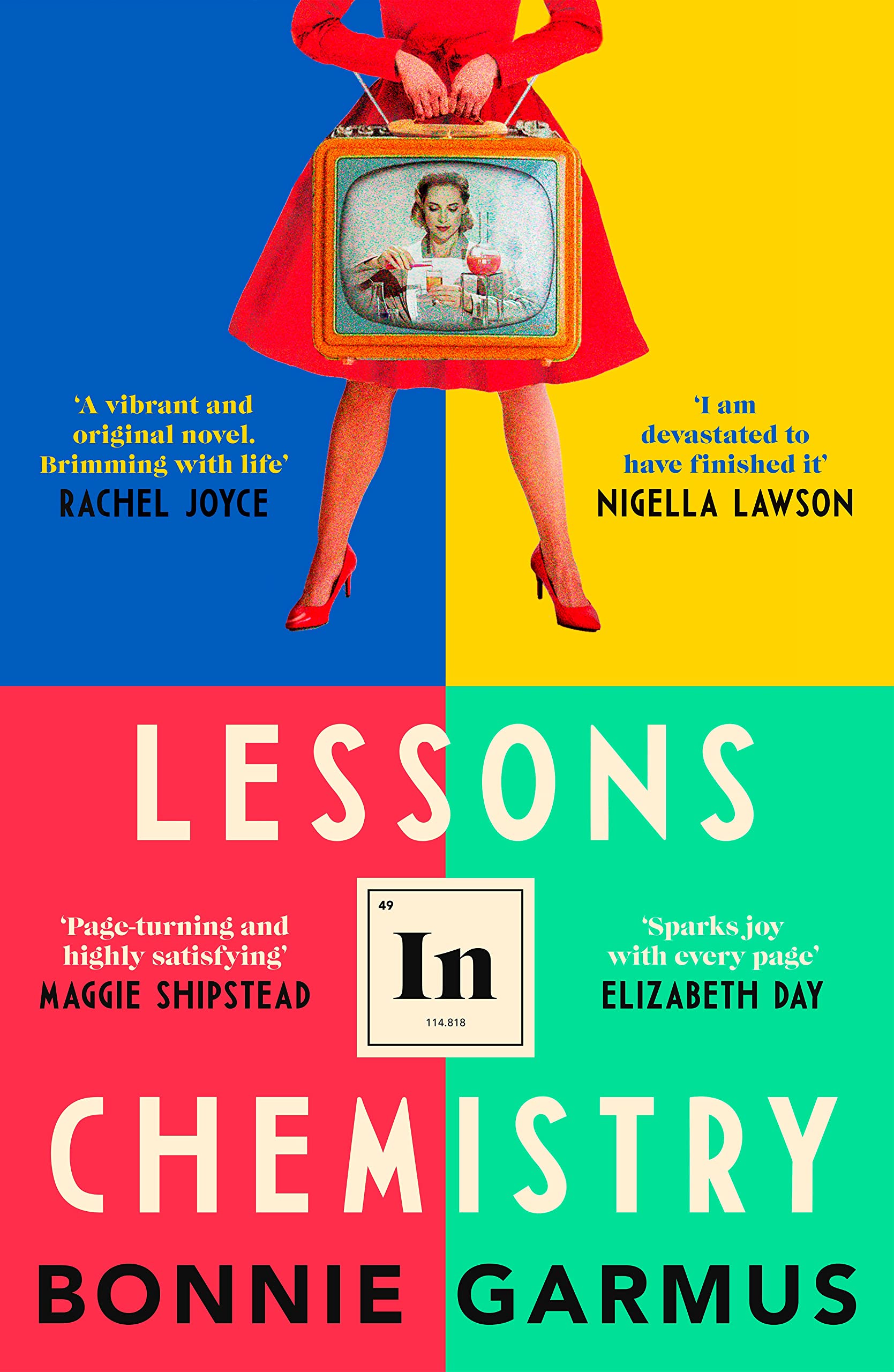
Judging a book by its cover: I think both covers for this book are somewhat misleading as to the sort of story you're actually getting. The American cover has a peach-coloured cover with just the hints of a woman's face, with cat's eye glasses and bright red lips. It makes the book look light-hearted and frivolous. The primary colours that make up the cover for the UK edition also seem to indicate a much more playful story, especially when you have the lady in the cheerful dress holding a television at the top. I'd heard good things about this book but was surprised at the actual contents after seeing the two covers. 

Crossposted on Cannonball Read

Sunday, 25 October 2020

#CBR12 Book 75: "Star Dust" by Emma Barry and Genevieve Turner

Page count: 313 pages
Rating: 3 stars

Official book description:
Houston, 1962

Anne-Marie Smith wanted normal: a loving husband, two beautiful kids, and a well-kept house. But when she catches her husband cheating, she decides that normal isn’t worth it. Now in a new city with a new job, she’s trying to find her new normal—but she knows it doesn’t include the sexy playboy astronaut next door.

Commander Kit Campbell has a taste for fast: fast cars, fast planes, and even faster women. But no ride he’s ever taken will be as fast as the one he’s taking into orbit. He’s willing to put up with the prying adoration of an entire country if it will get him into space.

But Anne-Marie and Kit’s inconvenient attraction threatens both normal and fast. As the space race heats up, his ambitions and their connection collide and combustion threatens their plans… and their hearts.

I feel like Kit is presented as a bit too much of a shallow playboy in the book description. He doesn't particularly seem to enjoy casual sex or the attention of shallow astronaut groupies all that much, and mostly, he seems super focused on his career, not the party lifestyle. Misleading book blurbs annoy me.

This book was a perfectly fine read, but the romance didn't exactly blow me away. What I enjoyed the most about this book was Anne-Marie trying to make an independent life for herself, getting a job, supporting her family, eventually making supportive female friends who didn't judge her for doing the unusual thing of taking her kids and divorcing her cheating husband, rather than stay in an unhappy marriage because divorces weren't really common back in the 1960s. Good for you, Anne-Marie, for looking out for yourself.

I kind of wish Anne-Marie had been childless. Her two plot-moppet children are not particularly engaging and feel sort of non-descript. I'm not sure they brought much to the story.

It was interesting to read a historical novel set in the mid-20th Century, most of my historical novels seem to be set in the 18th or 19th Century. I basically had the visuals for Mad Men in my head the whole time I was reading this. I got the whole series bundled in an e-book sale but still haven't made my mind up if I'm going to read the rest. This was OK, but really not much more than that

Judging a book by its cover: I think the original cover for this book features a photo of a couple embracing, but since I much tend to prefer my own mental image of the characters to whatever the book designer tends to come up with, I really like this stylised cover with period details. The silhouette of the stylish 60s lady, leaning nonchalantly on the title. The little space ship cartoon and the font, it all works for me. To top it off, the background is teal, a colour I really like. 

Crossposted on Cannonball Read

Tuesday, 4 September 2018

#CBR10 Book 65: "All the Crooked Saints" by Maggie Stiefvater

Page count: 320 pages
Audio book length: 9 hrs 9 mins
Rating: 4 stars

#CBR10 Bingo: Birthday (Ms Stiefvater's birthday is November 11th)

From Goodreads, because it sums it up nicely:
Here is a thing everyone wants: A miracle.

Here is a thing everyone fears:
What it takes to get one.

Any visitor to Bicho Raro, Colorado is likely to find a landscape of dark saints, forbidden love, scientific dreams, miracle-mad owls, estranged affections, one or two orphans, and a sky full of watchful desert stars.

At the heart of this place you will find the Soria family, who all have the ability to perform unusual miracles. And at the heart of this family are three cousins longing to change its future: Beatriz, the girl without feelings, who wants only to be free to examine her thoughts; Daniel, the Saint of Bicho Raro, who performs miracles for everyone but himself; and Joaquin, who spends his nights running a renegade radio station under the name Diablo Diablo.

They are all looking for a miracle. But the miracles of Bicho Raro are never quite what you expect. 

In this rather strange tale about the sprawling Soria family and the many pilgrims they surround themselves with, all people who have come to see them in the Colorado desert to have miracles performed, Maggie Stiefvater takes on magical realism.

In the 1960s, in the little desert town of Bicho Raro in Colorado, a number of pilgrims come to see the Saint and experience a miracle. The Saint of Bicho Raro is always a member of the Soria family, yet the miracles are strange and usually rather complicated. The  first miracle forces the pilgrim to face up to whatever darkness they have inside them, and only once they are ready and able to confront and process that darkness are they able to experience the second miracle and leave, finally free. If any of the Sorias try to speak to or help the pilgrims in any way, they risk their own darkness (which is apparently usually a lot more serious than that of a regular pilgrim) confronting them, and as a result, they have a strict rule against doing so. However, it means that over the years, more and more pilgrims are stuck in Bicho Raro, unable to complete their second miracle.

With the introduction of each new character, be they a member of the Soria family or a pilgrim, we are told a thing that character wants and a thing that character fears. We learn about the Sorias' history and the strange ways the miracles change the pilgrims. There's a priest with a coyote's head. There's a set of twins connected by a snake. There's a woman in a wedding dress, covered with butterflies, who's constantly wet because of the rain clouds that follow her. One woman can only ever repeat the last thing someone said to her. A radio DJ becomes a literal giant.

Of the younger generation of Sorias, there are three cousins. Beatriz believes herself to have no feelings, but discovers differently when a young man with a weak heart arrives in town to work for the Sorias. Joaquin loves music and wants nothing so much as to become a famous DJ. With his two cousins, he drives a box truck into the desert at night and runs a pirate radio station. Daniel, the current Saint of Bicho Raro defies the taboo of speaking to the pilgrims because he's in love with one of them. Struck down by his own darkness, he leaves his family to keep any of the other Sorias from being likewise cursed.

Beatriz and Joaquin are determined to save their cousin, no matter what the family rules state. They defy their elders and along with Pete, the young man who they were both initially so sceptical about, they set out to save him.

I don't think I've read a Maggie Stiefvater novel that I didn't enjoy. Some of them I absolutely adore. This book was very different from her previous novels, yet was still clearly very much her work. She has a way with words and descriptions that almost ensorcells the reader and keeps you spellbound. This book started slow, and it may have taken a bit too long to introduce every single character before actually getting to the "meat" of the story. But it's all worthwhile in the end. I listened to the audio book, narrated by Thom Rivera, and can very much recommend it.

Judging a book by its cover: The cover features ban owl and black roses, both things that play a significant part of the story. I'm unsure of whether the orange circle is supposed to be the sun or an actual orange - it's unclear.

Crossposted on Cannonball Read.

Sunday, 12 March 2017

#CBR9 Book 22: "The Turn: The Hollows Begins with Death" by Kim Harrison

Page count: 448 pages
Audio book length: 16 hrs 20 mins
Rating: 4 stars

Spoiler warning! I found it impossible to review this book without revealing plot details that would probably be considered spoilery, so if you like to start a book without knowing much, probably skip this review. Also, this book is a PREQUEL, best read after you finish the full thirteen book series by Kim Harrison.

In a world where humans are the dominant species, they are fully unaware that there are a number of supernatural races living among them, trying to stay firmly under the radar, doing their very best to always blend in. Witches, vampires, elves and werewolves may look and act human, but have their own genetic makeup and customs and are always worried that the humans will discover and turn on them. In addition to the species who can pass for human, there are a number of smaller groups, like fairies, pixies, gargoyles and trolls, who have to stay completely out of sight and whose numbers are rapidly dwindling because of increased urbanisation and increased pollution. Calling themselves Inderlanders, the supernatural species often have scientific and technological advances far beyond those of the humans, but can't publicly reveal them for fear of being outed.

Elves are among the most vulnerable of the Inderlanders, with their numbers small, as they have incredible difficulties conceiving children, who often need a lot of very expensive genetic tinkering to live to adulthood and have children of their own. Among the elves, most of them are tall, blond and pale-eyed, with the dark elves, with their dark hair and eyes considered somewhat inferior. Felicia Eloytrisk "Trisk" Cambry is one such dark elf, and she's worked hard to become the best of her class at bio-engineering, despite the fact that most dark elves are encouraged to stay in the background, in security type jobs. Her fiercest rival is Trenton "Kal" Kalamack, a spoiled, arrogant and entitled man whose family was once rich and very influential, but are now left with Kal as their only scion, having spent most of their fortune to even have him. He's determined to make his once great name powerful again, and doesn't really care who he screws over to do it.

It's not like the 1960s was a hugely progressive and supportive time for women to begin with, and as a woman, dark elf and daughter of a minor house, Trisk has her work cut out for her. At their graduation work fair, she and Kal get into a big argument and cause a massive scene, ruining any chance either of them has of the best jobs. Kal has tormented Trisk for most of their lives, being a shallow and thoughtless bully and once Trisk's best friend, Quen, accepted a job as security for the Kalamack family, she didn't really have the restraint to hold back her contempt for the man. After the job fair, Trisk is approached by one of the elven leaders and asked if she would consider taking a job with a human lab, to act as a spy for the Inderlanders, making sure that the humans don't make genetic advances that could be harmful to the supernatural races. She's initially reluctant, but needs to make money somehow, so has no choice but to accept.

Three years later, Trisk has thrived in her job, engineering a new strain of drought-resistant tomato which should help eliminate hunger in the third world. In addition, she's been working to make sure that her human colleague Daniel's new tactical virus won't in any way affect any of the Inderland species when it's finally let out of a lab. The virus is meant to give people fever, sickness and a rash for 24 to 48 hours, before they get better again and recover. It's meant to help armed forces neutralise hostile populations for long enough that soldiers can move in and take over an area. Trisk has made very sure that no matter how it actually works in practise, it won't touch Inderlanders. The ruling council of Inderlanders are still not entirely convinced Trisk has managed to make the virus entirely safe (she is a mere woman, after all), so they send as a consultant to double check her work. He's still angry because he lost a chance to work at NASA after the graduation fair, and plans to either outright steal or sabotage Trisk's work, making sure her reputation is utterly ruined. If he can seduce her and break her heart while he's at it, that will just be a bonus.

Long story short, because of pettiness and jealousy, once Kal discovers how good a geneticist Trisk actually is and that her work is flawless, he instead sets about sabotaging her, by forging a link between the tactical virus and her T4 Angel tomato. Unfortunately, something in the drought-resistant tomato makes the virus very potent and within 24 hours, humans are dying everywhere. Living vampires, who possess the vampire virus, but are not yet dead, are getting sick, but not dying. Once Trisk and Daniel realise what has happened, but not yet how, they go on the run, fully aware that they are going to be blamed for the disaster. Trisk needs to make it to the elven council, and they need a way to notify everyone not to eat tomatoes or anything tomato based, as it seems the virus spreads more rapidly than they could have imagined and is completely fatal to humans who catch it. Trisk is pretty convinced she knows exactly who is behind the plague, but also knows that unless she can find proof, it will be her word against Kal's.

This prequel to Kim Harrison's thirteen book paranormal fantasy series goes back and shows the reader how the deadly virus that took out a quarter of the world's humans started (and it turns out it was all because of Trent's dad). This book is really best read after finishing the rest of the books in The Hollows, because it assumes you already know how Harrison's paranormal universe works. In the early books of her series, she explains how all her various supernatural species interact and how, after The Turn (as the plague event came to be known), humans were no longer the dominant species and the Inderlanders could come forward without fear of being hunted and eradicated. In fact, since they were immune to the virus, they were the ones that were able to keep some semblance of order and lend aid to the dying humans. Significantly, in Harrison's alternate paranormal universe, no one ever made it to the Moon and genetic engineering was made illegal after the Turn.

As a long-time reader, it was fun to see a young and dashing Quen, as well as catch a brief glimpse of heroine Rachel's dad. There are several appearances by one of my favourite characters in the series, the wily and charming demon Algaliarept, but the main focus here are Trent's parents. I don't know if Harrison is planning more prequels, but based on what she shows in this book, that man cannot have had a good childhood as his mother and father were bitter enemies and well, his dad twisted his mother's work to cause a world-spanning plague. Oh, and his family's chief of security clearly fancied his mum. That's not going to make for a tranquil and harmonious home life. No wonder the man is morally dubious in the early books of the main series.

Trisk is a really cool character, who works so hard to prove herself. I want to tell you that she gets a happy ending, but unless there are more prequels to come, I really don't think anyone can say that where she ends up at the end of this book is a place where she'll thrive. This was a fun book to read, but it nearly got an even lower rating, because I hated Kal so very much. Even having read the book, i can't believe Trisk let her be fooled by him for even a second and certainly not to let her guard down for long enough to get knocked up. While there are hints in the original series that Trent's dad wasn't exactly nice, there is nothing to suggest he was this noxious and inexcusable a character. I want more prequels, where he suffers a LOT and Trisk gets all the good things she deserves.

Since Kim Harrison finished The Hollows, I've been pondering a full re-read, to see how the characters and story develops over the thirteen books. This book was an excellent way to get me into the head space I need, and I suspect I'll now have even more affection for Trent (a character I always loved, even when he was a worthy nemesis of Rachel), because compared to his dad, he's a saint.

Judging a book by its cover: Kim Harrison has said on her blog that this might be her favourite cover of all of her books, and it really is atmospheric and lovely. While the cover model (what you see of her cropped face) looks nothing like I imagine Trisk (I'm pretty sure her hair is described as darker, as well), the sparse colour scheme of red white and black is eye-catching, with the billowing red dress (not really period appropriate for the 1960s) evoking thoughts of blood, the woman cradling the tomato tenderly, even as it's turned deathly black and putrid contamination is swirling from it, staining both the letters and the dress. In a different setting, the snow and trees in the background might bring thoughts to peace and serenity, but here also bring to mind loneliness and underscores how alone Trisk really is.

Crossposted on Cannonball Read.
Sunday, 15 November 2015

#CBR7 Book 115: "4:50 from Paddington" by Agatha Christie

Page count: 351 pages
Audio book length: 7 hrs 8 mins
Rating: 2 stars

On her way by train to visit her old friend Jane Marple for Christmas, Mrs Elspeth McGillicuddy is shocked to realise that she's witnessing a murder in the train running parallel. A tall, dark man in a dark coat is strangling a blond woman in a fur coat and there is nothing Mrs McGillicuddy can do. As soon as the train stops, she notifies the ticket inspector and the station master of what she saw, and when she arrives at Miss Marple's, the two talk to the police and report the crime.

No one else appears to have witnessed anything amiss, however. No dead bodies have been found on the train, and no women have been reported missing. There are suggestions that perhaps Mrs. McGillicuddy imagined what she saw, but she is adamant she witnessed a crime, and her friend Miss Marple, far too experienced with the dark deeds that people commit, believes her. Once her friend leaves to visit her children after Christmas, Miss Marple starts her own investigation. She discovers that the train the murderer would have been on comes to a sharp turn shortly before it enters the station in the town of Brackhampton. There is a sloping hill where a body could easily have been dumped.

As Miss Marple is old and incapable of going around to snoop for a dead body herself, she engages the assistance of a young friend, Miss Lucy Eyelesbarrow, a highly intelligent and competent woman whose made a name for herself as the perfect domestic servant. She can perform the duties of housekeeper, cook, nursemaid or nanny for the people she works for, always leaving the household much better off than it was when she left. Because of her dedication and skill, she's in high demand, but has some free time because of the holidays and Miss Marple's problem intrigues her. She manages to secure a post with the Brackenthorpe family, who live in the manor where Miss Marple suspects the body has been hidden. When Lucy finds the dead woman in an antique sarcophagus in one of the manor's outbuilding, there are several mysteries that need to be unravelled. Who is the dead woman, who none in the Brackenthorpe family claim to recognise? How did she end up hidden in their barn? And last, but not least, who murdered the young woman?

Lucy Eyelesbarrow acts as Miss Marple's eyes, ears and legs in the case, while the godson of Miss Marple's good friend, Inspector Craddock, is in charge of the investigation on behalf of the Scotland Yard. As in most good Agatha Christie mysteries, there's a fairly large cast of characters who could all be guilty of the murder, and the blond woman on the train is not the only one who ends up dead.

This audiobook was bundled with The Man in the Brown Suit, a kind gift from my BFF Lydia. As a young teenager, I voraciously devoured all the Agatha Christie novels in Norwegian translation in my local library, and I was pretty sure I'd read most of the books in her bibliography. I know I much preferred the stand-alones and the Poirot books to those with Miss Marple, and at no point when listening to this book, did I remember anything that made it likely I'd read it before. They do all blend together a bit, but I really think this was the first time I came across this particular story. While Agatha Christie didn't really write any bad books, this one very much suffered from being listened to right after one of my all-time favourites. While Lucy was an engaging enough character and Miss Marple obviously is a very clever old lady, a sedate manor mystery set in the English countryside set shortly after Christmas just cannot compete with Anne Beddingfeld's adventures in South Africa with diamond theft, cruise ships, civil unrest in South African and dashing young men in brown suits.

Crossposted on Cannonball Read.

Monday, 13 July 2015

#CBR7 Book 72: "Populærmusikk fra Vittula"(Popular Music from Vittula) by Mikael Niemi

Page count: 224 pages
Rating: 2 stars

Matti grows up in a tiny town in the remote north of Sweden in the 1960s and 70s. The chapters in this book are more like little short stories about different aspects of his childhood and adolescence, chronicled with humour and the occasional forays into strange, magical realism-inspired fantasy sequences. The inhabitants of his town and the surrounding areas seem to be either deeply puritanically religious or Communists, not caring for the trappings of religion at all. The gruff and peculiar inhabitants are set in their ways and far too prone to alcoholism.

There's the story of Matti's near-mute best friend Niila, whose father, a lapsed preacher, is so domineering and abusive that neither of the many children of the family speak much, and Niila first learns to speak in Esperanto, through lessons he overhears on the radio in Matti's house. We hear about Matti and Niila's childhood discoveries of rock music, with the hits of Elvis Presley and the Beatles making a huge impact on their lives, inspiring them to form a band. There's the friendly rivalry of adolescent boys, and the organised warfare with airguns that the teens orchestrate in the neighbourhood. There's the summer when Matti is trying to make enough money for a guitar of his own, and engages in devious and gory rat extermination to keep the cabin of a visiting German author vermin free.

Because the book is occasionally a straight-forward coming of age narrative about boys in a rural area in the 60s and 70s, but then all of a sudden veers into some dreamlike sequence where a boy gets trapped in a furnace for a winter and starts growing roots, or there is a cross-dressing witch in the woods who can exorcise ghosts, it's hard to pinpoint what the book is actually trying to be. As such, I found the book more frustrating than satisfying. The jumps in narrative, where the story will in one chapter talk about Matti's childhood, then his teens, then back again to earlier in his life, in very strange, seemingly unconnected episodes (all with the common denomination that they're set in Vittula, where he comes from) made the book confusing and while I appreciate the writer's skill, this book just didn't really work for me.

Crossposted on Cannonball Read.

Saturday, 22 November 2014

#CBR6 Book 125: "The Outsiders" by Susan E. Hinton

Page count: 190 pages
Rating: 5 stars

Ponyboy Curtis is an orphan. He lives with his two older brothers, Darry, who works construction and Sodapop, who dropped out of school to work in a garage to help support the family. Ponyboy and his friends are Greasers, kids with leather jackets and long, grease-slicked hair from working class backgrounds, often with a lot of trouble at home. Quite a few of the Greasers are part of gangs and having a criminal record isn't all that uncommon.

Ponyboy would much rather be a Greaser with no parents than a Soc, however. The rich, privileged society kids with their expensive cars and their letterman jackets, whose favourite pasttime is teaming up to beat up Greasers. Ponyboy is the baby of the gang, and clearly the one with enough smarts and academic prospects to have a chance of getting a good college scholarship and making something promising with his life. Darry had to give up on his college dreams when their parents died, and Sodapop would much rather work on cars than go to school.

While the clashes between the Socs and the Greasers can get pretty rough, they tend to be broken up before anyone can get badly hurt. One fateful evening, when Ponyboy and the badly traumatised Johnny Cade are attacked by a gang of drunken Socs who get particularly threatening, everything goes to hell. Ponyboy and Johnny go on the run, hiding out from the cops in a countryside church. When there's an unexpected fire, the boys get a chance to show that hoodlums from the wrong side of the tracks can make a real difference.

The Outsiders was one of my favourite books as a young teen. I can't entirely remember how old I first read this book, but I can vividly remember my reaction to it. I stayed up way later than was sensible, considering it was a school night to finish it, and I cried so hard that I couldn't see the pages anymore. Big, racking sobs and full on ugly crying. I remember being amazed that the author was only fifteen when she started writing the book. Is it a literary masterpiece? No, probably not, it's a fairly simplistic story but it's a compelling novel written by a teenager, in the voice of another teenager and having re-read it for the first time in about fifteen years, in English for the first time, I was still really strongly emotionally affected by it.

Unfortunately, I no longer remember exactly what I thought about the social situation of the various Greasers described in this book, nor what I felt about Ponyboy's strained relationship with his oldest brother. Now, as an adult, I probably see a lot of the relationships in this book from a very different perspective. I still cried a lot at certain sections of the book, but I suspect I cried the hardest at other parts than when I was a young teen. I can't objectively judge the quality of this book, because it's such a powerful piece of nostalgia for me, and will always be an emotional reading experience for me. My husband has never read the book, nor watched the film (which I'd love to rewatch now, having not seen it for about as long as since I last read the book), and I plan to read this out loud to him, as he, early in our relationship, read me The Hobbit and The Wind in the Willows.

Crossposted on Cannonball Read.

Sunday, 23 March 2014

#CBR6 Book 20: "The Secret Life of Bees" by Sue Monk Kidd

Page count: 375 pages
Rating: 3.5 stars

Lily Owens grows up isolated, neglected by her father and lonely on a peach farm in Georgia in the 1960s. Her only friend is the woman who acts as her nanny, Rosaleen, a former field hand who's taken care of her since Lily's mother died in a tragic accident when Lily was little more than a toddler. When Rosaleen is forced to flee town after accidentally insulting some white men while on her way to registering to vote, Lily insists on coming with her. They decide to go to Tiburon in South Carolina, as one of the few things Lily has left after her mother is a small icon of a Black Madonna with the place name scrawled on the back.

As they make their way to Tiburon, Lily and Rosaleen discover that the Black Madonna is the logo of the honey produced by the three Boatwright siblings, who take the two in without asking too many probing questions. It is obvious that there is some kind of connection between the Boatwright sisters and Deborah Owens, Lily's mum, but it takes quite some time for Lily to gather up the courage to ask, afraid she'll be disappointed once more.

I was given this book as a birthday gift in 2005, and it's been languishing on my bookshelf ever since. Several friends have borrowed it, even, I just never got round to reading it. So when "life" was one of the key words for February in the Monthly Key Word Challenge this year, and with the book fitting into a whole slew of my other challenges, it felt like it was finally time to pick it up. It was a perfectly inoffensive little book, I just don't entirely think it was what I was in the mood for, and as such, I'm unable to rate it any more highly than I have.

Lily is understandably a character with a lot on her plate. Her mother died when she was little, and it seems clear from her hazy recollections of the event, that Lily is actually the one who accidentally killed her. Her father ignores and neglects her at the best of times, and straight up abuses her at the worst (making her kneel on corn grits until her legs bleed being a favoured punishment). She so desperately wants affection and a place to belong. When she finds the Boatwright sisters, who show her kindness and let her stay with them, she lies and claims to be an orphan, terrified that they're going to send her back to her father.

Lily is only 14, and as such, some of the things that annoyed me about her make perfect sense. Teenagers are frequently irrational and annoying, I should know, I work as a secondary school teacher. I still think her going from being curious about August's nephew to "ZOMG, I love him so much!" in the space of an afternoon a bit sudden, and I think some of her petulance and truculent attitude in the latter half of the book, once she discovers more about her mother, went on for too long and got exasperating. It's a perfectly sweet book, but it wasn't right for me during a rather stressful period. I certainly didn't like it as much as Genericwhitegirl, one of my fellow Cannonballers. I can't say whether the movie is a good adaptation or not, as I haven't seen it, but it looks to have a decent cast.

Crossposted on Cannonball Read.
Sunday, 5 May 2013

#CBR5 Book 45. "Maskeblomstfamilien" (The Figwort Family) by Lars Saabye Christensen

Page count: 285 pages
Rating: 1.5 star

"I had a good childhood. My father died when I was twelve. My mother went to bed early. I was an only child." 

These are the opening lines of Maskeblomstfamilien, a title which can be translated as The Figwort Family, but which can be interpreted in several ways, and holds more than one meaning. The plants and flowers of the Figwort Family usually have large leaves that cover up and blanket the ground. The flowers are often without scent, but if they do smell, it's more of an unpleasant stench than a refreshing smell. Foxglove, and other flowers in the Digitalis family, which is a subgroup of the Figwort family, are all poisonous.

In Norwegian, the title can also be broken into three - maske means mask, blomst means flower and familien means the family. Every significant person in this novel are not entirely as they appear at first, they all wear masks. The Greek tragedy of Oedipus also plays a central part in the last third of the novel, which is in itself structured as a classical tragedy in three acts. The flower is Adrian, the protagonist, who, considering the environment in which he is raised, unsurprisingly grows up to be a deeply twisted individual. The Wang family, his family, are not supportive or nurturing, and they all have dark secrets.

Adrian Wang might claim he had a good childhood, but the reader quickly learns that he is a very unreliable narrator. Born in the 1950s, during a solar eclipse, living in a dark and mostly empty flat in the centre of Oslo, situated right behind the Royal Palace, the reader quickly sees that he is not quite like other children. He doesn't take part in P.E, with a doctor's note ensuring that he can stay on the sidelines. He is told by more than one adult that he is completely shameless. He overhears his parents arguing with the family doctor about an operation that needs to be performed before he grows too old, and it's too late. He appears completely devoid of empathy for others, a calculating, devious child, always wanting to manipulate situations to his own advantage.

His mother is beautiful, delicate and distant. His father works long hours as a patent engineer. He doesn't seem to be around much, and when he's not working, he shuts himself away in his home office, or sits in the parlor, reading Time magazine with hands covered in white gloves. There is also an aunt, his father's older sister, who Adrian nicknames "the skeleton". She's skinny, bitter and cracks her knuckles loudly. These are the adults our protagonist is supposed to take his guidance from.

When it comes to peers his own age, Adrian doesn't really have any. He's a solitary child, with no real friends to speak of. None of the other boys seem to like him much, and more than once he is bullied and beaten up. The closest thing he has to a friend is Emilie, the Albino girl who lives one floor down from him. She's also an only child, and more of an obvious victim with her milky white skin, cleft lip and red, sensitive eyes. She tries to show Adrian kindness and friendship, but is frequently met with scorn and rebuffed.

The book follows Adrian from the age of 12 until he is 17. As he says in the opening lines - his father died when he was twelve - by shooting himself in the head with a shotgun. Whether it's because his business is failing, or something darker and more sinister, is unclear. Lillian, Adrian's already frequently distant mother, retreats into silent grief and/or shame and becomes the Widow for the remains of the story. The aunt moves in and tries to take control of the household. The Widow is moved from the master bedroom to the maid's pantry, spending most of her time in bed, until she is finally so far gone that she is taken away by the family doctor, and only Adrian and the Aunt remain, locked in a battle of wills. Then, at the end of the first act, Emilie disappears, to be found three days later, dead in the basement. Was her death an accident, or did something worse happen to her?

Lars Saabye Christensen is a very critically acclaimed Norwegian writer, and most of his books deal with boys growing up in Oslo in the 1950s and 60s. His protagonists are often a bit different, wanting nothing so much as to fit in, be one of the guys. He has a brilliant way with words, but despite this being the sixth of his novels that I've read, his books at best leave me indifferent and bored, and at worst, creep me out and disgust me. This book was one of the ones that absolutely disgusted me. I found it completely impossible to even vaguely sympathise with Adrian, despite the ways he is mistreated as a child, and clearly not given the help he so desperately needs. When he was bullied and beaten, a part of me cheered the bullies on. It's obvious from very early on that bad things are going to happen in the book, and that Adrian is going to be the cause of some of them. He is a sociopath and a very evil person. I wanted horrible things to happen to him. I don't like feeling that way when I read, I was comforted to hear that most of the others in my Norwegian course, including the lecturer felt much the same way - you're clearly not meant to like Adrian. Even so, I've given Christensen six chances, and with each new book I read, I'm more convinced than before that his books are not for me. I'm not going to be reading any more of Christensen's books, even if most of them don't have such twisted protagonists.