Showing posts with label Key Word Challenge. Show all posts

Sunday, 21 September 2014

#CBR6 Book 101: "The Silver Metal Lover" by Tanith Lee

Page count: 291 pages
Rating: 3 stars

Jane lives a pampered and privileged life, the only child of a wealthy and influential woman. She's lonely, insecure and immature. She has no real friends, just people who mainly seem to take pleasure in bullying her. One day, she encounters a robot minstrel, one in a new line of highly realistic, artificially intelligent androids and her life is never the same. Though she is initially frightened by the robot, she's also fascinated by him and can't put him out of her mind.

She runs away from home, giving up everything just to be with Silver, as she names her robot lover. She learns to fend for herself and makes a life on her own. She refuses any contact with her mother or former "friends" and begins to discover a wholly different, much happier existence. Yet the factory who first created Silver wants all the advanced robots destroyed and they are searching for Jane and Silver. How long until their happy romance comes to an end?

The Silver Metal Lover was written in 1981 and for as long as I've been reading young adult fiction with any sort of romantic element, this book has been on my radar. It appears on countless lists of romantic YA and has clearly meant a great deal to a lot of readers over the years. Yet the book never seemed to interest me all that much, probably because science fiction is not a genre I read all that much and robots are a lot less appealing to me than vampires, werewolves, faeries and witches. When this was the alt book in Vagina Fantasy book club in August, and the book also fit with my Monthly Key Word AND Monthly Motif reading challenges, I decided to check it out. I suspect that it would have made a much greater impact on me if I read it when I was actually a teen in the mid-90s than it did now.

First of all, Jane really is somewhat of an exhausting protagonist. She cries ALL the damn time. She cries so much she even points out that it's amazing she doesn't dehydrate herself from all of it. She's lived a sheltered and not very exciting life, so it's not actually surprising that she has the personality of a wet sponge, I just really didn't like her much at all. Even when she developed the backbone to run away to be with her robot lover, I didn't like her all that much. The best thing she had going for her was that every single character in the book, with the exception of Silver was so much worse than her.

Silver was pretty cool actually. I prefer my robots more of the Terminator variety, frankly, but as sentient robots go, he wasn't bad. I'm sure he could have done better than Jane though. Their romance didn't really work for me, as I found Jane dull as dish-water. The book had an interesting concept, but there are just so many better YA sci-fi romances out there now, and while it was a perfectly ok book, it didn't wow me in any way. 

Crossposted on Cannonball Read.

Wednesday, 1 January 2014

Reading challenge wrapup 2013 - Monthly Keyword Challenge

Kimberly Lynne over on Bookmark to Blog hosted the Monthly Keyword Challenge this year.

The guidelines:
- The title you choose can be a variation on one of the key words. For example - your title could include the word 'snowing' or 'snowflake' even though the keyword is 'snow'.
- Key words can be tweaked. For example - you could read "Cinder" or "Ashes" for the key word "Fire" and that would be just fine. If the key word is 'family' then your title could include the word 'sister' or 'mother'. If the key word is 'food' then your title could include the word 'cake'.

While some of the books may have been blogged in a different month, they were all read in the correct month of the year.

January:
Firelight (key word: fire)
Crown of Embers (key word: fire)
The Snow Queen (key word: snow)

February:
One Good Earl Deserves a Lover (key word: love)
The Dust of 100 Dogs (key word: animal)
The Way to a Duke's Heart (key word: heart)
Out Stealing Horses (key word: animal)
The Diamond Age (key word: diamond)

March:
Luck in the Shadows (key word: luck)
The Mislaid Magician (key word: magic)

April:
The Cavendish Home for Boys and Girls (key word: home)
The Figwort Family (key word: flower)
The Shadow of the North (key word: shadow)
Briar Rose (key word: flower)
Snow White and Rose Red (key word: flower)

May:
Across the Nightingale Floor (key word: bird)
Anna Karenina (key word: name)

June:
The Light Between Oceans (key word: sea)
The Ocean at the End of the Lane (key word: sea)
Fly by Night (key word: fly)

July:
It Happened One Midnight (key word: night)
Beauty and the Spy (key word: spy)
Summer Knight (key word: night)
About Last Night (key word: night)

August:
The Chocolate Touch (key word: food)
Breadcrumbs (key word: food)
The Broken Kingdoms (key word: broken)

September:
Flowers from the Storm (key word: storm)
Raw Blue (key word: blue)
Scoundrel's Kiss (key word: kiss)
Anna and the French Kiss (key word: kiss)

October:
Murder Mysteries (key word: death)
Three Parts Dead (key word: death)

November: several of books with the relevant key words were read in other months of the year, but due to a heavy work load, I seem to have completely missed out on actually hitting the target here.

December:
These Broken Stars (key word: star)

I hadn't actually realised until I compiled the list that I'd missed out on reading a key word book for November in the actual relevant month. Am really annoyed that I failed to hit at least one book a month now.

Tuesday, 31 December 2013

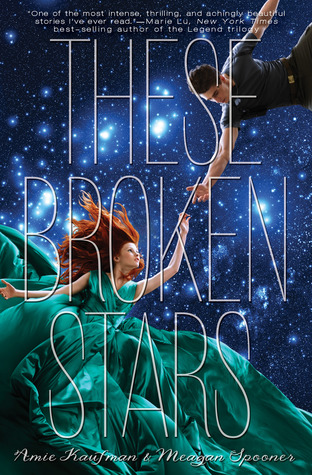
#CBR5 Book 146. "These Broken Stars" by Amie Kaufman and Meagan Spooner

Page count: 384 pages
Rating: 4 stars

Disclaimer! Disney Hyperion granted me an ARC of this through NetGalley in return for a fair review.

Much as I love the colours and the lush quality of the cover for this book (my husband disagrees with me, he thinks it's dreadful), it doesn't actually give a very realistic portrayal of what the book is about. It's not really floating about in space in a ball gown (but the gown does exist, and Lilac does spend a substantial amount of the story wearing it), or even Titanic in space, as I saw it described elsewhere (although there are obvious nods to the film). So if you're hoping for that, you may want to adjust your expectations before going in.

Boy meets girl on board the most expensive intergalactic cruise liner in the known universe. Boy and girl have a connection. The next time boy and girl meet, girl viciously rejects boy in front of her friends. Boy is deeply hurt, but this doesn't stop him from helping her to an escape pod when something goes horribly wrong and the ship they're on is wrenched out of hyperspace and needs to be evacuated. Boy and girl crash escape pod on nearby planet, and have to make their way across the deserted and sometimes dangerous planet with hardly any supplies, hoping to be rescued.

Our boy is Tarver Mendenson, an 18-year-old officer heavily decorated in the recent war and given special privileges aboard the Icarus because he's become a poster boy for the army. He's from a humble background, and not really comfortable in the opulent surroundings and among the wealthy passengers in the first class areas. Our girl is Lilac LaRoux, daughter of the richest man in the universe. Her father owns the Icarus (as well as much of the known universe), and Lilac has learned the hard way that young men who show any kind of interest in her have a nasty way of disappearing. She finds it charming and amazing that Tarver doesn't know who she is when they first meet, but has to dissuade him from ever talking to her again, lest he find himself suddenly deployed to the front line of another war zone before he knows what hit him. She can't tell him this, however, and by the time their escape pod crashes, he thinks she's a spoiled and callous space princess (while mysteriously adept at mechanics) and just wants to be rid of her as quickly as possible.

Being a trained soldier, Tarver has brought a pack of essentials with him. Lilac is dressed in an expensive ballgown and stiletto heels, and partially to live up to Tarver's expectations of her, insists on trekking through the wilderness while wearing them. They are horrified witnesses to the Icarus crashing several days' distance away, and realise that they'll have to get to the wreckage in the hopes of finding other survivors, and so there is a better chance of rescue ships finding them. Lilac is convinced that they will be rescued very soon, but as they trek towards the wreck, it seems more and more likely that she and Tarver are completely alone on the strange planet. But then they start hearing voices...and seeing strange things.

I first read about this book in one of the "On the Smugglers' Radar" posts on The Book Smugglers. When the ARC became available on NetGalley, I was delighted when I was granted a copy. The title also fit perfectly with the December Monthly Key Word Challenge, which meant I had to save the book until it was about to be released. As I said in my opening paragraph, I love the cover. The summary of the book on Goodreads also sounded very intriguing, and I'm happy to say that it didn't disappoint.

The book is told with alternating chapters from Tarver and Lilac's points of view. Before the start of each new chapter, there is also snippets of an interrogation, where Tarver is being questioned, which unfortunately takes away some of the suspense about whether or not the couple get rescued or not. As I also mentioned, there is a certain "Titanic in space" comparison to be made for the beginning of the book, but most of the story is one of being cast away in a lonely and hostile place, fighting for survival. There is a definite opposites attract element at play here, Tarver and Lilac are absolutely from different worlds. The romance that develops between them doesn't seem forced, though, and the story develops in ways that I certainly would never have expected, and parts of the plot were actually quite creepy. Not normally a huge fan of science fiction, this one worked for me, possibly because quite a lot of the story could just as well have been fantasy or historical fiction with a few tweaks. It looks as if the book may be the first in a series. I will be keeping a lookout for the sequels.

Friday, 1 November 2013

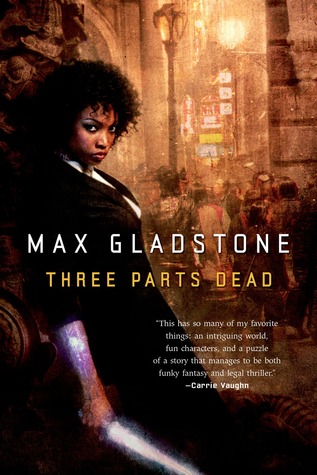
#CBR5 Book 131. "Thee Parts Dead" by Max Gladstone

Page count: 336 pages
Rating: 4 stars

Tara is a newly hired first year associate with the firm of Kelethres, Albrecht and Ao, and on her very first assignment, she needs to help resurrect a god. Kos, the fire god of Alt Coulumb, has mysteriously died (he may have been murdered) and if he cannot be brought back within the month, the power he supplied to the city will shut down, and there will be chaos.

Abelard is the cleric who was on duty when Kos died, and he is naturally having a bit of a crisis of faith, which he handles by chain-smoking incessantly. He is asked to aid Elayne Kevarian (Tara's boss) and Tara with the case, which also seems to involve a murdered judge, supposedly exiled gargoyles, and the re-appearance of Tara's old mentor, who's also responsible for her being expelled from the Hidden Schools before graduating. There are mysterious things afoot in Alt Coulumb - but who has the most to benefit from the death of Kos? How far are they willing to go to stop him being resurrected and restored to power?

This is not an easy book to classify. It's alternate reality urban fantasy, meets mystery meets steampunk. There are magical systems, and different religious beliefs. There's the necromantic Craft, and the strange legal battles that take place before a case can be settled. The necromancers seem to be part lawyers, part magic wielders. We discover the rules and customs of the world gradually, and the information is sometimes portioned out sparingly, not giving the reader the full story until a long way into the book.

The characters are distinctive, and complex, and not always admirable or likable, but they're never not interesting. I loved the world building and the rules for the use of magic. That gods are powered by the belief of their worshippers is nothing new, but that a god can be the source of power for an entire city is a cool and unusual idea. I liked Tara's ambition, I loved Elayne's cool ruthlessness, and I liked Abelard's genuine faith and devotion. Max Gladstone is a very entertaining writer, and having recently discovered that this is not a stand alone book, and that the next book in the series is out now, I will absolutely be reading more of his work.

Saturday, 12 October 2013

#CBR5 Book 126. "Anna and the French Kiss" by Stephanie Perkins

Page count: 386 pages
Rating: 4 stars

Anna Oliphant doesn't want to go to school in Paris. She's not sure why her father (who basically seems to be a thinly veiled parody of Nicholas Sparks) has enrolled her in a boarding school there. She had perfectly nice life in Atlanta with her mum and little brother, a great best friend, a very promising crush on one of the guys she works with at the local multiplex. Now she's a continent away from everyone she loves, surrounded by clever and cool teenagers who all know the school really well. She doesn't even speak French! Then she meets Étienne St. Clair, who is helpful, generous, charming, smart and gorgeous. Of course, he has a girlfriend. And even if he didn't, her new friend Meredith also obviously has a crush on him. So Anna is unlikely to experience any French kissing from him, right?

Now, at the start of the book, I was torn between wanting to slap some sense into Anna, and give her a hug. Her excessive whining that her pompous, somewhat emotionally unavailable, but very rich father has see fit to send her to a posh boarding school in Paris, one of the most beautiful cities in the world, is pretty much what you'd find in the dictionary as an example of first world problem. Yet at the same time, she's never been away from home before and she's an insecure teenage girl, and now she's half a world away from everyone and everything she knows, in a foreign country full of culture and sophistication. It speaks to her dad's cluelessness that he'd send his daughter to a boarding school in a country where she doesn't even speak the language. As someone who voluntarily moved to Scotland to go to University when I was eighteen, and had some pretty big culture shocks, I can understand and symphatise, because Anna's situation is so much scarier.

Luckily, Meredith, the girl in the room next to Anna comforts her when she hears her crying through the wall, and Anna soon makes a group of very good friends, one of whom is St. Clair (no one really calls him Étienne). Realising that he's completely out of her reach, Anna denies her crush as much as she can, but they have undeniable chemistry, and the more time they spend together, the more obvious it is that he's not entirely uninterested in her either. Yet he seems completely devoted to Ellie, his girlfriend who graduated the year before. And Anna has Toph back in Atlanta, who she may have a chance of a real relationship with.

This is a great YA book, with a friendship turning slowly more and more romantic, full of awkward moments, embarrassment and near misses. For all that they are great characters, both Anna and St. Clair had me shouting at the book, because they keep doing the exactly wrong thing and sabotaging their happy ending. The description of a close friendship that turns into something more romantic is so very well done. I was very good friends with my now husband before I woke up one day, realising that I was in love with him, and it was nerve-wracking to think I might ruin our friendship if I told him I fancied him and he didn't like me back. Also, he'd been dating another good friend of mine for a week. As it turned out, she wanted to date someone else, and he did like me back and this is our thirteenth year together. But this book hit a lot of right notes for me.

It helps that the supporting cast of characters are so much fun too. Anna's friendship with her bestie in Atlanta, Bridgette, is complicated when she returns home for Christmas break, but she makes some great friends at the School of America in Paris. As is only appropriate in a high school setting, even though it's in beautiful Paris, there are also antagonists with bitchy mean girls and douchy guys to fully round out the setting. I've been seeing this book raved about on a number of review sites for years, and my beloved Rainbow Rowell rated it five stars. I'm glad I finally had a chance to read it.

Thursday, 3 October 2013

#CBR5 Book 122. "Scoundrel's Kiss" by Carrie Lofty

Page count: 342 pages
Rating: 3 stars

Gavriel de Marqueda is trying to put his old life as enforcer, thug and hired killer for his ungrateful family. He's sought refuge with a monastic order, swearing vows of chastity, obedience and non-violence. He only needs to succeed in one last task to be accepted as a full member of the order. However, the test he is set might prove to make him break every one of his new vows.

Ada of Keyworth is far away from her English home. She's risking her position as translator to an influential Spanish noblewoman because of her all-consuming craving for opium. When Ada is about to be sold into slavery because of her debts, her young friend begs Gavriel and the other monastic brothers to save her. Gavriel's final task will be to wean Ada off her addiction. Ada resents him immensely, and is determined to escape his care. She also determines to ruin any chance he has of becoming a monk.

Set in 13th Century Spain during the Reconquista (the re-conquering of Spain from the Muslims), Scoundrel's Kiss has a vastly different setting from most romances out there on the market. Instead of Regency ballrooms during the Season, this book takes place mostly in the countryside and small towns of  Medieaval Spain. The heroine has a genuine and debilitating addiction which she's willing to do almost anything to feed, not caring whether it affects her work, her reputation or what it does to her friends. Any time she goes without for any period of time, she has horrible nightmares and suffers dreadful withdrawal. It's a weakness and a character flaw, but Lofty makes you see that there was little she could do to avoid the addiction, having started to take the opium for pain after being held captive and tortured. It also makes her determination never to be held against her will more understandable.

Unfortunately, while the above things were good and different, I didn't really emotionally engage with the book all that much. While Ada's character was somewhat unusual, and fairly well drawn, most of the supporting characters, to a certain extent Gavriel as well, remained more like ciphers. The villains, especially, were rather cartoonish, and both their motivations and their plotting towards the end of the book caused more confusion than tension. I also thought the romance developed in a rather haphazard way. Obviously, in the beginning Gavriel fights very hard to resist Ada, who in return is determined to tempt him into sin, first out of spite and later out of genuine attraction. His decision to abandon his sworn vows comes very suddenly, and seems a bit arbitrary, frankly. So despite the interesting premise and attempts at doing something different in the genre, this book really didn't work for me, and will probably be quickly forgotten.

Friday, 27 September 2013

#CBR5 Book 120. "Raw Blue" by Kirsty Eagar

Page count: 274 pages
Rating: 3.5 stars

Carly works the evening shift as a cook at a small cafe, so she can spend her days surfing. She's estranged from her family, and dropped out of university, and keeps herself mostly to herself. The thing she can't tell her family is that surfing is the only thing that makes sense to her anymore, and that helps her not to dwell on the incident after her high school graduation two years ago, when she got drunk, separated from her friends, and woke up in a strange apartment having been raped by three strangers. Carly doesn't want to be a victim, and telling people about rape, always makes them pity and see you in a different light - so she doesn't talk about it, and she allows no one to get close.

While Carly may want to stay isolated, there are people around her who want to get closer. Hannah, a Dutch woman estranged from her husband,lives upstairs from her (but has to keep using her shower because her plumbing is bad) and tries to take Carly salsa dancing and makes her breakfast. Danny, a persistent kid she meets while surfing has synesthesia and won't leave her alone, even when the colour he sees her as is occasionally unpleasant. He keeps wanting to hang out and discuss surfing movies, and persuades Carly to get him a part time job at the cafe. Lastly, there is Ryan, who stands out from some of the crowd of macho surfer dudes. He doesn't hide the fact that he's just out of jail, and that he'd like a chance to get to know Carly better. He wants to turn his life around into something better, and if Carly will let him, he wants her to be a part of that life. The question is if Carly is ready to let him in?

My friend Erica read this some time ago and rated it very highly indeed. She gave me a copy, but it's been lingering on my TBR shelf until blue was one of the monthly keywords for this month. Must admit, I didn't love it as much as she, or quite a few book reviewers out there on the internet did, possibly because I had such a hard time engaging properly with the book. I felt really bad for Carly, and really hoped that she'd get over her assault, but I didn't really like her all that much, and her very narrow goals in life (work in cafe, surf) were not something that resonated with me. While I felt bad about it, I occasionally found myself thinking that maybe Hannah, Danny and Ryan should just let her sulk in peace, she was clearly not going to reciprocate the kindnesses and patience they kept showing her. I also have absolutely no idea if the surfing terms used in the books are accurate, but am going to assume so, as it's such a central part of the narrative.

I've seen the book classified as young adult and new adult. As Carly is nineteen and Ryan is twenty-six, and there is some description of sex (while nothing particularly graphic or explicit), I think it would fit better in the new adult category. I'm not particularly bothered by such labels, myself, but figured it might be worth noting that the romance in this book is not of the "fade to black" variety, even though it's aimed at younger readers.

Tuesday, 10 September 2013

#CBR5 Book 115. "Flowers from the Storm" by Laura Kinsale

Page count: 560 pages
Rating: 5 stars

This is considered one of the great examples of romance literature, and it's been in the top 10 of the top 100 romance novels polls on All About Romance since 2000 (in 1998, it was rated 15th). When romance reviewers are asked to name their favourite books, it keeps being mentioned, and raved about, and I just never seemed to find the time to read it. Written in 1992, it's considered one of the works that really changed the genre (away from the frequently No means Yes rapey/forced consent romances into closer to what it is today). It's also a wonderful book to give to someone who claims romance is just trashy escapism for frustrated, sex-starved housewives. This is about as far from 50 Shades of Grey as you can get.

So what is it about then, you ask? Christian Langland, the Duke of Jervaulx is a dissolute rake if ever there was one, but he's also a mathematical genius, which is why Quaker spinster Archemedea Timms comes into contact with him. Her father, another mathematician, is blind, and Maddy (a necessary nickname if ever I heard one) writes out all his notes and takes them to the duke, and in turn reads all the duke's notes to her father. Then they hear that the duke's been killed in a duel, after an aggrieved husband called Jervaulx out. Maddy discovers this isn't true when she arrives at her cousin's posh mental asylum in the countryside, and finds Jervaulx locked up, senseless and in chains. She quickly realises what no one else has been willing to consider, that he's not mad but maddened, and that he's clearly in his right mind, just furious at being unable to communicate with those around him. A modern reader can see that Jervaulx has suffered a stroke, but it's not at all surprising that the duke's relatives would want him locked up and declared insane, so they could take over the running of his estates.

Maddy, despite being deeply uncomfortable with the Jervaulx's position and his dissolute lifestyle, believes herself to have received a calling from God, to help him. She stubbornly convinces her cousin (who for all the horrors of the asylum really is quite progressive, for the time) to let her tend him, and surprisingly rapidly, the duke is calm and compliant and even able to leave his cell on occasion. They grow increasingly closer the more time they spend together, with Jervaulx coming to depend on Maddy entirely. He has no way of communicating the amount of abuse he suffers from the other minders at the asylum, and realises that he can't risk them feeling threatened. He finally recovers enough that they deem him ready for his competency hearing, and take him to London, where most of his family still believe him completely addled. Only his battleaxe of an aunt believes him to be on the way to recovery, but she's worried about the reputation of the family, and wants Jervaulx to marry to secure the title. If he won't agree to matrimony, she'll have him shipped back to the asylum. Jervaulx has no intention of marrying anyone save Maddy, his rescuing angel, but her religious beliefs make such a union completely impossible.

Kinsale is considered a master of her craft, and I can see why in this book. At nearly 600 pages, it's quite a bit longer than a standard romance nowadays, and the relationship between Jervaulx and Maddy is slowly established, as their romance seems impossible. Jervaulx is all that is dissolute, sinful and decadent, and Maddy is a devout Quaker, who spurns creaturely comforts and worldly titles, calling everyone 'Friend' and even refusing to curtsy to the King of England himself. She fights her attraction to Jervaulx from the start, yet deeply respects his intelligence and kindness to her father, and is the only one who fights for him in the asylum. Yet this isn't the story of a selfless woman who through love and self sacrifice heals a broken man. While Jervaulx is initially terrified when Maddy is away from him, and seems incapable of managing without her, he gradually, with the additional help of loyal friends and servants, manages to rehabilitate himself. It doesn't hurt that most people regard him with so much awe and deference because of his title that they don't notice that he leaves out a few words here and there.

I love that Kinsale shows us both protagonists' POVs, and even the broken snippets of dialogue that are the only thing Jervaulx is capable of understanding as he recovers from his stroke. His rate of recovery is clearly shown in the amount of conversation he's able to follow. We also see firsthand Maddy's inner turmoil, and at no point are her devout religious beliefs judged by the author. There are no quick fixes in this book, there are no easy solutions. The harrowing conditions in even a very progressive and forward thinking asylum for the wealthy are terrifying, and I shared Jervaux's terror that he be sent back there, understanding why he might resort to less than honourable methods to win Maddy's hand in order to get his normal life back. While there is a lot of angst and anguish over the course of this book, it was also a deeply satisfying read, and I would heartily recommend it to anyone who thinks romance can't be real literature. I now understand why it's prized so highly among romance readers, and will absolutely be seeking out more Kinsale to read.

Sunday, 8 September 2013

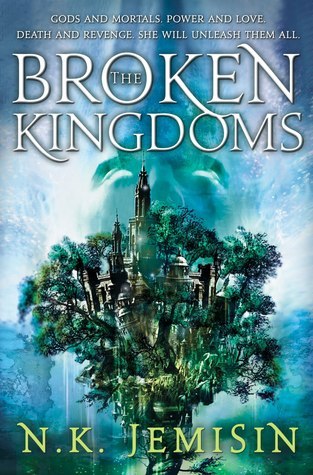
#CBR5 Book 113. "The Broken Kingdoms" by N.K. Jemisin

Page count: 417 pages
Rating: 4 stars

This is the second book in the Inheritance trilogy, and while the book can be read independently (I read the first book, The Hundred Thousand Kingdoms nearly a year and a half before I read this one, which was fine, once I'd re-familiarised myself with the plot on Wikipedia), you'll probably get a more cohesive and generally better reading experience if you read them in sequence (without waiting 18 months between them).

In the city of Shadow, beneath the World Tree that sprang into existence ten years ago, blind Oree Shoth makes her living as an artist. She does appear to be able to see magic of all kinds, though, and her strange second sight helps her paint. Oree lives with a mysterious, taciturn stranger who she rescued from a waste bin some months back. She doesn't think he's a godling (one of the many minor gods that have started appearing in the city since the World Tree grew), because he only glows at dawn. He's clearly not all human, either, as he keeps killing himself and coming back to life.

When godlings start turning up dead, Oree and her strange house guest, along with Oree's former lover, a godling called Madden, find themselves abducted and held prisoner by a secret religious organisation. They want to keep her friends hostage, to get Oree to cooperate with them. They need her help to kill one of the major gods, the Shadow Lord himself.

This book is set ten years after the end of The Hundred Thousand Kingdoms and the major characters in that book only turn up briefly in this book, mainly as cameos. So it's absolutely possibly to read the second book without knowing what happened in the first, but I found it added another dimension to know the reasons for the major changes this fantasy world has gone through in the last decade. As in the first book, the narrative is told in first person, this time from Oree's POV. Because it's a personal narrative, it jumps a bit back and forth, as personally recounted stories often do. This, of course, enables Jemisin to put in all sorts of foreshadowing and teases for the readers.

Those who have read the first book in the series, will not be that surprised at the identity of Oree's strange lodger, and I really like what Jemisin's done with this character and that she's built a fantasy universe where it's possible to explore the sorts of things she does. Jemisin is very highly acclaimed out there on the internet, and while I liked the book, I'm still waiting to be blown away by her writing, the way so many others out there seem to have been. Last year, as part of my now annual support of Worldbuilders, Patrick Rothfuss' charity fundraiser, I got the Literary Pinup Calendar, drawn by Lee Moyer. Very fittingly, September's image is of Oree. It's one of my favourite images in the calendar. I really wish I could love the book as much as I love this picture, but so far, after two books, for all that I see that her writing is great, there's just this little part of me that stays detached when I read Jemisin's books. That's not to say this isn't very good fantasy, quite unlike anything else I've found out there. Maybe the next book of hers is the one where I finally get properly hooked?

#CBR5 Book 112. "Breadcrumbs" by Anne Ursu

Page count: 336 pages
Rating: 4 stars

Hazel and Jack are best friends and live just down the street from one another. Until recently, they didn't go to the same school, but after Hazel's dad moved away, she had to change schools and now she's in the classroom across the hall from Jack. Hazel doesn't really fit in at school. None of the other kids were adopted from India and look completely different from their mum and dad. She only really feels like she completely belongs when she's with Jack, and when he's off playing with the other boys, she feels desperately alone.

Of course, there are worse things than your dad leaving your mum and you to manage by yourselves or your friend occasionally playing with others. Your mum could still be there, listless and uncaring, empty-seeming and no longer noticing much of anything, like Jack's mum. Maybe that's why he changes completely one day - becoming mean and distant the day after he had an accident in the school yard, when something seemed to pierce him in the eye? Suddenly he just wants to play with the boys, and ignores Hazel completely. Then he disappears. His parents say he's off taking care of his elderly aunt Bernice, but Hazel's known Jack her entire life - he doesn't have an aunt Bernice. One of the other boys mentions having seen Jack going into the woods, with a tall, icily beautiful, fur-clad woman, like the White Witch of Narnia. But witches aren't real, are they? Hazel knows that she needs to rescue her best friend, even if it means going off into terrible danger.

Breadcrumbs is a wonderful book, which retells the fairy tale The Snow Queen in a wholly original way. While it's meant for middle grade readers, it doesn't underestimate its target audience and deals with bullying, alienation, depression, divorce, the need to belong, the perilous fragility of adolescent friendships and the myriad challenges of growing up. Hazel loves to read, and constantly thinks of things in reference to other children's and YA books (to the point where it almost got a bit tedious, unfortunately). There are nods to fairy tales, J.K. Rowling, Philip Pullman, C.S. Lewis, J.R.R. Tolkien, Madeleine L'Engle and Neil Gaiman to name but a few.

Having gone to a non-standard school before her parents' divorce, Hazel finds it nearly impossible to adapt to the rigid structures and rules of her new school, where she also struggles to interpret the social codes of her peers, and keeps failing. Something as simple as having a backpack when everyone else has a shoulder bag can make you the odd one out, which can be devastating when you're already a different ethnic makeup to everyone around you.

Hazel has a caring, if struggling mother, and does her best to be a well-behaved and obedient child. She doesn't understand why all the grown ups want her to make friends who aren't Jack, at least until he changes overnight and abandons her. She's a brave and resourceful girl, who knows that going after your best friend when he's possibly been spirited away by an evil witch isn't going to be easy. She faces a number of challenges and dangers on her quest, and despite being told repeatedly that the White Witch never takes anyone who doesn't want to go with her, she refuses to give up on her friend. She doesn't want to stop being his friend, no matter what others, or even he himself, tell her. Through all her reading, she's learnt that sometimes the Knight is the one who needs rescuing, even though he may not realise it himself.

This is a little gem of a book, beautifully illustrated. Well worth a read, I'm very glad I found it.

Wednesday, 24 July 2013

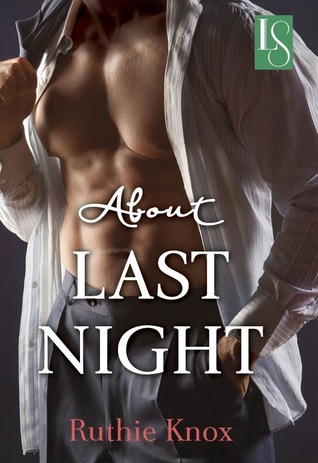
#CBR5 Book 99. "About Last Night" by Ruthie Knox

Page count: 230 pages
Rating: 4 stars

Cath Talarico is a Chicago girl trying to make a new life for herself in London She has made several big mistakes in her life, but for the past two years, she's been working her ass of, being New Cath, who stays out of trouble, never does anything wild and crazy, and works diligently on an exhibition at the V&A, hoping to earn herself an assistant curatorship, despite the fact that she has no formal qualifications. Her life is so predictable that she can tell tell exactly which of the many commuters she shares a train with every morning, will show up at what time.

After a disastrous blind date (that Cath only agreed to in the hopes of securing a particular item for the upcoming exhibition), wakes up in a strange flat, and vaguely remembers being taken home by the man she only thinks of as City - one of her fellow commuters, always impeccably dressed in a three piece suit, who clearly works in the financial district, probably as a banker. She remembers enough that she knows she wasn't taken advantage of in any way, and is touched when she discovers he's left a new toothbrush and a clean towel out for her. When she's freshened up, she discovers that City, who is indeed a banker, in reality called Nev Chamberlain (yes, after the Prime Minister), also paints, and may not be the elitist rich guy she imagined him.

Nev works in the family's bank, but is absolutely miserable doing so. His older brother presents him with an ultimatum from their autocratic mother. Nev will get a lucrative promotion in the bank, but only if he agrees to get married to some suitable young lady. His family are frankly appalled that he's moved away from their sphere of influence, and is trying to express himself through paintings. He's just as attracted to Cath as she is to him, and soon they're conducting a passionate love affair, even though Cath refuses to tell him where she lives, or what she does for a living, and staunchly refuses to let him take her on any real dates. She has four tattoos on her back, as permanent reminders of the past mistakes she has made, but guards her secrets and will only occasionally let something significant about herself slip.

It's quite clear that Nev and Cath are complete opposites, and with Cath's previous experiences, she is very wary of new commitment. She's an artist with a dark and troubled past, and more trust issues than you can count. Nev is from a rich and privileged background, and pretty much hates his life, but is too unsure of his own abilities as an artist to break out of the life his family's expectations has made for him. Can the two of them ever actually make it work?

About Last Night was one of this year's RITA finalists for contemporary romance. I'd seen it favourably reviewed in a few places, but when a friend mentioned that knitting played a central part in the plot that I became really curious about reading it. It's a quick and very enjoyable read. The sexy parts are very steamy indeed, but that wouldn't have mattered if I didn't believe the chemistry between the characters, and their developing relationship. It's obvious from how different the characters are that their backgrounds and emotional baggage are going to lead to some form of conflict, but I was especially impressed with how that conflict both played out, and was resolved. Cath is an understandably damaged and cautious heroine. Nev is a great hero. He makes mistakes, but works hard to make up for them as well. There is absolutely a fair bit of angst in this book, but unsurprisingly, what with this being a romance, it all works out well in the end, in a satisfying and fairly realistic way, considering the genre. Well recommended.

Tuesday, 23 July 2013

#CBR5 Book 97. "Summer Knight" by Jim Butcher

Page count: 371 pages
Rating: 3.5 stars

Harry Dresden is a wreck. He spends all of his energy trying to save his ex-girlfriend Susan from the vampiric curse that's pretty sure to claim her, and as a result, he may lose his office, his apartment and what few friends he has left. Mab, the Winter Queen of Faerie wants him to figure out who killed the Summer Knight, and most importantly, prove that she isn't the murderer. Harry tries to refuse her offer, but there are more complications thrown his way.

The White Council of wizards arrive in Chicago, and most of them want to gift wrap Harry and deliver them to the vampires, hoping this will make the vampires stop waging war. The only way Harry can keep them from basically stripping him of his wizard status and giving him up to become a vampire chew toy, is by accepting Mab's offer. If he doesn't figure out who killed the Summer Knight and stole his power, the Summer and the Winter Queens go to war against each other at Midsummer Eve, and that will have catastrophic results for the entire world. He should probably clean himself up a bit.

I've mentioned this on my blog before, but it bears repeating I don't know why I can read countless paranormal fantasy series with female protagonists (I haven't done a count in a while, but I'm pretty sure the various ongoing series I follow still number two figures) and find them fascinating, yet I have trouble engaging with male protagonists. The previous three Harry Dresden novels didn't really grab me, this is the first one where I didn't force myself to finish the book out of stubbornness, and frankly, if Harry hadn't snapped out of his moping over Susan, this would have been another chore to read.

Luckily, because of all the crap he gets dropped in his lap, Harry is forced to snap out of it. He seems to do really well when faced with near impossible odds, and it's not like he has a lot of support. The White Council are clearly mostly filled with douchebags, and it's not difficult to take Harry's side against them. I'm also a sucker for bad faeries, and as Harry still owes the Winter Queen two tasks before being free of her influence at the end of this book, it's clear that the faerie stuff is going to come back in later books too.

As far as I can tell from other reviews on the internet, this is the book where the Harry Dresden books really start becoming worthwhile. I really like some of the supporting characters, like Karrin Murphy and Billy the werewolf. If Harry actually stops moping so much and more of the future books involve faeries, I will probably keep reading. But not just yet. I have more lady-oriented paranormals to get through first.

#CBR5 Book 96. "Beauty and the Spy" by Julie Anne Long

Page count: 400 pages
Rating: 3.5 stars

When Susannah Makepeace's kind, but distant father dies, leaving behind him nothing but debt, Susannah's engagement to a young gentleman is broken, and she has to move in with a distant cousin in the little village of Barnstable. She's barely arrived before she runs into the notorious Viscount Whitelaw, diving naked into a pond mere feet away from where she is sketching.

Kit Whitelaw is a spy, but his somewhat scandalous personal life of late has forced his father to present him with a choice. Spend a month on the family's country estate putting together a natural science folio, with sketches of flora and fauna, or find himself on the next ship to Egypt. Kit would much rather figure out why his friend James Makepeace died under mysterious circumstances, so it's a happy coincidence, when he realizes that Makepeace's daughter is in Barnstable. The girl keeps having near fatal accidents, and it's clear that someone wants her out of the way. But why?

I'm a huge fan of Julie Anne Long's Pennyroyal Green books. This is one of her earlier novels, published in 2008. It's the first in a series of three, featuring the three daughters of a politician who is murdered in the very first chapter of this novel. His mistress flees to the Continent, as she is being framed for his murder, and the politician's friend, James Makepeace, takes it upon himself to find homes for his friends' daughters, so they are safe from the unscrupulous man who killed their father. Susannah is the youngest of the three daughters, and grows up never realising that Makepeace isn't her real dad.

It's obvious that Long has developed a lot as a writer since she wrote this book. It's in no way a bad book, but I found the villain in particular rather tedious, and it would have been a more enjoyable book if it hadn't been made obvious from the start that the man suspected of all these dastardly deeds was actually guilty. I also found the many botched attempts to off Susannah a bit samey after a while, and it took me a while to actually grow sympathetic to her. She starts the book as rather spoiled and whiny, but luckily realises how lucky she has been, and that while the man who raised her both physically and emotionally distant to her for much of her life, she still grew up in luxury, with a stunning wardrobe, a nice house and servants. She never had to light her own fire, or cook her own meals, or go without meat because the household accounts were meagre.

While this book is called Beauty and the Spy, there was sadly very little actual spy stuff in it. It's more of a mystery, where the reader knows full well who the villain is, and the hapless couple have to figure it out, while slowly falling in love along the way. We keep being told what a great spy Kit is, but most of the book is him sulking because he's not allowed to have a mistress in London, and trying to figure out a way to keep his father from banishing him to Egypt. In between saving Susannah's life and trying to prove who killed her adopted (and biological) dad.

A perfectly good holiday read, but not in any way up to the standards of Long's later books.

Friday, 28 June 2013

#CBR5 Book 66. "Fly by Night" by Frances Hardinge

Page count: 448 pages
Rating: 4 stars

Plot summary by Goodreads, because it's much more pithy than anything I myself could write:

After her father dies, Mosca Mye flees the hamlet where she grew up. With her goose companion and a smooth-tongued swindler, Eponymous Clent, she heads for the city of Mandelion - and a better life. There she finds herself living by her wits among highwaymen, spies and smugglers, insane rulers and floating coffeehouses. With peril at every turn, Mosca uncovers a dark plot to terrorize the people of Mandelion, and soon merry mayhem leads to murder...

Mosca is a clever child, living in a town where most people can't read, in a world where if something is found printed without the authorising seal of the Stationers' Guild, it's seen as illegal, and must be burned. The world she lives in resembles ours, in the 18th Century, to some extent. Various Guilds of Tradesmen vie for power in the various cities of the Realm, while Parliament debate who should inherit the throne. About ten years past, there was a terrible Civil War, when the religious radical group the Birdcatchers were all hunted down and destroyed. In Mandelion, the ruling Duke is clearly going slowly insane, his beautiful and enigmatic sister is trying to keep the Locksmith's Guild (who have the keys to any door and lock) from completely taking over, and there is someone with an illegal printing press, encouraging sedition and stirring up dangerous thoughts. Mosca is thrust straight into the middle of all of this, with her somewhat dubious companion, self-proclaimed wordsmith and con man, Eponymous Clent. Accompanied by a foul tempered gander and wanting desperately to better her situation in the world, Mosca agrees to help the alluring Lady Tamarind (the Duke's sister) try to figure out what is going on.

Mosca was taught to read by her father, who fled Mandelion years ago. She's fiercely intelligent, and hates her staid village life. In a town where no one else reads, she soaks up new words and learning like a sponge. She's so seduced by the silver-tongued Clent and "his way with words" that she rescues him from the stocks (and accidentally burns down her uncle's mill), and they go on the run together. She's learned early not to entirely trust anyone, which is a good quality to have in Mandelion, where the political situation is so fraught that the smallest spark could ignite another civil uprising.

This is a lovely and exciting book, wonderfully written - not surprising considering how much Mosca loves words so much. Frances Hardinge doesn't talk down to the middle grade/young adult audience she writes for, and I was amazed when I discovered that this was, in fact, her debut novel. I first read about this book on the The Book Smugglers' blog, where they're also highly enthusiastic about her other books. While this is my first Hardinge novel, it certainly won't be my last.


Thursday, 27 June 2013

#CBR5 Book 65. "The Ocean at the End of the Lane" by Neil Gaiman

Page count: 181 pages
Rating: 5 stars

Our unnamed narrator returns to the old farm near his childhood home after a funeral in Sussex. He remembers his childhood friend Lettie Hempstock, who lived in the old farmhouse, at the end of the lane near his house, and while looking out over the pond in the back (which Lettie claimed was an ocean), he slowly remembers the strange and horrifying events of his childhood, after one of his parents' lodgers stole their car and killed himself, not far from the house. There are dark and inexplicable consequences, and the three generations of Hempstock women help our narrator try to set things to rights.

This is Neil Gaiman's first book for adults since Anansi Boys in 2005. As that book is probably my least favourite of all his works, with the notable exception of Marvel 1602 and Eternals (which were so boring I don't even have the words), I was hoping that the excellent writing in his books for children and young adults would carry through to this story as well. I had very high expectations, because for all that I think his shorter fiction (comic book issues, short stories) is what he does best, it was just so unexpected and exciting to discover, early this year, that he had a new book out. Of course, this dark fable is a sliver of a book compared to, for instance American Gods. It's much more like Coraline, both in size and tone.

If you like Neil Gaiman, and you've read things by him before, you will recognise a lot of different things in this book. There's a child protagonist, there's really creeping and effective horror, there's a wealth of mythology and magical realism and the locations are so faithfully rendered that you feel as if you're in the story. I also think, as confirmed by the author himself, and his wife, Amanda Palmer, that it's his most personal book yet. It's thoughtful, and magical and creepy as hell, and I absolutely loved every last page of it, so much so that I also used one of my Audible credits to get the audio book as well. That way I was able to have Neil Gaiman read me parts of the story, with his wonderfully soothing voice, which came in very handy when I had to clean my office at work, and really only wanted to read. If you're not a fan of Gaiman, this book is likely to convert you. If you are a fan, you need to read this book. It's wonderful, in every sense of the word.

Tuesday, 25 June 2013

#CBR5 Book 63. "The Light Between Oceans" by M.L. Steadman

Page count: 384 pages
Rating: 5 stars

Tom Sherbourne was a soldier in Europe during World War I. Deeply affected by his experiences, and the guilt he feels for the lives he took, he signs up for a job as a lighthouse keeper, taking postings at the most remote and lonely lighthouses around Australia. When a posting becomes available on Janus Rock, a place so remote and lonely, other lighthouse keepers have been driven mad, Tom agrees to go, first as a temporary replacement, and later as the official lighthouse keeper. The only human contact is the supply boat that comes every three months.

Tom falls in love with a young woman, Isabel, and despite his initial reservations, marries her and brings her to Janus Rock. To begin with, they are blissfully happy, alone with each other in a place nearly a day's journey from the coast. After several years, things are more strained. Isabel has miscarried twice, and two weeks after her third pregnancy ended in stillbirth, she first believes herself to be hallucinating, when she hears a baby's cries on the island. A small boat, with a dead man and a living baby, has washed up on shore. Tom, always meticulous in his record keeping, wants to report the  findings to the authorities right away. Isabel begs him to wait, just a day, so she can spend some time with the baby. Against all his better judgement, Tom agrees, and he's then persuaded by his desperate grieving wife that they should just bury the dead man, and claim the baby as their own, naming her Lucy. No one knows that Isabel miscarried, they can just pass off the foundling child as their own.

Being on lighthouse duty means the couple only get holiday on shore every three years. Little Lucy is already two years old by the time the Sherbournes return to the mainland, and discover the truth about where their baby really came from. There is a grieving young woman in town, wondering about the fate of her husband and nearly newborn child, lost at sea so long ago. Her wealthy father has promised a fortune in reward for anyone who can give information. Can the Sherbournes continue their deception in the face of someone else's obvious grief?

I am not the first person to read and love this book. I'm not even the first Cannonballer. It's currently got over ten thousand 5 star reviews on Goodreads and over fifteen thousand 4 star reviews. It also won the Goodreads Choice Award for Best Historical Fiction last year. So it seemed like a pretty obvious choice to pick as my first "Read a book everyone else has read" for my Book Bingo card. The fact that I can also use it for my Monthly Keyword challenge, my A to Z challenge AND my historical fiction challenge, was just a bonus. Frankly, with the amount of reading challenges I'm doing at the moment, it's rare that the books don't at least qualify for at least three different ones.

Enough about my crazy need to make my reading more competitive - what was so awesome about this book? Was it the heart-breaking subject matter? Was it the lyrical writing that was so beautiful you just want to stop and read it out loud? Was it the interesting and slightly unusual setting and time period? Was it the skillful way the story was unfolded, making it nearly impossible to put the book down because you just had to read one more page, one more chapter? Was it the wonderfully rendered and extremely complex protagonists, who you just wanted to hug and comfort, at the same time as you often wanted to shake them until their teeth rattled? Was it the great cast of supporting characters, who again didn't feel like characters in a book, but real live people who you just had the fortune to be experiencing on the page? Unsurprisingly, it was all of these things. The fact that this is Stedman's first novel fills me with awe and admiration and bitter jealous rage all at once. I can't wait to see what she writes next. Do yourself a favour and read this book. You are unlikely to regret it.

Sunday, 16 June 2013

#CBR5 Book 58. "Anna Karenina" by Leo Tolstoy


Page count: 838 pages
Rating: 2 stars

Is there anyone who doesn't know the basic story of Anna Karenina? Beautiful and beloved society lady, married to older statesman, starts a scandalous affair with a young, handsome and wealthy cavalryman. It really doesn't end well. The book is over 800 pages long. Quite a lot of it doesn't even feature Anna, or her husband Karenin, or her lover Vronsky. If the book was truthfully named, it should probably be called Konstantin Levin tries to revolutionise Russian farming, but Tolstoy (or his publishers) were wise enough not to name the book that.

Seriously though, so much of this book is about farming. I get that Levin is the true hero. He's kind, and virtuous and treats his dependents well. The objection of his affection rejects him in favour of the flashy Vronsky, who in turn rejects her when he becomes determined to seduce and win Anna Karenina. Much of the rest of the book is about political machinations. I studied literature at university, I get that the winters in the 19th Century were long and cold and books were the chief source of entertainment, but dear God, the book is a slog to get through. While I can see that it's well written and gives an impressive insight into pre-Revolutionary Russia, the main reason I actually persisted and actually finished the book this time (I've previously started and abandoned it three times since I was about 15), was partly, BECAUSE I've been planning to read this damn book since I was in my early teens, and also because it qualified in no less than FIVE of my various reading challenges. Now I've read it, and I never have to do it again.

I have friends who adore this book. While I was struggling to get through it (making myself read at least a hundred pages a day), I also watched the most recent movie adaptation. When you focus on the main story of the Karenins, and the Levins and the Sherbatskys, I can see why it's a gripping story. It really is a truly tragic love story, and while I initially detested Vronsky, I came to pity both him and Karenin. I just don't have the patience for all the other guff, with the farming and the politics. Those bits were frequently skim-read, and bored me to tears. I also feel compelled to point out that, in the past, I suspect it was the fact that my mother's copy of this book is quite an old translation. This fairly recent English translation was beautifully done, and the language was in no way heavy or difficult to get through. Feel free to comment and explain why I've completely misunderstood the greatness of this book - I'll be happy to hear your thoughts. I'm just glad I finally got the book ticked off my TBR list for good.

Thursday, 16 May 2013

New Reading Challenge: Book bingo!

So with the previous review, I finished my primary reading challenge of the year - The Cannonball Read. I'm also doing fairly well in my other three reading challenges, having nearly completed the 24 books I signed up to read for Mount TBR reading challenge (Mount Blanc). At this rate, I'm going to have to upgrade my mountain to Mount Vancouver. I've already reached Ancient History level in the Historical Fiction reading challenge, and I've managed to read at least two books a month that qualify for the Monthly Key Word challenge. It helps that a lot of the books qualify for more than one reading challenge.

As everything is going so well, I figured I should sort out something that is a little more, well, challenging. When linking to Jen Ks blog yesterday (from whom I've pretty much nicked all the other challenges I'm doing this year), I discovered that she's doing a challenge I hadn't heard of before: Anne and Kristilyn's 2013 Book Bingo (the challenge where we read all the books). Readers of this blog know I'm all about reading all the books (except the ones that I don't like or think sound boring - where's the fun in that?). For this challenge, I wouldn't be able to have as much cross over, either, what with only being able to use the books once each. Having looked over the books I've read so far this year, I discovered that I could already almost fill the full bingo card. That wouldn't be very challenging at all. So I will start from the beginning, and obviously I aim to cover the whole board by the end of the year.


The one that's going to be the most difficult is "Read x books everyone but you has read", as I tend to be one of those people who jumps on a band wagon really early. To fill this whole bingo card, I will have to read 73 books in total (although 15 are re-reads), of which 15 are books "everyone else" has read and possibly reviewed before me. It's absolutely going to be a tricky one. Wish me luck!

#CBR5 Book 51. "Across the Nightingale Floor" by Lian Hearn

Page count: 320 pages
Rating: 4 stars

16-year-old Tomasu lives in a secluded Japanese village in an alternate version of feudal Japan. Most of the people there are of the Hidden, a secret religion of peace and tranquillity. One day, when Tomasu is out on a ramble, he returns to see that the entire village has been slaughtered by the soldiers of warlord Iida Sadamu, who want to eradicate all of the Hidden. The boy runs, and just as he is about to be captured by the hostile soldiers, he is rescued by the powerful Lord Otori Shigeru, who has his own score to settle against Iida.

Lord Otori tells Tomasu to forget his old life, and never mention the teachings of the Hidden again. From now on, he will be Otori Takeo, and Shigeru will adopt him as his heir. Most of Shigeru's loyal retainers think he's gone mad, still grieving the death of his brother, but Shigeru will not be argued with. He makes sure Takeo is tutored as befits a young lordling, and taught deportment, and etiquette and fighting. As time passes, and he gets to know Lord Otori better, Takeo understands that he is to be an important game piece in Shigeru's revenge.

Half the book is told from Takeo's first person narrative, but the other half is told in third person, narrating the experiences of Kaede, a young lady kept as a hostage by one of the vassal lords to Lord Iida. For much of her childhood, she is kept among the servants, despite her high birth. As she matures, and the soldiers start taking notice of her in all sorts of unfortunate ways, it becomes obvious that she needs to be kept more sheltered, or she'll get raped, and no longer useful as a bargaining piece. She is told that a marriage has been arranged for her, with the powerful Lord Otori Shigeru. She travels to her new home with the beautiful Lady Maruyama, who seems very friendly until she discovers the identity of Kaede's intended bridegroom.

This book had been on my shelf for nearly ten years, so it certainly qualified well for the Mount TBR reading challenge. I liked that it was a fantasy novel with a very different setting from what I am normally used to, and that the style of the characterisation was simplistic and a bit exaggerated, a bit like in one of the many beautiful wuxia films, like Crouching Tiger, Hidden Dragon. In a different book, I would be annoyed when two of the characters fall passionately in love the first time their eyes meet, as is the case with Takeo and Kaede. Here, it seems fitting, somehow.

This is primarily a fairly tragic story of revenge, and tragic romance, and a young man discovering his true heritage and what he has the potential to become. As I know little about feudal Japan, or the true traditions and history behind this period, any anachronisms and inconsistencies didn't annoy me, as it seems to have done a whole bunch of other people on Goodreads. I thought it was the very promising start to a fantasy series, as it is quite obvious that although the revenge plot of this book is wrapped up, it is not the end to Takeo and Kaede's story. Strongly recommended.

Thursday, 9 May 2013

#CBR5 Book 48. "Snow White and Rose Red" by Patricia C. Wrede

Page count: 278 pages
Rating: 4 stars

Another fairy tale retelling, this one is set in Elizabethan England, in a town not too far from London, where the Widow Arden lives with her two pretty daughters, Blanche and Rosamund. Mrs. Arden is a wise woman, who has taught her daughters some of her healing arts. Sometimes the girls have to cross the invisible border to the realm of Faerie to collect more unusual herbs and plants. John Dee, famous occultist and astrologer to Queen Elizabeth I, also lives in town. The book is set in the 1580s, when Dee was working with Edward Kelley and experimenting with alchemy and investigations into the paranormal.

As well as the widow and her daughters, and John Dee and Edward Kelley, the major players are the Queen of Faerie's two half-mortal sons. Hugh, the eldest, is quite content to stay put with his mother and her subjects, having pretty much forsaken his human side. His younger brother John, who was actually baptised as a baby, is much more restless, and feels compelled to return to the mortal realm, but returns home around Halloween and May Day. Some of the fairies at the court are displeased by the close connection between the Faerie and human world, and are hatching a plot to get rid of John. They manage to manipulate a spell Dee and Kelley are casting, but something goes wrong, and Hugh is hit instead. Soon he is turning into a giant bear, and his mother has no choice but to expel him from Faerie. John promises not to rest until he has restored his brother.

It doesn't take long before the stories of Arden daughters and the Faerie princes join up. Hugh the bear arrives on the widow's doorstep, and as he's still able to think, if not to speak, he's able to nod or shake his head to all the women's questions. They resolve to help him, and after an attempt at a healing spell, he at least gets the power of speech back. Now the young women and John need to figure out how to heal Hugh completely, which is tricky when part of Hugh's essence is trapped in a crystal in John Dee's heavily warded house.

As a Medieval historian, with a particular interest in Tudor history, it was especially fun to see Wrede's take on this story. I must admit, the story of Snow White and Rose Red is not one I know all that well. Helpfully, each new chapter starts with a little excerpt from the original fairy tale, letting the reader see exactly how the story has been altered and adapted. With it being a fairy tale, none of the characters are especially complex. The widow Arden is wise, sensible and a bit suspicious of her daughters getting involved in Faerie dealings. The girls are pretty and virtuous. Blanche is the calm and diplomatic one, Rosamund is the headstrong and feisty one. It's obvious from the start which brother will end up with which sister, but it's still fun to see the story develop much more gradually than in a fairy tale.

Including John Dee and Edward Kelley into the story and the complications that ensue from their botched spell casting, give a creative explanation as to why Dee packed up his family and suddenly left for Poland in 1583. This is yet another book that had been on my shelf for years and years, languishing unread. I'm glad my various reading challenges finally gave me the push to read it.