Showing posts with label fairy tale retelling. Show all posts

Monday, 20 April 2026

CBR18 Book 19: "Marry Me by Midnight" by Felicia Grossman

Page count: 352 pages
Rating: 4 stars

Nowhere Book Bingo 26: A book that takes place outside of the US
Monthly Keyword Challenge 26: Midnight
Defeat the Goblin TBR 26: The Locket Book - a romance or a book with a lot of yearning
Reading Rainbow - Blue cover

Isabelle Lira wants to take charge of her deceased father's business, but is hindered from doing so both because she is a woman and because the Jewish community she lives in finds it unacceptable. So she must find a husband who will not object to her controlling her family's interests, and who won't be cruel, abusive or who will take advantage of her and her wealth. In order to find a suitable match, she is arranging three festival events, where all eligible Jewish men are invited. 

Aaron Ellenberg is certainly not one of these eligible suitors. He works as a custodian for the synagogue, having failed to learn anything useful in a number of apprenticeships. He is about as lowly a member of the Jewish community in London as you can get, but he's handsome, polite, and unfailingly kind to the elderly, children and animals, down to even the rats and mice. He is known to everyone, yet not really noticed much. Isabelle offers to pay him to be her spy at the festivals; she needs him to observe her various matrimonial candidates and report back to her whether they might be men she could consider as suitors. 

Of course, every time they meet to talk, sparks fly. Their chemistry is undeniable, and while he may be far too lowly for Isabelle to consider him as a possible candidate, she feels safe and comfortable around him, as well as tingly in all the right places. Aaron, meanwhile, is baffled that such a beautiful, wealthy woman is even giving him the time of day, and with the money he will make helping her, he might be able to emigrate to America to make a new life for himself.

Marry Me by Midnight is the first of Felicia Grossman's fairy tale retellings, set in the Jewish community in London's East End. This book is a Cinderella retelling, with Isabelle being the prince to be wooed at a series of balls, while Aaron is our lowly scullery boy (of sorts). This story has adorable animal friends, an unexpected fairy godmother, and various fancy outfits to allow our hero to go to the ball. 

While I have read a lot of historical novels, I am not really familiar with the Jewish enclave of London during the Victorian era, so this book gave me some new and interesting insight, while also putting a spin on a familiar tale. Isabelle and Aaron are a lovely pairing who banter and yearn for each other, and eventually decide to act on their attraction (in some cases, in locations that seem somewhat exposed). The course of true love needs some obstacles in its way, and in this case, there is someone who seems determined to stop Aaron from finding his happy ending with Isabelle, using violence if necessary. 

There are three books so far in this series, and I know that the next one features one of the men who might have ended up as one of Isabelle's suitors, had she not pretty much had eyes only for Aaron from the start. The third one appears to be about Isabelle's friend, who is medically trained and works as a midwife, and both these books also really appeal to me, so this will certainly not be the only of Ms. Grossman's books that I read. 

Judging a book by its cover: While the exact scene depicted on the cover doesn't take place (because, really, why would they be dancing on the stairs?), it captures some of the book's magical atmosphere. The many shades of blue are lovely, and the couple on the cover seem to be really besotted with one another. 

Crossposted on Cannonball Read.

Tuesday, 5 August 2025

CBR17 Book 48: "The Goose Girl" by Shannon Hale

Page count: 383 pages
Rating: 3.5 stars

StoryGraph Easy Read Challenge: A book with flowers, plants or leaves on the cover
Buzzword Title Challenge 25: Animals (Birds are animals, right?)
Nowhere Book Bingo 2025: A YA book
CBR17 Bingo: TBR (I bought this back in 2009, it's been on my TBR for 16 years)

Anidora-Kiladra, the Crown Princess of Kildenree is taught the language of animals by her aunt while she is still a girl, but she has to hide this from people around her. Unfortunately, she's unconventional enough that as she gets older, her younger brother proves to be a more suitable royal heir and her mother the Queen announces that she's being sent to the neighbouring kingdom of Bayern to be married off to their Crown Prince. Ani, having been brought up believing she would be Queen of Kildenree at some point, doesn't really have any other choice but to obey her mother.

She is sent with a large retinue, including her beautiful and dangerously ambitious attendant Selia. About halfway through the journey, Selia has charmed enough of the guards to enact a coup, and Ani is shocked and devastated to see many loyal soldiers slaughtered around her. She manages to escape into the woods and finds refuge on a secluded farm in Bayern, where her wounds are treated and she's nursed back to health. She discovers that Selia has assumed her identity and is pretending to be the real princess. Once Ani is healthy enough, she makes her way to the capital and gets a job as a goose herder in the king's stables. She hopes to be able to make enough money to eventually make it home to her mother, to warn her of the dastardly deeds of Celia and the rogue guards.

Thanks to her secret skills, Ani is able to charm the geese enough that they will listen to her. She works hard and makes several friends among the other labourers, tending the king's livestock. She befriends the handsome and charming Geric and is, in general, quite happy to have avoided having to marry the prince, whom she's seen from a distance. He appears to be about thirteen, much younger than her. But then Ani discovers that Celia isn't just content to lie herself into a royal marriage; she is also trying to get the king of Bayern to declare war on Kildenree. Ani has to enlist the help of her friends to get to the king before the wedding is finalised.

This is a YA fantasy retelling of Grimm's The Goose Girl, and some pretty bleak stuff happens to Ani over the course of the story. For people who don't like harm to come to animals, be warned that Ani's beloved horse Falada meets a very unpleasant end. I also kept thinking of Anakin Skywalker because of Ani's shortened name, which isn't necessarily the best connotation to have to a protagonist. 

This was a nice young adult book with a plucky heroine and a more faithful retelling of the original fairy tale than T. Kingfisher's A Sorceress Comes to Call, which I read last year. Nevertheless, I much preferred that one, I think the darker, more grown-up themes were better done in that one. 

Judging a book by its cover: Cover design was different back in the early 2000s. I seem to recall that by the later books in this series, they did a complete redesign, leading anyone who owned the series to the cruel fate of owning mismatched books (we hates it). This book is remarkably cutesy-looking, considering the rather dark subject matter. 

Crossposted on Cannonball Read

Sunday, 5 November 2023

CBR15 Book 65: "A Curse So Dark and Lonely" by Brigid Kemmerer

Page count: 504 pages
Rating: 4 stars

A very long time ago, Prince Rhen, the crown prince of Emberfall, made a very foolish mistake and slept with the wrong woman. He's been paying for said mistake for centuries. Forced to relive the autumn of his eighteenth year over and over, he has to get a woman to fall in love with him in a few months, or he turns into a murderous beast and slaughters anyone he can find. If the curse remains unbroken, the season resets and Rhen is back on the day of his eighteenth birthday, starting the "game" once more.

The only one who survives his beastly rampages is Grey, the captain of his royal guard, who has to go into the mortal world for an hour at the start of every season to find a new woman to bring back to Emberfall, in the hopes of breaking the curse. 

Harper's mother is dying of cancer, and her father gambled away most of their money and abandoned his family, so now Harper's brother has to work as an enforcer for the people their dad owed money to. She's acting as a lookout for him while he's reluctantly threatening someone on behalf of his "employers" when she sees what appears to be a guy trying to kidnap a woman in an alley. Acting before she can think clearly, Harper jumps the guy to stop him and ends up in a magical land, trapped with Rhen and Grey. Apart from the two taciturn young men, the castle is completely empty. There are musical instruments that magically play, any food that is eaten magically reappears the next morning. Parker does her best to try to escape and discovers that the people who are living in the rest of Emberfall are suffering, believing that the royal family has abandoned them and trying their best to survive in the face of foreign invaders or the constant threat of the monster hanging over them.

The wicked sorceress who cursed Rhen in the first place has decided that this is his final chance at breaking the curse. If he doesn't find true love by the end of the season, he will remain a vicious monster and she will take over what is left of Emberfall. From Harper's clear dislike of him, Rhen is pretty sure that he's doomed, and tells Harper the truth (up to a point, he can't really bring himself to confess to being the monster that murdered the entire royal family and most of the surrounding villagers), figuring they might as well be honest with one another in the few months he has left.

Harper is not going to let the people around the castle starve or go defenseless. She demands that Rhen and Grey help her distribute some of the frankly staggering amounts of food around the castle, that just keeps magically replenishing every morning. She also makes Rhen understand that while he's rightfully depressed about the whole curse thing, he can't let Emberfall be invaded by a foreign power either. While scheming to try to trick the neighbouring ruler from giving up their invasion attempts, Rhen and Harper spend a whole lot of time together, but will it make Harper fall in love with Rhen before he turns into a monster one final time and all is lost?

This is the first of a trilogy, and the story is pretty much Beauty and the Beast meets Groundhog Day, except instead of Bill Murray learning to play the piano or carve ice sculptures, our hero is a mass murderer who has to live with the knowledge that as a monster he murdered not just the king and queen and his sisters, but all the people in the palace and a terrifying number of people in the areas surrounding the castle. In the many years since the curse began, Rhen and Grey have come up with plans to get the monster away from populated areas until the season resets, but while the prince and his loyal guard wake up healed and physically not a day older than they were when the curse set in, no one else who died can be brought back. That's going to mess anyone up, really.

Harper has cerebral palsy, and has had to go through a number of painful operations to fix her legs. She still walks with a limp, but refuses to let her illness define her. When the sorceress offers to magically heal her leg, Harper angrily responds that she's not broken. She hates that she's unable to do more to help her brother and mother, and it's her courage and sense of justice that makes her attack Grey when she sees him trying to bring another woman back to Emberfall, resulting in herself ending up trapped there instead. She's clearly nothing like any of the other women who have been brought there before and makes several escape attempts before realising that she might be better off working with Grey and Rhen, rather than against them. Once she sees how much the vengeful sorceress keeps torturing the prince and Grey, she reluctantly decides to make the best of a bad situation.

This is a very violent fairy tale retelling and I liked that it didn't pull its punches. The people outside of the palace do not have the seasons resetting, and while Rhen and Grey seem to have lived for centuries, only about five years or so have passed outside of the castle grounds. The common people of Emberfall have pretty much lost all hope, believing the royal family has fled and left them to manage on their own, against the raging monster and now an invading force from another country. Rhen isn't really sure how in the world he's going to be able to help his subjects, considering the rest of the royal family didn't flee, they were brutally murdered by the monster, as were all the other inhabitants of the castle, including the royal guard. There isn't really anyone to fight the enemy soldiers, but thanks to a rather farfetched scheme concocted by Harper, Rhen, and Grey, they're going to try anyway.

I'll be very interested in seeing where this series goes, considering the end of this one. There are some interesting new challenges set up and even if I didn't already own the whole trilogy, I would probably keep reading, just because Kemmerer did something a bit different with her story. 

Judging a book by its cover: On my paperback edition of this book, the title is in a shimmery silver (as is the back cover of the book) and I like the dark and slightly spooky look of the thorns and the woods. 

Crossposted on Cannonball Read

Saturday, 8 April 2023

CBR15 Book 13: "By the Book" by Jasmine Guillory

Page count: 325 pages
Rating: 3.5 stars

Isabelle (her friends call her Izzy) was so elated when she got a job as an assistant editor for a big publishing company. It was like a dream come true. Several years later, when she's overworked, underappreciated and still living with her parents at twenty-five, without even getting a promotion, she is starting to wonder if she should change careers. After having her own attempts at writing a book politely criticised by one of her more senior colleagues, that's another dream she's shelved, and now, despite her generally optimistic attitude, she is starting to consider giving up the whole publishing business.

After a conference in LA, Izzy hears her boss Marta complain loudly about one of their most difficult clients, infamous wild child Beau Towers, who got a massive advance on his celebrity memoir and then hasn't delivered so much as a page for over a year. Izzy impulsively offers to stay behind an extra day, drive to Santa Barbara and confront Towers personally, on the company's behalf. She's hoping that this extra effort might make her more likely to get a promotion, and if nothing else, it's another day in sunny California, rather than in wintery New York. 

When she arrives at the gorgeous mansion where Towers is apparently hiding away, she is met by the man's assistant. Towers himself doesn't even want to see her. How is she going to give him an optimistic and motivating pep talk if he won't even come out of his room? After Michaela, Towers' assistant trips and sprains her ankle as she's walking Izzy to her car, Izzy has no choice but to stay behind at the house to help ice and bandage the injured limb, and gets to see first how angry and terrifying Beau Towers can be to strangers, but also how friendly and gentle he is to his friends. Once he realises Michaela is hurt (he calls her Kettle), he completely changes from an angry grump to someone considerate and caring. He reluctantly agrees to let Izzy stay for dinner and listens to one of her pep talks, only to mock her mercilessly, causing Izzy to flee to the luxurious second-floor bedroom set aside for her. Having drunk too much wine with dinner, Izzy has no choice but to stay the night, and in the morning, Beau apologises for his rude behaviour and persuades her to stay for a few more days. 

The few days keep being extended, to one month and then another, and while it's clear that Towers has a volatile temper and can be rather grouchy, Izzy quickly realises that he's actually determined to write his memoir without any assistance from ghostwriters or the like, he just has no idea where or how to start. As the son of a famous supermodel and an award-winning screenwriter/director, Towers has lived a life of privilege and luxury. He clearly has no idea how much Izzy has to work just to make ends meet and how lucky he is to be able to isolate himself from the world in a ginormous mansion, without ever having to worry that his money is going to run out. However, he's also very lonely, having only interacted with Michaela for the past year, and as Izzy gets to know him, she discovers how conflicted he is about his dead father and the way both his dad and he treated his mother in the past. The main reasons for his failure to deliver any book pages isn't laziness, it's guilt and shame.

Even when Beau starts listening to Izzy's pep talks (she also discovers that he's been reading her weekly e-mails, despite them getting more and more informal as she became convinced they ended up in his spam folder) and they start working together to get him to write, it takes him several tries and quite a few temper tantrums before he's ready to really be open, honest and emotional in his writing. Beau's efforts at writing his memoir also motivates Izzy to consider her own writing again, and after being persuaded by Beau that her editor colleague clearly meant to sabotage her efforts with his harsh critique, she reassesses what she wrote and starts accepting that her own writing may have merit. 

Spending literally months together in a big house, working together daily in the gorgeous library, and having dinner together every night obviously make the two grow closer. Izzy fights her growing attraction to Beau, however, convinced she's only imagining the increasing moments of sizzling chemistry. She's also determined to stay professional. Besides, Beau is a rich recluse living in California and Izzy's life and job are still waiting for her back in New York. Once she gets Beau to complete the book, she'll never see him again. Right?

There are a lot of very clever and cute nods here, as you would expect. Our heroine is called Isabelle (Belle). She feels so lonely in Beau's big mansion during her first weeks there that she starts having imaginary conversations with the furniture. Beau calls his cook/housekeeper Kettle. There's a sweeping staircase up to the second floor. At one point, Izzy walks down it wearing a beautiful yellow dress. There's obviously a gorgeous library. There's even a rose garden. At work in New York, the colleague who keeps trying to sabotage Izzy (although it takes her so long to realise it) is called Gavin (Gaston). Nevertheless, the story also works in its own right, and I thought it was a fun twist on a well-known story, without ever getting too dark or angsty. 

I should note that this book is completely fade to black in terms of love scenes. The only heat you get is some passionate kisses, and this romance is a very slow burn, it takes Izzy and Beau a frustratingly long time to actually realise that they both feel the same way about each other, and smooching would be totally OK (and even strongly encouraged, in this reader's case). I'm guessing that's the Disney influence, can't have impressionable readers overwhelmed by actual sexy times happening (they clearly are, we just don't get to read about them).

This is the second book in the Meant to Be series, contemporary romance novels commissioned by Disney to retell their most famous animated movies. I've not read the first in the series, a Cinderella retelling written by Julie Murphy, but after this, I'm probably going to check it out, because this was charming as heck. I love a good fairy tale retelling and have a large collection of historical romances, contemporary romances and fantasy books that are all variations on Beauty and the Beast. It's important to note that this is a retelling of the Disney movie, not the original fairy tale. But since the Disney Beauty and the Beast was one of my favourite Disney movies growing up, this didn't present any problems for me. This might not be for everyone, but I thought it was a lovely February read (where I try to combine it being Valentine's Day - so romance, with Black History Month, so books by black authors, preferably with protagonists of colour). 

Judging a book by its cover: Every so often, a cartoony cover comes along to completely charm me, despite my general dislike of these sorts of designs. This is very much one that I adore, it's just so cute. The flowers, the heroine sitting up at the top, the flowing pages, the hero catching them. More of this, please, publishers. 

Crossposted on Cannonball Read. 

Thursday, 8 August 2019

#CBR11 Book 63: "Spinning Silver" by Naomi Novik

Page count: 480 pages
Audio book length: 17 hrs 56 mins
Rating: 4 stars

#CBR11 Bingo: Listicle (on a bunch of best of 2018 lists, including NPR, Bustle and Bookbub).

Miryem is the daughter and granddaughter of Jewish moneylenders, but her father is a dreadful one, who doesn't have the heart to actually claim back the debts that the villagers owe, even when his daughter is starving and the long, cold winters are making his wife sicker and sicker. Miryem refuses to see her mother die due to her father's weakness, hardens her heart and takes over her father's duties. Unlike him, she refuses to listen to excuses and starts forcing people to pay back some of what they owe. If they can't contribute coin, she'll take goods.

Wanda is the daughter and eldest child of a violent, drunken farmer who borrowed money from the moneylender when his wife was sick, but drank most of the money away, so she died. Now he abuses Wanda and her two brothers, who barely have enough to survive on, since what the tax collectors don't take away, their father spends on drink. When Miryem comes calling to collect on the debt, she decides Wanda will come work in her parents house as a servant, a maid of all work, and will gradually pay off the debt that way. Neither Mireym, nor Wanda's father realise how happy Wanda is about this change in her circumstances. Wanda is away from her father's violent presence for much of the day, she gets more to eat (even if she sometimes has to steal bread meant for the chickens), her father can't marry her off to anyone (as then no one will be paying off the debt) and gradually, she steps in as an assistant to Miryem, and slowly learns the intricacies of the numbers in her ledger.

Because Miryem is ruthlessly efficient, she manages to start reclaiming her mother's dowry. A savvy businesswoman, she sells everything her family can't directly use, making a profit, so that soon her family has gone from abject poverty to modest wealth again. Her grandfather is immensely proud of her, and lends her silver for more loans, which she is able to return to him as gold. Getting a reputation as someone who can start with silver and end up with gold is dangerous, though. Miryem finds herself challenged by the Staryk, the cold creatures who haunt the woods and terrorise people in the winter. The first time he brings her a small pouch of six silver coins to be returned as gold. If Miryem succeeds, she will be rewarded, if she fails, she will be turned to ice. Miryem takes the coins to a young jeweller in the city where her grandfather lives. He turns the magic silver into a ring, which they sell to the local duke, and not only do they manage to get the six gold coins the Staryk demands, but they both make a profit.

The second time, the Staryk lord comes, he demands sixty silver coins transformed and claims it is the second of three tests. Miryem is bold enough to ask what her reward will be if she actually succeeds, and is shocked to discover that should that come to pass, the Staryk lord making the demands will take her as his wife. She doesn't really want that (he's terrifying), but neither does she want to die. She goes back to the jeweller, who makes a beautiful necklace, which he also presents to the duke. The duke, who has never really thought he'd be able to make an especially good match for his plain daughter Irina, discovers that with the Staryk silver ring and necklace, she may not be beautiful, but she's striking and mesmerising in a way he can clearly capitalise on. He demands a silver crown from the jeweller, and since the third time the Staryk lord arrives, he wants 600 silver coins turned to gold, Miryem has no problem providing enough metal. As soon as she has presented the gold the Staryk lord (who turns out to be the king of his people), she is whisked away to his kingdom, and her family in the human world are left with only vague memories of her.

The jeweller makes a crown fit for a queen which the duke gifts to Irina, and when the tsar comes to visit, it is decided that he will take Irina as his bride. Sadly, Irina discovers that the reason the tsar was so ready and willing to agree to marry a minor duke's unremarkable daughter has nothing to do with her magical silver jewelry, but rather her distant Staryk ancestry. The tsar is possessed by a demon, who craves the Staryk cold within her. He intends to murder Irina and eat her life force. Luckily for Irina, she discovers that wearing her silver, she can slip through mirrors into the cold, snow covered Staryk kingdom, hiding away from the demon when he comes every night. In the daytime, her husband is human, and she puts up a very credible show of them being wildly infatuated, while trying desperately to figure out a way she can tempt the demon with something else, so she, or those she loves, don't become victims of the demon instead.

Irina is not the only one who ends up with an undesirable husband. Miryem is taken to the centre of the Staryk lands, and it turns out that while she could metaphorically turn silver into gold in the 'sunlit lands' because she was a clever negotiator and drove a good bargain, in the Staryk kingdom, she can literally turn silver into gold with a touch. This makes her an important asset to the Staryk king, who clearly resents the fact that she succeeded with his three impossible tasks in the first place, and ended up as his wife. They barely interact, except every evening, when Miryem gets to ask him three questions.

As the story progresses, Irina, Miryem and Wanda's stories become even more intertwined than in the beginning. Miryem needs to stop the Staryk king from covering the human world in pretty much eternal winter, and try to find a way to get back to her parents. Wanda and her brothers end up orphaned after a truly horrible accident and need to find a way to survive. Irina needs to figure out how to save her spoiled, indifferent husband and the kingdom she now feels responsible for from the ravages of the demon.

This is the follow-up to Novik's Uprooted, which while it felt like it should be, wasn't actually a retelling of any fairy tale. In Spinning Silver, however, Novik takes on the fairy tale of Rumplestiltskin, but mainly by using many different elements of the old tale in a completely new way in this novel. It's not straw being turned into gold, but silver. In the story, the desperate young woman forced by the king to spin the straw, pays the little imp first with a necklace and then with a ring, and finally, she's forced to bargain her firstborn child to succeed in her impossible tasks. The Staryk silver that Miryem is asked to transform as her initial tests, are turned into a ring, a necklace and a stately crown. She is later set an even bigger, seemingly impossible task, involving her new-found magical powers, but succeeds through her own cleverness. There are marriages (to an otherworldly king and a tsar) because of magical interference, and I was surprised and delighted that there was even callbacks to the promise of a firstborn child as the story progressed. The danger of revealing your true name to someone, and how it can grant others terrible power over you is a factor, as it is in so many faerie stories. There are also some elements of the Hades and Persephone myth (always a good one) in the second half of the book.

I found it interesting, that while female friendship is so central to the story in Uprooted, this book, which can be said to have three different female protagonists have all three struggling alone, without much support from others of their sex at all. Miryem loves her mother, but has no female friends. Wanda lost her mother to childbirth, and while she is given a job by Miryem, they never become close - it is entirely an employer/employee relationship. Irina also lost a mother to childbirth, and is only really close to the nurse who raised her, Magreta. The three women's stories weave into each other more tightly as the story progresses, but even towards the end, they each seem to stand alone, just helping each other a bit to achieve the same end goals.

While I liked this book a lot, and think it's probably structured better than Uprooted, overall (there were no sections that felt like they dragged unnecessarily, like I remember from the previous book), there was one thing that was annoying, and rather distracting, throughout the book.  The point of view changes suddenly from one character to the other, without any warning for the reader. It can take a while to realise who you are reading about when you get to a new section. I listened to the book in audio, but because all of these women have vaguely Eastern European accents, there wasn't a lot of differentiation there either. This book, which in total has six different points of view (Miryem, Wanda, Irina, Wanda's younger brother, Irina's nurse Magreta and, only once, the tsar), may have been better served by multiple narrators, so it would be clear when the voices changed which character's section you were moving into.

I also thought that the ending was a bit rushed, and would not have complained if there was a bit more romance throughout the story. Being married off to a supercilious winter king who seems to loathe you for your humanity because of a strange magical bargain seems like the ultimate enemies to lovers story, doesn't it? I never got beyond the first of Novik's Temeraire books, despite my general fondness for dragons. Now, I hope Novik keeps writing fairy tellings or her own original folklore interpretations for many years to come.

Judging a book by its cover: The cover design is in the same style as Uprooted, but with much cooler colours (since so much of this is set in winter) and because silver plays such an important part in the story. The central image is clearly Miryem, using her magical powers to turn silver into gold. There's also one of the Staryk pouches of coins, the haughty face of the Staryk king and a rain of gold coins, all central elements of the book.

Crossposted on Cannonball Read.

Saturday, 23 March 2019

#CBR11 Book 9: "Wintersong" by S. Jae-Jones

Page count: 448 pages
Rating: 3.5 stars

Liesl dreams of becoming a famous composer, but is left to write compositions for her talented younger brother to play instead. Her beautiful younger sister is set to be married to the most eligible young man in the village, while Liesl helps her long-suffering mother and bitter father run their inn, their days of musical success and glory behind them. Jealous of her sister's beauty and brother's opportunities, Liesl becomes careless and suddenly, it seems her sister has been enchanted by the goblins, and taken away by the Goblin King. Even worse, no one seems to even remember that her sister has ever existed. Liesl has until the next full moon to figure out a way to retrieve her sister.

Once Liesl joins the kingdom of the goblins underground, she begins to remember more of her past, and her previous encounters with the Goblin King. As a little girl, she used to roam the woods, and play her music for a strange, pale boy, always slightly older than her. He kept asking him to marry her, and she would refuse. Growing up and being burdened with more responsibilities, becoming a supporting character in the lives of her more vivacious siblings, Liesl forgot all about the Goblin King. Tradition demands that he take a bride, however, and if Liesl won't come to him willingly, he will lure her there by threatening to take her sister instead. The Goblin King requires a mortal bride. Will it be Liesl, or her beautiful younger sister? And if she does decide to give in to the Goblin King, will Liesl really be fine with never seeing her family or the human world ever again?

This book, which is apparently Ms Jae-Jones' debut novel, was very favourably reviewed on several of the review sites I follow regularly, like Smart Bitches, Trashy Books and Forever Young Adult. This book isn't a retelling of just one story, but a bit of a mish mash of several familiar tales. As the Smart Bitches review points out, you can find elements of the Hades and Persephone myth in here, some Beauty and the Beast, some Phantom of the Opera and the Goblin King, or Erlkönig, is clearly visually modelled on David Bowie in Labyrinth. Even his eyes are two different colours.

The story is set in a historical Bavaria, around the 19th Century, where there are clearly faeries or goblins (complete with changelings and the like), who like to play mischief with humans. Over the course of the story, we discover that there have been a series of Goblin Kings, and that he has to have a mortal bride, or the seasons will stop turning. Liesl's childhood playmate is the last in a long line of Erlkönigs, and she is the last in a long line of mortal brides who have given up their humanity and entered into a marriage sure to end tragically.

Liesl's parents were both talented musicians in their youth, but time has taken its toll and her father's drinking has made it so that they have had to retire to a small village, running an inn and hoping their talented young son will be the next person to carry on the family legacy. That Liesl is clearly a talented composer seems to be entirely ignored. Always finding herself falling short in comparison to her brother's musical talents or her sister's beauty and charm, Liesl is quite the abrasive, jealous and bitter young woman. While she loves her family, and especially her siblings, she's also deeply envious of them and sick of having to sacrifice herself and her dreams in order to take care of them. She goes underground to retrieve her ensorcelled sister, but also to experience adventure and while she has to sacrifice a lot to become the Goblin King's bride, she also gets to be selfish. He clearly wants her, and she wants him back. She isn't choosing to stay with him out of selflessness, but rather to finally put herself first.

Liesl and her Goblin King don't exactly settle down into harmonious and happy domesticity, but Liesl does get the chance to truly devote herself to her music, and there is certainly passion between her and her supernatural spouse. I don't know entirely what I was expecting from this book, but the story took turns I was not expecting and the romance was a lot more thorny and challenging than I was hoping for. I liked the book, but I didn't love it and I'm not sure I'm in any urgent rush to read the sequel, for all that this one ends on quite the cliffhanger. It was a good book, but not quite the magical fairy tale I was hoping for. Maybe I was still working through my book hangover from The Winter of the Witch?

Judging a book by its cover: The cover is lovely, with the delicate rose preserved inside a snow globe. Not entirely sure what the cover is supposed to represent, as there are no snow globes of any kind in the actual novel, but it's a very arresting and inviting cover nonetheless.

Crossposted on Cannonball Read.

Sunday, 27 January 2019

#CBR11 Book 3: "The Girl in the Tower" by Katherine Arden

Page count: 395 pages
Rating: 4.5 stars

Spoiler warning! This is book 2 in a trilogy, and the story pretty much follows on directly from the ending of the previous book. This book, while very good, doesn't really stand on its own, you would do much better to start at the beginning, with The Bear and the Nightingale. 

There are roving gangs of bandits travelling the countryside around Moscow, pillaging and burning the villages and abducting young girls. Prince Dimitri sends his cousin, brother Alexandr, affectionately known to his family as Sasha, to investigate. Sasha has been out travelling the land, and brings an injured and exhausted priest he found on his travels to his sister Olga's household for tending. Neither of them know about Father Konstantin's connection to their family, and are therefore shocked when the priest tells them of the strange events surrounding their father's death and their sister Vasya's disappearance and likely demise.

As Sasha believes his sister to be dead, he's certainly not expecting to find her riding hell for leather, pursued by bandits, disguised as a boy, with three young girls clinging to her for dear life. Reunited at the monastery where Sasha and Dimitri spent part of, where the men are resupplying while out searching for traces of the bandits, Sasha is forced to lie to his cousin about Vasya's identity, presenting her as his younger brother Vasily. As they return to Moscow, Olga has no choice but to support Vasya's deception either, as their sister has chosen to flout all the conventions of society. In a world where women either marry and get locked up in terems, or go to convents (and get locked up there), Vasya's refusal to conform to the gender norms is unacceptable and eventually gets her (and her family) into more trouble.

It will come as no surprise to any reader that our brave and non-conforming heroine's deceptions are eventually revealed (in a very public and rather breathtaking scene). As well as the jealous malice of Father Konstantin, she's up against a new antagonist in this book. The man behind the raids on the villages is eventually revealed, and he has an unexpected connection to Vasya's family and ambitions that could cause problems for Prince Dimitri, Sasha, Olya, as well as Vasya herself.

Vasya's sister Olga was a supporting character for a while in the first book, but then disappeared out of the story as she was married off to a Prince in Moscow. Here we get to see much more of her life, as the head of a noble household in Moscow. We also get to spend a lot more time with Sasha, Vasya's beloved older brother, now a famous warrior monk and the right hand adviser of his cousin, Prince Dimitri of Moscow. Obviously Sasha is massively uncomfortable having to lie to his cousin and best friend about Vasya, but his younger sister's behaviour is so at odds with everything expected and accepted of women in that time that he doesn't really have a choice. Women don't dress up as boys and run away from home. Women don't infiltrate bandit camps and rescue kidnapped girls. Women don't pretend to be folk heroes, go to parties and accept challenges for public horse races.

In a lot of cases, the second book in a trilogy is a bridging book, with not much actually happening. That is absolutely not the case here. Interestingly, while Vasya is mostly the focus of the first book (certainly after the first half that tells of her backstory), it's clear that her family are just as important to the overall series, especially Sasha, Olya and Olga's little daughter Marya, who like her aunt can see the nature spirits, although their presence is much more muted in the city than in the woods of Vasya's old home. We also discover more about Vasya's ancestry, and find out what happened to her grandmother, as well as why Morozko, the winter king, is so drawn to her.

While he's not a big part of the story, as in the first one, Morozko's presence is felt and the scenes between him and Vasya are probably the best in the book. I was initially displeased to see Father Konstantin reappearing in the story, but trust that Ms. Arden knows what she's doing.

I love how Arden makes us both sympathise with Vasya, who not unreasonably doesn't want to become a wife and mother, a nun or just die, but rather forge her own path and become an adventurer and a warrior, yet we also feel for her sister and brother and worry about the consequences of her rash actions. Part of what makes me love these books so much is the vivid descriptions of the setting. When Vasya is riding alone through the forest, you feel the cold settling in your bones. You can almost see and feel the bustle of the closed off women's quarters of the terem and the raucous, smelly gatherings of the Prince's palace. As a historian, who specialised in European medieval history, getting all these details about Russian society and folklore, as well as the gripping and exciting main story is great.

The Bear and the Nightingale ended up being one of my favourite reads of 2017. I waited to read this until I knew the third book was already out, as I was pretty sure I would want to dive into the next book right away after finishing this one, and I was not wrong. These are such great fantasy books, with a fascinating cast of characters. Now that the trilogy is completed, there is no excuse not to start the series.

Judging a book by its cover: The cover on this book is so incredibly lovely, and the image fits nicely with the story within, without spoiling anything. I don't know who the cover artist is, but they've knocked it out of the park.

Crossposted on Cannonball Read.

Thursday, 6 October 2016

#CBR8 Book 111: "Six-Gun Snow White" by Catherynne M. Valente

Page count: 207 pages
Rating: 4 stars

From the blurb:
From New York Times bestselling author Catherynne M. Valente comes a brilliant reinvention of one of the best known fairy tales of all time. In the novella Six-Gun Snow White, Valente transports the title's heroine to a masterfully evoked Old West where Coyote is just as likely to be found as the seven dwarves. 

A plain-spoken, appealing narrator relates the story of her parents - a Nevada silver baron who forced the Crow people to give up one of their most beautiful daughters, Gun That Sings, in marriage to him. With her mother's death in childbirth, so begins a heroine's tale equal parts heartbreak and strength. This girl has been born into a world with no place for a half-native, half-white child. After being hidden for years, a very wicked stepmother finally gifts her with the name Snow White, referring to the pale skin she will never have. Filled with fascinating glimpses through the fabled looking glass and a close-up look at hard living in the gritty gun-slinging West, readers will be enchanted by this story at once familiar and entirely new.  

This novella is a clever retelling of the classic German fairy tale, Snow White and the Seven Dwarves. Having moved the narrative to the Old West, the girl at the centre of the story, the half-blood daughter of a Crow Native American woman and a wealthy prospector, grows up alone and unloved on her father's ranch. She entertains herself with card tricks and sharp shooting, her only companions the impersonal servants and the wild animals in the ranch menagerie.

When her father eventually remarries, it is to a beautiful young woman who takes it upon herself to civilise "Snow White", as she names her stepdaughter. Mrs H's lessons of love involve Snow performing the duties of all the female servants (all of whom were let go after the wedding), nearly drowning in icy milk baths meant to make her skin paler and various kinds of physical and emotional abuse. Having never had anyone show her any attention at all, Snow takes it all, without complaining. Her stepmother has a dark and mystical mirror, where Snow sees visions both of herself, and Mrs H's past. Eventually her stepmother gives birth to a baby boy, but only in the mirror. The child seems to grow fast and he and Snow have a strange connection.

Snow leaves the only home she's ever known, riding off to find the Crow, hoping to reunite with her mother's people. She travels through frontier towns and mining villages, defending herself against all manner of aggressions. She spends some time prospecting in a ruby mine along with seven rugged men. A ruthless Pinkerton agent trails her tirelessly, hired by her stepmother to catch her, so he can cut out her heart and bring it back to Mrs. H. Snow can be bested by no man, however, and escapes the detective with her heart intact.

Eventually arriving at a town populated by women, cast out from other places, Snow begins to find some solace and peace. The reach of her stepmother's powers are long, though, and once Snow stops running, she'll be easier to catch.

The story is told in an oddly poetical manner, narrated in a special cadence, which even when you read it seems very oral. Transposing the classic fairytale to a new setting makes you see the story in a new light. Valente certainly makes the story more feminist and diverse, highlighting how lost Snow is, never fitting into her father's world, or that of her mother. Mrs. H, Snow's stepmother isn't merely a one-dimensional villain. It is made clear that the way she treats Snow is a somewhat harsher way than she herself was treated before she got married. Mrs. H turned to witchcraft to gain power, Snow runs away instead. Only towards the end does she see the caring and nurturing side of womanhood.

This novella incorporates a lot of mythology, both Native American and Western. It plays with the reader's expectations and the well-known story tropes, re-inventing the old tale for a new time. Because the narrator imposes a sort of distance in the way the story is told, I never emotionally connected with it as much as I wanted to, but I was entertained and impressed. It's also not a very long story, so I didn't have time to get bored - which was not the case when I read Valente's twist on Russian folk tales, Deathless. 

Judging a book by its cover: The Charles Vess cover for this novella is absolutely gorgeous. Snow triumphantly rearing on her loyal horse Charming. Her stepmother, Mrs H, kneeling holding up a bloody heart. The various animals and creatures of the wilderness coming in from the left, looking as if they're about to stampede over the stepmother. I pretty much love everything about this.


Crossposted on Cannonball Read.

Monday, 11 July 2016

#CBR8 Book 75: "Castle Waiting, vol 1" by Linda Medley

Page count: 457 pages
Rating: 4 stars

The opening story of Castle Waiting, which explains how the castle came to be abandoned, so to speak, is a variation on Sleeping Beauty. Only once the princess is awakened from her century of sleep and the hedge surrounding the castle lets people in and out, she goes off with her prince and pretty much forgets about the place where she slumbered and the people in it. As the years pass, the castle becomes a refuge for various outcasts and odd characters, with the princess' now elderly handmaidens being the only original inhabitants still staying there.

The second story concerns the journey of a mysterious lady, who is revealed to be pregnant, who after travelling for months, arrives at the castle, seeking sanctuary. Once the baby is born, she reveals that the baby's father is not her husband, and while not much is revealed about the baby daddy, the child has green skin and his father apparently had horns, at least, so he's clearly something a bit out of the ordinary. I'm assuming more about the lady Jain and her baby may be revealed in future volumes, it's not actually given that much focus here.

We are also given the story of the nun, sister Peaceful, and her order of bearded nuns. Turns out, Peaceful was originally a tavern keeper's daughter, until she started growing a beard and decided to join the circus. There she discovers they already have a bearded lady (who becomes her BFF) and the two eventually run off and discover the convent of the Solicitine nuns, all of whom have facial hair. My favourite story was probably that of the Mother Superior of the order, and her life before she came to the convent.

Linda Medley studied folklore and it shows in her gentle twist on a number of fairy tales. It's only really the first tale that is a version of Sleeping Beauty. The rest of the book involves more of an anthology of tales involving the various inhabitants of Castle Waiting or people they've met before they came there. The art and lettering is absolutely gorgeous throughout, and reminded me a bit of Charles Vess (who among other things illustrated Neil Gaiman's Stardust and some issues of Sandman). There is a strong feminist theme to many of the stories, with female friendship being an important common denominator throughout the book.

Only the final story of the book, involving a greedy mill owner making things difficult for the Solicitine nuns didn't really work for me. That one was boring. Other than that, there are a lot of quirky and unusual characters making friendships and forming bonds throughout the stories. Found family is absolutely a big thing here. This is once again one of those books that has languished on my shelves for years and years without me ever picking it up. I'm glad I finally did. It was well worth some hours of my time.

Judging a book by its cover: I have a lovely hardcover edition of Castle Waiting, vol 1. The spine is green and the cover image feature all of the various inhabitants of the castle, in a full colour illustration. As the inside illustrations are all in black and white, it's nice to see the characters in colour, at least once.

Crossposted on Cannonball Read. 

Thursday, 5 May 2016

#CBR8 Book 46: "A Court of Thorns and Roses" by Sarah J. Maas

Page count: 432 pages
Rating: 4 stars

After Feyre's father lost all his money, her family (widowed, crippled father and two older sisters) live in a tiny cottage desperately trying to make ends meet. They mainly survive because Feyre taught herself to hunt and tries to make sure they have enough to eat. The only way they make money is if her father sells one of his wood carvings or Feyre has animal skins to sell at the market. One day, when Fayre sees a giant wolf in the woods while hunting and kills it with an arrow through the eye. The pelt brings her a fair amount at market, but come the evening, she discovers that she made a huge mistake.

The wolf was in fact a faerie in disguise, from the near-by faerie kingdom of Prythian. A gigantic fearsome beast comes tearing into her family's cottage and demands that she come with him, to spend the rest of her life in Prythian, or pay with her life for killing the wolf. Fayre doesn't really have a choice and fears for the safety of her father and sisters if she doesn't go with the beast. She discovers that the creature is in fact one of the high fae, Tamlin, High Lord of the Spring Court and the wolf she killed was one of his vassals. Due to a curse, all the members of Tamlin's court are stuck forever wearing elaborate masks. There is clearly something badly wrong in Prythian, a danger that may easily spill over the borders to the human lands, but no one seems willing to tell Fayre the truth about anything, while she's otherwise treated as an honoured guest in Tamlin's household.

Initially, Fayre keeps trying to escape to get back to her family, until Tamlin reveals that he's made sure her father and sister are safe and in fact prosperous again, but only as long as she stays put on his lands. Reluctantly, she tries to settle into her new life and slowly, but surely, she grows closer to both Tamlin and his sarcastic, one-eyed envoy, Lucien. It also becomes clear that neither of them want any of the faeries from the other High Courts or the mysterious "she" who cursed them to realise that Fayre is living there.

Fayre's hatred and resentment towards faeries eventually changes, and she grows more and more attracted to Tamlin, who in return seems to love her. When danger threatens, he sends her home to her family to protect her, but she refuses to stay, wanting instead to fight it with him. She returns to find him gone, with his servants finally able to tell her more about what the curse actually entailed. Fayre now has to fight her way into the evil Faerie Queen's realm and risk everything she has to break the curse and rescue Lucien and Tamlin.

While I've seen this book described in a lot of places as a retelling of Beauty and the Beast, which certainly applies a bit, the fairy tale it reminded me the most of was East of the Sun, West of the Moon, one of my favourite stories as a child. The youngest girl in a family is taken away by a large white bear in return for untold riches given to the family. By day a bear, he turns into a man by night, although the girl never gets to see what he looks like. When she's eventually tempted enough to light a candle to take a look, three drops of wax fall on his shirt and he wakes up. If the girl had stayed patient for a while longer, the prince's curse would have been broken. Instead he has to go marry a troll princess. The girl travels east of the sun and west of the moon to track him down and has to complete three tasks to rescue him.

If I'd been aware that this book was based on one of my favourite fairy tales (I've not seen this confirmed anywhere, but I refuse to believe the similarities in the overall plot are co-incidental), I probably would have read it a lot sooner. As it is, I waited until it fit into my Monthly Key Word Challenge for April and found it quite hard going in the beginning, because Fayre really isn't the most engaging of protagonists. She's angry, cranky and quite hateful and it took me a while to warm up to her. At the same time, I suppose the fact that she refused to meekly accept her captivity and kept trying to save herself is better than meekly submitting, like a lot of classic fairy tale heroines.

The book really got interesting to me by the time I figured out that the story was indeed a lot more East of the Sun, West of the Moon than Beauty and the Beast and Fayre has to face up to what her pride and stubbornness has wrought. The challenges posed to her by the Faerie Queen really are nearly insurmountable and Fayre is forced to make some really uncomfortable bargains to survive long enough to get a chance to rescue Tamlin and Lucien.

While I thought the evil Queen veered too close to insane, evil stereotype, there were a lot of other interesting characters in the supporting cast. The eldest of Fayre's sisters seems pretty horrible at first, but really grew on me as the book progressed. I hope she returns in one of the sequels and gets more to do. I also liked Lucien, and while Rhysand was made out to be a bit of a push-over and a sinister creep to begin with, there is clearly a lot of complicated reasons he acts the way he does, and the way the final half of this book played out, we're clearly going to find out a lot more about him in the sequel. I'm asking you up front, Ms. Maas, can we please avoid the inevitable love triangle? Pretty please, with sugar on top? Can't Rhysand have a different love interest? Thank you in advance.

I tend to like my faeries when they're dark, ruthless and sinister and there was certainly enough of this in A Court of Thorns and Roses. One of the benefits of waiting so long to pick it up is that the next book in the series is out any day. So now I have that to look forward to.

Judging a book by its cover: It's an eye-catching cover, to be sure.There's a striking contrast between the red and black dominating the cover, with the writing all in white. I'm assuming the woman on the cover is Fayre, our heroine, based mainly on her long brown hair and the tattooed arm. Her outfit, however, looks like a leotard seemingly made out of black scales and feathers, and bears no resemblance to anything she is described as wearing at any point in the story.

Crossposted on Cannonball Read. 

Thursday, 3 December 2015

#CBR7 Book 129: "Winter" by Marissa Meyer

Page count: 824 pages
Rating: 3.5 stars

WARNING! This review WILL contain spoilers for earlier books in the series. Do NOT keep reading this review if you're not caught up, having read all three previous books! There are also some minor spoilers for this book, but if you skip my list of dislikes, you'll avoid them.

Winter was one of the books I was most anticipating in the second half of 2015. Marissa Meyer's retellings of Grimm fairy tales with a clever YA sci-fi dystopian twist just kept getting better with every book. I was extremely pleasantly surprised by the first book in the series, Cinder, where Cinderella is a cyborg mechanic who falls for the son of the emperor, and turns out to be the long lost, believed to be dead princess of the moon. In book 2, Scarlet, we meet our Red Riding Hood, French farm girl Scarlet Benoit, looking for her missing grandmother. She meets Cinder, now an international fugitive on the run with spaceship captain Carswell Thorne. Scarlet also falls for a biologically augmented Lunar super soldier, her Wolf and they both join in Cinder's seemingly impossible quest to reclaim her throne. In book 3, the little band of rebels liberate the evil Lunar queen's secret weapon, tech genius Cress (our Rapunzel) from a spy satellite orbiting Earth. Cress and a blinded Thorne have to traverse the desert together to reunite with the others, and Cress' initial crush on the captain, based on fantasies she made up when alone on her satellite, become actual infatuation as she spends more time with him.

When Winter begins, Cinder has prevented Queen Levana's wedding to Emperor Kai by kidnapping him. He is working with Cinder and the others on a plan to depose Levana and restore Cinder (or Selene - her birth name), but the rebels have also lost someone dear to them. Scarlet has been taken prisoner by Lunar soldiers and the gang don't know if she's alive or dead. She's actually being held captive in the zoo in the Lunar capital, kept alive by the kindness of princess Winter, Levana's stepdaughter.

Winter is our Snow White, "fairest of them all" on Luna, despite, or possibly because of the scars marring her cheek (forced on her by her jealous stepmother). Winter is the only Lunar who refuses to use her gift to manipulate the minds and perceptions of others, never using glamour or trying to influence actions, and as a result, she is slowly going insane. She has moments of lucidity and is clearly quite clever, but also episodes where she has to focus to hold it together, as she vividly feels herself turning to ice and shattering or sees the palace walls running with blood. More alarming than your run of the mill panic attack. The daughter of a palace guard, Winter became a reluctant member of palace royalty when her father married Levana. Crazy or not, she's forced to be present in the throne room every time her stepmother sentences anyone, making herself seem unaffected by the bloody spectacle.

Winter is terrified that Levana will execute Jacin, the royal guard she grew up with and has loved pretty much always (Winter, not Levana obvs.). Jacin is accused of treason and siding with Cinder and the other rebels, but manages to convince the queen that he was spying on them after he reveals some very incriminating information about them. He is punished, then re-instated as a royal guard, given the task to personally guard Winter (and make sure she is kept under control and from making scenes in public).

Kai is returned to his home in the next level of the plan to topple Levana and restore Cinder as Luna's rightful queen. He convinces Levana to move the wedding to Luna, allowing his ship to smuggle Cinder and her crew along. Of course, everything starts going pretty seriously wrong shortly after the ship lands in the Lunar capital and Cinder and several of friends are separated. Kai is taken into house arrest, safe at least until after the wedding, as Levana isn't going to let the chance of becoming Empress pass her by. Trying to quash the rebellion of her niece, Levana gets more and more frustrated with Winter's continued popularity amongst the common people.

She gets one of her chief goons to propose marriage to the princess, who is shocked and creeped out and refuses, thus sealing her death sentence. Levana demands that Jacin prove his loyalty once and for all by murdering Winter, claiming that at least he will make sure it's quick and painless. Jacin manipulates security footage so it looks like he stabs Winter, but instead frees Scarlet and makes her promise that she will take Winter to safety, joining Cinder and the gang, currently hiding out in a remote mining settlement.

Thus Jacin and Winter get irrevocably connected with Cinder and her rebellion and from there on out, they become supporting characters in a book which has so many characters and plot lines to keep track of. Cinder's plan to convince the populace of Luna that she is the long-lost princess Selene, incite a revolution, dethroning Levana and becoming the rightful ruler is poorly thought through, to say the least and for much of the book, it seems like pure luck that they get anywhere at all, rather than brutally mowed down by Levana's security troops.

I really liked the first three books in this series and had such high hopes for this book. Generally I found this book a disappointment. Here's why:
  • At more than 800 pages, it's more than twice the length of the first book in the series. Yet so much of what happens in it feels rushed, confusing and chaotic. There is far too much plot crammed into this book - making it a very hectic read.
  • In previous books, the action has taken place on Earth or in space, for the most part. This is the first book where the plot is mostly set on Luna. Lunar society, with an artificially created and extravagant capital, full of dolled-up nobility without any sort of social conscience, and the many remote provinces full of oppressed commoners creating resources for the capital - it all got very Hunger Games-y. 
  • Just as Cinder's rebellion felt a bit like Mockingjay. So much of it felt like things I'd read before, elsewhere, which is sad, because in the previous three books, that has not been the case.
  • In the previous two books, while the newly introduced characters were woven into the larger framework of Cinder's story, they've still had a chance to shine, and Meyer has successfully re-imagined three different fairy tales. Winter and Jacin, who should have had their chance to shine in this book, are almost buried in all the other stuff that happens. This is a great shame, as Winter seems like a delightful character and her interactions with Jacin, as well as their whole relationship, is pretty much solid gold.
  • Cress, who I loved in her own book, spends much of this one being terribly self-conscious and annoyingly insecure, mooning over Thorne in a really frustrating way.
  • The climax of the book got incredibly confusing. There is too much repetition of the same things over and over again (one or more of our characters are in peril, probably manipulated by a Lunar into attacking one of the others, situation gets resolved - rinse -repeat)
  • Wolf's capture and the alterations made (don't want to say more and spoil things) seem like they are very easily worked around. If they are, why was his capture such a big deal?
  • Levana - just not scary enough. She has utterly terrifying power, yet seems tedious most of the time. For complete and utter mind control done right, see Kilgrave in Netflix and Marvel's Jessica Jones. That's how scary mind control should be. Why isn't it here? 
  • I'm also not at all keen on the way Cinder and the others felt that the video of Levana without her glamour should be the thing that really helped them incite rebellion. Surely there are a lot worse accusations that could have been levelled at Levana to get support from the common people, rather than just expose what she looks like under her glamour?
So what did I like?
  •  Finally getting Winter's story and all the clever sci-fi-twisting of the Snow White fairy tale. I also really like that Winter is dark-skinned, adding further to the diversity of the series.
  • Winter and Jacin are super adorable. I didn't like Jacin much in previous books, when he was being used as an antagonist, but he is wonderful whenever he is around or thinking about his princess.
  • Seeing more of Luna and discovering where Wolf came from was nice.
  • All the cool fairy tale twists reminds me how creative and clever Meyer can be.
  • It was certainly a roller-coaster of a read. Soo many cliff-hangers.
The previous three books show how good a writer Meyer can be. There is so much potential in this book, but ultimately, it just tried to do too much. I think maybe it should have been split into two, so we could have had more focus on Winter in this book, leaving the final rebellion and grand conclusion to the story to happen in a fifth book. There was so much that needed to happen in this last book. It just all got a bit too much of a muchness. It's by no means an awful book, but absolutely the weakest in the series and a disappointing end to an otherwise fun and original sci-fi ride. 

Crossposted on Cannonball Read.

Thursday, 27 March 2014

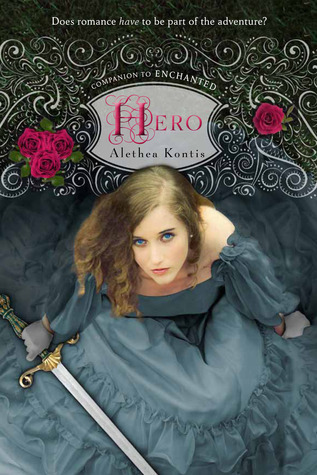
#CBR6 Book 24: "Hero" by Alethea Kontis

Page count: 304 pages
Rating: 4 stars

Saturday Woodcutter believes she is the only one of her many siblings without any magic, until the day when she throws a mirror out of the window in a rage, and conjures an ocean in the backyard. Because one of her brothers has run away and Saturday believes her ocean may have drowned him, she grabs her trusty axe (which has decided to change shape into a sword for the time being) and sets sail on her sister Thursday's pirate ship in order to try to locate him again. She's abducted by a giant bird and taken to an icy cave, towards the top of the highest mountain in the world. The blind witch there isn't actually all that skilled at magic and was attempting to kidnap Saturday's eldest brother, the adventurous Jack Woodcutter, who's the man who stole the witch's eyes in the first place.

Saturday is advised to keep silent about her true identity by Peregrine, a cross-dressing young man also trapped at the top of the mountain. The witch believes him to be her daughter, after the foolish young noble accepted a wish from what he thought was a kindly fairy. The wish was in fact a curse, and it allowed the witch's daughter to escape her mountain home, forcing Peregrine to take her place instead. He's lost track of the years he's spent there, trying to foil the witch's many plots. Peregrine dreams of breaking free of the curse and going back to his betrothed, who he believes he's seen in visions through much of his time in captivity. Imagine his surprise when he realises that the fearless warrior woman he's seen in visions and dreams is in fact Saturday.

Saturday, in turn, doesn't see why romance needs to have any part in her adventure, although she can't deny that she likes kissing Peregrine. To rescue him, and escape the mountain, it looks like she's going to have to kill the witch, who's dangerously close to opening a portal to a hell dimension. Of course, killing the witch may wake the slumbering dragon on the mountain top and kill them all. What's an adventurous young lady to do? It's not easy being a hero.

This is a sequel to Enchanted, where we first meet the Woodcutter family, and Saturday's youngest sister Sunday falls in love with a frog prince. Alethea Kontis doesn't really retell just the one fairy tale, instead mixing all sorts of elements from fairy stories, mythology, folk lore and adventure stories in a blender and throwing the results together into exciting young adult fantasy stories. While Sunday's story was sweet, I think I liked Saturday's story even more, as the gender reversal of the characters in this book really appealed to me.

Saturday is tall, and not particularly feminine, and comes from a family blessed with a number of magical gifts, without believing herself to have any. She's got an enchanted axe, and has been working with her woodcutter father and brother in the woods for much of her life. With a brother whose legendary for his quests and adventures, several sisters married to royalty and one who's off on the high seas being a pirate, Saturday never really imagined she'd get to leave on an exciting journey on her own. She's pragmatic and sensible, and not prone to daydreaming. She certainly never expected to find a man in a skirt, posing as a witch's assistant on the top of a mountain, confessing that he's dreamed about her since very likely decades before she was actually born. That's going to flummox the best of people.

As Saturday discovers on her adventure, you don't always choose to be a hero, sometimes circumstances just force you into it. She's a great character, as is Peregrine, who is a wonderful example of a beta hero, not at all concerned with the idea that Saturday is physically stronger or a more skilled fighter than he is. The curse the witch's daughter cast on him keeps him from aging while he's trapped, and gave him a much more feminine appearance than he was born with. He's learned to adapt to his long hair (which grows back if he tries to cut it) and being forced to dress in skirts, but has hidden every mirror he can find and tries to avoid reflective surfaces. His captivity is a fairly lonely one, especially after Jack Woodcutter managed to escape, having stolen the witch's eyes. His only friend is Betwixt, a chimera also captured by the witch, who's forced to change shape every time the witch does magic, unable to choose his own shape until the witch dies. The two make a wry and humorous odd couple, keeping each other company and trying to foil the witch as best they can.

I applaud Alethea Kontis' imagination and creativity and hope she keeps publishing at least a book a year. There are clearly more books coming in this series, and I hope that while sequels possibly also focus on other members of the Woodcutter family, this is not the the readers see of Saturday, Peregrine and Betwixt.

Crossposted on Cannonball Read.

#CBR6 Book 23: "Princess of the Silver Woods" by Jessica Day George

Page count: 336 pages
Rating: 3 stars

This is the third book in a series, which began with Princess of the Midnight Ball. While you don't really need to have read the second book in the series, Princess of Glass to fully appreciate the book, you should probably have read the first one (or at least be more than passingly familiar with the fairytale of The Twelve Dancing Princesses) to get the full experience of this book, as there are a lot of references to the events of the first book. There will also be mild spoilers for the first book in this review. You have been warned. 

Princess Petunia is the youngest of King Gregor's twelve flower-monikered daughters, and spent the first few years of her childhood dancing every night in the shadowy realms of the King Under Stone. The curse was broken when her eldest sister Rose's now husband Galen figured out a way to defeat the King Under Stone and trap those of his twelve sons that survived in their underground kingdom. Lately, Petunia and her sisters have been having nightmares where they're back, forced to dance with their terrifying suitors. Several of the princesses are wasting away under the strain, and it's obvious that there is still a curse hanging over them.

Petunia is on her way to the estates of a neighbouring Grand Duchess, who seems to want to make a match between the young princess and her grandson, Grigori. On the way through the woods, Petunia's carriage is attacked by highwaymen dressed in wolf masks, and Petunia is abducted once she sees the face of one of bandits. It turns out that the bandits are in fact run by a young Earl, whose lands were lost after the recent war and who's been forced to turn outlaw to support his dependants. Young Oliver knows that he's playing a dangerous game, he's now convinced he's going to be executed, having kidnapped a member of the royal family. Petunia, however, is appalled that her father has just abandoned the Earl and his people, and promises to argue his case, as long as they take her to Grand Duchess Volenskaya as quickly as possible.

Once Petunia arrives at the kindly old grandmother's house, however, it becomes quite obvious that the old lady's benevolence may be masking something more sinister. Shadowy figures roam the gardens and flock around Petunia's window at night. Petunia contacts her sisters, they will have to work together to defeat the new King under Stone and his evil brothers once and for all. Oliver must travel to King Gregor to alert him of the danger to his youngest child, even if it means risking imprisonment and even execution for his crimes.

Princess of the Midnight Ball was a creative retelling of The Twelve Dancing Princesses, while Princess of Glass borrowed heavily from Cinderella. As may be obvious to the reader from the cover, with Petunia in her lovely red cloak, the fairy tale that Princess in the Silver Woods is indebted to, is Red Riding Hood. There's the young girl on her way to a grandmother, who encounters a wolf of sorts in the woods, but those are as far as comparisons can be drawn, really. There are a number of other fairy tale elements in the book, though. There is the dastardly King Under Stone, heir to the original, and his brothers who are still intent on forcing the twelve princesses into marriage, no matter that some of them have husbands in the real world whom they love dearly. There is a wise old crone and enchanted rose bushes and a curse that must be broken. It qualifies nicely for my Monthly Motif Challenge, which this month focuses on fairy tale retellings, but it wasn't, on the whole, one of the most memorable books I've read.

The target audience for Jessica Day George's Princess books is obviously in the lower end of young adult, so they're not meant to necessarily thrill me. I still found both the previous books more entertaining than this, and here parts of the storyline felt a bit stretched, as if the author didn't quite have the idea for a full book, but went ahead and wrote it anyway, to finish off a trilogy. The characters are sweet enough, but I mainly finished this book out of a sense of completion. Hoping that the author does something new and exciting next.

Crossposted at Cannonball Read.

Saturday, 15 February 2014

#CBR6 Book 13: "Cress" by Marissa Meyer

Page count. 550 pages
Rating: 4.5 stars

This is the third book in a series, and I would strongly recommend you don't start with this one. This review will contain minor spoilers for Cinder, the first book in the series and Scarlet, the second book, so if you've not read them, go read them first. This review will be here when you're done.

Crescent Moon, or Cress, as she'd prefer to be called, has spent the last seven years all alone on a satellite orbiting Earth, monitoring communications for the Lunar government and doing all sorts of tricksy things to make sure Lunar ships can travel undetected to the planet below. About once a month, her boss, Queen Levana's head thaumaturge (think scary psychic) Sybil comes with more supplies, and to check on whatever progress Cress has made. At the moment, Sybil wants her to locate the missing Lunar fugitive Linh Cinder and her accomplices, not realising that Cress and her hacking skills are in fact what's keeping the authorities from locating the spaceship they are on.

While once a loyal Lunar citizen, happy that despite being a shell (a Lunar who doesn't possess the ability to manipulate minds with glamour) she has been kept alive (because the law states they should be killed at birth), Cress has long been trying to subvert Queen Levana every chance she gets. She devours all she can find of Earthen culture and media, and sent the warning to Cinder that Levana was planning to kill Emperor Kai once they were married. Now she's hoping that Cinder will be able to rescue her from her prison on the satellite. She's researched everything she can find on the cyborg fugitive and her accomplices, even a lot that's not available through official channels. With her hacking skills, Cress can get any kind of written record, if she just works for long enough. She's especially taken with the handsome Captain Carswell Thorne, who claims to be a rogue and a scoundrel, yet Cress is convinced he's a good man, really.

So Cress is rescued, Cinder defeats the evil queen and it's all good, right? Not so much. This is the third and penultimate book in Meyer's Lunar Chronicles and it's clearly where some spanners have to be thrown in the works for our brave heroes and heroines. Cress and Thorne crash to Earth in the satellite, having to find their way to civilisation from the crash site in the Sahara desert, with Thorne blinded and Cress unaccustomed to anything outside her orbiting prison. Scarlet is taken prisoner and taken to Luna, tortured and interrogated by Levana's people, determined to find Cinder at any cost. Cinder, a frantic wolf and a rogue Lunar royal guard travel to darkest Africa to find Doctor Erland, who may be the only one who can help Cinder prepare to face the Queen, and stop her impending marriage to Emperor Kai.

This is the longest book in the series so far, and my favourite of the three. The main heroine this time around is poor, lonely and day-dreaming Cress, so obviously modelled on Rapunzel and so desperately infatuated with a man she's never met. To his credit, Thorne realises very quickly (even when blind) that Cress is sheltered and impressionable and does nothing to take advantage of her affection for him, even doing his very best to set the story straight about what she believes were noble and courageous deeds, but in reality were fairly selfish and sometimes foolhardy acts. Of course, through his continued interactions with Cress, getting her through the desert safely, risking his own comfort and safety for her, he may indeed end up the heroic ideal Cress has built up in her mind.

Cinder is getting desperate, and she's running out of time. She has decided that the best way to stop Levana is to interrupt the wedding ceremony and expose to the world what an evil fraud the Lunar Queen actually is. She travels to find Dr Erland in Africa, hoping that he will give her the tools she needs to set her plan in motion. Can she trust Jacin Clay, the royal guard who claims he'll help her take down Levana, if only the princess is kept safe?

Through Scarlet, we see more of the cruel and capricious nature of a lot of the Lunars, and she is not treated well in her captivity. She makes a possible friend in Clay's strange and possibly mad Princess Winter, though, who seems none too fond of her stepmother, and refuses to manipulate the minds of those around her with glamour.

I knew I was setting myself up for a long and frustrating wait for the fourth and final book in the series when I chose to read Cress as soon as it came out. These books are just getting better and better, with multiple protagonists, story lines and plots, all moving towards what will no doubt be a spectacular conclusion in Winter's book, out sometime in 2015. I can't wait to see how it all ends. Hopefully, like in the fairy stories the series is based on, they will all live happily ever after.

Crossposted on Cannonball Read.

#CBR6 Book 12: "Scarlet" by Marissa Meyer

Page count: 452 pages
Rating: 4 stars

This is the second book in the Lunar Chronicles, and won't really work so well if you haven't read the first one. Start with Cinder, then come back and read this review when you've caught up. Really, you don't want to be reading this review - it's going to contain spoilers about the first book. Continue reading if you don't mind, but don't say I didn't warn you.

Scarlet Benoit needs to find her grandmother, who disappeared without a trace a few weeks ago. Her ID chip was left behind, and Scarlet is convinced she's been kidnapped. The local police, however, don't suspect foul play and have rejected the case. Scarlet's determined to locate her grandmother on her own, but has few leads or clues. How is the mysterious prize fighter, calling himself Wolf, connected? He arrived in the area around the same time Scarlet's grandmother disappeared, and seems very interested in Scarlet.

How is Scarlet's grandmother connected with dangerous Lunar fugitive and cyborg Linh Cinder? The heroine of Meyer's previous book has escaped from prison along with self-styled Captain Carswell Thorne thanks to the advanced cyborg enhancements Doctor Erland gave her at the end of the last book. On the run in Thorne's stolen spacecraft, the two manage to constantly stay one step ahead of the Lunar and Earthen authorities, and discover that a former officer named Michelle Benoit may have further clues about Cinder's past.

Newly appointed Emperor Kai is still reeling from the discovery that the charming mechanic he impulsively invited to the ball is not only a cyborg, but actually a dangerous Lunar. Was his attraction to her nothing but trickery brought on by her Lunar powers? He is desperately trying to fend off the powerful and terrifying Lunar Queen, Levana, who demands that the girl be caught within three days, or there will be disastrous consequences for Earth.

In Cinder, Meyer introduced us to the Cyborg mechanic who bore a clear resemblance to the Cinderella of Grimms' fairy tales. While I liked the book, a lot of it was establishing the world and world building, and I found it a bit slow in places. In the sequel, the fantastic sci-fi world is already in place, and quite a few of the main conflicts and players have been set in motion. Or so I thought. Because Meyer proceeds to introduce more characters, with complicated back stories and motivations. There's a lot more action in this book, it moves ahead at a faster pace all the way through.

The spirited Scarlet argues with townspeople and wears a red hoodie. She's a talented pilot and loves her grandmother, who more or less raised her, fiercely. She's willing to risk pretty much anything to find her, even allying herself with the rather shady Wolf, whose motivations are a lot more murky than she likes. She's sometimes frustratingly stubborn, refusing to believe that there could be something in her grandmother's past that led her to being abducted, even when further investigations keep revealing that her Michelle Benoit hadn't always been an eccentric farmer.

Also introduced in the book is adventurer, wanted thief and confidence trickster Carswell Thorne. When Cinder is escaping from prison, she accidentally drops into his cell, and upon discovering that he has a spaceship, she reluctantly agrees to take him with her. He uses his charm like a weapon, yet she is entirely immune. In reality a cadet in the American forces, he became wanted when he stole an advanced military aircraft to go adventuring. While he calls himself a captain, he's not actually a very good pilot, and it seems that he and Cinder evade the authorities through luck more than skill.

Levana keeps being scary and villainous, and more of her plans to wage war on Earth is revealed in this book. Kai and the rulers of the other Earthen nations do their best to defy her, but without much success. While Kai has to send out forces to try to capture Cinder, he's secretly happy as long as she stays missing, even though he knows her continued freedom could have dire consequences for the people of Earth. It's a dreadful situation for a young, inexperienced ruler to be in, and when Levana's plots against Earth start coming out into the open, he does the only thing he can to try to avoid more death and bloodshed.

As in the first book, there is a romantic subplot in the book, although it's by no means the most prominent. Scarlet seems to go from distrusting and worrying about Wolf to being attracted to him very quickly, but I suppose added danger can throw people together, and he does help her look for her grandmother, even against his better judgement. I suspect Captain Thorne may become a romantic interest for the heroine in the third book, which is coming out in a day or two. I'm very much looking forward to seeing where the story goes next.

Crossposted on Cannonball Read.