Showing posts with label mediaeval. Show all posts

Thursday, 14 May 2026

CBR18 Book 28: "The Familiar" by Leigh Bardugo

Page count: 385 pages
Audio book length: 12 hrs 57 mins
Rating: 4 stars

Dark Corner Selection: March 2026
Defeat the Goblin TBR 26: The Bog book - A book you started, but never finished (started it in May 2025, but only made it about 30%)
Buzzword Cover Challenge 26: Metallic element

In a different version of 16th-century Spain, young Luzia Cortado works grudgingly as a scullery maid for the miserable and petty Doña Valentina. Luzia can use what she calls "small magics" to make her life easier. She can mend seams, multiply the groceries, unburn bread or reassemble broken things. She performs these little spells, learned from generations of her Jewish ancestors, by singing quietly. Luzia is a convert; she dutifully goes to Mass and hides any traces of her Jewish lineage to escape the clutches of the Inquisition. 

However, when Doña Valentina discovers Luzia's powers, she sees an opportunity to increase her social standing. She makes Luzia perform for dinner guests, and before long, powerful and ambitious men show interest in Luzia's abilities. To improve her abilities, she is put under the tutelage of the mysterious Santangel, rumoured to be immortal. 

This book, a medieval alternate history, is very different from all of Leigh Bardugo's previous books. As someone with a Master's degree in European medieval history, I was really interested in this book, yet when I first tried reading it, in 2025, I couldn't get very far into it, and eventually decided to put it down until the time was right.

This year, my book club decided to vote for most of our books of the month. When The Familiar became the book of the month for March, I figured it was a sign from the universe that now the time was right. While I made it all the way through this time, I can see why I put it down the first time. It has a very slow start, something that was also remarked on by many of the members of my book club. I did discover that had I just kept going for a few more chapters the first time, I would have finished it. 

I really liked the unusual setting for this book. I liked that it tells the story of three very different women (Luzia, Valentina, and Luzia's aunt), who are all just trying for a better life. The magic used is interesting. I agree with several of the members of my book club that the romantic subplot involving Luzia and Santangel is entirely unnecessary, and that the conclusion of it is frankly quite disturbing, if you think about the power dynamics of the whole thing. There is also a lesbian subplot introduced towards the end that was definitely a bit unexpected, and considering how much is made of the power of the Inquisition and how feared they are, it seemed unlikely that these women would have been able to safely and rather publicly make a life with one another. But that's a minor niggle. 

I hope this remains a standalone book and that Bardugo doesn't decide to write a sequel at some point. 

Judging a book by its cover: Even with the scorpion crawling out of the lacy sleeve, this cover seems more like it belongs on a historical literary fiction book. Except for the name of the author, there is really nothing that marks this out as fantasy. 

Crossposted on Cannonball Read


Sunday, 24 November 2019

#CBR11 Book 81: "The Magnolia Sword: A Ballad of Mulan" by Sherry Thomas

Page count: 352 pages
Rating: 4 stars

Official book description:
CHINA, 484 A.D.

A Warrior in Disguise:
All her life, Mulan has trained for one purpose: to win the duel that every generation in her family must fight. If she prevails, she can reunite a pair of priceless heirloom swords separated decades earlier, and avenge her father, who was paralyzed in his own duel.

Then a messenger from the Emperor arrives, demanding that all families send one soldier to fight the Rouran invaders in the north. Mulan’s father cannot go. Her brother is just a child. So she ties up her hair, takes up her sword, and joins the army as a man.

A War for a Dynasty:
Thanks to her martial arts skills, Mulan is chosen for an elite team under the command of the princeling—the royal duke’s son, who is also the handsomest man she’s ever seen. But the princeling has secrets of his own, which explode into Mulan’s life and shake up everything she knows. As they cross the Great Wall to face the enemy beyond, Mulan and the princeling must find a way to unwind their past, unmask a traitor, and uncover the plans for the Rouran invasion…before it’s too late.

Inspired by wuxia martial-arts dramas as well as the centuries-old ballad of Mulan, The Magnolia Sword is a thrilling, romantic, and sharp-edged novel that lives up to its beloved heroine.

A young adult retelling of the Mulan story, written by one of my favourite historical romance authors? Who just happens to be Chinese, so someone you might hope would do a good job of researching and writing this? Of course I was going to want to read this as soon as I could get my hands on it.

I love Disney's Mulan, and this may be one of the cases where I'll actually go see the live action remake they're doing, as I'm also a huge fan of wuxia films. I don't know if this retelling that Thomas was commissioned to do has anything to do with Disney, or if her publisher is just cashing in on the fact that there will be a new movie soon, but if the new film is anything like the story presented here, I'll be very happy. This is of course not the first novel that Ms. Thomas has written about a capable, Chinese female warrior. In her Heart of the Blade duology, The Hidden Blade and My Beautiful Enemy, set in late 19th Century China and England, Ying Ying (or Catherine, as she uses in England) is also a very skilled swordswoman and martial artist. I forget whether Ms. Thomas at that point said anything about being influenced by the Mulan myth.

Here we have a dutiful young woman who has been posing publicly as a man for a long time. Her twin brother died, but her father let the authorities believe his girl child was the one who passed away. Hence, when conscription forces each household to yield one able-bodied man, Hua-Mulan is the only one who can go. She has been trained in martial arts and swordplay since she was very young, as her family owns one of two legendary swords, and at some unspecified future date, she will face the champion who has possession of the other sword. During the last duel, her father was paralysed, so she needs to avenge his honour, as well as secure both the heirloom swords for her family.

Shortly before Mulan is forced to go off to join the army, her father receives a message from the rival champion, announcing that because of the hostilities threatening the border, their duel will have to be postponed. Mulan is worried about how she's going to hide her gender in the army, but her advanced martial arts skills gets her a special assignment with a small group of men, so she more easily can hide her real identity. I'm sure no one's going to be terribly surprised to discover that her immediate supervisor, the Duke's son, is none other than the rival she's been training most of her life to duel. They have met for secret practise bouts a few times over the years, but both have been masked. Nevertheless, Mulan feels a sense of kinship with the nobleman the very first time they meet, and their relationship doesn't exactly become less complicated once their family connections are revealed.

What Mulan has never been told by her father, during all her years of training, is that he didn't exactly act honourably in the duel that crippled him and that the Princeling has even more reason to feel vengeful, should he so choose. He seems to treat her with the respect of an equal and no animosity (not quite the same from his extended family) and it's obvious that if their family rivalry didn't span generations, they could have been friends, or more.

I don't know much about the original ballad of Mulan, but this is set in 5th Century China, and the research and information about social structure all felt realistic. There is quite a lot of creeping about, spying and trying to gather intel, but it would be a pretty boring book if there weren't amazing feats of martial arts as well. There is obviously a romance subplot (possibly more than one, but the second one is WAY subtle), but this is a YA novel and it's all very chaste (especially since Mulan is posing as a young man for much of the novel).

I really really liked this and hope that as well as writing more Lady Sherlock novels, Ms. Thomas possibly writes more Chinese-set adventure novels starring kick-ass young women.

Judging a book by its cover: I didn't realise that magnolia flowers could come in other colours than white until I saw this cover. I actually googled to look it up, as I was unsure of whether the publishers had just taken artistic licence and made the flowers purple, or whether you could actually find magnolias in this colour in reality. That's when I discovered that not are there several different kinds of magnolia flowers, but they come in many different shades. It's always fun to learn something new.

Crossposted on Cannonball Read.

Monday, 4 March 2019

#CBR11 Book 5: "The Winter of the Witch" by Katherine Arden

Page count: 384 pages
Rating: 5 stars

Spoiler warning! This is the third and final volume in the trilogy, and the action starts immediately after the second book. This is not the place to start. If you are not caught up, drop everything and start from the beginning with The Bear and the Nightingale

Vasilisa "Vasya" Petrovna managed to defeat one enemy, but at a great cost. Releasing the legendary firebird has caused much of Moscow to catch fire and the citizens, spurred on by the vengeful and jealous Father Konstantin are looking for a scapegoat. Vasya is dragged from the safety of her sister's home by an angry mob and accused of witchcraft. Suffering a great personal loss in the process, she is determined to protect those she loves from further harm, and goes along with the crazed crowd.

Yet it is not Vasya's fate to die in a fire on the outskirts of Moscow. In a desperate attempt to keep his beloved safe, the frost demon Morozko has made a deal with his demonic brother Medved and freed the giant bear, dooming himself in the process, all in order to keep Vasya from burning. However, no helpless damsel, Vasya finds unexpected reserves of her own and rescues herself, fleeing into the realm of the supernatural to heal up, figure out how to undo Morozko's bargain, save the people of Moscow from Father Konstantin's toxic influence and make sure no more harm come to her family. As if that were not enough for one young woman to carry on her shoulders, a war is looming and Vasya may be the only one who can stop it.

Our Vasya has come a long way from her rural upbringing in the Russian forest. Truly a worthy example of "what doesn't kill us, makes us stronger", Vasya is turning into a force to be reckoned with. She has learned a lot about herself and her heritage, and escaping Father Konstantin and the furious mob determined to end her leads her further down the path of her family history. Previously just accused of witchcraft because of her ability to see and communicate with the many hearth and nature spirits around, Vasya's several trials and tribulations appear to have actually made it possible for her to tap into magic. Now she just has to make sure it doesn't drive her utterly mad, which the demon bear Medved seems to be gleefully hoping for.

Not realising just how resourceful an individual Vasya actually is, he formed a foolish bargain with his formerly imprisoned brother to ensure her survival. It led to the chaos-hungry demonic entity being free to cause further mischief, primarily by causing plague to spread through Moscow and zombie-like vampires to roam the streets, only held back by the seemingly super powered Father Konstantin. Once Vasya heals up, she needs to locate the now imprisoned frost demon she has come to love, before figuring out how to stop Medved and Father Konstantin.

Her entire life, Vasya has seen how the modern world and especially the spread of Christianity seems to be threatening the adherence to the old ways, and the spirits and supernatural entities who have helped her throughout her life are fading away. With the Mongol army threatening to conquer Russia once and for all, High Prince Dimitri needs to unite his people against the external threat. He needs all the help he can get, and Vasya, along with the unusual allies she has acquired, can lend invaluable aid.

While I thought it had a slow start, I was amazed at how much the story of The Bear and the Nightingale stayed with me. The Girl in the Tower was an amazing second volume, expanding on the world building, history and folklore. My expectations for The Winter of the Witch were very high, but amazingly, this book managed to exceed them. I'm very far behind on my reviews, and finished this book more than a month and a half ago, yet the story has stayed with me, and I keep thinking about little details on and off, still marvelling at how well all the story strands were tied up and the trilogy was concluded.

The series is an amazing way to learn more about medieval Russian political and social history, mythology and folklore. as well as be thoroughly entertained. Vasya is such a complex and fascinating protagonist, and I love how Katherine Arden resists the temptation to populate her novels with one-sided character tropes. There are complex reasons for the antagonists acting the way they do, there is never simply good or evil, but a fascinating array of motivations. Vasya's stepmother, Father Konstantin, Medved - none of them are wholly irredeemable. The supporting cast are all excellent, which raises the stakes when the action becomes tense, as you don't want anything bad to happen to them either. Without saying too much, this book had me in tears very early on, after a gut punch of an event, showing just how much Arden makes you care for the various human and non-human characters in the story. I loved discovering more about Vasya's family history and seeing her reach her full potential, in full feminist glory, was so satisfying.

While this was one of the very first books I read this year, I'm going to be very surprised if it doesn't end up on my 'Best of' list of 2019. If you haven't read Arden's books yet, do yourself a favour and check them out - the trilogy is completed, so you can have so much satisfying story without any pesky waiting for the next book.

Judging a book by its cover: Having recently studied all three covers for the series quite carefully (the cover art is so gorgeous), I can't help but notice that the tone changes from dark to light over the course of the books. As our heroine, Vasya, grows and matures and properly comes into her own, the covers become brighter and lighter. The cover for The Bear and the Nightingale shows the darkened woods in the middle of winter. The Girl in the Tower shows the outskirts of Moscow at dusk, with the sky in reds and oranges from the setting sun. This depicts Vasilisa Petrovna alone, yet unafraid, facing an army, with the firebird lighting up the sky ahead of her. I can't imagine these choices aren't deliberate. With each book, despite all the harrowing and horrible things that happen to Vasya along the way, her future gets brighter and more open.

Crossposted on Cannonball Read.
Sunday, 27 January 2019

#CBR11 Book 3: "The Girl in the Tower" by Katherine Arden

Page count: 395 pages
Rating: 4.5 stars

Spoiler warning! This is book 2 in a trilogy, and the story pretty much follows on directly from the ending of the previous book. This book, while very good, doesn't really stand on its own, you would do much better to start at the beginning, with The Bear and the Nightingale

There are roving gangs of bandits travelling the countryside around Moscow, pillaging and burning the villages and abducting young girls. Prince Dimitri sends his cousin, brother Alexandr, affectionately known to his family as Sasha, to investigate. Sasha has been out travelling the land, and brings an injured and exhausted priest he found on his travels to his sister Olga's household for tending. Neither of them know about Father Konstantin's connection to their family, and are therefore shocked when the priest tells them of the strange events surrounding their father's death and their sister Vasya's disappearance and likely demise.

As Sasha believes his sister to be dead, he's certainly not expecting to find her riding hell for leather, pursued by bandits, disguised as a boy, with three young girls clinging to her for dear life. Reunited at the monastery where Sasha and Dimitri spent part of, where the men are resupplying while out searching for traces of the bandits, Sasha is forced to lie to his cousin about Vasya's identity, presenting her as his younger brother Vasily. As they return to Moscow, Olga has no choice but to support Vasya's deception either, as their sister has chosen to flout all the conventions of society. In a world where women either marry and get locked up in terems, or go to convents (and get locked up there), Vasya's refusal to conform to the gender norms is unacceptable and eventually gets her (and her family) into more trouble.

It will come as no surprise to any reader that our brave and non-conforming heroine's deceptions are eventually revealed (in a very public and rather breathtaking scene). As well as the jealous malice of Father Konstantin, she's up against a new antagonist in this book. The man behind the raids on the villages is eventually revealed, and he has an unexpected connection to Vasya's family and ambitions that could cause problems for Prince Dimitri, Sasha, Olya, as well as Vasya herself.

Vasya's sister Olga was a supporting character for a while in the first book, but then disappeared out of the story as she was married off to a Prince in Moscow. Here we get to see much more of her life, as the head of a noble household in Moscow. We also get to spend a lot more time with Sasha, Vasya's beloved older brother, now a famous warrior monk and the right hand adviser of his cousin, Prince Dimitri of Moscow. Obviously Sasha is massively uncomfortable having to lie to his cousin and best friend about Vasya, but his younger sister's behaviour is so at odds with everything expected and accepted of women in that time that he doesn't really have a choice. Women don't dress up as boys and run away from home. Women don't infiltrate bandit camps and rescue kidnapped girls. Women don't pretend to be folk heroes, go to parties and accept challenges for public horse races.

In a lot of cases, the second book in a trilogy is a bridging book, with not much actually happening. That is absolutely not the case here. Interestingly, while Vasya is mostly the focus of the first book (certainly after the first half that tells of her backstory), it's clear that her family are just as important to the overall series, especially Sasha, Olya and Olga's little daughter Marya, who like her aunt can see the nature spirits, although their presence is much more muted in the city than in the woods of Vasya's old home. We also discover more about Vasya's ancestry, and find out what happened to her grandmother, as well as why Morozko, the winter king, is so drawn to her.

While he's not a big part of the story, as in the first one, Morozko's presence is felt and the scenes between him and Vasya are probably the best in the book. I was initially displeased to see Father Konstantin reappearing in the story, but trust that Ms. Arden knows what she's doing.

I love how Arden makes us both sympathise with Vasya, who not unreasonably doesn't want to become a wife and mother, a nun or just die, but rather forge her own path and become an adventurer and a warrior, yet we also feel for her sister and brother and worry about the consequences of her rash actions. Part of what makes me love these books so much is the vivid descriptions of the setting. When Vasya is riding alone through the forest, you feel the cold settling in your bones. You can almost see and feel the bustle of the closed off women's quarters of the terem and the raucous, smelly gatherings of the Prince's palace. As a historian, who specialised in European medieval history, getting all these details about Russian society and folklore, as well as the gripping and exciting main story is great.

The Bear and the Nightingale ended up being one of my favourite reads of 2017. I waited to read this until I knew the third book was already out, as I was pretty sure I would want to dive into the next book right away after finishing this one, and I was not wrong. These are such great fantasy books, with a fascinating cast of characters. Now that the trilogy is completed, there is no excuse not to start the series.

Judging a book by its cover: The cover on this book is so incredibly lovely, and the image fits nicely with the story within, without spoiling anything. I don't know who the cover artist is, but they've knocked it out of the park.

Crossposted on Cannonball Read.

Thursday, 23 February 2017

#CBR9 Book 12: "The Bear and the Nightingale" by Katherine Arden

Page count: 336 pages
Rating: 4 stars

Disclaimer! I recieved an ARC copy of this through NetGalley. That has in no way influenced my review.

Pyotr Vladimirovich is a boyar, the lord of northerly and remote Lesnaya Zemlya in medieval Russia. A part of the world where the winters are long and harsh and isolate the populace, it's no wonder that the cold, dark nights are spent telling fairy stories, like those of Morozko or Lord Karachun, the Frost demon himself - who sometimes rewards those who are brave and pure of heart with treasures beyond their wildest dreams, while he punishes the greedy and claims their lives. Pyotr has three sons and a daughter, when his beloved wife, Marina, believed by some to be a witch's daughter, announces that she is having another child, a second daughter, who will inherit her grandmother's gifts. Both Pyotr and Dunya, Marina's old nurse (and now that of her children) are worried and don't think Marina is strong enough to carry another child to term, but she does, and dies shortly after.

Vasilisa Petrovna, commonly known as Vasya, grows up to be an unruly and impetuous child. When she is six, she gets lost in the woods she normally knows as well as the back of her hand, and under an unfamiliar oak tree, she finds a sinister, one-eyed man sleeping. She wakes him by accident, and discovers that half his face is badly scarred. The man tries to get her to come to him, but just as she is about to step closer to him, she is interrupted by the arrival of younger man on a beautiful white horse. He has piercing blue eyes and wears a long fur cloak. He puts the older man, Medved, to sleep with a word and tries to talk to Vasya, but she is scared and runs away and is eventually found by search parties in the woods. As she grows older, she more or less forgets about the whole incident.

The episode makes it clear to Pyotr and his family that Vasya needs a new mother and that Dunya and Olga (Vasya's older sister) are not enough to raise her into a properly well-behaved young lady. Pyotr needs to marry again and travels with his two oldest sons to Moscow to find a new wife, and hopefully a prospective bridegroom for Olga, as well. The current grand prince there is Ivan, Marina's half-brother, so Pyotr has hopes of a decent match both for himself and his daughter. While he is there, his middle son, Sasha, meets a holy man and states his desire to join a monastery, not exactly something the northern lord looks favourably upon.

They are also approached by a handsome, dark-haired stranger while in the marketplace. A cranky, hungover Kolya (the eldest brother) challenges the man, but is easily bested by the deadly man, who nevertheless promises to spare the young hot-head's life, if Pyotr will only bring a gift back for his youngest daughter. The stranger gives him a beautiful blue jewel on a delicate chain, making Pyotr swear that Vasya will keep it close always, as it will protect her. If he doesn't give her the necklace, the stranger promises to come for Kolya, taking his life.

While in Moscow, Grand Prince Ivan promises Pyotr a very favourable marriage between his nephew and Olga, and also offers his eldest daughter from his first marriage to Pyotr as a young bride. Pyotr is wondering what in the world is wrong with the woman, to make her father want her exiled in the northern wastes, but can't really refuse such a handsome offer. As it turns out, Anna Ivanovna is a recluse, who believes herself to be mad. She sees demons everywhere, except in church, and therefore wants to join a convent. She's not at all happy when her father announces that she is to wed a much older boyar and move to the north.

When Pyotr returns, he gives the strange necklace to Dunya the nurse, for safe-keeping. She doesn't think a wild young girl like Vasya should wear something so fine, but is haunted by vivid dreams after she hides it away. A dark stranger visits her and threatens both her and the family. Dunya promises that she will give the girl the necklace when she gets older, and the stranger eventually agrees, leaving the old woman's dreams in peace.

Anna Ivanovna is completely miserable in the north, seeing even more demons than before. She doesn't realise that the creatures she sees as demonic are the same ones her stepdaughter Vasilisa considers her secret friends. They are the various nature spirits who protect the house, yard, stables, fields and homes in the village. Some of the ones of the streams and forests are more malevolent than others, but all care for young Vasya and she makes sure they are given appropriate gifts of food and drink to be kept happy.

When the old priest dies and the young, handsome and very ambitious Father Konstantin arrives from Moscow, Anna finally believes she has found a proper ally. Together the zealous and hysterical woman and the charismatic priest persuade the villagers to abandon their old superstitious practises. No more offerings to the various nature spirits are allowed, only church services and devotion. Only Vasya, who speaks to them (but has learned to hide it from everyone, especially her stepmother) sees the negative effects. She tries valiantly to sneak the spirits offering in secret, but they are clearly weakening.

Anna is a bitter, unhappy woman and cannot fail to notice what a striking and confident young woman her stepdaughter is becoming. Maybe not beautiful, but arresting nonetheless, and she sees how fascinated Konstantin the priest is with her, even though he's supposed to be a man of God. Anna convinces Pyotr that the girl needs to be either married off or sent to a convent, before Vasya's wild ways shame the family.

Dunya refuses to give her young charge the necklace, even as she grows older, worried about the origin of the amulet. She rightly suspects that the dark stranger is none other than Morozko, the Frost demon himself and that the talisman will bring Vasya under his influence. Only when she is dying does she persuade Vasya to take the necklace, but is it already too late?

Has the frantic and jealous Anna's efforts, along with the priest's, weakened the various defences of the village and forest too much? Has the abandonment of the old ways allowed dark forces to take control in the area? Crops are failing, the winters are longer and the summers far too warm. There are wild beasts roaming the woods and uncontrollable forest fires threaten. Can Vasya save her home and her family before the dead rise and destruction reigns?

If my plot summary is a bit TL, DR just trust me that this is a slow-burning, but very worthwhile exploration of Russian folklore, a fantasy set in 13th Century Russia (before the country was even called that). While Vasilisa is the true protagonist, for the first third or so, she barely even exists, as the book takes its time to tell the story of how her parents met, how her family live before she is born, and how her father grieves her mother's passing, having insisted on giving birth to this apparently gifted child. While Vasya is a brave, loyal and independent heroine, this is a world where women are completely subservient to men and she can't exactly be a blazing feminist icon in a time where women either got married and had children (until they died in childbirth, probably) or joined a convent, shutting themselves away to pray for their extended family, governed by religion.

Growing up motherless and unruly, Vasya is generally given much more freedom than most women, and though she chafes under the discipline from her new stepmother, she's still allowed to roam freely in the woods, like the free spirit she is. It's only when her father invites a young man from a neighbouring village as a suitable match for her that he sees how different his daughter is from other proper, demure young ladies. She shocks everyone with how outspoken she is, and once she humiliates the potential groom by being a far superior rider than him, there really is no other option for Vasya than a convent. Telling her family that nope, she can't join a holy sisterhood, because she has to save the village from evil, isn't really going to work. Luckily, Vasya has the help of her youngest brother Alyosha, who tries to help her as best he can.

While the book felt excruciatingly slow at first and I wasn't entirely sure if it deserved all the rave reviews I've seen for it online, once Vasya grows a bit older and takes centre stage, the story becomes a lot more engrossing. Because we get to see her back in Moscow, before she is unwillingly married off to the older Pyotr, Anna really isn't your traditional evil fairytale stepmother. She's clearly a woman who had completely different hopes and dreams and whose religious upbringing makes her stand in complete opposition to everything her stepdaughter believes and has learned to trust growing up.

The contrast between the old faith, the belief in various spirits of the home and hearth and the new, as comprised in Christianity, is interesting. Neither Anna, nor Konstantin are bad people, as such, but their wishes and beliefs allow an older, more ancient evil to creep back into the area, taking advantage of their zealotry to weaken the natural defences that was there.

The internet tells me that this is the first of three books featuring the plucky Vasya, and probably some of her siblings too. I especially enjoyed the last third of this book and the romantic possibilities that are alluded to. Always a huge fan of fairy tales, I am very much looking forward to reading more about Vasilisa and the dark stranger who had placed her under his protection. So if you like a good dark fairy tale, this is well worth checking out. Just be patient and stick with it through the first third. It is worth it in the end.

Judging a book by its cover: This book has two different covers, and I absolutely love one of them, while find myself baffled by the other (which I also don't like at all). I've chosen to comment on the one I do like, with a motif I think fits perfectly for the second half of the book, with the dark forest, night skies, winter woods, spooky mist and the lonely, but warm-looking cottage in the woods, with a lone female silhouette walking towards the warmth and the light. The image fits perfectly with the action of the last quarter of the book and has a suitable fairy-tale feel.

Crossposted on Cannonball Read

Sunday, 19 June 2016

#CBR8 Book 57: "Doomsday Book" by Connie Willis

Page count: 608 pages
Rating: 3.5 stars

Kivrin Engle is a young history student at Oxford University, whose dream it is to time travel back in time to the Middle Ages. You see, in the 2050s, historians have the option to travel back in time as a research tool, to truly discover what the past was like. Most historians travel back to the early to mid 20th Century, and there are certain periods that are deemed far too dangerous. The Middle Ages has generally been deemed one of them, due to the devastating effects of the Black Plague.

But Kivrin is to be sent back to the Oxford region around 1320, deemed to be safe enough, as the plague didn't arrive there until 1348. She's learned spinning and weaving, Latin, and Middle English. She's had a translator gadget installed and a slew of inoculations to protect herself. The history department have constructed an elaborate back story for her, to explain why a young woman would be travelling alone in a period when women were never left unattended. Despite the constant worry of her tutor, Mr. Dunworthy, she is determined to go on this brief two week adventure, to observe Christmas celebrations in the past.

Despite Mr. Dunworthy's fussing and protestations, Kivrin is sent back in time as planned, only to discover that book learning and reality are very different things. Instead of arriving close by a road, she is transported into a wood, and although the time travelling "net" that transported her, isn't supposed to let diseases through, she's clearly caught something nasty that's making her dizzy and disorientated. She is rescued by a kindly priest and taken into the household of the local gentry, and once she recovers from her illness, is desperate to figure how to get back to her pick-up point, so she isn't stuck in the past forever. As she's travelled back to the right time of year, it takes her a while to realise that she's not in 1320 after all, but that something has gone badly wrong, and she is in fact, going to witness first-hand the ravages of the Black Plague in England in 1348.

Mr. Dunworthy worries terribly for Kivrin, and once the technician who set her coordinates in the past collapses with a high fever after gasping that "Something is wrong!", he is even more frantic. Dunworthy and his doctor friend Mary Ahrens (who gave Kivrin all her inoculations) are all too soon stuck in a medical quarantine, after the mysterious virus which knocked out the lab technician seems to be spreading with worrying speed and more and more people succumb. Having to work out the logistics of how to house, feed and accommodate people stuck in Oxford during the quarantine and figuring out where the virus originated from becomes more of a priority, but Dunworthy still doesn't stop trying to figure out what has happened to Kivrin. He's determined to get her fetched home safely, no matter what time period she ended up.

I don't read a whole lot of science fiction, but when it's the topic of choice for the Cannonball Read book club, I couldn't very well refuse to join in. As a historian myself, with a particular interest in the Middle Ages, a book in which historians actually have time travel at their disposal seemed like it really was designed to appeal to me, so I purchased the book and set to reading. It's a big book, which starts off slow with a lot of minute details about the preparations to get Kivrin sent off, and then pretty much alternating chapters following Kivrin in the past and Dunworthy in the future. I can see how the book is meant to show us that even with so many centuries of distance, people in general haven't changed all that much and a crisis situation involving a disease epidemic brings out the worst of the crazy and fear in some, while others knuckle down and deal with the realities with patience and compassion.

Even though it was slow in places, and nothing much of anything happened (for a while at least, before all the dying started), I really liked the meticulous descriptions of the Middle Ages and Kivrin's observations there. It was, as they say, relevant to my interests. The bits where Dunworthy is stressing around Oxford, trying to locate the director of the history department or other people by phone or having to deal with the logistics of housing and feeding a bunch of people stranded in the city during the quarantine was less exciting.

Quite purposefully, Willis has a lot of parallels in the narrative, intending to show us, that despite the great differences, there are also similarities between the past and the future. In both time periods, there is a plot moppet who varies between being quite engaging and dreadfully annoying. In 2058, that child is Mary Dunworthy's great-nephew Colin and in 1348, it's Agnes, the youngest daughter of the family Kivrin is staying with. There are people reacting with fear, suspicion and panic in the face of disease and there are people who will work themselves ragged to care for people, without any sort of praise or personal reward. Even in the face of terrible tragedy, like a disease epidemic, most people will be concerned with their own petty goings-on, oblivious to the bigger picture.

I do not think this book needed to be 600 pages long. Far too much of this book involved people not locating others by phone (when predicting the future, Ms. Willis did not anticipate mobile phones or the internet), waiting around for phone calls, being deeply concerned about the availability of toilet paper and eggs, Kivrin frantically trying to get back to the drop point and just too many minute descriptions of mundane events that didn't really further the plot.

I had originally rated this book 4 stars, but in the weeks since I finished it (yes, I'm once again WAY too far behind on my reviews), what I remember most are the boring bits that frustrated me, rather than the good bits that entertained me, and as a result, the book is being downgraded a bit. I'm sure it was a huge literary achievement in 1992 and it's won pretty much all the literary science fiction awards out there, but in 2016, it has dated quite a bit. If I haven't already gotten this across, it is rather dark and depressing book, and towards the latter half, the death toll is unrelenting and dispiriting, both in the Middle Ages and in the future Kivrin came from. The book has a happy ending, of sorts, but I have to wonder about the years of therapy Kivrin is likely to need after her ordeal.

Judging a book by its cover: Since this book came out in 1992, it's had a large array of covers. My edition is the 2012 edition from SF Masterworks, where they tend to have fairly simple and elegant covers. The simple sandy-beige background seems to imply a portal of sorts, with clock faces towards the upper right corner. The hooded person wearing a plague mask is clearly meant to invoke the time period Kivrin travels to, even though no one in the book ever wears such an outfit. The only thing that puzzles me is the stylistic inky cloud behind the person, which seems to be smoky versions of various tools and surgical instruments, really not relevant to the story at all.

Crossposted on Cannonball Read

Wednesday, 16 July 2014

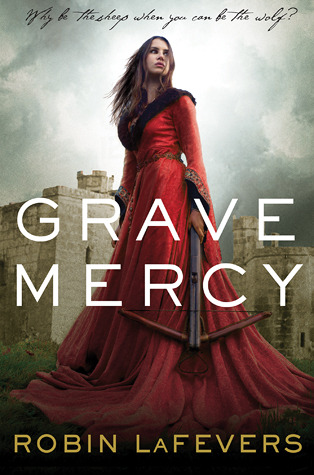
#CBR6 Book 75: "Grave Mercy" by Robin LaFevers

Page count: 549 pages
Rating: 3.5 stars

Ismae's mother went to a herb witch to expel her from the womb, but Ismae survived. The poison marked her with red all the way down her side, and proved to the community that she is one of Death's daughters. When her abusive father marries her to the local pig farmer, she is convinced he's going to beat her to death once he discovers her dark secret. But the itinerant priest who performed the service spirits her away with the help of the local herb witch and she ends up at the convent of St. Mortain, who used to be worshipped as the God of Death himself. At the convent, she learns that she has a number of gifts, including a complete immunity to poison and an advanced healing ability. She's offered sanctuary at the convent, if she agrees to be a handmaiden of Death - an assassin working for the old gods of Brittany.

Ismae, who has never known a kind word or touch from anyone in her life, doesn't take long to agree. She is trained in all manner of deadly arts, and by the time she is seventeen, she is ready to complete her training. She isn't too happy with her graduating assignment, though, having to pose as the mistress of Gavriel Duval, half-brother to the Duchess of Brittany and her most trusted advisor. The Abbess of St. Mortain and the Duchess' Grand Chancellor know that there is at least one traitor at court, trying to deliver Brittany and its young Duchess to the French, and they'd like nothing more than for Ismae to prove that Duval is said traitor.

To begin with, Duval and Ismae can barely stand each other. He feels that she trusts too blindly in the orders she receives, she thinks that he is arrogant and conceited and has no wish to be dependent on any man, even as a ruse. Of course the two grow closer, and it becomes readily apparent that Ismae is going to have to learn to trust her instincts and intuition, not just the orders her convent sends her.

A young adult book set in Medieval Brittany, about assassin nuns, with romantic elements, seemed to be right up my alley. I do, after all, have a degree in European Medieaval history, and I love all things YA and romantic. And who doesn't like a good assassin story? There's a lot of potential in this book, but it's too long, and far too much time is spent on things that weren't all that interesting. The story could absolutely have been tighter and more action-packed.

Pretty much all of the training Ismae goes through at the convent is conveniently skipped, and then far too many chapters are spent on her getting settled at court. I have to agree with Duval that she is far too innocent and trusting in her superiors, but that's not really surprising in a farm girl elevated to assassin nun. I doubt any convent is big on training their acolytes in independent thought, critical thinking and questioning their elders. Young women who are sent out to assassinate on behalf of the old gods are not the sort of people you want branching out on their own and going independent. Certainly not if they're immune to poison, like Ismae is. Still, she was a bit dense at times, and it got on my nerves.

The romance springs a bit out of nowhere. Ismae is falling in love with Duval before she's really even spent all that much time with him. As it turns out, he's a pretty great guy, loyal to his young sister and willing to risk his life to make sure she finds happiness in a good marriage and doesn't have her duchy invaded by the French. But Ismae is already madly in love with him by the time we find out all these things.

It was pretty obvious to me who the traitor was long before it was revealed, and the deus ex ending that means Ismae might be looking at her HEA was a bit too convenient for my tastes. Too much of this book was boring day to day court life, and too little of it was assassination, romance and intrigue. Still, I have heard that the sequel is better, so I will probably keep going. After all, medieaval assassin nuns, right?

Thursday, 3 October 2013

#CBR5 Book 122. "Scoundrel's Kiss" by Carrie Lofty

Page count: 342 pages
Rating: 3 stars

Gavriel de Marqueda is trying to put his old life as enforcer, thug and hired killer for his ungrateful family. He's sought refuge with a monastic order, swearing vows of chastity, obedience and non-violence. He only needs to succeed in one last task to be accepted as a full member of the order. However, the test he is set might prove to make him break every one of his new vows.

Ada of Keyworth is far away from her English home. She's risking her position as translator to an influential Spanish noblewoman because of her all-consuming craving for opium. When Ada is about to be sold into slavery because of her debts, her young friend begs Gavriel and the other monastic brothers to save her. Gavriel's final task will be to wean Ada off her addiction. Ada resents him immensely, and is determined to escape his care. She also determines to ruin any chance he has of becoming a monk.

Set in 13th Century Spain during the Reconquista (the re-conquering of Spain from the Muslims), Scoundrel's Kiss has a vastly different setting from most romances out there on the market. Instead of Regency ballrooms during the Season, this book takes place mostly in the countryside and small towns of  Medieaval Spain. The heroine has a genuine and debilitating addiction which she's willing to do almost anything to feed, not caring whether it affects her work, her reputation or what it does to her friends. Any time she goes without for any period of time, she has horrible nightmares and suffers dreadful withdrawal. It's a weakness and a character flaw, but Lofty makes you see that there was little she could do to avoid the addiction, having started to take the opium for pain after being held captive and tortured. It also makes her determination never to be held against her will more understandable.

Unfortunately, while the above things were good and different, I didn't really emotionally engage with the book all that much. While Ada's character was somewhat unusual, and fairly well drawn, most of the supporting characters, to a certain extent Gavriel as well, remained more like ciphers. The villains, especially, were rather cartoonish, and both their motivations and their plotting towards the end of the book caused more confusion than tension. I also thought the romance developed in a rather haphazard way. Obviously, in the beginning Gavriel fights very hard to resist Ada, who in return is determined to tempt him into sin, first out of spite and later out of genuine attraction. His decision to abandon his sworn vows comes very suddenly, and seems a bit arbitrary, frankly. So despite the interesting premise and attempts at doing something different in the genre, this book really didn't work for me, and will probably be quickly forgotten.