Showing posts with label middle grade. Show all posts

Sunday, 22 February 2026

CBR18 Book 9: "How to Train Your Dragon" by Cressida Cowell

Page count: 241 pages
Rating: 4 stars

Read the Rainbow - Red

Hiccup Horrendous Haddock III may be the least intimidating Viking in several generations, which is a bit of a problem, since he's the son of the Chief, and therefore meant to lead the Hairy Hooligans when he gets older. He's skinny, puny, bookish and not even slightly intimidating, and when he has to compete in the traditional manhood trial of the tribe, and sneak into a cave to capture himself a dragon, he ends up with the smallest, least impressive dragon of the lot. Hiccup should have an advantage over the other youths when it comes to taming and getting a dragon to do his bidding - he can speak Dragonese. He can't really tell anyone about that, of course, since Dragonese has been forbidden in the Hairy Hooligans for over a hundred years. Also, Hiccup's dragon, Toothless, is stubborn and selfish and couldn't care less about listening to Hiccup.

When the day of the dragon trials finally arrives, a massive fight breaks out among all the recently tamed dragons, and in an unprecedented event, all the youths of the tribe (and their rivals) are supposed to be banished to the wilderness. However, before that can happen, the tribes are faced with a new, much bigger challenge - a very large, very hungry sea dragon has awoken and now wants to eat all the humans. How are they going to defeat something so enormous and dangerous?

I was already at university when these books came out, and I have only watched the first two movies, which are clearly VERY loosely based on this source material. So loosely that pretty much the only thing they've kept is the names of Hiccup and his dragon Toothless (who is not black, super rare and very playful), and maybe some of the vikings in the tribe. So, at least I didn't have anything spoiled for me when I picked this up to read it for a bonus book club meeting we had about dragon riders. Of course, while Hiccup discovers that it's possible to ride dragons in the first movie, nothing like that happens in the book. They mostly use the dragons to intimidate each other and to catch fish. 

Nevertheless, it was a fun book, and I think my eight-year-old son would probably enjoy it. I will probably read it to him at some point in the next year, after the husband and I are done reading him children's classics from our own childhoods. I don't see myself continuing the series for my own sake, but if the kid enjoys them, I will probably read more of them. They are short, action-packed and feature dragons? What's not to love?

Judging a book by its cover: This is a children's book, so I would have thought you'd want something more colourful and exciting to catch the eye of the potential reader. Red, red, maroon and gold is certainly a choice, but I'm not sure I would have grabbed this off a library shelf if I hadn't already known what the book was about. Hiccup also looks nothing like he's described in the book. 

Crossposted on Cannonball Read 

Friday, 20 February 2026

CBR18 Book 5: "Kraft & Mod (Courage)" by Trine J. Cederlöf

Page count: 163 pages
Rating: 4.5 stars

Nowhere Book Bingo 26: A Middle Grade Book
Defeat the Goblin TBR: The Shiny book (added in December 2024)
Reading Rainbow - Green cover

Disclaimer! The author is a friend of mine, but my opinions are my own, and I bought the book with my own money (because friends make sure friends get royalties). 

As part of the peace agreement between the Green Shores and the Blue Mountains, Prince Mirounga (called Miro), nephew and heir to the king of the Green Shores, is sent into fosterage to the Blue Mountains. He is still grieving his father, an admiral who died in the war between the countries, but understands that spending a year working as a squire at the court will foster new diplomatic ties between the countries, as well as teach him important skills he will need when he becomes king in the future. 

The Red Sands was another country defeated by the Blue Mountains in the war, and it has also sent a young man to train with the royal guard. Tarek is the younger brother of the sultan, and he's clearly not intending to befriend any of the other recruits. He mostly keeps to the stables, more comfortable around the horses than people his own age. 

The two young men are pretty much exact opposites. Miro is almost as tall, wide and strong as an adult, but painfully shy, while Tarek is slender, agile and very flexible. During the second part of their training, the recruits are all supposed to be stationed in the snowy borderlands near the Black Mountains. There are multiple complications, which mean that all the recruits, even Miro and Tarek, need to learn to work together, or lives could be lost. 

In 2014, my friend Trine wrote a book, Crippled, retelling an old Danish fairy tale. Now she has written a sequel, set in the same fantasy universe, but focused on different characters. The boys who grew up over the course of Crippled are now the King and the General of The Blue Mountains, having fought and won a difficult war. King Vincent has a wife, a daughter and another child on the way. After the war, it is time for diplomacy, and the countries that lost both have to send a young man to apprentice in the Royal Guard for a year. 

This book doesn't retell any particular folk tale, but is a coming-of-age tale for the very different young men and how they find the friendship, belonging and well, the courage, to be who they were always meant to be. The story is in parts funny, adventurous, thrilling and moving. At more than one point in the story, especially towards the end of the book, I teared up and sniffled a little, because the writing hit me straight in my feels. I liked the first book, but I liked this one even better, probably because of the emotional beats. I just wish the stories were longer. 

Because I am lucky enough to have insider knowledge, I know for a fact that my friend is working on the third book in series, set in The Red Sands, involving the eldest princess of The Blue Mountains (who, it is hinted at having some unusual abilities) and the only princess of The Red Sands. So after two books where boys are the protagonists, we get to see the story of some young ladies, who build a friendship while solving mysteries together. I'm very excited. 

Judging a book by its cover: The first book in the series involved princes from the Blue Mountains, and the book cover was a lovely sky blue. One of the protagonists from this book is from the Green Coasts, and as a result, the cover is green. 

Crossposted on Cannonball Read. 

Sunday, 9 November 2025

CBR17 Book 67: "Nevermoor: The Trials of Morrigan Crow" by Jessica Townsend

Page count: 480 pages
Rating: 4.5 stars

Nowhere Bingo 25: A middle-grade book
CBR17 Bingo: N (a book starting with the letter N)

Morrigan Crow is a cursed child, born on Eventide (think New Year's Eve, but unlucky) and as such, is due to die at midnight on her 11th birthday. She keeps being blamed for everything bad that happens in her surroundings and spends a lot of time writing apology notes. 

However, before she can meet her doom, a mysterious stranger called Jupiter North appears and takes her away, chased by shadowy monsters hunting them, to a different world (or alternate dimension) and a city called Nevermoor. Now, Morrigan gets to live in the magical hotel that Jupiter runs, and starts making friends for the first time in her life. Jupiter intends for Morrigan to join the Wundrous Society, where he is also a prominent member. But to be accepted, she has to compete in four different and very challenging trials over the course of the year, and the final one consists of showing off one's extraordinary talent. Everyone keeps telling her that her talent will be revealed in due course, but Morrigan is pretty sure that being cursed is not what the leaders of the Society are looking for. 

To complicate matters further, it turns out that Jupiter has illegally smuggled Morrigan into Nevermoor, and if she doesn't pass the trials and get accepted into the Wundrous Society, she'll be returned to her own world, just in time for her previously scheduled midnight death. 

This is the sort of book that I'm pretty sure my son will really enjoy in a few years, when I either read it to him or he picks it up for himself (he currently loves reading comics, like the Dogman books or Moon Girl and Devil Dinosaur). Morrigan, who is pale and constantly wears black, even when everyone else is in riotous colours around her, feels very inspired by Wednesday Addams, but she has a more cheerful disposition, and doesn't seem to actively resent making friends. 

Nevermoor is a very intriguing fantasy world, and there are lots of strange, magical things, including sentient talking animals and chandeliers that grow from the ceilings. For a child who has never really known any kind of warmth or affection, it's a big adjustment for Morrigan to live in a place where people seem to care about what her wants and wishes are and treat her with kindness and curiosity. Jupiter is very nice to her, but he is secretive, and also extremely busy, and has to be away a lot. He has a nephew, Jack, who stays at the hotel during the holidays, and he and Morrigan do not get along. There are hundreds of children taking part in the first trial for the Wundrous Society, but about half get eliminated with each new challenge. While Morrigan makes a very good friend, there are also some mean girls who would like nothing more than to see her fail and be forcibly evicted back to her own world. 

Since the series has been out for quite a few years now, I think I've acquired at least the first three in e-book sales, so they're just waiting for me on my TBR. I'm sure it will come as no surprise to anyone that by the end of the book, Morrigan discovers that there are good reasons why Jupiter decided to rescue her from certain death, and she has an interesting future ahead of her. I'm looking forward to seeing where the series goes next. 

Crossposted on Cannonball Read. 

Monday, 12 August 2024

CBR16 Book 46: "Kong Krøbling" (Crippled) by Trine J. Cederløf

Page count: 145 pages
Rating: 4 stars

Nowhere Book Bingo: Disability rep

Disclaimer! The author is a friend of mine, but I paid for my own copy of the book and my opinions are my own. (Hope she'll still be speaking to me after she reads this).

In the fairy tale kingdom of The Blue Mountains, the king and queen try for many years, but the queen fails to have any living children. She encounters a witch who calls herself the Queen of Bees, who offers her a solution to her difficulties. Giving her a seed, which she must water with her tears, a plant will grow, with two flowers - one will give her a boy, the other a girl. The king and queen are desperate, so the queen eats both, and nine months later, two boys are born. The first is small and misshapen, with eyes in two different colours. The second baby is perfectly formed. The staff are worried when the firstborn, the heir, is born with physical disabilities, but the royal couple are equally delighted with both their boys. They name the eldest Vincent and his twin Niklas.

The twins grow up being treated exactly the same, and are pretty much inseperable. Vincent has to use a wheelchair, but excels in the lessons their tutor assigns them. His brother, who is handsome and healthy, struggles with understanding all the reading they are assigned. He manages to teach Vincent to swim and ride, because these are abilities important for a prince to know. Vincent helps Niklas realise that he's by no means stupid, he just has reading difficulties, so Vincent sums up their lessons to him with visual aids and helps him do his written homework. It takes their parents and tutor years to figure out their scheming, but once they do, the conclusion is that Niklas has dyslexia, and their parents realise the princes are probably old enough to go to school with other children, which means the boys start to make friends. Vincent is the more introverted and bookish one, Niklas is extroverted and excels at anything physical. Once they get older, Vincent goes to university, while Niklas joins the royal guard.

Then their mother announces that they are old enough to get married. Both princes need wives and heirs, and so they need to visit with princesses from nearby kingdoms to see whether they suit. While Vincent is well-loved and popular in his own kingdom, his visible disablilities create difficulties once the queen starts matchmaking. It turns out his perfect match is closer to home than he realised. 

This story is a retelling of a very well-known Danish fairytale called King Lindworm. Growing up, I loved mythology and folklore, and have read fairy stories from a lot of different countries. The story seemed vaguely familiar to me, but having read a summary of the original, this is not really a story that's very popular in Norway or Sweden. It also means that this book introduced me to a new (and kind of weird) fairytale, as well as a very entertaining middle grade book.

While this is aimed at a younger audience, as all the best books for children, it doesn't underestimate them or talk down to them. A number of serious issues are touched upon, such as infertility (this led to a very interesting discussion during our book club chat about this book), physical disabilities and dyslexia. At no point are the boys bullied or mistreated in their own kingdom by teachers or peers. The twins have a really close relationship, and while it's mentioned that they fight a lot as children, they always present a united front against others. Without Niklas, Vincent would not have challenged himself physically, and would have been much more limited by his disabilites. Without Vincent, Niklas would have convinced himself he was stupid and useless, and good only for grunt work. There are also several examples of openly queer characters, so while this is set in a sort of vagely 18th Century time period, there is no discrimination or prejudice (in The Blue Mountains, at least). 

While I try to challenge myself to read in Swedish a couple of times a year, so I don't forget how to, this is the first time in a very long time I had to read a whole book in Danish. To non-Scandinavians, Norwegian, Swedish and Danish would not appear to be very different from one another, and the most commonly used form of written Norwegian is directly derived from Danish. A lot of the language is therefore not that challenging, but every so often, there will be a word or expression in Danish that means something entirely different in Norwegian, and it took me out of the story for a moment. Thankfully, the book has a fun and engaging plot which moves at a nice pace, and once I actually set down and concentrated, it didn't take me long to finish the book.

To me, the opening difficulty with infertility obviously affected me greatly. Among the topics we discussed about this book is how many stories in myth and folklore involve parents who struggle to concieve or have living children, and how common infertility difficulties are, yet very rarely talked about. My little boy is the result of several long gruelling years of IVF treatment, and I feel very lucky to never have suffered a miscarriage during my many years of trying. If medical science wasn't advanced enough, would I have made a deal with a mysterious old woman in the hopes of having a baby? I suspect I would. 

Because this is the first book in a planned series, the author already has several other books in development, all focusing on different kingdoms in this fictional world. We get a glimpse of some of the neighbouring kingdoms, and one of our major complaints when discussing the book with the author was the lack of a map. The book should absolutely have included a map at the beginning (so Trine sat down and drew one for us during the meeting). Having heard her talk about her ideas for future books, and some of her influences for the various kingdoms and peoples, I cannot wait to get my hands on more of her stories.

So why only four stars? I wanted more! This story was great, but I wanted more time with these engaging characters, and I would especially have liked to know more about the Queen of Bees. 

Judging a book by its cover: I really love the simplicity of this cover, with the wheelchair which plays such an important part of the plot (and Vincent's life) front and centre. The various shades of blue are also lovely, no doubt picked because the book takes place in the fictional country of The Blue Mountains. 

Crossposted on Cannonball Read.

Tuesday, 17 October 2023

CBR15 Book 61: "Class Act" by Jerry Craft

Page count: 249 pages
Rating: 4 stars

Drew Ellis goes to the prestigious Riverdale Academy Day School, but unlike a lot of his more privileged classmates, he feels like he has to work way harder and he still might not get the same opportunities that they do. While a lot of his fellow students live in enormous mansions, Drew lives alone with his grandmother (who has to work almost constantly to provide for him). He also knows that no matter how good his grades are or which school he attends, most people are only going to see the colour of his skin. Of course, his friends Jordan and Liam have their own problems to deal with.

This is a companion novel to New Kid, which I haven't read. The good news is that you don't need to have read that book to enjoy this one, but I suspect I would have gotten even more out of this if I'd also read the first book in the series.

For our Cannonball Book Club in October, we continued last year's success of banned books, this time focusing on graphic novels. I had already read the other two we selected, This One Summer by Mariko and Jillian Tamaki and Gender Queer by Maia Kokabe, so this was the only one left for me to read. Thankfully the Oslo public library had a copy, so I was able to read it before our online discussion and Zoom meeting.

This is very highly rated on Goodreads, and I liked it a lot. I'm very much not the intended target audience, and had I been younger, I might have rated it even higher. As always when we read banned books, I am utterly baffled as to why anyone would think this was a bad thing for young people to read. This shows a very nuanced portrayal of several young individuals from very different family backgrounds and how they all, even when they might seem to have no worries, might not have perfect lives. What a terrible thing for tweens to read, apparently.

Judging a book by its cover: Craft is an excellent artist, and shows inside the comic that he's capable of drawing in a number of styles. I really like the playful cover, with some of the characters being juggled, along with the demands and responsibilities Drew faces daily. 

Crossposted on Cannonball Read

Saturday, 22 October 2022

CBR14 Book 29: "Ti kniver i hjertet" (Ten knives in the heart) av Nora Dåsnes

Page count: 250 pages
Rating: 3.5 stars

Tuva is about to start seventh grade (age 11-12 here in Norway) and is very much looking forward to seeing her best friends Linnea and Bao and catching up after a long summer apart. She shares all of her hopes and fears writing and drawing in her diary. 

When she gets back to school, however, nothing is as she was expecting. Linnea has a boyfriend now, and doesn't really want to hang out, playing in their secret treehouse in the woods. She just wants to talk about boys, and lipgloss and tries to make Tuva figure out who her type is. Bao wants nothing to do with all the talk about boys and girly stuff, and soon Tuva is torn between her two best friends.

Tuva isn't all that interested in boys or makeup, she still likes listening to music and playing in the woods and spending time with Bao. But she's also rather dazzled by Linnea's pretty older sister, who has an Instagram account and wants to be an influencer. In the really rather difficult phase between being a child and a young adult, Tuva is easily swayed by ideas of how a girl should behave, who and what she should like. She doesn't want to have to pick sides when her two friends seem to have diametrically opposite viewpoints. Then a new girl starts in her class, and Tuva begins to feel some of the stuff Linnea has been going on about - but can a girl really be "her type"?

While there is a hint of queer romance in this story, the main themes are the difficult friendships between girls and the very confusing process of coming of age, when you're no longer exactly a carefree child, when hormones make you confused and you're not quite old enough to be a teenager either. This is Nora Dåsnes' debut graphic novel, aimed at at a younger audience than her YA graphic novel Ubesvart Anrop. The themes here are less heavy than the collective grief of a nation, survivor guilt and depression, but they are still important for young readers to face head-on. 

As a teacher in secondary school, I teach kids in 8th to 10th grade. They come to our school when they are 12 or 13 years old, and many are still very immature and rather childish. By the time they graduate at the end of 10th grade, they are 15 or 16 and have gone through massive changes, both physically and emotionally. It's both a fascinating and deeply frustrating age to be responsible for their learning. While these girls are a year younger than the kids I teach, it's really not just a myth that a lot of girls mature faster than boys (by no means all, but in many cases). So it seems realistic that this sort of identity crisis between who one is and who one is going to become might happen earlier for a lot of girls. 

I thought this was a stand-alone story, but it turns out that Dåsnes had been working on a sequel for a while now, showing the further adventures of the three girls. In the new book, which was released only a few weeks ago, Bao gets involved in school politics to save the river and woods behind the school, so it sounds like one of the major themes is environmentalism. It's nice to know that someone is making engaging and well-told stories for middle graders. I hope that Dåsnes has a long and successful career ahead of her.

Judging a book by its cover: I like Dåsnes' art and the cover gives a good idea of what it looks like. It's a cute cover with inviting colours. 

Crossposted on Cannonball Read. 


Tuesday, 5 July 2022

CBR14 Book 13: "The Beast and the Bethany" by Jack Meggitt-Phillips

Page count: 256 pages
Rating: 4 stars
 
Ebenezer Tweezer is 511 years old, but you'd never know it to look at him. He lives in a great big house, surrounded by exciting treasures and artifacts and all of this is possible because of the hideous beast he keep in his attic. In return for Ebenezer feading it interesting things, the Beast gives him potions once a year that keep Ebenezer young and beautiful. It's also given him all the special things in his house. However, the Beast is greedy and grows more demanding with each passing year. It only wants to eat things it's never tried before, which in 511 years you can imagine isn't that long a list. The Beast has decided that it wants to eat a nice, juicy child, which may be a line not even Ebenezer will cross.
 
Of course, if the Beast withholds Ebenezer's potions, he'll start aging at a rapid pace, and after a day or two of feeling the effects of age creeping up on him, Ebenezer starts pondering solutions. If he were to feed a really bad child to the Beast, would that really be such a terrible thing? At first, Ebenezer tries to steal a child from the zoo, but all the children there seem terribly well protected by parents. Then he's told about the local orphanage and goes there to find a child that will do instead. However, Ebenezer isn't expecting to get so charmed by so many of the children. Then he encounters Bethany, a very surly and unpleasant little girl, and she seems to be the solution to all of his problems. Then, when Bethany actually meets the Beast, she insults it so gravely it almost refuses to even consider eating her, which would very much be counter to Ebenezer's plans.
 
He decides to take Bethany away and try to fatten her up a bit (she's terribly skinny), while also trying to persuade the Beast that Bethany is in fact exactly the sort of plump and succulent child it has demanded. Completely contrary to Ebenezer's plans, however, is how he starts to warm to her and see actual improvement in her behaviour after a few days together. The longer the two spend together, the more like friends they become, and soon, Ebenezer can no longer live with the idea of feeding Bethany to the Beast. He is aging rather rapidly, though, and the Beast really doesn't like to be told it can't have what it wants. It's up to Bethina to come up with a solution that gets rid of the Beast once and for all, so she and Ebenezer can live happily ever after.

This is delightful middle grade book which I very much look forward to my own son reading at some point in the future. I suspect readers of Roald Dahl, A Series of Unfortunate Events or fans of Despicable Me would find it very entertaining. The book is illustrated throughout with beautiful and very funny pictures by Isabelle Folath, and it was a very quick read in a month when I otherwise managed to complete very few books. I know that there is now a sequel, so I suppose I should see if my local library has a copy. I wouldn't mind spending some more time with Bethany and Ebenezer. 

Judging a book by its cover: I pretty much adore this cover. The almost neon green to draw your eye in (on my copy, the endpapers are sprayed the same lurid colour!), the fang-tastic maw and the no-nonsense little girl in the middle. I wanted to read this the first time I saw it on a library shelf.
 
Crossposted on Cannonball Read.  

Sunday, 8 August 2021

#CBR13 Book 27: "Ghost Squad" by Claribel A. Ortega

Page count: 288 pages
Audio book length: 5 hrs 31 mins
Rating: 4 stars

Lucely (pronounced Lu-sell-i, at least by the audio book narrator) Luna may be living alone with her father (her mother left them when Lucely was little) but due to an unusual family legacy, she's able to see the presence of all the family's departed members. Her father, who once had the gift, can only see them as fireflies but accepts that they're there and cooks massive meals to provide for all the extended members who keep Lucely company. The family spirits are all tied to the large tree in the family's backyard, so when a member of the bank comes and announces that if Lucely's dad can't cover his mortgage payments any longer, the family will be evicted, it doesn't just mean potential homelessness for Luna and her dad, but they'll be separated from the family spirits forever. 

Lucely really needs to figure out a way for her father's failing ghost tour business to get more customers and she and her best friend Syd are trying to wrack their brains. Halloween is coming up, and something sinister is brewing in the little town of St. Augustine, where they live. Lucely's grandmother delivers a very ominous warning to her granddaughter and then seems to fade away, her firefly lazy and lethargic. Lucely and Syd rummage through the secret collection of Syd's very alive and formidable grandmother, Babette (rumoured to be an actual witch). They find a spell that they hope will make Lucely's grandmother come back, but it turns out to be something a lot more sinister, and soon the girls are forced to come clean to Babette and enlist her help, and that of her cat Chunk, to reverse the spell and send the malevolent ghosts back where they came from - otherwise the town will be overrun on Halloween.

One of my goals for my seven-week-long summer vacation was that I was going to get on top of my massive review backlog. Now, here we are, with me starting work again tomorrow morning, reviewing books I read in the middle of May. I'm generally trying really hard to focus on the many things my husband and I have achieved during the holiday, while also both struggling with depression, corona-induced cabin fever, and the challenge of constantly entertaining and responsibly raising a boisterous three-year-old. So, not couning this one, there are still fifteen reviews left for me to do before I catch up. My memory of the finer plot points of this middle grade adventure novel, which I read as part of the CBR Book Club this spring, Young at Heart. 

I'm obviously not the main target audience for this book, but every time I read children's or middle grade books, I am struck by how much more diverse and imaginative they are than most of the ones I remember from my own adolescence. The official book description for this book tries to sell it as a sort of mix of Coco meets Ghostbusters, which as is often the case with these quick pitches is at least halfway misleading. There are a lot of Latinx family vibes in the story, absolutely, and there is absolutely a supernatural element, but the Ghostbusters side of the pitch is more accurate, if those busting the ghosts are two determined girls, an over-weight cat and a grandmother with a lot of arcane knowledge.

Family is a huge focus in the story. The Lunas may only have two living members, but the various ghost relatives who show up to support Lucely in different ways (even willing to risk their afterlife to fight bad ghosts with her) are great. We don't see much of her overworked father, but he clearly cares a lot about her. There's also the family you choose, Lucely's best friend Syd, and Babette, who not only has a house full of cats (all named for characters from The Goonies), but also may or may not be an actual dyed in the wool witch.

This book was fast-paced, adventurous and suitably creepy, I'm sure I would absolutely have adored it if I read it in my tweens. Almarie Guerra does a very good job with the narration, and I shall keep a look-out for her on future audio books.

Judging a book by its cover: I don't have a lot to say about this, except I love the art style and the depiction of the girls, not to mention Chunk, in all their (don't remember what gender the cat is) overweight glory. 

Crossposted on Cannonball Read. 

Friday, 28 February 2020

#CBR12 Book 9: "Wonder" by R.J. Palacio

Page count: 410 pages
Rating: 3.5 stars

Official book description:
August Pullman wants to be an ordinary ten-year-old. He does ordinary things. He eats ice cream. He plays on his Xbox. He feels ordinary - inside.

But Auggie is far from ordinary. Ordinary kids don't make other ordinary kids run away screaming in playgrounds. Ordinary kids don't get stared at wherever they go.

Born with a terrible facial abnormality, Auggie has been home-schooled by his parents his whole life, in an attempt to protect him from the cruelty of the outside world. Now, for the first time, he's being sent to a real school - and he's dreading it. All he wants is to be accepted - but can he convince his new classmates that he's just like them, underneath it all?

This book has been on my TBR list for years and years, but this semester, we're teaching the book in 9th grade English, and I can't very well teach the kids a book I haven't read myself. So I spent a pleasant weekend in January reading it, and can see why it's gained such popularity and critical acclaim. It's a book that deals with a lot of important subjects, like living with a deformity, both personally or as a family member, bullying, friendship, loneliness and otherness. While August is the main character of the book and the first POV character we meet, there are also sections where other people who interact with him, his sister Via (Olivia), her boyfriend Justin, Auggie's friends Jack and Summer. We get to see not only how Auggie perceives the world and the way people treat him and interact with him, but also how it affects those around him.

This is a middle-grade book, so it's not like the characterisations of all the various people we meet are terribly deep, nuanced and subtle. While a lot of difficult topics are covered, I find I have to agree with some of the reviews I've seen, that point out that some of the ways in which the book approaches serious matters is a bit simplistic and not necessarily as nuanced as one might have wished. Because the POV characters are children, some of their thoughts and observations are a bit naive.

I watched the movie adaptation of this on a plane a while back now, can't remember exactly when, and was pleasantly surprised to discover that the Pullman family in the book is a lot more diverse than the movie's casting suggests. Julia Roberts is a good actress, but she doesn't exactly look Brazilian. One thing I really liked about the movie, which I was surprised to discover isn't in the book, is the focus on August's mother, who has put much of her life on hold to take care of her son in between his many surgeries, and homeschooling him until he's old enough to finally start going to a real school. In the movie, she starts working on her degree again and seems to re-visit her old career as a children's book illustrator, while in the book, it's unclear what she does with her time once August goes to school. Apart from worrying about her children (and Via mostly feels ignored by her), she doesn't seem to have much of a role, which is a bit sad.

I always try to read the source material before watching the TV or movie adaptation, but in this case, I watched the movie first. As far as I could tell, the movie (despite its somewhat white-washed casting) does a good job of adapting the book, and as I mentioned before, make some interesting changes that give at least Auggie's mother more of a presence and personality. Once the kids have actually managed to complete their reading, we'll probably watch the movie again. It will be interesting to see what I think about it then.

All in all, I would say this is a good book, and it works very well as something to use in school, as there are so many subjects that are relevant to the pupils' lives that we can discuss. I think it's a good book, if not necessarily great. 

Judging a book by its cover: I'm really not a huge fan of the rather abstract cover for this book. One of the reasons it took me so many years to actually read this book is that I thought the cover looked rather bland and non-descript. There was nothing there to excite me. I get that portraying Auggie's face was going to be almost impossible, but this is one of the rare instances where I almost prefer the movie tie-in cover, which has the little boy playing August wearing the big space helmet and covering up his tragically deformed face.

Crossposted on Cannonball Read.

Saturday, 26 October 2019

#CBR11 Book 76: "Sangen om en brukket nese (The Ballad of a Broken Nose)" by Arne Svingen

Page count: 207 pages
Rating: 4.5 stars

Bart is about to turn thirteen. He's named after Bart Simpson, because it seems his mother wanted him to be tough and clever and able to handle himself. This is also why she's signed him up for boxing lessons. He dutifully  goes to practise several times a week, and one of these days, he may actually start hitting. His boxing coach suggests he may want to try out for some other sport, which Bart can understand, as except for having a pretty good guard, Bart is pretty dreadful at boxing. He refuses to give up, however.

What Bart is actually rather excellent at is opera singing. The downside is that he can only sing well without an audience. This means he mostly sings locked in his tiny bathroom, since Bart lives alone with his morbidly obese, mostly unemployed mother (who is clearly an alcoholic) in a tiny one-room flat, where privacy isn't easy to come by. Bart and his mother live in an old building where the hallway floors are covered in old rubbish, broken syringes and other unpleasant things that make it very clear that Bart can never actually make any close friends, because God forbid one of them ever wanted to come round to his after school one day. He's not exactly a bullying victim, but pretty firmly on one of the lower rungs of the social ladder.

Bart's life takes a turn for the more dramatic when Ada, the pretty, popular and persistent girl he sits next to at school (it's not that she likes Bart THAT way, she has a boyfriend in another town, besides, she's so well-liked and popular their differing social statuses pretty much span a galaxy) figures out that not only does Bart enjoy listening to opera, but he sings it as well. Since he's unable to sing in front of others, he makes her a recording, but forgets to make her promise not to share it with anyone else. It turns out that Ada is pretty bad at keeping secrets. First, she shares the recording with the entire class, and Bart's enthusiastic teacher won't stop nagging until he agrees to perform at the end of year school performance. Then, she unexpectedly shows up on his doorstep and stays for dinner. Sadly, the next day, most of the school knows that Bart lives in a terrible wreck of a building and his mother is an overweight shut-in.

Then, on the very day he turns thirteen, Bart wakes to find his grandmother bearing sad news. His mother, who went out the evening before, has been hospitalised and needs an operation to get better. His grandmother will have to stay with him until his mother recovers. It's at this point Bart break down and tells his grandmother the truth (which she's been pretty aware of for a long time) about his rather dismal living situation, and having unburdened himself, immediately feels like things might actually start looking up. Ada keeps wanting to spend time with him, trying to figure out ways to help him overcome his stage fright (including managing to sneak him into the hotel room of his music idol, Bryn Terfel, when the opera singer is in Oslo about to perform). Bart may even have managed to track down the man who might be his father, after all these years.

This is a book my colleagues and I decided to read out loud to our eighth graders this term. I have read other books by Arne Svingen, a hugely popular YA and middle grade Norwegian author before, but this book is by far my favourite. It's impossible not to love Bart fiercely, because he stays so achingly optimistic despite all the sad and horrible things in life. His mother is dangerously obese, clearly partially disabled, barely works and comes home drunk several nights a week. They live in a tiny, crowded one-room flat in a building full of junkies and society low lifes. He makes very sure to keep everyone at school at a safe distance, desperate to hide his dismal home situation.

Bart and his mother constantly lie to his grandmother about the true state of affairs, claiming his mother has a steady job and healthy finances. His mother refuses to take any handouts from the grandmother. Opera singing is his secret escape, but after just a few weeks of getting closer to Ada, all his secrets are out in the open and unless he overcomes his stage fright and puts on the performance of a life time at the school performance, he'll go from anonymous nobody on the fringes of the school yard to favoured bullying victim for the whole school.

Bart spends much of his free time searching the web for the father he never met. Unfortunately, all his mother would tell him is that the man is called John Jones, and that he's an American. It's obvious that his parents didn't spend long together, and naturally, there are a LOT of search results for such a common name. However, Bart steadfastly keeps searching, occasionally sending off e-mail enquiries in the hopes that THIS time, he's found the right man, the John Jones who is missing his Norwegian teenage son.

As someone who grew up with an alcoholic father (who thankfully gave up drinking more than 30 years ago now), parts of this book hit very close to home for me, and I had to actually read the last few pages of the book to assure myself that everything was going to turn out well in the end. Very perceptively, one of my students observed yesterday, when I was asking them how they thought the story would continue and end (we're now about halfway through), that the book has to end on a happy note, because what we've read so far, has been really rather sad and bittersweet and the story won't work unless things turn around and get better for Bart in the second half of the story. While I have read the whole book, my class as of yet have not, and I thought that was a very mature (and entirely correct) observation, which shows this kid has a very good grasp of how narratives are structured. I'm honestly not sure I was as insightful a reader (or in his case, listener) when I was in my early teens.

All the way throughout reading this book, I kept comparing it to About a Boy by Nick Hornby. I remember being surprised at how much darker and more serious the book was to the delightful movie adaptation. Bart, unlike the Marcus of the book (and film) doesn't befriend someone as cool as Will (Hugh Grant's character), although he does strike up a friendship with one of the heroin addicts who live in his building, and who mobilises many of the fellow residents to show up and take part in a day of volunteering to clean up the hallways and back yard of the building in honour of Bart's birthday. They even get him a bike (with the serial number neatly filed away) and a brand new bike lock they actually paid money for(!). It's not exactly the same as the expensive trainers Will gifts Marcus, but in many ways, a lot more touching.

I'm so glad we decided to read this to the students this term, and I'm also happy that my class seems to mostly be enjoying the book as much as I do. This book has now been translated into a number of different languages and has been nominated for multiple awards, both in Norway and internationally. So if you're looking for a quirky, bittersweet and very heartwarming read, I can very much recommend this one.

Judging a book by its cover: This book comes with several different covers, but this is the one we use on one of the editions we're reading to the pupils in y school, and thus seemed appropriate. The boxing gloves and the microphone are both very relevant to the plot, and nothing on the cover gives too much away about the story.

Crossposted on Cannonball Read.

Monday, 22 July 2019

#CBR11 Book 45: "Where the Mountain Meets the Moon" by Grace Lin

Page count: 260 pages
Rating: 4 stars

#CBR11 Bingo: Far and Away (book set in fantasy version of historical China)

Official book description:
In the valley of Fruitless mountain, a young girl named Minli lives in a ramshackle hut with her parents. In the evenings, her father regales her with old folktales of the Jade Dragon and the Old Man on the Moon, who knows the answers to all of life's questions. Inspired by these stories, Minli sets off on an extraordinary journey to find the Old Man on the Moon to ask him how she can change her family's fortune. She encounters an assorted cast of characters and magical creatures along the way, including a dragon who accompanies her on her quest for the ultimate answer. 

This is an utterly lovely middle grade fantasy book, inspired by a lot of the Chinese folklore tales that Grace Lin herself read while growing up. The main story is about young Minli who leaves the only home she's ever known to try to find a way to ensure a better, richer life for her hard working and desperately poor parents. There are also countless stories within the story, that all link up in clever ways as the main story progresses. Minli's father tells her stories, people and creatures she encounter along her journey tell her stories - there are so many various tales that make up the whole of this delightful book.

As well as follow Minli on her quest to find the Old Man on the Moon, we see how her worried parents fare and think about her while she's gone. While Minli goes on a long and occasionally hazardous journey by herself, her mother is forced to go on an emotional journey of sorts, to figure out what role she may have played in her daughter's sudden disappearance (initially she wholeheartedly blames her husband and his "filling the girl's head with silliness and dreams"). It's not often we see those left behind while our hero or heroine goes off on their quest narrative, and as a parent myself now, I appreciated seeing how the parents kept trying to cope at home.

Minli has a difficult and often dangerous trip ahead of her, and meets many individuals along the way. There are dragons, mischievous monkeys, kind villagers, scrappy orphans, a king, a vengeful tiger spirit, just to name a few. As with Western fairy tales, being kind, polite, helpful and courteous will usually lead to good things for our protagonist, and one of the things I just really love about folklore are the similarities, for all that a lot of the finer details are different.

I very much enjoyed this book and as far as I can tell, Grace Lin has written a number of other books, both for young and middle grade readers. I can't wait to check out more of her stuff.

Judging a book by its cover: Grace Lin isn't just a very talented middle grade author, she's also an illustrator who makes the beautiful pictures that accompanies her writing throughout the story. On the cover of the book, we see our heroine, Minli, riding on the back of her loyal dragon friend. I also love the intricate top and bottom border of the cover, with a number of other little details from the story.

Crossposted on Cannonball Read.

Tuesday, 9 July 2019

#CBR11 Book 38: "Are You There, God? It's Me, Margaret" by Judy Blume

Page count: 160 pages
Rating: 3 stars

#CBR11 Bingo: Banned/Challenged (has been on the list among the most banned/challenged books for several decades now)

Margaret Simon, almost twelve, has just moved from New York City to the suburbs, and she’s anxious to fit in with her new friends. When she’s asked to join a secret club she jumps at the chance. But when the girls start talking about boys, bras, and getting their first periods, Margaret starts to wonder if she’s normal. There are some things about growing up that are hard for her to about, even with her friends. Lucky for Margaret, she’s got someone else to confide in . . . someone who always listens.

Eleven-year-old Margaret moves to the New Jersey suburbs with her parents and is very worried about fitting in. She misses her colourful grandmother and the things she's used to in New York City. Nevertheless, she seems to make friends quickly enough, but is slightly worried when asked about what church she goes to. Margaret's parents don't believe in God. Her paternal grandmother is Jewish, her maternal grandparents (who the family is estranged from) are Christian, but Margaret's parents don't seem to hold with any religion, and it makes Margaret confused and questioning. She keeps talking to God, pretty much using her one-sided conversations like a sort of journal, and asking questions, not really sure if he's up there somewhere or not.

Margaret and three of her new friends form a secret club, where they are mostly concerned with talking about boys, chanting mantras to get their chests to grow and worry a lot about menstruation and what it will be like when one of them gets it. They have a lot of rules (like you can't wear socks with shoes - that way blisters lie) and gossip about other girls in their year (often very unfairly). It all seems pretty standard pre-teen stuff, especially in how much they talk about things they really know very little about.

Margaret spends much of the book questioning a lot of things and desperately wanting to start puberty. As someone who developed fairly early, I would probably have been more like some of the girls Margaret and her friends gossiped about (if I hadn't been so very nerdy and completely unnoticed by any boys). I do remember being super curious about having your period, and both wanting and dreading its arrival. It's really quite sad how much time and energy young women over the years seem to have expended on wishing for something that is a literal and figurative pain, when they should instead be thanking their lucky stars for as long as they can remain free of it.

This book is older than I am, and seems to have been controversial for a long time. It's appeared on the list of banned and challenged books for decades (I'm assuming both for its questions about religion, and its frank depiction of menstruation and how to deal with it) and I suspect that if I'd read it when I was closer to Margaret's age, rather than nearly forty years old, it would have made a lot more of an impact on me. As it was, I kept waiting for Margaret to get a clue about her judgy so-called friends an realise what a good thing she had with her supportive parents and cool paternal grandmother. I should probably read more Judy Blume, but I fear I'm far from the target audience anymore.

Judging a book by its cover: This isn't a particularly exciting cover, and it has very little to do with anything the book is actually about. Yes, Margaret is searching for answers and questioning things, but this isn't a romance, where she's risking her heart, so I'm not sure why the cover model is holding a paper one. A bit too generically YA here, and not great.

Crossposted on Cannonball Read.

Monday, 1 April 2019

#CBR11 Book 11: "The Girl Who Drank the Moon" by Kelly Barnhill

Page count: 400 pages
Ratin: 4.5 stars

Because tradition dicatates it, each year on a certain day, the council of elders in the Protectorate take an infant and leave it in the woods as a sacrifice to the witch. Bad things will happen to the settlement if they don't (although no one is really clear what dire consequences there will be, because there has never been a time when they didn't place a child in the woods). Normally, the grieving family whose child has been selected meekly go along with the council's edict, but one year, the infant's mother rages, screams and tries to fight back (can't say I blame her). She's locked away in a tower, run by sinister nuns. Antain is a young apprentice elder, and he is deeply discomfited by the whole thing. Eventually, he quits the council and becomes a carpenter instead.

Xan, the witch in the woods, travels to the same spot in the woods each year, to pick up the poor, abandoned child left there. She feeds the babies starlight and finds them good homes in the cities on the other side of the forest, far away from the Protectorate. These star children are always deeply cherished and go on to lead especially successful lives. This one year, she's a bit late, and flustered, she feeds the baby moonlight instead of starlight. Moonlight gives the recipient magical power, and before Xan has a chance to rectify it, little Luna (as she names the girl) is clearly brimming with magical potential. Because of the accident, Xan can't give Luna up to another family and takes it upon herself to raise the girl herself. Aided by Glerk, a pessimistic, yet very poetic bog monster and Fyrian, a tiny, hyperactive dragon, she does her best to teach Luna, while hoping that she can prepare her properly for her magical gifts, that are likely to come bursting forth around puberty.

As Luna happily grows older in Xan's care, her mother sits locked up in a tower in the Protectorate, making elaborate birds from paper she seems to conjure out of nothing, longing for her lost child. Antain, horribly scarred after a meeting with the madwoman, becomes a very successful carpenter, marries and gets his own child. However, the Protectorate tradition has marked his unborn baby the next to be left in the woods. Antain decides he has to track down the witch and stop her once and for all.

This book has already been reviewed a bunch of times by other Cannonballers, and as far as I can tell, they all really loved it. That's because this is an absolutely wonderful middle grade book, which I would have adored if it had been available to me growing up. It's a different kind of fairy tale, and subverts the reader's expectations several times throughout the story. I loved the way magic seems to work in the story, and the way the story slowly unfolded, giving little glimpses of important backstory portioned out along the way, so it took quite some time to understand the whole picture.

I loved the found family of Xan, who end up raising Luna, despite being really rather unprepared for the task of bringing up a very magically gifted child. I felt immense sympathy for poor Luna's mother and think I may also have been driven utterly mad had someone stolen my child away from me. I was very glad when they were eventually reunited, even as I ached for all the years they had lost.

I saw a Goodreads review that complained that while there are a number of interesting and powerful women in this story, all the male characters are utter buffoons. I'm not entirely sure what book that person has read, because that is not my experience here at all. Yes, there are some male characters that are stupid, but others who are very heroic and capable, if misinformed for parts of the story.

This book won the Newberry Medal in 2017, as well as several others, plus it was nominated for a bunch it didn't win. It's a lovely story, which while sad at times, has a proper and satisfying resolution. I can't wait for my son to be old enough to read it for himself.

Judging a book by its cover: Such a sweet book, such a lovely cover. I love everything about it, from the glowing paper birds, to the tiny dragon, to the giant moon with the dynamic little girl in front of it. If I recall correctly, the cover is one of the reasons I wanted to pick up this book in the first place.

Crossposted on Cannonball Read.

Tuesday, 8 August 2017

#CBR9 Book 71: "Greenglass House" by Kate Milford

Page count: 384 pages
Rating: 4 stars

Milo Pine lives at the large and sprawling Greenglass House with his adopted parents, Nora and Ben. The house is an inn that tends to cater to smugglers and other people not always on the right side of the law, but during the Christmas season, it's normally empty and quiet and Milo is looking forward to a few weeks of relaxation and quiet with his family. His parents are extremely surprised and Milo rather annoyed when they seem to be absolutely inundated with guests only a few days before Christmas Eve. This is really going to put a damper on Milo's vacation.

Greenglass House has an illustrious history, and once belonged to legendary smuggler Doc Holystone. Somewhat of a local hero, he was eventually cornered by law enforcement and died on the property. As the days pass, it turns out that all the strange guests who have shown up have some sort of connection either to Doc Holystone, Greenglass House or the mystery surrounding him. While the group is snowed in by the inclement weather, it turns out that someone is stealing items from some of the guests. Milo and his new friend Meddy, the housekeeper/cook's youngest daughter decide to investigate and figure out what is going on, and try to locate not just the missing items, but who is responsible for stealing them.

Greenglass House is a middle grade mystery novel with a frame narrative. While there are several mysteries to be solved, the book is also very much about story telling of various kinds. The main story about Milo, his parents and the various strange guests is a frame narrative. There is also the book of local legends and stories that Milo is lent by Georgie, one of the guests, and the many stories that the various guests are persuaded into telling in the evenings, both to entertain and for the various individuals stuck at the house to get to know each other better. Some of the stories obviously turn out to have more of a significance to the plot than others, but even the more throw-away ones are a delight to read.

Milo starts the story as a rather shy and introverted boy, who is forced out of his comfort zone more than once because of the unusual pre-Christmas events he becomes part of. Meddy is a much more outgoing and impetuous individual and she persuades Milo to investigate, while also creating "roles" for them, using the rules of an old role-playing game of sorts. Meddy knows all of the rules and character traits for the various personas, and badgers Milo until together they've created Negret, who is in many ways the direct opposite of the youth. Meddy becomes Sirin, an incorporeal spirit, who will be invisible at all times, so she will be able to observe the various people as Milo has to do most of the active investigating and questioning. As the story proceeds, and Meddy encourages him, he becomes a lot more assertive and brave.

While it's not a major plot point in the story, the fact that Milo is adopted and doesn't look like his parents (he's of Chinese origin) does come up. While he's lived with Ben and Nora since he was a baby and loves them and never feels anything less than absolutely treasured, he does still occasionally wonder about his biological family and what they may be like. He's painfully aware that new guests who arrive at the inn will always instantly see that he's adopted and looks nothing like his parents. While role-playing Negret and solving mysteries with Meddy, he's able to work through some of his identity qualms in a pretty good way.

While this seems to be a contemporary story, there is a lack of much identifiable technology, and some of what is mentioned appears almost Steampunky. There is also a supernatural element, but I don't want to say too much about it, so as to not spoil anything for new readers. The plot with a number of colourful individuals stuck together by circumstance, while a mystery needs to be solved, is also reminiscent of a lot of cozy mysteries, like those by the excellent Agatha Christie. Here the detective is not an eccentric Belgian or a village spinster, but a clever young man instead, which made for a nice change. The book won an Edgar Award in 2015 and has been nominated for a number of other ones.

This is the first Kate Milford book I've read, after having heard so many good things about her. This book was a fascinating read, because of the multiple levels of story telling, the mystery and the wonderful interplay between the characters. I can highly recommend it to anyone looking for something quick and entertaining to pass the time.

Judging a book by its cover: This cover is absolutely lovely, giving the reader a very good idea of what the fanciful Greenglass House and its snow-clad surroundings look like. I like the various shades of green that are used, in the title font, the various trees in the woods and the colourful glass of the house. Such excellent cover design.

Crossposted on Cannonball Read.

Sunday, 25 June 2017

#CBR9 Book 57: "A Monster Calls" by Patrick Ness

Page count: 215 pages
Rating: 4 stars

Pretty much every night, Conor wakes up screaming from the same nightmare. So when the monster shows up in his garden, just after midnight, he's not as scared as you may have thought that he'd be. After all, he deals with some pretty unpleasant things on a daily basis. The bullies who pick on him in school. The fact that he seems to be falling out with his only friend. The teachers either ignoring him or being overly understanding and solicitous. His father, who seems to have forgotten about him and his mother after he moved to America and got a new family. His strict and demanding grandmother. The worry about his mother's deteriorating health and the worry about why the treatments are taking so long to work this time. It's going to take more than some monster to scare Conor.

The monster, which seems to be a walking version of the yew tree over by the church yard, that Conor can see from his window, and which his mother always comments on when gazing at the view. The monster claims it will tell him three stories, and once it's done, it wants something Conor is not ready or willing to give. It wants the truth.

Siobhan Dowd, who came up with the initial idea for this book, died from cancer before she had a chance to tell the story she wanted. Patrick Ness took her initial idea and developed it and turned it into something new, while still honouring Ms. Dowd's memory. This is a dark book, full of sadness, rage and grief. I don't think I'm really spoiling anything for anyone when I say that you probably shouldn't expect a happy ending to this tale, where a woman is slowly wasting away despite countless medical treatments, and her only son is desperately trying to deal with it the best way he knows how.

The stories that the big tree monster tells are allegories, possibly meant to help Conor deal with his anger and grief in some way. The monster claims to have lived a long life, helping many people when they needed it the most. None of its stories turn out entirely the way Conor expects, making him more angry and frustrated, because he wants predictability and solace from his stories, not difficult life lessons.

So many others have already confessed to crying when reading this book, and I was no different. Was it a good idea to read the final quarter of this book in a coffee shop, in full view of a lot of people? Possibly not. Did I do it anyway, and ugly-cry, to the likely embarrassment of many around me? You bet I did. I've heard very many good things about the recent movie adaptation, but I suspect I'm going to wait to see it until I'm in a more stable place emotionally, or it's likely to completely destroy me all over again.

Judging a book by its cover: My edition of this book is an illustrated paperback I was given for Christmas by my husband. The cover, and all the inside illustrations are done by Jim Kay in black and white and are wonderfully atmospheric and adds a lot to the tone and feel of the book. I really like the cover and the other illustrations and don't think the book would work as well without them.

Crossposted on Cannonball Read.

Saturday, 27 February 2016

#CBR8 Book 24: "Anne of Green Gables" by L.M. Montgomery

Page count: 320 pages
Audio book length: 7 hrs 24 mins
Rating: 5 stars

Marilla and Matthew Cuthbert are a middle-aged brother and sister who live together and manage the farm of Green Gables on Prince Edward Island in Canada. They intend to take in a small orphan boy to be of help to them on the farm, but due to a mix-up, little eleven-year-old Anne Shirley is sent to them instead. Matthew, who is extremely shy, especially around women, nonetheless warms to the loquacious and imaginative child and after hearing a bit about the hardships the orphan girl has suffered before she arrived with the Cuthberts, Marilla doesn't have the heart to send her away either. She makes Matthew promise that he won't "stick his oar in" when it comes to the raising of the girl and sets about trying to teach the impulsive, talkative, rather flightly girl to be a useful and well-behaved little person.

Anne strives to be good, but at least initially, fails more often than not. She has a unique knack for getting into scrapes. She's deeply self-conscious about her pale skin, her freckles and her long red hair. She loses her temper with Marilla's best friend Mrs. Lynde, when that woman has the nerve to call her an "ugly skinny thing" and she breaks her slate over handsome schoolmate Gilberth Blythe's head when he makes the mistake of pulling one of her braids and calling her "Carrots" to try to get her attention (the poor boy is clearly infatuated with her). While she apologises to Mrs. Lynde and forgives her, she does no such thing with Gilbert and proceeds to consider him an enemy for five long years before finally making up. 

Anne comes up with imaginative names for all the geographic features in Avonlea, wanting things to be as romantic as possible. She learns to deal with her red hair and her plain dresses by imagining herself to have raven tresses and puffed sleeves, like the other little girls. She makes a life-long friend in neighbour Diana Barry, but is forbidden to play or speak with her for a long while when she accidentally gets Diana drunk on cordial wine (thinking it was raspberry preserve). She bakes a cake for the minister's wife flavoured with liniment rather than vanilla when she has a cold and dyes her hair a hideous shade of green, having been tricked into buying hair dye by a travelling peddler.

This first book, the audio book of which I got in an Audible sale last November, covers the first five years of Anne's time with Marilla and Matthew and was one of my favourite books growing up. I have actually lost count of how many times I read the books about lovely and impetuous Anne Shirley, first in Norwegian and later in English. I was delighted, but not actually all that surprised to discover that the book still holds up and is just as wonderful and eventful as I remembered. I had not remembered that the first book covered such a space of time, and unfortunately I had also managed to repress (most likely) the very sad events towards the end of the book. Not going to lie, I sobbed loudly while finishing the book on the sofa last night and can't imagine anyone not being moved by the grief that touches Anne's life after she's graduated school.

I hope to one day have a girl of my own that I can share this lovely book with. If I don't, I certainly hope that one of my two nieces appreciates it (they will if they know what's good for them). I really want to visit Prince Edward Island (like I loved visiting one of the many Laura Ingalls Wilder museums when I was in the US a few years ago) some time and really bask in the surroundings of one of my most beloved fictional characters.

Crossposted on Cannonball Read.

Friday, 24 January 2014

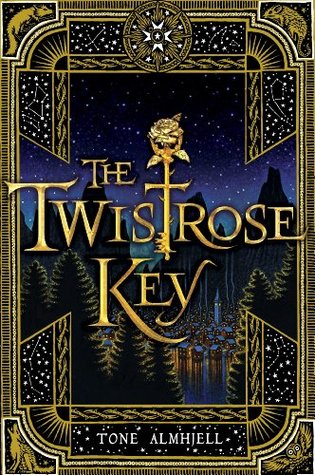
#CBR6 Book 4: "The Twistrose Key" by Tone Almhjell

Page count: 358 pages
Rating: 4 stars

Eleven-year-old Lindelin "Lin" Rosenquist is mourning the death of her pet vole, Rufus, and miserable in her new home away from her best friend and childhood haunts. One dark evening, she receives a mysterious package labelled "Twistrose" with a rose-shaped key inside. She discovers that the key unlocks a strange portal in the cellar under the house, and the portal leads to the magical kingdom of Sylver, entirely populated by animals with some kind of special bond to children on Earth. The petlings are deceased pets, and the Wilders are ones that were tamed, and in Sylver they have ways of watching over their beloved friends.

Lin is overjoyed to discover that not only is she reunited with Rufus, but he is now nearly as big as she is, and can talk to her. Lin soon discovers that in times of great need for Sylver, children who can help the eternally snow-covered kingdom are called. These children are called Twistroses, and Lin is the latest of them. She needs to find the missing Winterfyrst quickly, before the sinister and mysterious Margrave and his army of snow trolls take over the kingdom, and make it impossible for Lin to ever return home to her family.

While Scandinavian authors seem to be the big thing in the mystery genre nowadays, they're not really known in the fantasy genre, certainly not internationally. Yet Tone Almhjell, with her Masters' degree in English literature, got a profitable book deal from a subdivision of Penguin for her debut novel before it was even published in Norwegian. That the book was also favourable reviewed in a lot of places after its release made me curious, and the beautiful cover made me determined to own the book. While she apparently began writing the book in English, she wrote the majority of it in English once she secured the international book deal, and proceeded to translate the English manuscript back to Norwegian with her sister for a later Norwegian release. As the Norwegian version has a waiting list of about six months, I ended up buying the English version from Amazon.

There are clear influences from a lot of other fantasy series here, the most obvious ones probably being The Chronicles of Narnia, The Wind in the Willows and His Dark Materials. Lin is a plucky, brave and clever protagonist initially staggered by the seriousness of her task. Yet she doesn't back down from her challenge and with the help of the sometimes less than helpful Rufus, she starts to investigate the disappearance of young Isvan Winterfyrst.

The book is clearly written to hold the attention of a young audience. There is a lot of action, suspense and many many cliff hangers, making sure you are rarely bored. There are mysterious allies, and dastardly villains and a convoluted plot that needs to be foiled. While I though the inclusion of many traditional Norwegian elements was very cute, I'm not sure they'd be obvious to non-Norwegian readers, as they might just seem like fantasy ideas to add to the verisimilitude of the fantasy world building. At the beginning of each chapter, there are also lovely illustrations, by Jan Schoenherr, adding to

I saw a couple of reviews on Goodreads complaining that the author's English isn't up to scratch. I'm an English teacher, and read pretty much exclusively English books, and while there was the occasional turn of phrase that read as very Norwegian to me, I think Almhjell's editors have done a good job, and if I hadn't known that the author is a Norwegian, I would just have thought she was taking poetic licence with the language. I'm not sure if Almhjell is planning to turn this into a longer series, but this book is self-contained, and made me interested in checking out more Norwegian fantasy.

Crossposted on Cannonball Read.

Tuesday, 31 December 2013

#CBR5 Book 150. "Zel" by Donna Jo Napoli

Page count: 227 pages
Rating: 3 stars

Zel lives in a remote cottage in the mountains with Mother. The only time she sees other people is twice a year, when they go to Market in the nearest town, quite some distance away. While Zel finds the people, bustle and excitement of town life exhilarating, Mother insists that they have everything that they need in their little home, and warns her daughter away from strangers. Yet Zel dreams of a different life, of some day having a husband and children and a home of her own. Just before her thirteenth birthday, she meets a beautiful young man with a spirited horse, and she can't seem to get him out of her mind.

Konrad, the young count, is also unable to forget the young girl he met in the marketplace, and who seemed to almost magically calm his horse. Even when his parents try to arrange suitable marriages for him with lovely young maidens, he refuses, riding around the countryside trying to find out where the mysterious Zel can be found.

Mother grows anxious and worried when Zel mentions the pretty young man, and claims that there are bad people out there who want to harm them. She takes Zel to an abandoned tower, a fair distance from even their remote cottage, and before Zel realises entirely what is going on, she is trapped high above ground, with no way of escaping, with Mother on the ground, saying she will keep the bad people away. Zel's hair starts growing at a furious rate, until she can pull Mother in and out of the tower with it. Lonely and distressed, the young girl dreams about the young man, and tries to while away the months and years of her imprisonment. She's fairly sure she's gone entirely mad, when one day there is a call for her to let down her hair, and count Konrad climbs in instead of Mother.

This is a short read, and an interesting retelling of the story of Rapunzel. Some of the chapters are narrated in third person, and show Zel and Konrad's point of views. The ones from Mother's POV are in first person, making her account the most personal of the three, and making the reader empathise more with her, even as she's the nominal villain of the story. The witch who forced a young couple to give away their child in return for the Rapunzel salad they had stolen from her garden, who locks the girl in a tall tower to keep her away from all others - Mother is more than this here. A frustrated and intelligent woman given a tempting choice, incredible power over all growing things in return for a soul she might not even believe she has, who finds herself barren and alone, willing to do anything to gain a child, and who loves that child so much that she's determined to do anything to keep her, even if it means making the girl possibly hate her. Mother can't bear to lose her beloved daughter, but when it becomes clear that she may have caused her more harm than good, she makes the ultimate sacrifice to ensure her daughter's eventual happiness.

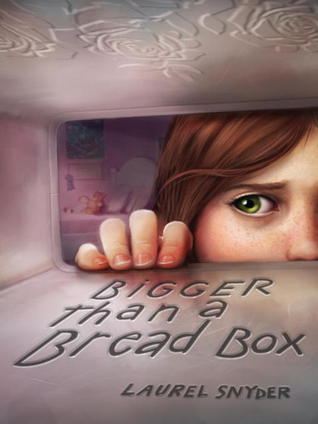
#CBR5 Book 149. "Bigger Than a Bread Box" by Laurel Snyder

Page count: 240 pages
Rating: 3 stars

12-year-old Rebecca's parents have been arguing for a while, and one day Rebecca's mother takes the kids and her stuff and moves from Baltimore back to her mother in Atlanta, needing some space to figure things out. Rebecca is not at all happy about her parent's separation, having to live in a new place, starting a new school and spends quite a lot of time sulking. Rummaging around in her grandmother's attic, she finds an old breadbox, which appears to grant wishes, as long as whatever is wished for actually exists in the world and can fit into the space within the breadbox (so no unicorns or infinite wishes).

Thanks to the things Rebecca manages to acquire through the breadbox (new clothes, an Ipod, money, gift cards, lots and lots of candy, among other things), she manages to make herself quite popular at school and finds her new home with her grandma a bit easier to accept. While she still resents her mother for taking them away, and misses her father terribly, she's starting to settle in and adjust. Then she discovers the truth about where the items in the breadbox come from, and things get a lot more uncomfortable and difficult. Rebecca discovers that you can't get something for nothing, there is always a price to be paid.

Having reached December with quite a few books left on my "A to Z" reading challenge, this is the book I picked for X (as Q, Z and X don't need to be the first letter of the book, cause that would be very difficult indeed). It deals with the rather serious issues of separation and sudden upheaval well, and while Rebecca spends a lot of the book being a total brat to her mother (I, as a grownup, had a lot less patience with her clearly rather useless dad), being completely uprooted and having to settle in at a new school when just entering your teens is never going to be fun. Apart from the magical breadbox, there isn't a lot of fantasy to this book, and the lessons Rebecca gets about actions having consequences are things that a lot of middle grade books, in my experience, gloss over.

Sunday, 8 September 2013

#CBR5 Book 112. "Breadcrumbs" by Anne Ursu

Page count: 336 pages
Rating: 4 stars

Hazel and Jack are best friends and live just down the street from one another. Until recently, they didn't go to the same school, but after Hazel's dad moved away, she had to change schools and now she's in the classroom across the hall from Jack. Hazel doesn't really fit in at school. None of the other kids were adopted from India and look completely different from their mum and dad. She only really feels like she completely belongs when she's with Jack, and when he's off playing with the other boys, she feels desperately alone.

Of course, there are worse things than your dad leaving your mum and you to manage by yourselves or your friend occasionally playing with others. Your mum could still be there, listless and uncaring, empty-seeming and no longer noticing much of anything, like Jack's mum. Maybe that's why he changes completely one day - becoming mean and distant the day after he had an accident in the school yard, when something seemed to pierce him in the eye? Suddenly he just wants to play with the boys, and ignores Hazel completely. Then he disappears. His parents say he's off taking care of his elderly aunt Bernice, but Hazel's known Jack her entire life - he doesn't have an aunt Bernice. One of the other boys mentions having seen Jack going into the woods, with a tall, icily beautiful, fur-clad woman, like the White Witch of Narnia. But witches aren't real, are they? Hazel knows that she needs to rescue her best friend, even if it means going off into terrible danger.

Breadcrumbs is a wonderful book, which retells the fairy tale The Snow Queen in a wholly original way. While it's meant for middle grade readers, it doesn't underestimate its target audience and deals with bullying, alienation, depression, divorce, the need to belong, the perilous fragility of adolescent friendships and the myriad challenges of growing up. Hazel loves to read, and constantly thinks of things in reference to other children's and YA books (to the point where it almost got a bit tedious, unfortunately). There are nods to fairy tales, J.K. Rowling, Philip Pullman, C.S. Lewis, J.R.R. Tolkien, Madeleine L'Engle and Neil Gaiman to name but a few.

Having gone to a non-standard school before her parents' divorce, Hazel finds it nearly impossible to adapt to the rigid structures and rules of her new school, where she also struggles to interpret the social codes of her peers, and keeps failing. Something as simple as having a backpack when everyone else has a shoulder bag can make you the odd one out, which can be devastating when you're already a different ethnic makeup to everyone around you.

Hazel has a caring, if struggling mother, and does her best to be a well-behaved and obedient child. She doesn't understand why all the grown ups want her to make friends who aren't Jack, at least until he changes overnight and abandons her. She's a brave and resourceful girl, who knows that going after your best friend when he's possibly been spirited away by an evil witch isn't going to be easy. She faces a number of challenges and dangers on her quest, and despite being told repeatedly that the White Witch never takes anyone who doesn't want to go with her, she refuses to give up on her friend. She doesn't want to stop being his friend, no matter what others, or even he himself, tell her. Through all her reading, she's learnt that sometimes the Knight is the one who needs rescuing, even though he may not realise it himself.

This is a little gem of a book, beautifully illustrated. Well worth a read, I'm very glad I found it.