Showing posts with label banned books. Show all posts

Saturday, 13 December 2025

CBR17 Book 69: "The Song of Achilles" by Madeline Miller

Page count: 369 pages
Audio book length: 11 hrs 15 mins
Rating: 4 stars

Nowhere Book Bingo 25: Reimagining or retelling of a classic
CBR17 Pie Chart Challenge: History

Patroclus is exiled from his father's kingdom after he accidentally kills a boy and is sent into fosterage with King Peleus. Here is where he meets Achilles, whose mother is the sea nymph Thetis. Achilles is supposed to become the greatest warrior who ever lived, and trains diligently to achieve this goal. While they are vastly different, Patroclus and Achilles become sworn companions, and Patroclus accompanies Achilles to train with the legendary centaur Chiron.

The boys stay with Chiron for several years, until they become young men. Their bond deepens, and they become lovers. Unfortunately, their pastoral life is cut short. Helen, rumoured to be the most beautiful woman in the world, has been abducted by Prince Paris of Troy. All the kingdoms of Greece are oath-sworn to accompany King Agamemnon and Menelaus to rescue her. Thetis takes her son and attempts to hide him away in a distant kingdom, since there is a prophecy that if he faces Prince Hector of Troy on the battlefield, he will die. However, Achilles is tracked down and seduced by the chance to fulfil his destiny. He can't become the greatest warrior ever if he doesn't go to Troy. He figures he'll just stay away from Hector, and then he can't be killed.

The quick and decisive victory the Greeks were expecting instead becomes a gruelling siege that lasts over a decade. Agamemnon, the leader of the Greeks, grows ever more resentful of Achilles, who refuses to show him the respect he believes he is owed. The tension and conflict between them keep escalating, eventually ending in tragedy. Prophecies can only be evaded for so long before the gods decide to manipulate matters to end as they have been foretold. 

Ok, fair warning, I'm not going to spoiler tag a myth that is literally thousands of years old. If you don't know the story of Achilles and how and why he eventually met his tragic end, that's really not on me. They even made a big movie starring many hunky men! Of course, in that one, Patroclus is Achilles' "cousin", and they give our dashing hero a female love interest and everything. No homo when you're Brad Pitt. Suffice it to say, in this book, which is frequently found in the top ten of banned books every year, Patroclus and Achilles are NOT cousins. They come of age together, yes, but they are in no way related, and their feelings for one another are most definitely romantic and sexual. Pretty sure no one would bother banning this book if they were just cousins and bros, happily seducing the various priestesses they captured as prizes of war. 

Having finally read this, which I have owned for oh so many years, I won't say that I was disappointed, because it is a very well-written book, but neither was I swept away by the story. Since Patroclus is the narrator of the book, I was idly curious whether he would keep narrating from the afterlife (turns out, I was right!). This is a good book, but I had read so much about how it had people in floods of tears. I felt no such emotions, probably because I knew when I started the book how it would end. Miller's other mythological novel, Circe, affected me much more strongly. I should re-read that and The Odyssey before Christopher Nolan's movie comes out next year. 

Judging a book by its cover: The cover for my audiobook is this fairly simple teal green one, with a golden Greek helmet on it. I much prefer it to the alternate cover with the big shiny golden breastplate. 

Crossposted on Cannonball Read

Sunday, 22 September 2024

CBR16 Book 57: "The Master and Margarita" by Mikhail Bulgakov

Page count: 448 pages
Rating: 3.5 stars

Nowhere Books Bingo: Banned books (Wasn't published until 27 years after Bulgakov's death, and only then in a censored version. )
CBR16 Bingo: Cult (cult classic, and there's the whole Devil and his entourage as a central plot point - that's pretty cultish, right?)

I can't remember exactly how long The Master and Margarita has been on my TBR list, but it's certainly more than twenty years. A quick glance on Goodreads shows me that 15 of my friends have rated it four or five stars, with several naming it one of their favourite books. So why has it taken it so long for me to read it? Some of my reticence comes from having tried to read translated Russian novels in the past, and in on one memorable occasion, nearly losing my will to read anything at all (Anna Karenina, I am absolutely looking at you). So the idea of tackling another Russian classic wasn't always that appealing. Knowing that so many people whose opinions I respect and trust rate it so highly, also makes me nervous - what if I don't like it and they'll be disappointed in me?

I made an attempt to read my mother's Norwegian translation of the novel for the first couple of chapters, but because the copy she had was translated in the 1970s, the language was heavy and archaic enough that I struggled. So instead I read the 50th Anniversary edition, translated into English by Richard Pevear and Larissa Volkhonsky. Once the language flowed more smoothly, reading became a lot less like unpleasant homework. As readers of my reviews know, I mostly read genre fiction like romance, fantasy and science fiction, where the plots are light-hearted and the books are very easily digestible. That is not the case with this book, written in the 1930s and up until the author's death in 1940, and finally published in 1996. It's an allegorical political satire, written in a very different time and culture, and getting into it felt like a bit of a slog.

I feel like I'm letting down all of my bookish friends and acquaintances when I confess that the first part of the novel mostly either bored and/or confused me. So much of it is absurdist and strange, and there is a long series of, to me, mostly interchangeable men with long Russian names either dying or ending up in an asylum, as a result of their encounters with Woland (the Devil). Nor was I particularly interested in the sections that involved Herod and Yeshua.

The novel finally got interesting to me in the second part, where the reader finally gets to meet the eponymous Margarita, and discovers the lengths she will go to to be reunited with her beloved, the Master. This section seemed more like a dark fairytale for the most part, and while it also had some odd twists and turns, I was mostly enjoying what I read. I can also faithfully say that at no point could I predict where the story was going to go next, and certainly not the way it was going to end. 

If the entirety of this book had only been the main story of part two (which involved Margarita and her beloved), I think I would have liked the novel a lot more. 20th-century history was never an area that particularly interested me, and while I know some of the atrocities committed in the Soviet Union under Stalin, I am in no way well-versed enough in the background of this novel to get the many layers of satire that the author has created. I found all the digs at literary intellectuals and various officials tedious. 

I don't regret finally reading the book, even though the first part was very hard going. However, I think I can also conclude that great Russian literature is not for me. I have tried several authors now, and if this, which so many of my bookish friends rate five stars, only for about half the novel, entertained me, it may be time to accept that I'm just not cut out for the Russian greats. I can see why it has been a controversial novel since its publication, not just for the political critique, but for prominently featuring the devil and witchcraft as part of the plot. 

Judging a book by its cover: There are 1229 (!) different editions of this listed on Goodreads, so obviously there are also a huge amount of different covers available. Most of them seem to have a black cat somewhere on the cover (Behemoth is a very striking character, who can blame them?). My e-book edition seems to have the black cat in upper corner and the face of a young woman (obviously Margarita) in the lower one. 

Crossposted on Cannonball Read

Tuesday, 17 October 2023

CBR15 Book 61: "Class Act" by Jerry Craft

Page count: 249 pages
Rating: 4 stars

Drew Ellis goes to the prestigious Riverdale Academy Day School, but unlike a lot of his more privileged classmates, he feels like he has to work way harder and he still might not get the same opportunities that they do. While a lot of his fellow students live in enormous mansions, Drew lives alone with his grandmother (who has to work almost constantly to provide for him). He also knows that no matter how good his grades are or which school he attends, most people are only going to see the colour of his skin. Of course, his friends Jordan and Liam have their own problems to deal with.

This is a companion novel to New Kid, which I haven't read. The good news is that you don't need to have read that book to enjoy this one, but I suspect I would have gotten even more out of this if I'd also read the first book in the series.

For our Cannonball Book Club in October, we continued last year's success of banned books, this time focusing on graphic novels. I had already read the other two we selected, This One Summer by Mariko and Jillian Tamaki and Gender Queer by Maia Kokabe, so this was the only one left for me to read. Thankfully the Oslo public library had a copy, so I was able to read it before our online discussion and Zoom meeting.

This is very highly rated on Goodreads, and I liked it a lot. I'm very much not the intended target audience, and had I been younger, I might have rated it even higher. As always when we read banned books, I am utterly baffled as to why anyone would think this was a bad thing for young people to read. This shows a very nuanced portrayal of several young individuals from very different family backgrounds and how they all, even when they might seem to have no worries, might not have perfect lives. What a terrible thing for tweens to read, apparently.

Judging a book by its cover: Craft is an excellent artist, and shows inside the comic that he's capable of drawing in a number of styles. I really like the playful cover, with some of the characters being juggled, along with the demands and responsibilities Drew faces daily. 

Crossposted on Cannonball Read

Sunday, 8 October 2023

CBR15 Book 51: "All Boys Aren't Blue" by George M. Johnson

Page count: 320 pages
Rating: 4 stars

CBR15 Bingo: Queer Lives

In July, the Forever Young Adult Reading Challenge prompt was Banned Books. Since All Boys Aren't Blue was the second most banned book in America during the 2021-2022 school year, only beaten by Gender Queer, and I'd had the book on my digital bookshelf for a while, it felt like a suitable book to choose. This book was also one of the book club selections last year for the Cannonball book club, when we did banned books (this year we did banned graphic novels) and I never got round to reading it back then. But now I have.

All Books Aren't Blue is a memoir aimed at young adult readers, written by queer activist George M. Johnson (they/them). The book is about growing up Black and queer, and always feeling different but not having the words to express it. Johnson wanted to give black and queer youths growing up now more of a vocabulary to talk about their own experiences. Johnson said in an interview with NPR that although the book has been banned or challenged by more than 26 school districts, it still has more defenders than detractors, and he doesn't regret writing the book. They say that "students have publicly said on record that works like mine have saved their lives, works like mine have helped them name their abusers, works like mine have helped them come to terms with who they are and feel validated in the fact that there is somebody else that exists in the world like them,"

I am a white, middle-aged, cis-gendered woman, so the experiences Johnson writes about in this memoir were entirely different from anything I experienced growing up in a privileged middle-class family in Norway. I am deeply grateful that books like this exist, so youths in similar situations to Johnson, black and/or queer, can see that they are not alone out there. I am grateful that I can learn and expand my own understanding of the lives of others because it's only through being open and interested that we continue to grow and improve as people. I am glad that there are still a lot more parents,  educators, and/or librarians out there working to get this book out to young people than there are trying to repress and ban this book. 

Judging a book by its cover: The beautiful flower crown that Johnson is wearing on the illustrated cover of this book feels very joyful, and it certainly caught my eye and made me read more about it the first time I saw it. 

Crossposted on Cannonball Read

Saturday, 5 August 2023

CBR15 Book 35: "Gender Queer" by Maia Kokabe

Page count: 240 pages
Rating: 5 stars

CBR15 Bingo: Picture This (can also be used for Queer Lives)

Official book description:
In 2014, Maia Kobabe, who uses e/em/eir pronouns, thought that a comic of reading statistics would be the last autobiographical comic e would ever write. At the time, it was the only thing e felt comfortable with strangers knowing about em. Now, Gender Queer is here. Maia's intensely cathartic autobiography charts eir journey of self-identity, which includes the mortification and confusion of adolescent crushes, grappling with how to come out to family and society, bonding with friends over erotic gay fanfiction, and facing the trauma of pap smears. Started as a way to explain to eir family what it means to be nonbinary and asexual, Gender Queer is more than a personal story: it is a useful and touching guide on gender identity—what it means and how to think about it—for advocates, friends, and humans everywhere.

Despite this being a pretty obvious pick to read during Pride month, I actually finished Gender Queer in May. I got it from the library and was going to save it for June. I was just curious and started reading a few pages. After about four pages, I didn't put the book down until I was finished. I am cis-gendered and straight, so for me, a lot of this was just learning to understand about someone else's experiences. I'm also asexual, though, and know how long it took me to discover that this was an actual thing and not just that I was some sort of aberration, so I can understand both why this was a difficult book for Kokabe to write and illustrate, but also why it felt important for em to share eir experiences, so that others in eir situation (or similar ones) could see that they are not alone out there. 

The internet tells me that in 2023, this book has been banned from shelves in more American states than any other book, because of its subject matter, and illustrations. The book deals with Kokabe's journey exploring eir gender and sexuality, and because the memoir is graphic, there are also pictures. I didn't think anything was particularly graphic or shocking, and some of the topics explored, like body dysphoria and discomfort with periods or gynecological exams, I suspect would be just as applicable to a lot of cis-gendered people as trans-gendered or non-binary individuals. 

The deeply puritanical and backward thinking of people who ban or challenge books never fails to surprise and depress me. I'm assuming that the justification for wanting this removed from shelves is that it might turn kids gay, or non-binary or something? I'm in my early forties and it wasn't until my mid-thirties that I even knew that asexuality was something that existed. I know how uncomfortable I felt until I realised that this was an actual orientation, and not just me being weird. Questioning one's gender identity and not feeling comfortable in one's body must be a million times worse. Books like this, which can show teens and adults that there are others out there that feel the same are hugely important and can change and even save lives. So this book should not be banned. It should probably be taught in schools, at least for older teens and college students. Only a day or two after finishing the library copy I had borrowed, I went out and bought a copy for myself, so I can lend it to friends. That's how important I think this book is. 

I applaud Kokabe's bravery, and reading about eir intense discomfort of being referred to as a 'young lady' or having people use the wrong pronouns has made me try to be better about using more neutral pronouns with the students I teach because you never know which of them might not be comfortable being lumped in with other cis-gendered, binary classmates. I am sorry to say that I still need to work on remembering not to misgender my non-binary and/or trans-gendered friends on occasion, but I am trying to be more sensitive to these issues. 

Judging a book by its cover: I really like both covers of this book, the one on the original edition and the one on the hardback special edition. Both covers feature two versions of Kokabe, one a more youthful and innocent depiction, the other an older, more reflective one. E is a very good artist, and subsequently, the cover illustrations are evocative and tell a story in their own right. 

Crossposted on Cannonball Read

Friday, 1 July 2022

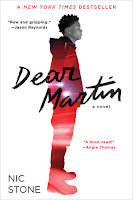
CBR14 Book 9: "Dear Martin" by Nic Stone

Page count: 226 pages
Rating: 4.5 stars

Justyce McAllister is a seventeen-year-old with a bright future, thanks to his grades and being lucky enough to have a mother who has worked herself to the bone to send him to the prestigious prep school in Atlanta. Then one evening, when trying to help his extremely drunken ex-girlfriend get home safely (she's half-black, but looks more like her Norwegian mother than her black dad), he's detained by a very aggressive cop who's convinced he was trying to carjack and abduct the girl. Even after the girl's actual parents show up at the scene to protest, the cop is reluctant to let Justyce go and the scars the episode give him aren't limited to the bruising on his wrists that take weeks to heal. 

Justyce suddenly finds himself becoming a lot more aware of race relations and especially the micro-aggressions that he and his fellow black students at the school (there aren't many) suffer, as well as how cases of police violence against black youths are being presented in the media, not to mention tried in the courts. His best friend Manny has a rich CEO father and lives a life of privilege very different from what Justyce has experienced growing up. Manny has a bunch of white friends and doesn't seem to understand exactly why Justyce suddenly seems to see racism everywhere. The fact that Manny's frequently insensitive friends can hold him up as a black success story to prove that, sure, there's equality now, doesn't exactly help matters. Justyce begins to spend more time with his debate partner, valedictorian S-J (Sarah Jane). She's Jewish, so a lot more used to having to fend off insensitive comments and micro-aggressions than Manny.

Justyce starts a journal, where he tries to model his life more on the teachings on Martin Luther King Jr, by writing letters to the dead preacher. This seems to work for a while, but all thoughts of journalling are gone from Justyce's mind after he and Manny go driving one evening, blasting their music loudly on the speakers, and a deeply unfortunate encounter with an angry off-duty cop ends with Manny dead at the wheel. Even more traumatic than being wrongfully arrested, Justice now needs to process surviving where his best friend didn't. He's gone from reading the headlines to becoming one himself, and the event leaves him shaken and deeply conflicted. 

My fellow English teachers and I taught this book in school along with The Hate U Give, and the two novels feature a lot of the same themes. Novels written by young black women, dealing with gun violence, racism and police brutality, with protagonists who are more or less the token black teens at their schools, with all the challenges that brings. Our tenth-graders could choose if they wanted to read this book, The Hate U Give or both (none of them chose both, unsurprisingly). One of my colleagues prefers this book to Angie Thomas', as she feels that the longer novel deals with too many themes that distract from the central message. As someone who really loved how Thomas wrote about Starr and her family, as well as the journey of personal development Starr had to go through after her friend Khalil is murdered by a cop, I think that novel still has the edge for me. This book is shorter, and doesn't spend as much time on the community and people around Justyce. Both books are excellent, and very important novels for readers interested in the #blacklivesmatter cause and the challenges sadly faced by a lot of young African Americans today.

One benefit for us teachers when using this as part of the curriculum, this novel doesn't have a movie adaptation that the kids can watch and then claim that they've read the book. In the subsequent group talks we had on the topic, it was very clear who had actually read and finished their assigned novels when we spoke about Dear Martin, the ones who hadn't just taken the easy way out and watched the film. Also published in 2017, I don't think Stone's novel has gotten the praise and attention that The Hate U Give did, which is a shame, because both novels are great and this book deserves just as big a readership as Thomas'.

Judging a book by its cover: A relatively simple cover, with a mostly white background and a young, black man in silhouette. I like how you see red lights like police sirens shining through the body of the young man, hinting at the contents of the book.

Crossposted on Cannonball Read